Lion of Alnwick by Carol Wensby-Scott

Set in the 14th century during the reigns of Edward III and Richard II, Lion of Alnwick tells the story of Henry (Hal) Percy, 1st Earl of Northumberland. The novel begins in the year 1357 and ends in 1409, covering all the major events of Hal’s adult life including his marriage to Margaret Neville, sister of his bitter enemy and rival Northern lord, his conflict with John of Gaunt, the Duke of Lancaster, and his relationship with his son Harry “Hotspur” Percy.

Before I say any more about this great historical fiction novel, I should point out that this book has now sadly gone out of print, but for anyone who loves fiction set in medieval England it is definitely worth reading if you can manage to find a copy. Please don’t let the cover (pictured above) put you off – it has to be one of the worst covers I’ve ever seen and is really not representative of the quality of the story!

I can’t remember how this book first came to my attention, but the reason it appealed to me is because I only live an hour away from Alnwick and have been there several times (usually to visit the castle, the gardens or Barter Books) so I was attracted by the mention of Alnwick in the title. There are so few books that focus on the north east of England that whenever I do come across one I always feel I should read it (though of course, with this novel being so epic in scale, the action is not just confined to Northumberland but also sweeps down to York and Westminster and across to Wales).

The story concentrates on Hal, his son Harry, and their respective wives, Margaret Neville and Elizabeth Mortimer, but we also meet lots of other fascinating characters, most of them real historical figures of the period. One of the most intriguing characters, I thought, was Hal’s enemy from over the border in Scotland, Archibald Douglas, known as The Black Douglas. His rivalry with Hal is a recurring theme throughout the novel and I looked forward to all of their encounters. I also thought the characterisation of Richard II as a young and incompetent king unable to command the respect of his men while bestowing gifts and titles on his favourites, was very well done.

The author does seem to assume that the reader already has a good knowledge of the period; the history becomes very complex and detailed, so this is the type of historical fiction novel I would recommend only to readers who really do love history! It’s such a shame this book is out of print; it was very well-written and well-researched, maybe not as much fun to read as a Sharon Penman or Elizabeth Chadwick novel, but almost as good. If you’re interested in reading this book I would suggest trying to get a copy of this one and the other two in the trilogy (Lion Dormant and Lion Invincible) as soon as you can, before they become impossible to find!

Emma by Jane Austen (re-read)

Having read all of Jane Austen’s novels, I decided that for the Austen in August event hosted by Adam of Roof Beam Reader, I would re-read the only one I didn’t really like the first time – Emma. I didn’t hate it on my first reading, but I definitely enjoyed it less than the others, and the problem I had with the book, unfortunately, was the character of Emma Woodhouse herself. I was curious to see whether, on returning to this book after a gap of a few years, my opinion of her would have changed.

Emma is the youngest daughter of Mr Woodhouse of Hartfield and is “handsome, clever and rich, with a comfortable home and happy disposition”. The story begins just after the marriage of Emma’s governess, Miss Taylor, to a widowed neighbour, Mr Weston. Although Emma is sorry Miss Taylor is leaving Hartfield, she is pleased that they have married because she was responsible for introducing them to each other. She decides to continue matchmaking by finding a husband for her new friend, Harriet Smith, but it seems that the man she chooses, Mr Elton, has other ideas. As Emma continues to meddle in other people’s lives, she slowly becomes aware of who she herself is in love with.

Jane Austen herself once said that in Emma she had created a heroine nobody apart from herself would like. This is obviously not true, as I’ve seen so many people name Emma as their favourite Austen novel and talk about how much they love Emma despite her flaws. But the first time I read this book I found it difficult to see past her treatment of Harriet Smith near the beginning of the story and I remember having such a negative reaction to Emma’s character that it spoiled the rest of the book for me.

As several years have now passed since that first read I wanted to give Emma another chance. And guess what? This time I found myself really liking Emma! Her snobbish attitude and superiority still irritated me but I was able to be more tolerant of her faults and to admire the way she learned from her mistakes and grew as a person as the story progressed. Yes, she can be insensitive at times and yes, she causes a lot of trouble by interfering in her friends’ lives, but she does eventually accept that she was wrong.

Although it has been a while since I read this book, I was surprised to find how many little details of the plot I remembered: Harriet’s book of riddles, for example, and the mystery of Jane Fairfax’s piano. Yet this is a very character-driven story, even more so than Jane Austen’s other novels. Nothing very dramatic or exciting happens, but the story is never boring and this is due to the wonderful collection of characters. Mr Knightley is one of my favourite Austen heroes, and who could forget Emma’s hypochondriac father and his obsession with his own health and everyone else’s, the obnoxious Mrs Elton and Miss Bates, who never stops talking. The last three characters I mentioned make this one of Austen’s funniest novels, at least in my opinion! As well as the humour, Emma is filled with clever, sparkling dialogue and insightful observations. I posted some of my favourite quotes last week for the Classics Challenge I’m participating in so won’t repeat them here.

Finally, I liked the way Austen took the time to tie up all the loose ends in this novel. I was happy with the way Emma’s story ended and with Harriet’s – I think everyone probably ended up with the right partner!

Have you read Emma? What is your opinion of Emma Woodhouse?

In a Treacherous Court by Michelle Diener

There are already so many historical fiction novels set in the Tudor court that for a book to stand out from the others the author really needs to find a new way to approach the subject. Michelle Diener’s In A Treacherous Court is refreshingly different because it features two interesting but little-known historical figures – John Parker and Susanna Horenbout – both of whom really existed, yet aren’t characters that you would usually find in Tudor novels. Despite having read a lot of books set during this period, I had never come across either of these people until now.

Susanna Horenbout is a Flemish artist who travels to the court of Henry VIII in 1525 to become the king’s illuminator. During the journey to England, a man dies on board the ship and Susanna is at his side as he whispers his dying words, a secret message that he wants her to deliver to the King. It seems that someone is afraid of what Susanna may have learned, because as soon as she arrives in England an attempt is made on her life. One of the King’s most trusted courtiers, John Parker, Yeoman of the Crossbows, has been sent to meet the ship and after discovering how much danger Susanna is in, he vows to protect her while at the same time trying to unravel a plot that could threaten Henry’s throne.

In a Treacherous Court is the first in a series and after reading this one, I think both Susanna Horenbout and John Parker have a lot of potential as characters. As historians know so little about their lives, it gives the author some freedom to create exciting adventures for them without being too restricted by what really happened (the story does stick to the historical facts where possible though, and there is an author’s note at the end of the book that explains which parts of the novel are based on truth and which are purely fictional). I did find the romance between Susanna and Parker a bit hard to believe as it all seemed to happen so quickly, but who can say whether or not their relationship might really have developed the way it did in the novel?

The plot is very fast-paced with lots of action in every chapter which makes the story fun to read, although I thought the constant murder attempts and attacks on Susanna did become a bit repetitive. This book is definitely at the lighter end of the historical fiction spectrum, but it’s certainly an entertaining read with some original ideas that give it a different feel from most of the other Tudor court novels I’ve read.

I received a review copy of In a Treacherous Court from Simon & Schuster

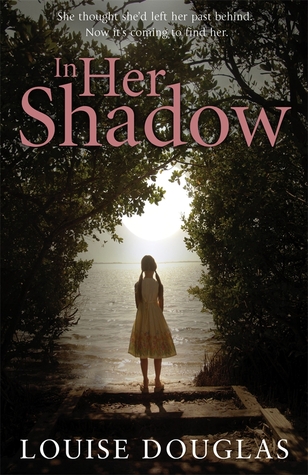
In Her Shadow by Louise Douglas

After reading The Secrets Between Us last year as part of the Transworld Book Group, I’ve been looking forward to reading another book by Louise Douglas and I was pleased to find that her new novel, In Her Shadow, has the same combination of suspense, mystery and psychological drama that I loved in The Secrets Between Us.

The story is narrated by Hannah Brown who works at the Brunel Memorial Museum in Bristol. When Hannah glimpses her best friend Ellen Brecht in the museum one day, she is left feeling shocked and frightened…because Ellen died almost twenty years ago. Is Hannah imagining things or has her friend really come back from the dead?

In alternating chapters, Hannah tells her present day story and also shares with us her memories of growing up in the 1980s with both Ellen and another friend, a boy called Jago who was adopted by Hannah’s family. She remembers the day Ellen moved to their quiet Cornish village with her glamorous parents – her handsome, charismatic German father Pieter and her mother Anne, a former pianist. At first Hannah is captivated by the Brecht family but as time goes by she learns that things might not be quite as they seem. And so Hannah’s happy, nostalgic childhood memories are mixed with other, more disturbing ones that she would rather forget.

I really like the way Louise Douglas writes and the way she creates atmosphere. There are some lovely pieces of descriptive writing in this book, especially when she is writing about the area of Cornwall where Hannah, Jago and Ellen lived, but despite the beautiful, idyllic setting, there’s also a mood of darkness and foreboding that hangs over the story. We know from very early in the novel that something had happened between Hannah and Ellen that damaged their friendship and left Hannah with feelings of guilt, but we aren’t told what it was. We don’t know the circumstances surrounding Ellen’s death, what Jago’s involvement was, or why Hannah is still affected by it all so many years later. And we are kept wondering whether or not Ellen is really dead or whether her appearances are just a figment of Hannah’s imagination. As the novel progresses, the truth is gradually revealed and we can eventually start to piece the story together.

I didn’t find any of the three main characters – Hannah, Ellen and Jago – very easy to like, yet I could still have sympathy for all three of them and could care about what happened to them. They make mistakes, do the wrong things, make poor decisions and act on impulses, but their flawed, unpredictable behaviour only makes them feel more believable and human.

The construction of the novel, with the chapters alternating between Hannah’s current story and her childhood story, means that we learn a little bit more in every chapter, but some of the biggest surprises remain hidden until the very end of the book. Sometimes this type of structure can feel disjointed and confusing, but in this case I thought it worked perfectly and it helped maintain the right levels of tension and suspense throughout the book. I enjoyed In Her Shadow as much as I enjoyed The Secrets Between Us and I’ll be looking out for any future books by Louise Douglas!

I received a review copy of In Her Shadow from Transworld

Classics Challenge August Prompt: Quotes from Jane Austen’s Emma

This year I am taking part in a Classics Challenge hosted by Katherine of November’s Autumn. The goal is to read at least seven classics in 2012 and every month Katherine is posting a prompt to help us discuss the books we are reading. This month we are asked to share some quotes from our current read.

The classic I just finished reading yesterday was Emma by Jane Austen. This was a re-read for me and I’ll be posting my thoughts on the book next week. For now, here are some quotes from Emma. Katherine’s prompt recommended choosing some that were not so well-known. I’m not sure it’s possible to find any quotes from a Jane Austen novel that are not well-known, so I’ve just posted a selection of my favourites. Some might be more obscure than others.

“That is the case with us all, papa. One half of the world cannot understand the pleasures of the other.”

***

“I have none of the usual inducements of women to marry. Were I to fall in love, indeed, it would be a different thing! But I never have been in love; it is not my way, or my nature; and I do not think I ever shall. And, without love, I am sure I should be a fool to change such a situation as mine.”

***

“A sanguine temper, though for ever expecting more good than occurs, does not always pay for its hopes by any proportionate depression. It soon flies over the present failure, and begins to hope again.”

***

“To be sure – our discordancies must always arise from my being in the wrong.”

“Yes,” said he, smiling, “and reason good. I was sixteen years old when you were born.”

“A material difference, then,” she replied; “and no doubt you were much my superior in judgement at that period of our lives; but does not the lapse of one-and-twenty years bring our understandings a good deal nearer?”

“Yes, a good deal nearer.”

“But still, not near enough to give me a chance of being right, if we think differently.”

***

Was it new for any thing in this world to be unequal, inconsistent, incongruous — or for chance and circumstance (as second causes) to direct the human fate?

***

“I cannot make speeches, Emma,” he soon resumed; and in a tone of such sincere, decided, intelligible tenderness as was tolerably convincing. “If I loved you less, I might be able to talk about it more. But you know what I am. You hear nothing but truth from me.”

***

Seldom, very seldom, does complete truth belong to any human disclosure; seldom can it happen that something is not a little disguised or a little mistaken.

The Spring of the Ram by Dorothy Dunnett

This is the second book in the eight-volume House of Niccolò series. In the first book, Niccolò Rising, we saw how Nicholas, a young dyer’s apprentice, rose in the world to become head of the Charetty trading company. In The Spring of the Ram, Nicholas and the other men of the Charetty company – including the doctor Tobias, notary Julius, priest Godscalc, engineer John le Grant and mercenary leader Astorre – journey to the Black Sea port of Trebizond to establish a trading post. With them every step of the way is Pagano Doria, a sea adventurer who has married Nicholas’s thirteen-year-old stepdaughter, Catherine de Charetty, and is now in a position where he may be able to seize control of the company through his marriage.

One of the things I love about Dorothy Dunnett’s books is that they give me an opportunity to learn about people and places I might never have known anything about otherwise. Dunnett’s novels open up whole new worlds, focusing on periods of history and geographical locations that are usually ignored in historical fiction. This is the first book I’ve read about Trebizond, a final outpost of the Byzantine Empire which at the time the story is set (1461) is under threat of falling to the Turkish army at any moment, and I thought it was a fascinating setting. I loved all of the beautiful descriptions of Trebizond and the other places Nicholas and his companions pass through on their journey to and from the Black Sea coast. This, for example, is the moment when the two ships belonging to Doria and Nicholas finally arrive at Trebizond:

So there came to the poisonous honey of Trebizond the two vessels from barbarian Europe, the four months of their travelling over, and winter turned into spring. One after the other, they crossed the wide, irregular bay towards the green amphitheatre which lined it. In its midst, the classical City gleamed on its tableland, alight with marble and gold against the dark mountain forests behind. There stood the fabled City, treasure-house of the East.

I enjoyed The Spring of the Ram much more than the first book, Niccolò Rising, possibly because I’m more familiar with the characters now and so found it easier to get straight into the story. And of course when I first started to read Niccolò Rising it was inevitable that I was going to compare it with Dunnett’s other series, the Lymond Chronicles, however hard I tried not to, and although I liked Nicholas and Marian de Charetty, most of the other characters seemed to me to be less interesting than the ones in the Lymond Chronicles. It seems that I just needed to give myself time to get used to them though, because now that I’ve read two Niccolo books I feel that I’m starting to get to know and understand some of the characters better. Nicholas himself continues to amaze me with his complex machinations and intricate trading deals, but despite the amount of time we spend inside his head in this book (which is more than we were ever allowed to spend inside Lymond’s) his character and motivations still remain a bit of an enigma to me. Most of what we learn about him is through the observations of the people around him – Tobie, Godscalc and the others – but we have to remember that none of them truly understand Nicholas either and have a tendency to misinterpret his actions.

All of Dunnett’s books are clever, complex and intricately plotted; this one, I thought, was particularly complicated because there seemed to be so much happening behind the scenes, so many different forces and factions all vying against each other, pulling in different directions and trying to turn things to their own advantage. The main trading powers – Venice, Florence and Genoa – are all rivals with conflicting business interests, then there are the various rulers and leaders – Emperor David of Trebizond, Uzum Hasan of the White Sheep Tribe, Sultan Mehmet II of the Ottoman Empire, and others. Members of Nicholas’s family also seem to have agendas of their own, and finally there are Violante of Naxos and the mysterious Greek with the wooden leg, both of whom are also trying to control Nicholas’s actions. With so much going on, I won’t pretend that I fully understood everything that was happening in the book because I certainly didn’t, but as with all of Dunnett’s novels I’m looking forward to reading this one again!

It has taken Niccolo a bit longer to win me over than it took Lymond but I’ve been pulled into his world now and have already started the third in the series, Race of Scorpions.

Wolf Hall Readalong: Week 1

During August and September I am taking part in a readalong of Wolf Hall, Hilary Mantel’s Booker Prize-winning novel about Thomas Cromwell. The readalong is hosted by Michelle of The True Book Addict and Kai of Fiction State of Mind. This week we have been reading Part One, which consists of three chapters.

Here are my answers to this week’s discussion questions:

1) What prompted you to join this read-a-long?

As an avid reader of historical fiction I should probably have read this book before now, but for some reason, despite its success and popularity, I never got around to reading it. Now that the sequel, Bring Up the Bodies, has been released and getting so much praise and attention too, it seemed like the perfect time to finally read Wolf Hall, and when I saw that there was going to be a readalong it helped motivate me to actually pick the book up and start reading. I also like the way this readalong is structured and hopefully I won’t have any problems keeping up with the schedule!

2) What do you think of Thomas so far?

I don’t feel that I know Thomas Cromwell very well yet, but as I’ve still only read the first three chapters I’m sure I’ll get to know and understand him better as I read on. However, each of these first three chapters has given us an insight into a different side of Thomas’s character. In the first, we get a glimpse of what appears to have been a very unhappy childhood, living with a cruel and abusive father. In the second, we meet Thomas again as an adult and we are shown his public persona, the part he is playing in the politics of the country, and his interactions with other important historical figures such as Stephen Gardiner and Cardinal Wolsey. And in the third we see Thomas in his role as a husband and father.

3) What do you think about Thomas’s feelings towards his son Gregory? Do you think he is too indulgent? Do you think his treatment of Gregory now will affect Gregory’s future?

I think it’s a good thing that Thomas is trying to avoid treating Gregory the way his own father treated him. This quote gives us a good idea of his feelings on this subject:

Bawling, strong, one hour old, plucked from the cradle: he kissed the infant’s fluffy skull and said, I shall be as tender to you as my father was not to me. For what’s the point of breeding children, if each generation does not improve on what went before?

I don’t think Thomas is being too indulgent, but it’s too early to say at this point in the novel what effect his treatment of Gregory will have on Gregory’s future.

See Kai’s post for other participants’ thoughts on Part 1 of Wolf Hall.