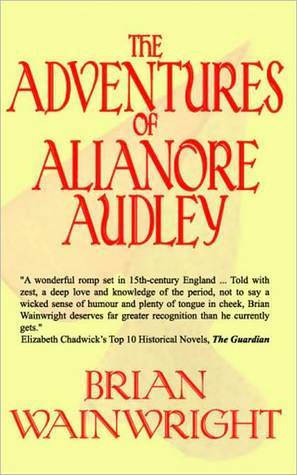
The Adventures of Alianore Audley by Brian Wainwright

I’m always looking out for novels about one of my favourite periods in English history, the Wars of the Roses and the reigns of King Edward IV and Richard III. When I came across The Adventures of Alianore Audley, described as “a brilliantly funny, subversive spoof” I was intrigued…it sounded like something very original and refreshing. I was even more interested in reading it when I found that the author Elizabeth Chadwick had named it one of her top ten historical fiction novels!

This book is a lively and entertaining account of the Wars of the Roses as seen through the eyes of Alianore Audley, a fictional 15th century ‘damosel’ who is present at some important moments in history and meets some of the leading historical figures of the period. She has an interesting personal story of her own, involving her marriage to the knight Roger Beauchamp and her career as a spy for Edward IV and Richard III, collecting information for ‘Yorkist Intelligence’, but the main focus of the novel is on Alianore’s sharp and witty observations of the historical events of the time.

The language Alianore and the other characters use is (deliberately) filled with modern slang and references that would sound ridiculous in a serious historical fiction novel, but perfectly suit the tone of this book. Alianore is quite pro-Richard and the way she explains the disappearance of the Princes in the Tower is about as believable as any other theory I’ve read. And if you’re a Ricardian you’ll probably appreciate all of her comments about “the obnoxious Tudor slimebag”, Henry VII, who she wishes she’d dropped down the shaft of the garderobe at birth.

I enjoyed Alianore’s jokes about her hennin (the cone-shaped headdress fashionable at the time) and I loved the idea of Richard reading the Court Circular and looking for his latest war horse in the “Used Destriers” section! Another thing I liked was the way so many parallels are drawn between 15th century and 21st century politics. Alianore is always worrying about Richard’s “image problems” and on another occasion she tells Edward his “ratings in the North have plummeted to their lowest levels since 1469”. I’m going to be completely honest though and say that unlike most of the reviewers of this book on Amazon and Goodreads, I didn’t find it hilariously funny. I did think it was amusing and witty but I suppose a sense of humour is an individual thing and while this book might have made other people laugh out loud it didn’t quite have that effect on me. This is not to say that I didn’t enjoy it though, because I did.

Despite the light-hearted feel of the writing, it’s obvious that the author has a good knowledge of the period (and I’m sure it’s usually the case that you would need to fully understand a subject to be able to write a convincing parody of it). Although this book was not difficult to read I don’t think I would recommend it as a first introduction to the period because to understand most of the jokes you really need to be familiar with at least some of the history involved. You might still enjoy it, but you wouldn’t be able to fully appreciate all of Alianore’s wit and sarcasm. But if you do decide to give this book a try, I can almost guarantee that it will be unlike any other historical fiction novel you’ve ever read!

One final thing I should mention: The Adventures of Alianore Audley is published by BeWrite Books, who are now an ebook only publisher. You might still be able to get a print copy, but I read the Kindle version which I thought was reasonably priced and well worth the money.
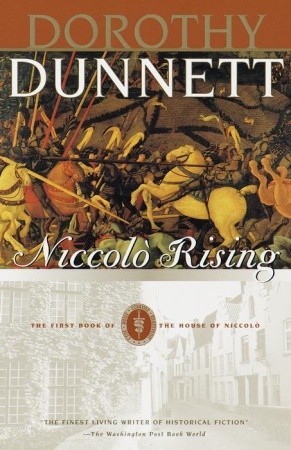
Niccolò Rising by Dorothy Dunnett

If you’ve been following my blog for a while, you’ll probably remember that I read (and loved) Dorothy Dunnett’s Lymond Chronicles earlier this year. I read the sixth and final book in the series in April and was planning to wait a bit longer before I started the House of Niccolò series, but in the end I couldn’t resist the temptation.

The House of Niccolò books were written after the Lymond Chronicles but are set in an earlier period (the 15th century rather than the 16th) and there are some links between the two series. Niccolò Rising, as the title suggests, follows our hero Nicholas as he begins to rise in the world to become a successful merchant and courier. And that’s really all I can tell you about the story. It has so many different layers and is so complex, intricate and cleverly plotted that I wouldn’t know where to begin writing any kind of summary. It’s also difficult to know how much I can say without spoiling things for future readers; if you started reading this book without knowing anything at all about it, it’s possible that you might not even be able to tell at first who the main protagonist of the series is going to be, as Nicholas goes by a different name for the first half of the book.

This book, like all the other Dorothy Dunnett novels I’ve read, was not the easiest of reads but in my opinion it was definitely worth making a bit of extra effort. I did find myself feeling completely confused on many occasions while I was reading, but some of my questions had been answered by the end of the book and the rest I’m hoping will become clearer later in the series or on a re-read. The biggest problem I had was trying to keep the characters straight in my mind. There are over one hundred of them listed in the character list at the front of the book (many of them are real historical figures) though with even the help of the list I still couldn’t seem to keep track of them all! The historical setting for this story is not one that I’m at all familiar with (the world of trade, banking and politics in Flanders and Italy in the 15th century), but I enjoyed learning more about it. Bruges, where a lot of the action in the book takes place, is somewhere I’ve wanted to visit for a long time and it has now moved even higher on my list.

All the time I was reading this book I was trying my best not to compare it with the Lymond Chronicles or Nicholas with Francis Crawford but really it was almost impossible not to. So the question is, as an introduction to the series did I like this book as much as the first Lymond book, The Game of Kings? The answer is no. The writing style is quite different and I didn’t find it as much fun to read. I was enjoying it enough to be in no doubt that I would keep reading to the end, but it never quite reached ‘unputdownable’ status. Nicholas, I suppose, could be considered more instantly likeable than Lymond (though it soon becomes obvious there’s a lot more going on behind his seemingly cheerful exterior than anybody realises) but he hasn’t quite won me over yet; we’ll see how I feel about him when I get further into the series.

When I came to the end of this book I didn’t feel compelled to immediately pick up the next one the way I did with the Lymond Chronicles, but I will definitely be continuing with the series. A copy of The Spring of the Ram is already waiting on my shelf.

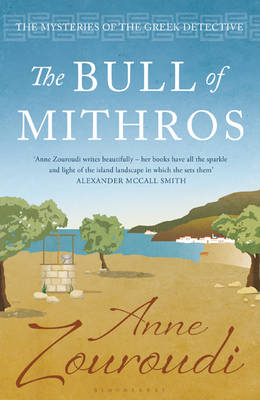
The Bull of Mithros by Anne Zouroudi

This is the sixth title in Anne Zouroudi’s “Greek Detective” mystery series. I haven’t read any of the five previous novels but that wasn’t a problem at all as this one worked perfectly as a standalone mystery.

The story is set on the small Greek island of Mithros, where the peace and tranquillity of island life is broken when a man is robbed and another killed by the escaping thieves. Seventeen years later, a boat appears in the bay and a stranger is thrown overboard. Until he can provide identification he is forced to stay on the island, where several of the islanders begin to recognise him. Is he connected in some way to the crime that took place all those years earlier? Soon another man arrives on the island of Mithros – this is Hermes Diaktoros, who has come to investigate. But where has he come from and who is he working for?

Hermes Diaktoros is a fascinating and unusual detective, a character shrouded in mystery. His name suggests a connection with Greek mythology (Hermes was the messenger of the gods) and there is definitely something slightly otherworldly about him. We learn very little about his past and he never reveals the identity of his employers either. He is referred to throughout the story as ‘the fat man’, which I thought might be irritating at first but it actually wasn’t. Despite him being such an enigmatic character (or maybe because of it) I really liked the fat man. He also reminded me in some ways of Poirot and in fact I think this series might appeal to Agatha Christie readers.

The pace of the story is gentle and relaxed, but not too slow. It also has a beautiful, atmospheric setting and would be the perfect book to take with you if you’re planning to visit a Greek island this summer! I enjoyed meeting Hermes Diaktoros for the first time and I didn’t feel I was at any disadvantage because of not having read the other novels first. Now that I’ve discovered this series I’d definitely like to read the earlier books and see how the fat man solved his previous five mysteries.

I received a review copy of The Bull of Mithros from Bloomsbury via Netgalley

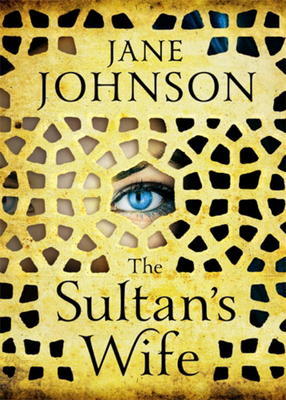
The Sultan’s Wife by Jane Johnson

The Sultan’s Wife is set in Morocco in the year 1677 and is narrated by two different characters. The first is Nus-Nus, a eunuch slave in the palace of the Sultan Moulay Ismail and the second is Alys Swann, an Englishwoman who has been captured at sea by corsairs and given to the Sultan as a gift. Amidst the dangers and conspiracies of Ismail’s court, Nus-Nus and Alys form a friendship and try to help each other survive.

I haven’t read any of Jane Johnson’s previous novels and chose to read this one purely because the setting sounded so interesting. I’ve never read a novel set in 17th century Morocco and I fell in love with the setting from the very first chapter. Everything was described so vividly, I wasn’t surprised to find that the author lives in Morocco herself and has already written two other books set in the same country. I learned so many fascinating little facts about Moroccan history and culture and about the building of the historic city of Meknes (which was intended to rival Versailles). There are also a few chapters where the action moves to England and the court of Charles II in Restoration-period London. It was interesting to be shown the English court through the eyes of Nus-Nus and to see the ways in which it was both different and similar to the Moroccan court. But although there are lots of descriptions of food, clothing, furnishings etc, the pace of the story never slows down and there’s always something happening.

Nus-Nus and Alys are fictional characters but Moulay Ismail, the Sultan, was a real person and is considered to be one of the cruelest rulers in history (one of his nicknames is ‘the bloodthirsty’). This is something that Jane Johnson portrays very convincingly – based on some of the things he does in this novel, living in his household must have been a terrifying experience! Nus-Nus and the other slaves and courtiers are constantly in fear of their lives, knowing that they are at the mercy of his whim, and they have learned to be extra careful when they see him dressed in yellow as this indicates he’s in a particularly murderous mood. Ismail’s wife, Zidana, is also portrayed as a villain; a jealous, scheming person who uses poisons and witchcraft to attack her enemies.

Of the two narrators, I didn’t find Alys Swann a very memorable character but I did really like Nus-Nus. In fact, he was the main reason why I enjoyed this book as much as I did. Nus-Nus was captured from his Senufo tribe as a young man and before coming to the Sultan’s palace had spent some time assisting a British doctor who taught him to read and write and to speak English. These skills make him invaluable to both Ismail and Zidana and are the reason why he’s in a position where he’s able to befriend and help Alys. As a black slave and a eunuch, Nus-Nus is often treated unkindly by other members of the court, but still has a lot of dignity and courage. I thought he was a wonderful character.

The story does touch on some controversial subjects including slavery, racism and prejudice, torture and cruelty (some of the things described in the novel are very brutal and characters lose their lives in some gruesome ways) but I thought everything was handled sensitively. The only criticism I really have is that Alys didn’t have a very distinctive voice; sometimes she didn’t sound any different from Nus-Nus and I didn’t immediately realise the narrator had changed. Apart from that, The Sultan’s Wife was exciting, informative and swept me away to another time and place, which is what I’m always looking for in historical fiction. I loved it!

Sacrilege by S.J Parris

Sacrilege is the third in a series of historical mysteries set in Tudor England and featuring Giordano Bruno, a former monk who left his monastery in Italy to escape the Inquisition. Bruno is now in London working as a spy for Queen Elizabeth I’s Secretary of State and ‘spymaster’, Sir Francis Walsingham. At the beginning of Sacrilege, he is reunited with Sophia, a girl he met in a previous instalment of the series. Sophia has run away from her home in Canterbury after being accused of murdering her husband, Sir Edward Kingsley, and she wants Bruno to help clear her name.

Bruno agrees to travel to Canterbury with Sophia where he hopes to uncover the truth about Kingsley’s death and discover the real murderer, but he also has another reason for visiting the city: Walsingham has asked him to investigate rumours of a Catholic plot against the Queen. But soon after his arrival there’s another death and Bruno finds himself caught up in a conspiracy involving the remains of St Thomas Becket, the former Archbishop of Canterbury who was murdered in the cathedral centuries earlier.

If you’re new to this series it would probably be better to start at the beginning with Heresy, and read the books in order. I haven’t read the previous two novels and although I was able to follow the plot of this one without too many problems, I did feel I was missing out on some important background information. The novel is narrated in the first person by Giordano Bruno, but I felt I never really got to know him, which could be partly due to the fact that I started in the middle of the series. I thought he was likeable enough, but not really the charismatic narrator the blurb had promised.

I didn’t know anything about Bruno before reading this book, but he was a real person, an Italian philosopher, mathematician and astronomer. It was interesting to read about him after finishing the novel and discover how much of his back story given in the book was based on the known facts about his life. We do meet some of the better known historical figures of the Elizabethan period too (Francis Walsingham and Sir Philip Sidney, for example) but although they do have a role to play, during most of the story they are kept in the background while the focus is on Bruno and his investigations.

The actual mystery storyline was interesting and complex. Although things did move forward at quite a fast pace, there were also a lot of long descriptive passages and I found I had to really concentrate on these because they sometimes contained clues and information that were vital to the plot. The novel appears to have been well researched and I thought the atmosphere of 16th century Canterbury, the city and the cathedral, was evoked quite well, but it all felt just a bit too modern to be completely convincing. I did enjoy Sacrilege but I don’t think I liked it enough to want to read more books in this series.

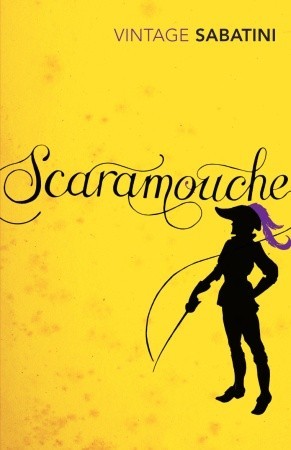
Scaramouche by Rafael Sabatini

Scaramouche is set at the beginning of the French Revolution and tells the story of Andre-Louis Moreau, a young lawyer from Britanny who has been brought up by his godfather, a man who many people believe is really his father. Andre-Louis has little interest in politics until his friend Philippe, who is passionate about the revolutionary cause, is provoked into fighting a duel with the Marquis de La Tour d’Azyr. It’s a duel Philippe has no chance of winning and when he is killed by the Marquis, Andre-Louis considers it to be murder.

Deciding that his friend’s voice must not be silenced, Andre-Louis speaks out against the privileged classes but when his speeches turn out to be much more successful than he expected, he finds himself in trouble with the law and is forced to run for his life. Joining a group of travelling actors, he takes the role of Scaramouche and discovers he has a natural talent for both acting and writing plays. First as Scaramouche, then as a fencing master and a politician, Andre-Louis sets in motion a plan for taking revenge on the man who killed Philippe.

From the wonderful opening line of this 1921 novel by Rafael Sabatini (“He was born with a gift of laughter and a sense that the world was mad”) I could tell I was going to love Scaramouche! And I did – it’s one of the best books I’ve read so far this year. The story involves a bit of everything: action, romance, history, political intrigue, humour and adventure.

Some readers might find Andre-Louis too unbelievable as a character, in the way he seems to succeed at almost everything he does, whether it’s acting, writing, orating or fencing, as well as being clever, courageous, quick-witted and charismatic. I can definitely understand this point of view, but it wasn’t really a problem for me. I thought he was a great character and I was able to suspend disbelief enough to just accept that he was good at everything! And he’s not perfect; he can be difficult to like at times and is often described by other characters as heartless (though we, as the reader, know that sometimes he’s putting on an act and not showing his true feelings). He does have flaws, he makes mistakes and his motives are not always easy to understand. His enemy, the Marquis, is another interesting character with more depth than he appears to have at first and some good qualities as well as bad ones – he’s more than just a stereotypical villain.

My favourite part of the book was the section in the middle where Andre-Louis joins the troupe of Commedia dell’Arte actors. Before I read this book I admit that I would have been unable to explain exactly what Commedia dell’Arte involved; now I know that it’s a form of improvisational theatre where the actors perform ‘scenarios’ or sketches, with each member of the group taking on one specific role. The best known of the stock characters found in Commedia dell’Arte, all of which have their own costumes and characteristics, include Harlequin, Pierrot, Pantaloon, Columbine and Scaramouche, who Wikipedia describes as a ‘roguish clown character’. Andre-Louis seems to identify with the character so much that even when he’s not acting he still sometimes thinks of himself as ‘Scaramouche’.

The events leading up to the French Revolution are central to the plot but this aspect of the book never became too overwhelming so if you don’t have much knowledge of the historical background it shouldn’t be a problem. There’s a good balance of historical detail and swashbuckling action, and there’s always something happening: a swordfight, a last-minute escape or a dramatic revelation. The fencing and duelling scenes are well written though I wished I understood all the terminology so I could fully appreciate Andre-Louis’ skill!

I’m not sure why it never occurred to me before to read Sabatini, considering he’s often compared to Alexandre Dumas, who I love. Having now read this book, I can understand the comparisons. Scaramouche has a lot in common with The Count of Monte Cristo, one of my favourite novels of all time (they are both historical adventure novels with a French setting, both have vengeance and justice as major themes and the character of Andre-Louis reminded me in some ways of Edmond Dantes). If you like Dumas or other books of this type, then I would highly recommend giving Scaramouche a try. I’ll definitely be reading more of Sabatini’s books – Captain Blood next, I think.

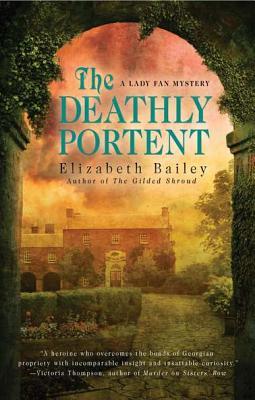
The Deathly Portent by Elizabeth Bailey

The Deathly Portent is the second in a series of historical mystery novels featuring Ottilia Fanshawe (also known as Lady Fan). The first in the series is The Gilded Shroud, but it’s not necessary to have read that one first as this is a complete story in itself.

The story is set in England during the Georgian period. Ottilia and her husband Lord Francis are riding home from a visit to Ottilia’s godmother when their coach breaks down near the village of Witherley. When they send their groom to look for the village blacksmith, they discover that Duggleby the blacksmith has been the victim of a murder – and that Cassie Dale, a young woman who has been branded a witch, is being blamed for it.

Ottilia has recently solved a mystery involving her husband’s family and is confident that she will be able to solve this one too. Believing Cassie Dale to be innocent, she begins to investigate in the hope of finding the real murderer and clearing Cassie’s name, but things soon start to become more dangerous than she had expected.

As soon as I started reading this book it reminded me in many ways of a Georgette Heyer novel – the time period, the language, the characters’ names, the dialogue – and so I wasn’t surprised to read that Heyer is one of Elizabeth Bailey’s influences. The appeal of this book for me was really the historical setting and the characters, though I did enjoy watching the mystery unfold too. There were lots of possible suspects, all with different motives for wanting Duggleby dead, and I was kept guessing until the truth was revealed at the end of the book.

One of the reasons I enjoy historical or vintage mysteries is that in the past we obviously didn’t have all the scientific methods of crime-solving that we have today and so detectives had to rely on making careful observations, hunting for clues, and talking to suspects and witnesses. And so Ottilia spends a lot of time getting to know the various residents of the village, listening to gossip and trying to make deductions from what she learns.

I loved Ottilia and Francis as a couple – they are both very easy to like and some of my favourite scenes were the ones in which they both appear together. Ottilia is a strong, intelligent character with a real enthusiasm for detective work and her husband is very supportive, although he can’t help worrying about her, particularly when he thinks she’s putting her life at risk unnecessarily. I’ll be interested to see how their relationship develops in any future novels in this series.

The events of the first Lady Fan novel, The Gilded Shroud, were referred to a few times in this book but not so much that I felt the previous novel had been spoiled. I will probably go back and read it at some point as I enjoyed meeting Lady Fan and would like to see how she solved her first mystery.

I received a copy of The Deathly Portent from the author for review.