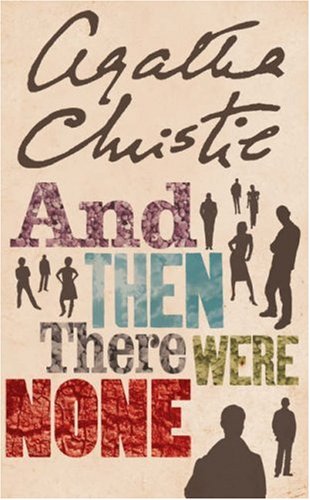
And Then There Were None by Agatha Christie

Although I usually enjoy mysteries, I’ve never considered myself to be a big fan of Agatha Christie. I didn’t really like the Poirot books I’ve read (though admittedly I’ve only tried a few of them) and Miss Marple didn’t appeal to me either. If only I had started with this one instead!

At the beginning of the book we are introduced in quick succession to ten people who have all been invited to a house on Soldier Island, off the coast of Devon. Each person has been given a different reason as to why their presence on the island is required, but on arriving at the house the group discover that their hosts are mysteriously absent. When, one by one, they begin to suffer gruesome deaths in accordance with the children’s rhyme “Ten Little Soldiers” it becomes obvious that one of the ten is a murderer.

The thing that makes this book such an exciting and suspenseful read is that all ten characters seem suspicious and the more you learn about them the more it appears that any one of them could be the killer. Halfway through the book I thought I had worked it out as there was one character in particular that I had suspected from the start (although it was more just an instinct rather than anything specific that he or she had done). As the story moved towards the conclusion it looked as if I was going to be right…

Do I need to tell you that I got it entirely wrong? I admit that solving whodunits is not one of my strong points, but I think most people would be baffled by this one! Christie expertly leads you to believe one thing, then a few pages later proves you wrong. I was sure that as more and more of the ten were eliminated one of them would emerge as the most obvious suspect, but that didn’t happen.

Have you read this book? Did you guess the solution to the mystery?
April Reading Summary

I can’t believe it’s May already! Looking back at the books I read in April, it was probably my best month so far this year. I read fifteen books (plus a few children’s books – more on that later this week) including six from the Orange Prize longlist, two classics and my Persephone Secret Santa present.

Favourite books read in April

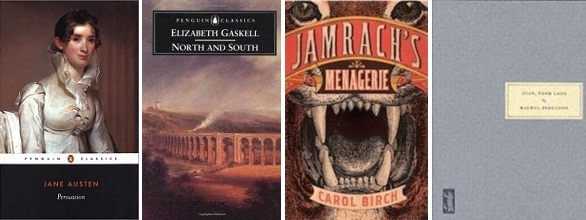
I loved Persuasion and now Sense and Sensibility is the only Austen novel I still haven’t read. I also enjoyed North and South – and as I’ve now read two works by Elizabeth Gaskell this year it means I’ve completed the Gaskell Reading Challenge. I thought Jamrach’s Menagerie was a very entertaining read. And Alas, Poor Lady has become one of my favourite Persephones so far!

Other books read in April

The Seas by Samantha Hunt
Naming the Bones by Louise Welsh
Room by Emma Donoghue
The Song Before it is Sung by Justin Cartwright
The Tiger’s Wife by Tea Obreht
The Daughter of Time by Josephine Tey
Swamplandia! by Karen Russell
Great House by Nicole Krauss
Darkside by Belinda Bauer
Brooklyn by Colm Toibin
The Echo Chamber by Luke Williams

I enjoyed all of these apart from the Justin Cartwright book. Reviews will be coming soon, I promise! They’ve all been written and it’s just a case of scheduling the posts. I don’t really like posting more than three or four times a week but it might be necessary for a while until I catch up.

I hope you all had a good April. Enjoy your reading in May!

Naming the Bones by Louise Welsh

In Naming the Bones, the first book I’ve read by Louise Welsh, university lecturer Dr Murray Watson takes a sabbatical from work in order to research a new book on the life of Archie Lunan, a little-known Scottish poet. Lunan drowned in a sailing accident decades earlier and his death is still surrounded by mystery. Murray’s investigations take him from his home in Glasgow to the Isle of Lismore – where he learns more about Lunan’s life and death than he could ever have imagined and begins to ask himself the question: does knowing what an artist is like as a person really add to our appreciation and understanding of their work – or is the work best left to stand on its own?

Although I did end up enjoying this book, it wasn’t really what I was expecting at all – from the blurb and the quotes on the back of the book it sounded like it would be a fast-paced thriller. Unfortunately I really struggled to get through the first half of the book – it was very slow and there were too many sub-plots that didn’t seem to add much to the story – Murray’s affair with his head of department’s wife, for example, and his estrangement from his brother. But I did like Murray as a character – I found him a likeable and wryly funny narrator who seemed to stumble from one disaster to another – and I wanted to find out what had happened to Archie Lunan, so I was happy to keep reading.

In the second half of the book, when Murray arrived on the island of Lismore, the pace started to pick up and the story became very compelling. The island with its ruined castle, abandoned cottages and ancient broch provided an atmospheric setting for this part of the novel. Welsh increased the tension with every chapter, threw in some twists and surprises (though nothing too unbelievable) and left me feeling satisfied with the way the book had ended.

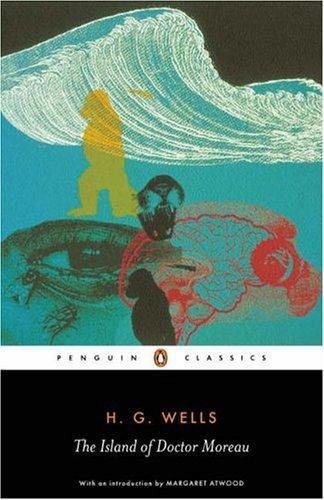
The Island of Doctor Moreau by H.G. Wells

After reading my first H.G. Wells book, Ann Veronica, in March I mentioned that I now felt ready to try one of his science fiction books. The Island of Doctor Moreau is the one I chose to read, and it certainly couldn’t be more different from Ann Veronica!

The story is narrated by Edward Prendick who, having been shipwrecked, is rescued by the crew of the Ipecacuanha. Whilst on board, he becomes acquainted with one of the other passengers, the mysterious Montgomery, who is transporting a cargo of wild animals home to the island where he lives. When the drunken captain of the Ipecacuanha attempts to have Prendick thrown overboard, Montgomery takes pity on him and invites him to accompany him to the island. Here Prendick meets the famous vivisectionist Doctor Moreau, who is carrying out some secret experiments on animals – and as the true horrors of Moreau’s island are revealed, Prendick begins to realise that his own life could be in danger.

I’ve never been a fan of science fiction and wasn’t sure what to expect from this book, but I enjoyed it more than I thought I would. The opening chapters were a bit slow, but things became much more interesting when Prendick arrived on the island and after that the pages flew by.

I didn’t think the story was frightening, although I did feel a growing sense of disgust and repulsion. Some of Moreau’s nightmarish creations were truly horrible to read about. Whatever your personal views on animal testing may be, the way Wells describes the unnecessary pain and suffering Moreau inflicts on his animals is very sad and disturbing. Like Frankenstein and more recently, Jurassic Park, The Island of Doctor Moreau can be seen as a warning of the negative effects of science and the dangers of ‘playing God’. When this book was published in 1896, the kind of technology Wells described only really existed in fiction. But during the 20th and 21st centuries the advances scientists have made in areas such as genetic engineering and cloning mean that Wells’ ideas are no longer so far-fetched. And that’s what really is frightening!

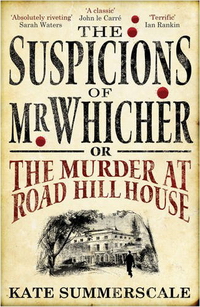
The Suspicions of Mr. Whicher by Kate Summerscale

One night in June 1860 a little boy called Saville Kent was murdered at his home in the village of Road, Wiltshire. As it seemed certain that nobody had entered the house from outside, suspicion fell on the Kent family and their servants. When the local police proved to be incompetent, the Home Secretary requested that Scotland Yard send Detective Inspector Jonathan Whicher to assist them with the investigation. In The Suspicions of Mr. Whicher, Kate Summerscale tells the full story of the case and how it affected Whicher’s career.

This is a non-fiction book based on a true story. Considering the book combines two of my favourite things in literature – mysteries and the Victorians – you won’t be suprised to hear that I thought it was completely fascinating! And although I regretted not reading it sooner (it was first published in 2008), my timing actually couldn’t have been better. Just after finishing the book I discovered that it had been adapted for television, so the story was still fresh in my mind when I sat down to watch it on ITV1 last night (Monday 25th April). I enjoyed the TV adaptation but I’m glad I managed to read the book first.

I appreciated the fact that Summerscale was careful not to give away the solution to the mystery too early in the book, which meant the reader had a chance to study the clues and try to solve the mystery along with Whicher. It was interesting too to see how the vocabulary used in detective work has developed over the years, such as the origins of the word ‘clue’.

Summerscale also explains how during the 19th century people began to place a greater importance on the privacy and security of their homes than they had in the past. Thus a case like the Road Hill one was even more shocking in that it had taken place behind locked doors. The sanctity of the home had been violated and it seemed that the murderer was almost certainly one of the household. This must have made people all over the country afraid that the same thing could happen in their own family home. And with the multitude of new national and local newspapers that had appeared in recent years, detailed reports of this and other horrific crimes could be brought to an even wider audience. This, of course, allowed the public to become ‘armchair detectives’ and come up with their own theories as to what really happened.

The murder at Road Hill House captured the imagination of the British public and inspired a number of fictional detective stories such as The Moonstone by Wilkie Collins, which I read a few years ago. The character of Sergeant Cuff in The Moonstone is thought to be based on Whicher and I can also now see how Collins incorporated some other elements of the Road Hill investigation into his story – the importance which is placed on checking the family’s laundry, for example. I really need to re-read The Moonstone soon because I’m sure that knowing some of the background behind it will help me to get more out of it!

Have you read The Suspicions of Mr Whicher? Are there any other true crime stories that you’ve enjoyed reading?

The Lost Book of Salem by Katherine Howe

Note: This book was also published under the title The Physick Book of Deliverance Dane.

This book got a lot of attention when it was first published a couple of years ago and I couldn’t wait to read it as I thought it sounded like something I would really enjoy. But after seeing quite a few negative reviews I wasn’t so sure and decided that maybe I wasn’t in such a hurry to read it after all. I finally picked it up in the library last month and thought I’d give it a try.

The Lost Book of Salem (I’m not sure why it was necessary to change the title) is a dual time-frame novel, with part of the story set during the Salem witch trials in the 17th century and the rest of the story taking place in 1991. The modern day storyline follows Connie Goodwin, a history graduate who is attempting to track down a spell book belonging to Deliverance Dane, one of the Salem women accused of witchcraft in 1692. Connie believes the book has been passed down through the generations and could still be in existence. Through a number of flashbacks we meet Deliverance Dane herself and some interesting questions begin to arise: could she really be a witch – and does magic really exist?

I wish I could say I had enjoyed this book, but I didn’t. I had trouble with Katherine Howe’s writing style, which was overly descriptive and made the story drag in places. I also found the plot too predictable – it was interesting enough to keep me turning the pages, but there were no real surprises.

As the main character, I found Connie very irritating. Considering she was a PhD student and supposedly an expert in colonial American history she was very slow to pick up on clues that were obvious even to me. She didn’t appear to have much knowledge of the period she was studying either – I’d have thought she would have known that β€˜receipt’ used to mean β€˜recipe’, for example, and she seemed to be mystified by the word β€˜bottel’ before it finally dawned on her that it was just the phonetic spelling for β€˜bottle’. Deliverance Dane was a more interesting character and I would have preferred to have spent longer in the 17th century, rather than just the brief interludes that we were given.

There were still a lot of things to like about this book, though. The historical sections were atmospheric and appeared to have been well-researched. And for anyone with an interest in the Salem witches, the book goes into a lot of detail about the trials and the events that lead up to them. So, although I was disappointed by it, I’m sure other people would enjoy it more than I did.

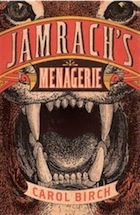
Jamrach’s Menagerie by Carol Birch

When young Jaffy Brown comes face to face with an escaped tiger in the streets of London, it leads to him being offered a job with Mr Jamrach, a dealer in wild animals. For the next few years Jaffy works at Jamrach’s menagerie, helping to take care of the animals – until one day he gets the chance to go to sea in search of a very special creature…

This novel, the first I’ve read by Carol Birch, grabbed me from the very first page. It was everything I love in a book: historical fiction set in the Victorian period with a fast-paced plot and quirky, interesting characters. When a few chapters into the novel Jaffy set off on his voyage and it became clear that most of the book was going to take place at sea I was slightly worried as I often find seafaring stories boring – but not this time! I was pleased to find that I enjoyed reading about Jaffy’s adventures on board the Lysander, visiting distant lands and battling against storms, starvation and superstition as much as I enjoyed the chapters set in working-class 19th century London.

From tigers and whales to exotic birds and giant reptiles we encounter a large number of animals, both at Jamrach’s London menagerie and in their natural habitat (and be warned that Birch doesn’t shy away from describing the cruel ways in which these creatures were treated in the 19th century). But more importantly, we learn a lot about human nature, about friendship, love and loyalty. Jaffy, as our narrator, is the character around whom all the others revolve including Ishbel, the girl he loves; Tim, his childhood friend and rival; and Dan Rymer, the older sailor who becomes a father figure to the boys.

Birch’s writing is atmospheric and descriptive, giving the story an almost supernatural, mystical feel at times. And although there were a few occasions where I thought the plot suffered slightly from taking second place to the detailed descriptions, for the most part I found the book completely gripping. A good old-fashioned adventure story and a very enjoyable and entertaining read!