The Seas by Samantha Hunt

If you’ve been following this year’s Orange Prize for Fiction, it probably won’t have escaped your attention that the shortlist was announced on Tuesday (following the earlier announcement of the longlist last month). I don’t necessarily have any plans to read all of the books on either list, but am picking out the ones that sound appealing or that I can get hold of easily. The Seas is one of the longlisted titles that didn’t make the shortlist. This book (which was Samantha Hunt’s first) was originally published in 2004, but became eligible for the Orange Prize after being published in the UK last year.

Ever since she was a little girl and her father told her she was a mermaid, the unnamed narrator of The Seas has felt different from everyone else in her town. Now, at the age of nineteen there are two main influences on her life: one is her love for Jude, an older man who has recently returned from fighting in Iraq. The other is the lonely, oppressive atmosphere of the town itself – a town so far north ‘the highway only goes south’ – and the sea that surrounds it.

There is a lot of this kind of sadness here. It slips in like the fog at night. The fog that creeps out of the ocean to survey the land that one day she thinks will eventually be hers.

This is not the type of book I usually choose to read, but sometimes it’s good to take a risk and try something a bit different. And The Seas is certainly different! As well as being a strange and unusual novel, it’s also a surprisingly short one. In just 200 pages, Samantha Hunt manages to cover a number of topics such as the Iraq War, post traumatic stress disorder and mermaid mythology – as well as creating some interesting minor characters, including the narrator’s grandfather, a retired typesetter who is busy working on a new dictionary – yet I never felt that the author had tried to pack too much into too few pages, which proves that sometimes a book doesn’t have to be long in order to say everything it needs to say.

Although there didn’t seem to be much of a plot and I wasn’t sure where everything was leading, I enjoyed the first half of the book and was pulled into the narrative by the quality of the beautiful, dreamlike prose, filled with wonderful ocean imagery. It wasn’t enough to hold my attention right to the final page, though, and towards the end of the book I started to lose interest. Sadly there were too many things about this book that didn’t quite work for me, but overall I thought it was an impressive debut novel.

Three Men in a Boat (To Say Nothing of the Dog) by Jerome K. Jerome

I have book blogging to thank for the fact that I’ve finally read this wonderful classic. It’s not a book I would ever have thought of reading until I started to notice other bloggers giving it glowing reviews and decided I really had to read it for myself. I’m pleased to say that it lived up to my expectations – I found it an easy, entertaining read, not to mention a genuinely hilarious one! I can’t remember the last time I read such a funny book and I would recommend it to anyone who feels daunted by the thought of reading a Victorian classic.

The ‘three men’ are our narrator, J., and his two friends, George and Harris. When they decide they need a break, the three men (accompanied by Montmorency the dog), set off on a boat trip along the River Thames – and everything that can go wrong does go wrong!

What makes Three Men in a Boat so funny is that, despite the book being written such a long time ago, so much of it is still true of modern day life. The accuracy of the British weather forecast, for example, doesn’t seem to have improved at all since Victorian times!

I do think that, of all the silly, irritating tomfoolishness by which we are plagued, this “weather-forecast” fraud is about the most aggravating. It “forecasts” precisely what happened yesterday or the day before, and precisely the opposite of what is going to happen to-day.

Most people should be able to identify with at least a few of the disasters that J. and his friends recount. I’m sure anybody who has ever been camping will laugh at the descriptions of two people trying to put up a tent in the rain. And what about Uncle Podger hanging a picture on the wall? Does this scenario sound familiar?

“There!” he would say, in an injured tone, “now the nail’s gone.”

And we would all have to go down on our knees and grovel for it, while he would stand on the chair, and grunt, and want to know if he was to be kept there all the evening.

The nail would be found at last, but by that time he would have lost the hammer.

“Where’s the hammer? What did I do with the hammer? Great heavens! Seven of you, gaping round there, and you don’t know what I did with the hammer!”

Some of the funniest parts are when the three men relate to each other little anecdotes about things that happened to them in the past – my favourite was George getting up and going to work in the middle of the night because his watch had stopped and he thought it was morning. I also loved the story Harris told about the time he got lost in Hampton Court Maze.

During their journey up the Thames, we are given lots of historical and geographical facts about the places the three men pass in their boat; these sections read almost like a travel guide and I suspect they might have been of more interest to me if I lived near the Thames and was more familiar with the area. I also don’t have any interest at all in sailing, rowing or boats in general so a lot of the boating jokes went over my head – but I suppose I shouldn’t really complain about there being too much boating terminology in a book called Three Men in a Boat!

Whether you’ll enjoy this novel or not will depend on whether you can connect with Jerome K. Jerome’s sense of humour. If you can’t then you might be disappointed because the book doesn’t really have a plot, other than the outline I’ve given above – so if you do read it I hope you’ll be able to laugh at it as much as I did!

Time for Read-a-thon!

The 24 hour Read-a-thon is here again!

This is the third Readathon I’ve participated in and I’m planning to approach it in the same way I’ve approached the previous two i.e. no goals, no targets, no pressure. I have plenty of books on my pile to choose from including the following:

The Tiger’s Wife by Tea Obreht
The Daughter of Time by Josephine Tey
Darkside by Belinda Bauer
The Secret Lives of Baba Segi’s Wives by Lola Shoneyin
Family Roundabout by Richmal Crompton
Naming the Bones by Louise Welsh
Great House by Nicole Krauss

I’ll also try to read a few more chapters of my current classic read, North and South by Elizabeth Gaskell, and I have my ereader for additional options if necessary.

It’s a beautiful spring day here so hopefully I’ll be able to do some of my reading outside in the sunshine. I’ll keep this post updated throughout the day though and let you know how I’m progressing. If I decide to participate in any of the mini-challenges I’ll also add them below rather than having lots of separate posts.

Good luck to everyone taking part in today’s Read-a-thon!

UPDATE: Hour 10
I haven’t finished any books yet – but I haven’t been reading for the full ten hours so I’m happy with the progress I’ve made. I’m more than halfway through The Tiger’s Wife by Tea Obreht (which I’m loving, by the way) but it was too much to read it all in one day, so I’ve also started The Daughter of Time by Josephine Tey. I think I’ll probably have to go to bed soon, but hopefully I’ll finish The Tiger’s Wife tomorrow before the Read-a-Thon ends.

UPDATE: Hour 24
Well, the Read-a-Thon is now over. I finished The Tiger’s Wife this morning and read two more chapters of North and South. I’m also in the middle of The Daughter of Time. I’m not sure exactly how many pages I’ve read – I know it’s not as many as a lot of bloggers, but I’m happy with what I’ve achieved. I hope everyone who participated had fun and managed to get lots of reading done! Sorry if I didn’t have a chance to visit all your blogs, but it’s been such a nice weekend here that I didn’t want to spend much time on the computer. For the same reason I ended up not taking part in the mini-challenges, though they all looked very tempting.

Thanks to everyone who commented and offered encouragement!

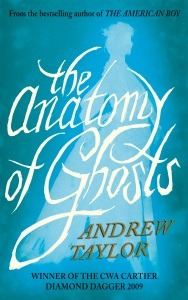
The Anatomy of Ghosts by Andrew Taylor

The Anatomy of Ghosts is an entertaining historical mystery set in and around Cambridge University in the late 18th century. I should read historical mysteries more often because I almost always enjoy them – and this one was no exception.

When London bookseller John Holdsworth’s son is drowned in a tragic accident, his wife insists that their little boy is communicating with them from the spirit world. Holdsworth doesn’t agree and is so disgusted by his wife’s claims that he decides to write a book in which he attempts to prove that ghosts don’t exist. The title of Holdworth’s book is The Anatomy of Ghosts and it soon brings him to the attention of Lady Anne Oldershaw. Her son, Frank, has suffered a nervous breakdown after apparently seeing the ghost of a friend’s wife, Mrs Whichcote, at Jerusalem College, Cambridge. Holdsworth agrees to help Frank – and at the same time he begins to uncover the truth behind what really happened to Mrs Whichcote.

This is the first book I’ve read by Andrew Taylor and I really liked his writing style – it’s detailed yet flows nicely and is easy to read. Some might find the book too slow to begin with, but it does pick up pace. Something that really impressed me about Taylor’s writing was the way he managed to bring his settings so vibrantly to life. Whether he was describing John Holdsworth pushing his barrow of old books through the bustling streets of 18th century London or a couple of students in their caps and gowns strolling through the quiet courtyards and gardens of Cambridge, the sounds, sights and even the smells are incredibly vivid. As a historical novel, though, I think it would have benefited from a few points of reference to anchor the story in the 1700s, as it did at times feel more like the Victorian period to me.

The characters, unfortunately, were not the most likeable of people. In fact, I didn’t like any of them, not even Holdsworth, but it didn’t matter too much – the strength of this book was definitely its plot rather than its characters. And I’ve been left intrigued about what was actually in John Holdsworth’s book, The Anatomy of Ghosts. It would have been a nice addition to the story if we could have read a few excerpts!

Are Andrew Taylor’s other books as good as this one?

13, rue Thérèse by Elena Mauli Shapiro

One day, American academic Trevor Stratton finds a mysterious box in his new office in Paris. On opening the box, he discovers a treasure trove of letters, postcards, photographs and other items that once belonged to a woman called Louise Brunet. As Trevor lifts each object out of the box, he begins to imagine what Louise’s life might have been like…

13, rue Thérèse is like nothing else I’ve ever read. The book is uniquely presented, making it a joy to read. Each item found in the box is reproduced on the page for the reader to look at. Whether a letter, a photograph, a pair of gloves or a coin, every one of these objects provides us with a wealth of information about Louise and her family. With each illustration we are encouraged to look beyond the obvious and search for hidden clues; it’s surprising how much we can learn about a person just by the way they address an envelope, for example. I really liked this aspect of the book; the pictures really enhance the story and give a feeling of intimacy and involvement.

Louise was an intriguing character, although her behaviour was often uncomfortable to read about. I loved the way her history gradually unfolded as Trevor pieced together information based on the contents of the box.

I did feel slightly confused at times while reading this book. I wasn’t always sure who the narrative voice belonged to and I wondered what the significance was of Josianne, the woman who left the box for Trevor to find. But when I reached the end of the book and spent some time thinking about what I had just read, everything became a lot clearer.

13, rue Thérèse is an interesting mixture of history, romance and mystery – with a touch of magic. It’s not an easy read, but I would have no hesitation recommending it to anyone who’s prepared to try something very imaginative and unusual.

I received a copy of this book from Headline for review.

The Guernsey Literary and Potato Peel Pie Society by Mary Ann Shaffer and Annie Barrows

Everyone seemed to be reading this book a couple of years ago, apart from me! It had never appealed to me before, but recently I’ve been reading a lot of World War II fiction so I thought it was time I gave it a try – and I’m glad I did.

In The Guernsey Literary and Potato Peel Pie Society we meet Juliet Ashton, who has become famous as a result of the witty newspaper column she wrote during the war. When the war is over, Juliet receives an unexpected letter from a man called Dawsey Adams. Dawsey, who lives in Guernsey, one of the Channel Islands, tells Juliet about the Guernsey Literary and Potato Peel Pie Society, a group he and his neighbours had formed to enable them to meet without arousing the suspicion of the German soldiers who occupied the island. Through Dawsey, Juliet corresponds with the other members of the society. They all have their own stories to tell about both literature and wartime Guernsey, so each member writes to Juliet individually to talk about their favourite books and the joys of reading.

Despite the popularity of this book I had somehow managed to avoid hearing very much about it, so I wasn’t aware until I started reading that it was going to be told entirely in the form of letters. At first I was concerned that this wasn’t going to work for me, but I actually thought the use of letters to tell the story was very effective. It meant we were given a wide variety of different narrators and it allowed each of their stories to unfold slowly and gradually through their correspondence.

I’m ashamed to say that I’ve never even thought about what it was like to live in Guernsey during the war when the island was occupied by German troops and effectively cut off from Britain for five years – and I’m glad that, having read this book, I’ve now learned something about it. There are both happy scenes, such as when all the children who had been evacuated from the island came home to Guernsey at the end of the war, and sad ones – people’s pets being put down because there wasn’t going to be enough food for them, for example. And I enjoyed reading how the islanders managed to outwit the German officers who insisted that all livestock should be handed over to them.

This is a lovely, inspiring story of how in times of hardship and tragedy, people can make the best of a bad situation and work together to help each other survive – and even to have fun.

March Reading Summary

I was intending to post my March Reading Summary yesterday but the day turned out to be busier than expected, which is why I’m posting this later than planned!

March was another good month. I read seven books by men and nine by women – all but four were new authors for me. I read books set in France, England, Spain, Italy, USA, Sweden and the former Czechoslovakia (only one was a translation, though). And unfortunately I’ve only had time to post my thoughts on five of them so far, which means another month of trying to catch up!

Favourite books read in March:

After years of thinking I wouldn’t like Life of Pi, I’ve read it at last – and loved it! I also loved Three Men in a Boat by Jerome K. Jerome and in And Then There Were None I’ve finally found an Agatha Christie book that I really enjoyed.

Other books read in March:

Ann Veronica by H.G. Wells
Mistress of the Art of Death by Ariana Franklin
Far to Go by Alison Pick
A House of Pomegranates by Oscar Wilde
Echoes from the Dead by Johan Theorin
The Weed That Strings the Hangman’s Bag by Alan Bradley
The Suspicions of Mr. Whicher by Kate Summerscale
Ethan Frome by Edith Wharton
Samuel Pepys: The Unequalled Self by Claire Tomalin
The Creation of Eve by Lynn Cullen
The Lost Book of Salem by Katherine Howe
13, rue Therese by Elena Mauli Shapiro
The Island of Doctor Moreau by H.G. Wells

As I mentioned earlier, I still have a lot of these books to review, although I do have most of them drafted and ready to post soon. I might have to try some of those multi-book posts that I’ve seen other bloggers use so effectively!

Other reading/blogging events:
During the week of 14-20 March, I took part in the Irish Short Story Week which was hosted by Mel U of The Reading Life. The story I chose to read was Laura Silver Bell by Joseph Sheridan Le Fanu. Although I didn’t think it was a fantastic story, it was still enjoyable and good enough to make me want to try some more of Le Fanu’s work soon.

How was your March? What are you looking forward to reading in April?