Review: The Talisman Ring by Georgette Heyer

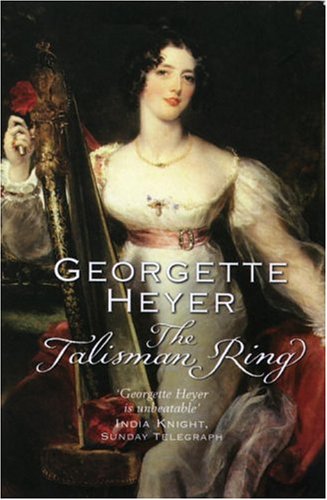
Before I started blogging I had never considered reading Georgette Heyer, but after seeing how popular she is with so many other bloggers I knew I would have to give her a try. I’m glad I did – and I’m glad I chose to begin with The Talisman Ring because I really enjoyed it.  I could describe this book in one word: fun!

Lord Lavenham’s dying wish is that his great-nephew Sir Tristram Shield will marry his granddaughter Eustacie de Vauban.  However, Tristram is a sensible, practical man in his thirties while Eustacie is a romantic, passionate girl of eighteen – and neither particularly wants to marry the other.  Eustacie would prefer to marry her other cousin, Ludovic, but there’s just one problem: Ludovic is a fugitive, wanted for murder.  With the help of Sarah Thane, Tristram and Eustacie begin a search for the talisman ring that will prove Ludovic’s innocence.  This is all part of a thrilling adventure involving smugglers, excisemen, the Bow Street Runners and a Headless Horseman!

I enjoyed the witty dialogue and the way all the characters interacted with each other, particularly the relationships between Tristram and Sarah, and Eustacie and Ludovic.  Even the minor characters were well drawn and fun to read about. One of my favourites was Sir Hugh Thane, Sarah’s brother, who appeared completely oblivious to what was going on around him and was more interested in the contents of the Red Lion’s cellar.

I thought Eustacie was very over the top and as a result, not very realistic, but I can appreciate that Heyer had intended her to be an amusing, entertaining character. I preferred the book’s other heroine, Sarah Thane, who was more down to earth and composed – though like Eustacie, she longs to have some excitement in her life…

“I thought it too good to be true,” said Miss Thane. “If there is one thing above all others I have wanted all my life to do it is to search for a secret panel! I suppose,” she added hopefully, “it would be too much to expect to find an underground passage leading from the secret panel?”

The Talisman Ring has a bit of everything: mystery, adventure, history, romance and comedy. In general I prefer my historical fiction to be more serious, but I still enjoyed this book and am looking forward to reading more of Heyer’s work. I have a couple of her other books waiting to be read, so it will be interesting to see what I think of them.

Recommended

Genre: Historical Fiction/Pages: 320/Publisher: Arrow/Year: 2005 (originally published 1936)/Source: Library book

Review: Tess of the D’Urbervilles by Thomas Hardy

Tess Durbeyfield’s life changes forever when her father learns that he is descended from the noble D’Urbervilles. After discovering that he has some wealthy D’Urberville relatives living nearby, Tess is sent to visit them in an attempt to improve the family’s fortunes. While there she is taken advantage of by Alec D’Urberville and returns to her parents pregnant. A few years later when she falls in love with Angel Clare, the parson’s son, she is forced to decide whether to trust Angel with the truth about her past…

It seems that people either love or hate Tess of the D’Urbervilles. Among those who hate it the main reasons for disliking it appear to be that the book was too dark and depressing, or that Tess was too passive and weak. Although I can understand these complaints, I personally fall into the group of readers who loved the book. I don’t have a problem with a story being tragic, melodramatic or depressing as long as it’s well-written. And Hardy’s writing is beautiful. With other books I am often tempted to skim through pages of descriptions of trees, fields, sunrises etc, but Hardy’s portrayal of nature and the English countryside is so poetic I wanted to read every word. Be prepared, though – you will learn more than you ever wanted to know about milking cows, threshing wheat and slicing turnips!

It’s true that Tess doesn’t stand up for herself enough – there were plenty of times when I wanted to scream at her – but I mostly felt sorry for her. She was young (sixteen I think at the start of the book), innocent, naive, and didn’t have the best family life, with a father who was often drunk.  It seemed that everything that could go wrong for her did go wrong. More than poor Tess, it was Alec d’Urberville and Angel Clare who both really infuriated me – and I actually thought Angel was worse than Alec in some respects.

The injustice of a society with different sets of rules for men and women, Christianity vs pagan symbolism, the Industrial Revolution, and the class system of Victorian England are some of the interesting topics this book covers. The only thing I didn’t like about the book was the ending – the final chapters just didn’t seem to fit with the rest of the novel.

So, if you haven’t read this book yet give it a try – you might hate it…but you might just love it like I did.

Highly Recommended

Genre: Classics/Pages: 464/Published:BBC Books (Random House)/Year: 2008 (originally published 1891)/Source: Library book

Childhood Memories: Books and Ballet

I have never had much interest in watching ballet, I’ve never attended a ballet class in my life – and yet I used to love reading books about ballet dancers. For my second Childhood Memories post (you can see the first one here) I thought I’d take a look at some of the children’s ballet stories that I remember reading.

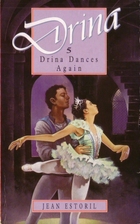
One of my favourite ballet series was the Drina series by Jean Estoril. Jean Estoril was a pseudonym of Mabel Esther Allan, a British author of children’s books. The Drina series consisted of 11 books following the dancing career of Drina Adams. The only ones I owned – and I still have them – are Drina Dances in Italy, Drina Dances Again, Drina Goes on Tour and Drina, Ballerina, but I remember borrowing the others from the library.

In the first book, Ballet for Drina, Drina starts attending ballet classes much to the disapproval of her grandmother. She can’t understand why her grandmother doesn’t want her to dance – until it is revealed that Drina’s name is really Andrina Adamo and she is the daughter of the famous ballerina Elizabeth Ivory who was killed in a plane crash following a performance. Drina’s grandmother blames ballet for her daughter’s death and has vowed that her granddaughter would never be allowed to dance. Over the course of the series, we see how Drina overcame obstacles, coped with the jealousy of other girls and dealt with some devastating disappointments to eventually, in the final book, become a prima ballerina. I think part of the reason I liked these books was that they showed fame, celebrity and the ballet world in a realistic light, rather than portraying it as glamorous or romantic.

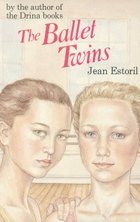
Another great book by Jean Estoril was The Ballet Twins. This one was about the Darke twins, quiet Doria and confident Debbie, who compete against each other for a scholarship at a London ballet school.

It’s sad that these books now seem to be out of print, but I suppose they would be very dated now and maybe not what kids would want to read anymore (although, as they were published in the 1950s and 60s, they were already pretty old-fashioned by the time I was reading them).

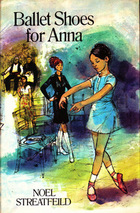
Probably one of the most famous authors of ballet stories was Noel Streatfeild. Her 1936 novel Ballet Shoes, the story of Pauline, Petrova and Posy Fossil, is a children’s classic (and one of those books that can be enjoyed by adults too) but another of her books that I loved was Ballet Shoes for Anna. The book was about a little girl called Anna who lives in Turkey. Her grandfather is a ballet instructor and is teaching Anna to dance. When an earthquake destroys the family home, she and her brothers Francesco and Gussie are sent to England to live with an aunt and uncle. The rest of the book looks at the problems the three children face in settling into their new home in 1970s England and their attempts to earn money so that Anna can continue to learn to dance.

Mary Noel Streatfeild was born in Sussex, England in 1895, the daughter of an Anglican Bishop. Apart from the books I’ve mentioned above, she wrote many other children’s books including White Boots, A Vicarage Family and Thursday’s Child, and several books for adults.

Did anyone else enjoy reading ballet books – whether or not you actually like ballet?

Review: Under a Blood Red Sky by Kate Furnivall

Unfortunately I was unable to finish this book – which is not something that happens to me very often. I hadn’t heard of Under a Blood Red Sky (also published under the title The Red Scarf) until I saw it in the library and I thought I’d give it a try as I love historical fiction set in Russia.   It sounded interesting:

Anna and Sofia are two women who meet whilst imprisoned in a Soviet labour camp in the 1930s and become best friends. When Anna becomes ill, Sofia comes up with a daring plan to run away from the camp and find help. Anna has told her about a childhood friend, Vasily, who is now living under an assumed name in the town of Tivil. After successfully escaping, Sofia heads for Tivil to look for Vasily and ask him to return to the camp with her to save Anna.

However, right from the beginning of the book I felt we were being asked to accept things that weren’t plausible.  The whole plot was just too far-fetched for me.  The other (bigger) problem I had with this book was that I couldn’t connect with any of the characters. Although they were constantly putting their lives at risk and facing unimaginable horrors under Stalin’s communist regime, I found I didn’t really care what happened to them. Sofia was one of those model heroines – beautiful, brave, intelligent and perfect. Everybody seemed to be captivated by her and I couldn’t really understand why. She just didn’t feel like a real person to me. Of course, there were some situations that even Sofia couldn’t deal with – that’s where the gypsy Rafik came in, using mesmerism and mind-control to overcome obstacles.  I thought the whole magical aspect of the book seemed a bit out of place.

I tried to keep reading, thinking the book might get better but when I found I was almost halfway through and still wasn’t enjoying it, I decided not to waste any more time on it and put it down with a sigh of relief. I’m glad I had borrowed this book from the library instead of spending money on it – at least I didn’t lose anything apart from a couple of days when I could have been reading something else.

Genre: Historical Fiction/Pages: 512/Publisher: Sphere/Year: 2008/Source: Library book

Review: I’ll Never Be Young Again by Daphne du Maurier

I’ll Never Be Young Again was Daphne du Maurier’s second novel, written when she was only twenty three years old. It’s different from the other books of hers that I’ve read so far. It doesn’t have the suspense or the gothic feel of some of her other works – this is more of a psychological, character-driven book. It’s the story of Richard, a young man who has grown up in the shadow of his famous father, and his struggle to find his own identity. I’m not really a fan of ‘coming-of-age’ novels, but I’m glad I chose to read this one. It certainly seems to be one of her least well known novels –  and I was concerned that this might mean it wasn’t very good. Well, I can tell you that it is good and I enjoyed it a lot more than I was expecting to.

The book opens with Richard – or Dick as he prefers to call himself – standing on a bridge, preparing to jump. Immediately the reader is intrigued, wondering what has happened to drive him to suicide.  At the last minute Dick feels a hand on his shoulder – this is Jake, a complete stranger who saves his life and becomes his closest friend. The first half of the book follows the adventures of Dick and Jake as they leave England and sail to Scandinavia together in search of a new life. The second half is the story of Dick’s relationship with Hesta, a girl he meets in Paris.

The whole book is written in the first person from Dick’s perspective, which is significant as it was apparently the first time Daphne du Maurier wrote from a man’s point of view – and I thought she captured the male voice perfectly. The only problem I had was that I just didn’t like Dick very much. I found his immaturity and whining very irritating – although I understood that the point of the book was to follow his development from an insecure, selfish youth into a sensible, mature adult. Eventually he does begin to grow up and want different things out of life, but this comes too late in the book for me to be able to warm to him. However, the book is so well-written I could still enjoy it even with such an unsympathetic narrator. Her writing is absolutely beautiful and quite dreamlike, as she lets us get right inside Dick’s head and share his thoughts and emotions. There are also some vivid descriptions of the mountains and fjords of Norway and the other places that the characters visit, particularly Paris with its cafés and boulevards.

This would probably not be the best Daphne du Maurier book for a newcomer to begin with, but it’s a good choice for someone who wants to venture away from Rebecca and read one of her less popular novels. A word of warning, though – if you’re going to read the Virago Modern Classics edition, leave the introduction until last as it gives away the entire plot, including the ending (this is good advice with any book – I’ve learned from experience never to read the introduction first).

This is my first book for the Daphne du Maurier Challenge hosted by Chris at Book-a-rama. I wasn’t planning to take part in this challenge until I discovered my local library had almost all of her books. I’m looking forward to reading some more of her work during the next year, as there are still a lot of her books I haven’t read yet. This book also counts towards the 1930s challenge as it was a contemporary novel published in 1932 and set in 1930s Europe – and also the Typically British challenge.

Pages: 304/Publisher: Virago Press (Virago Modern Classics 515)/Year: 2005 (originally published 1932)/Source: Library book

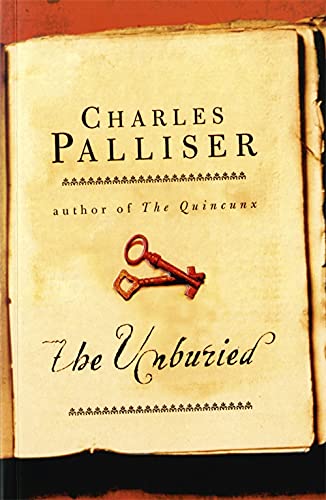
Review: The Unburied by Charles Palliser

The title of this book may suggest a horror story complete with zombies and vampires, but The Unburied is actually a scholarly murder mystery which reminded me of The Name of the Rose by Umberto Eco or An Instance of the Fingerpost by Iain Pears.  I wanted to read it because a few years ago I read another Charles Palliser book, The Quincunx, which I really enjoyed.  Like The Quincunx, this one is set (mostly) in Victorian England.  It begins with a mock ‘Editor’s Foreword’ in which we are told that we are about to read an account which will throw new light on the controversial Thurchester Mystery.  This account, known as The Courtine Account, forms the bulk of the book.

Dr Edward Courtine, a historian from Cambridge University, has been invited to spend the week before Christmas with Austin Fickling, an old friend from his student days who is now teaching at a school in the cathedral city of Thurchester.  He and Austin haven’t seen each other since they parted on bad terms twenty years ago, and Courtine is eager to renew their friendship.  He also has another reason for wanting to visit Thurchester – he has been studying King Alfred the Great and has learned that an ancient manuscript detailing the events of Alfred’s reign may be available in Thurchester Library.

On the night of Courtine’s arrival he hears the story of a murder that took place in the cathedral two centuries earlier.  Courtine is fascinated, but as he begins to investigate he becomes involved in another murder mystery – and discovers Austin’s true motive for inviting him to Thurchester.

As the main narrator of the book, I found Courtine very irritating, but at the same time I felt slightly sorry for him.  For such an obviously intelligent person he was completely lacking in perception, constantly saying the wrong things, missing important clues and failing to notice people behaving suspiciously.  Sometimes he would tell us that he was beginning to form a theory or that an idea had occurred to him, but he didn’t let us know what it was.  This was good in one way, as it encouraged me to work things out for myself, but it also annoyed me because I was already finding it difficult enough to keep all the threads of the story straight.

Although the town of Thurchester and its community are vividly depicted, I didn’t find any of the characters particularly memorable.  The fact that some of them had similar names (Slattery, Sheldrick, Sisterton for example) didn’t help.  There is actually a character list at the back of the book but I was trying not to look at it in case I came across any spoilers.  As for the plot, it’s so intricate you really need to read this book in as few sittings as possible so you don’t forget any important details.  There seemed to be a constant stream of unexplained deaths and forged documents, with at least three separate mysteries from different eras all running parallel to each other – and different characters giving different versions of what may or may not have happened.   I wished I had been taking notes from the beginning.

This is a very atmospheric book with lots of gothic elements, from the freezing fog that accompanies Courtine’s arrival in Thurchester to the obligatory ‘ghost’ supposedly haunting the cathedral.  It would have been a good book to read in front of the fire on a cold winter’s night.  In spite of the slow pace the book was relatively quick to read and although it was certainly confusing, I did enjoy it, especially when the various mysteries began to unravel towards the end.  Not as good as The Quincunx, though – if you’ve never read a Charles Palliser book before, try that one first.

Genre: Historical Fiction/Mystery/Publisher: Phoenix/Pages: 389/Year: 1999/Source: My own copy purchased used

Winners of Our Promised Land!

Throughout April Michael T. Darkow has been offering readers of this blog the chance to win one of 5 copies of his book Our Promised Land.

The contest ended yesterday (Thursday April 29th) and today I used the List Randomizer to find 5 random winners.  The winners are:

Rhonda, Suzie, The Book Whisperer, Barbara S and Rick!  I have contacted you by email to ask for your addresses so that the author can send you your books.  Congratulations to all of you!