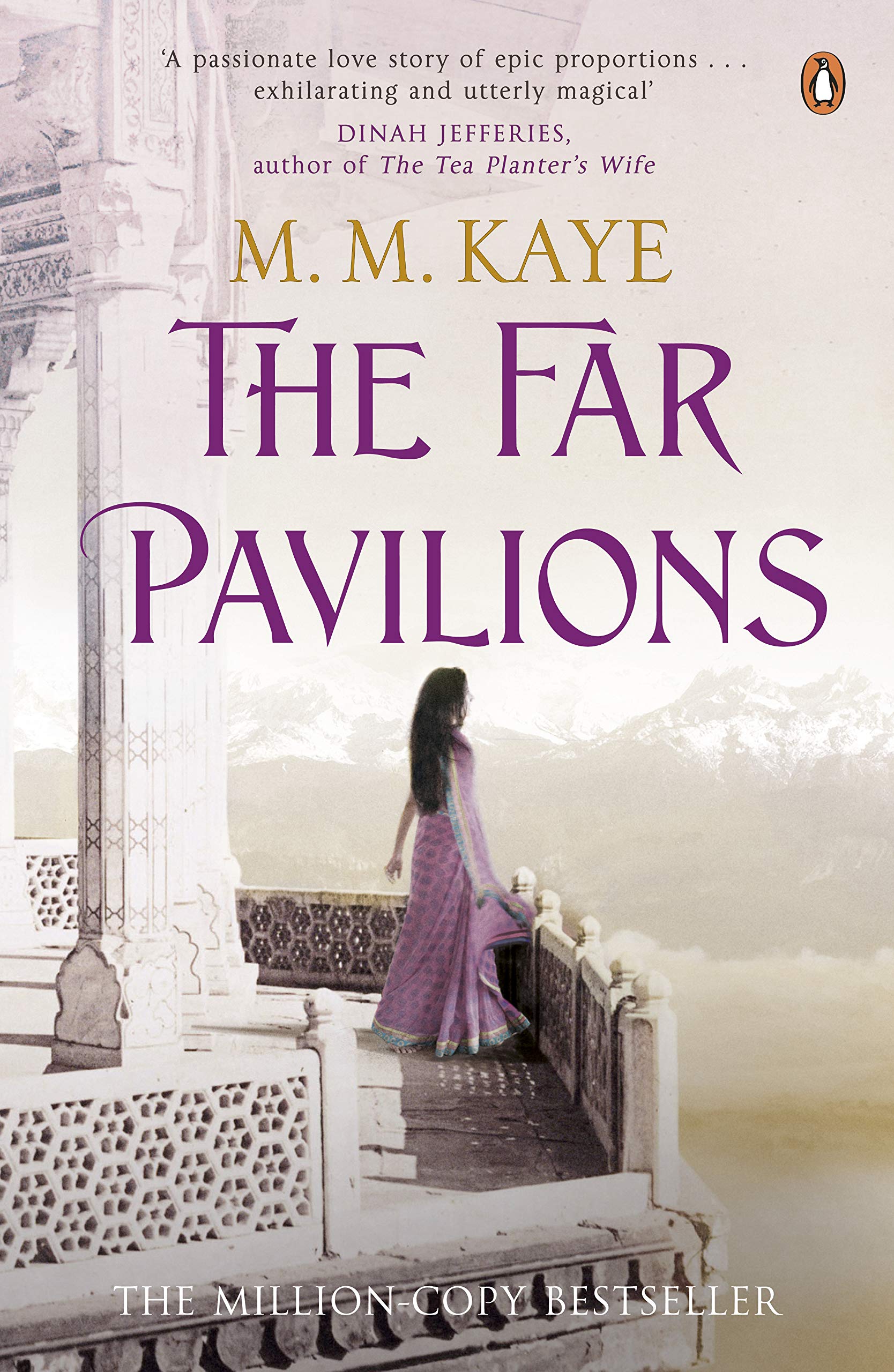
Review: The Far Pavilions by M. M. Kaye

The term ‘sweeping epic’ is used so often it’s become a cliché, but it’s actually an accurate description of The Far Pavilions. M. M. Kaye takes us on a journey across 19th century India and Afghanistan, during which we witness some of the major turning points in the history of those two countries.

Ashton Pelham-Martyn is born in India, the son of British professor Hilary Pelham-Martyn and his wife Isobel. When both of his parents die within a few years of each other, the four year-old Ash is brought up by Sita, the wife of his father’s Hindu groom, unaware that he is not actually Indian. Several years later, after Sita’s death, Ash learns the truth about his birth and is sent to school in England. Eventually he returns to India to serve in the British army, but finds that his loyalties are torn between his Indian friends and the members of his regiment. The Far Pavilions is the story of Ash’s struggle to find his identity.

At the heart of the story is a forbidden romance between Ash and the Hindu princess, Anjuli. However, that’s only one aspect of the book. Non-romance fans will enjoy the action and adventure, descriptions of military life or simply learning more about 19th century British-ruled India. Most of the battles and other historical events mentioned in the book did actually take place and several of the characters, such as Walter Hamilton and Louis Cavagnari, were real historical figures – you may find it interesting to do some research as you read.

Of all the historical fiction books I’ve read, this is one of the most detailed and well researched. Whilst reading this book I’ve learned a huge amount about 19th century British India, from the names of mountains and rivers, details of battles and mutinies, facts about Hindu and Islamic culture, right down to the various types of flora and fauna. We encounter a large number of Indian words and phrases (most are explained either directly in the text or in the glossary at the back of the book) which feels natural and adds to the authenticity of the story. M. M. Kaye spent a lot of time living in India which explains how she was able to write so convincingly about the country and its people. It’s also interesting that although the author was British, she uses various characters in the novel to explore conflicting opinions on whether British rule was a good or a bad thing for India.

At more than 950 pages it does sometimes feel as if the book will never end, but that’s not necessarily a bad thing because it’s one of those books that pulls you into the story so much that you don’t really want to reach the last page and leave behind the characters you’ve spent so much time with. However, the main storyline comes to a natural end at around page 700 and the book could easily have finished at this point in my opinion. The final 200 or so pages deal with the Second Anglo-Afghan War which is still interesting to read about but could have been the subject of a separate book.

The Far Pavilions is one of my all-time favourite historical fiction novels.

Highly Recommended

2010 Blog Improvement Project: Week 1

I’ve decided to take part in the 2010 Blog Improvement Project. I know there are plenty of areas in which my blog needs improving and I’m hoping that participating in the BIP will give me some ideas and inspiration.

How does the BIP work?

On the first and third Monday of every month, a new activity will be posted on the BIP blog. Each participant can then spend the next two weeks working on that task or challenge.

Week 1: Create a Blogging To-Do List

After spending some time thinking about what I would like to achieve this year, in terms of improving the quality of my blog, here is a list of things I want to focus on.

  • Comments – I’ll try to include more questions at the end of posts to encourage people to comment more. I have a few ideas for other ways in which visitors could interact too. I also need to comment on other blogs more often and get more involved in the blogging community.
  • Navigation – Now that Blogger allows us to create permanent pages (in a similar way to WordPress) it means there are more options as far as navigation is concerned, so I could add an About page, Awards page etc.
  • Frequency of posts – One of my biggest problems is finding time, so I want to be better organised and have more posts written in advance. Also, I’d like to be more consistent – there are some weeks where I manage to post almost every day, but other weeks there are three or four days between posts.
  • Quality of posts – At the moment, I have book reviews and the occasional meme or challenge post. I would like to include more original content and other types of posts to add some variety.
  • Labels – This was one of the areas I worked on during Bloggiesta last month, but I will continue to delete labels or add new ones whenever I think it’s necessary.
  • Social Media – I will try to use Twitter for more than just announcing new blog posts (I use twitterfeed which does this automatically). I also want to learn about other social media tools. I’d appreciate any advice on this – which ones are worth using and which aren’t?

As the year progresses I know I’ll probably think of other things I want to improve on, but this list is a good starting point.

Fiendish Fridays #3: Biju Ram

Fiendish Fridays is hosted here at She Reads Novels, profiling some of our favourite literary villains. You can see a complete list of previous Fiends and suggest one of your own here.

This week’s Fiend comes from one of my current reads – The Far Pavilions.

#3 – Friday 5 February 2010: Biju Ram

Name: Biju Ram (also known as Bichchhu-ji – the scorpion)

Appears in: The Far Pavilions by M.M. Kaye

Who is he? Although he is officially an attendant of Lalji, the young heir to the throne of Gulkote, it is believed that Biju Ram is working for Lalji’s stepmother, the scheming Janoo-Rani.

What is he like? He wears a single diamond earring in one ear and has a distinctive giggling laugh.

What makes him a Friday Fiend? He has been an enemy of our hero, Ashton, for many years. As a child Ash was the target of his practical jokes and cruel comments. Biju Ram is also involved in two assassination plots (I won’t tell you if they were successful or not) and probably responsible for at least one murder.

Redeeming features: None. We see Biju Ram only from Ash’s point of view and Ash sees only the bad side of his character.

Teaser Tuesday: The Tenant of Wildfell Hall


Teaser Tuesdays is a weekly meme hosted by MizB of Should Be Reading. The rules:

* Grab your current read
* Open to a random page
* Share two teaser sentences from somewhere on that page (avoiding spoilers)

I’m currently reading The Tenant of Wildfell Hall by Anne Bronte and probably won’t be finished until the weekend – so in the meantime, enjoy this teaser!

“The next minute saw me hurrying with rapid strides in the direction of Wildfell Hall – to what intent or purpose I could scarcely tell, but I must be moving somewhere, and no other goal would do – I must see her too, and speak to her – that was certain; but what to say, or how to act, I had no definite idea. Such stormy thoughts – so many different resolutions crowded in upon me, that my mind was little better than a chaos of conflicting passions.”

p.78 “The Tenant of Wildfell Hall” by Anne Bronte

NaJuReMoNoMo – Challenge Complete

National Just Read More Novels Month 2010 (also known as NaJuReMoNoMo) ends today. The challenge was hosted by yellojkt of Foma and the idea was to read some novels (as opposed to non-fiction, memoirs etc) during the month of January.

The books I read in January were:

The White Queen by Philippa Gregory
Madame Verona Comes Down the Hill by Dimitri Verhulst
The Divine Sacrifice by Tony Hays
The End of the Alphabet by CS Richardson
Spring Bear by Betsy Connor Bowen

That’s 5 books which means I’m a Silver Winner.

Silver Winner

Review: Spring Bear by Betsy Connor Bowen

I received this novella from the First Reads program at Goodreads. Spring Bear is the story of a girl called Evvie Mallow who lives in the small town of Soper’s Mills, Maine. Evvie’s father suffered bad head injuries in an accident which left him unable to speak or take care of himself, and her mother has become involved with another man – Lester Darrow, a surly, aggressive man who traps bears in the woods.

Evvie dreams of going to California and escaping from the poverty and misery of her home, but when she discovers that she’s pregnant it seems that her chance of a better life has disappeared.

This self-published book is Betsy Connor Bowen’s debut novel. She has achieved what she set out to do, which is to successfully convey the atmosphere of a small town in Maine. I’ve never been to Maine, and the way of life described in the book was very different from my own – in some ways, a simpler way of life but not without its own set of problems and challenges.

Although I could sympathise with Evvie’s sad, lonely existence, I didn’t really feel any connection to any of the other characters – I would have liked to have been able to get to know them in more depth. Maybe if it had been a longer novel, there would have been more opportunity for character development, but for a quick, short read this book was quite enjoyable.

Genre: General Fiction/Pages: 96/Publisher: Lonefeather Productions/Year: 2009/Source: Won from Goodreads

Fiendish Fridays #2: Thenardier

Fiendish Fridays is hosted here at She Reads Novels, profiling some of our favourite literary villains. You can see a complete list of previous Fiends and suggest one of your own here.

#2 – Friday 29 January 2010: Thenardier

Name: Thenardier
Appears in: Les Miserables by Victor Hugo
Who is he? Thenardier is a greedy and corrupt innkeeper.
What is he like? He is introduced to us as a “small, skinny, sallow-faced man, bony, angular and puny”, who is “thoroughly crooked, a sanctimonious knave”.
What makes him a Friday Fiend? When we first meet Thenardier near the beginning of the book he is extorting large amounts of money from the poverty-stricken Fantine on the pretext of needing it to feed and clothe her daughter Cosette. We also see him stealing from corpses after the battle of Waterloo – he subsequently claims to have been a sergeant in Napoleon’s army, hence the name of his inn, The Sergeant of Waterloo. Later in the book he causes further trouble for our hero, Jean Valjean.

Many people consider Inspector Javert to be the villain of Les Miserables but I disagree. Yes, Javert also makes life very difficult for Valjean, but he behaves the way he does because of his belief in upholding the law no matter what. I don’t see Javert as an evil character, unlike Thenardier who cares about nothing but himself and his latest money-making schemes.

Redeeming features: I can’t think of any – can you? His wife Madame Thenardier is equally unpleasant but at least appears to love her daughters, whereas Thenardier doesn’t seem to care about anybody.