Author Interview: Tony Hays

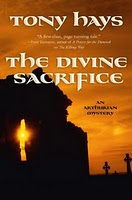
Today I’d like to welcome Tony Hays for an author interview. Tony’s latest book The Divine Sacrifice will be published on March 30th 2010. You can see my review here.

Hi Tony! The Divine Sacrifice is your second historical mystery set in the days of King Arthur. How did your interest in the Arthurian age begin?

I grew up, of course, seeing Sword in the Stone and A Connecticut Yankee. But I have always been fascinated by the debate over Arthur’s historical existence. I believe that fascination was first sparked by reports of the South Cadbury excavations of the late 1960s. Over the years, I’ve kept up with developments. As luck would have it, the secretary of the Camelot Research Committee, which sponsored the digs, was Geoffrey Ashe, who is now among the most renowned of Arthurian scholars and a good friend of mine.

In The Divine Sacrifice we meet characters who are familiar to us from Arthurian legends e.g. Arthur, Guinevere and Merlin. When you created the character of Malgwyn was he inspired by any legendary or historical figure or is he entirely fictional?

Actually, no. I wanted a narrator who was not enamored with Arthur, one who didn’t really like Arthur all that much, although he shares Arthur’s belief in justice. I also wanted a character who would not only solve the mystery, but gain something himself. I couldn’t bring myself to use any of the familiar characters, so Malgwyn was born.

I read on your website that you like to visit some of the places mentioned in your books. How important do you think it is for an author to visit the places they are writing about and how does this help you with your research?

My first published novel was set in 1602 London, onstage at the Globe Theatre. Going to London wouldn’t have helped me at all. Too much has changed. But I could not write the new series without spending a great deal of time in the west country. While some things have certainly changed, many have not. I lived just south of Glastonbury in 2008 for six months, hiking everyday in the Somerset Levels. I can write about sunrise over Glastonbury Tor, how the air smells, because I have been there. I use Cadbury Castle in South Cadbury as the location for Arthur’s headquarters. I used to go up there and sit and plan out the town layout and, with a nod to my acting friends, “block out” the scenes. So, the short answer is, some books demand reconnoitering the locations. Some don’t.

There must be very little historical information available about life in the 5th century. Did this make your task of writing the novel easier or harder?

Both. I had to do hours of research in what sources are available to make certain that I did nothing to conflict with those. But, the lack of primary source material gave me a free hand to invents bits myself. I have read literally dozens of archaeological reports on digs from that time period (I’m also a huge Time Team fan) and I have used actual artifacts found in the books, sometimes suggesting ways that they could have ended up where archaeologists found them years later. The historical Arthur (and I believe that there was a leader named Arthur who had a tremendous impact on his world) would have had to worry about things like economics, trade, the Church. So, I’ve tried to immerse myself in what we know about those aspects of the Dark Ages as well. My Arthur concerns himself with where the resources will come from to continue fortifying specific sites, with exploiting the natural resources like tin. But in case people worry that Arthur is too grounded in reality, as the series progresses, Malgwyn and Arthur will also encounter, and deal with, things that cannot be explained – call it the supernatural or paranormal. There are things in this world that we do not understand, and there were back then too.

What type of books do you like to read yourself? Are there any authors you’ve found particularly influential?

I like history, obviously, even in fiction. I particularly like modern novels with a historical basis. George Macdonald Fraser’s Flashman series and John Maddox Roberts’ SPQR series about the last years of the Republic are great. I cut my teeth as a youngster on the Revolutionary War novels of Kenneth Roberts and Louis L’amour’s westerns. For the Arthur series, Geoffrey Ashe’s work, the historical studies of Christopher Snyder, and the Celtic books of Peter Beresford Ellis have been my mainstays.

If you could go back in time and meet one historical figure, who would it be? In your case, would it be Arthur or someone else entirely?

At this point, I think it would be Arthur. Here’s a figure from 1500 years ago, from one of the least documented time periods in any culture’s history, and yet his impact is felt even today. That’s a person I’d love to meet. I might be disappointed with the reality, but I don’t think so.

Finally, can we look forward to more books in the Malgwyn series?

Absolutely! The Divine Sacrifce will be followed first by The Beloved Dead (April 2011) and then The Stolen Bride (2012). Given good sales, my editor and I plan to keep exploring Dark Ages Britain with Malgwyn for years to come.

Thanks for your time, Tony!

You can find out more about Tony Hays and his books here:
http://www.tonyhays.com
http://www.chroniclesofmalgwyn.com

Review: The Divine Sacrifice by Tony Hays

The Divine Sacrifice is the second in a series of historical mysteries set in Arthurian Britain. Don’t miss my interview with author Tony Hays.

My review:

When an elderly monk is found murdered in his cell at the abbey of Ynys-witrin, King Arthur’s counselor Malgwyn ap Cuneglas is asked to investigate. On their arrival at the abbey, however, Malgwyn and Arthur are surprised to find that St Patrick is also about to arrive from Hibernia in order to root out heresy in the monastery. Is there a connection between the death of old Elafius and the presence of St Patrick at the abbey? As Malgwyn begins to unravel the mystery he discovers something which could threaten not only Arthur but the future of the country.

The Divine Sacrifice can be enjoyed on different levels as an Arthurian story, a historical fiction novel and a murder mystery, although it’s the combination of all three that makes the book so compelling. I have read a lot of mysteries and a lot of historical fiction but this book really stands out as something new and different.

I love the character of Malgwyn, who is one of the most unusual detectives I’ve ever encountered in a book. As one of the other characters in the novel observes, he’s an ‘uncommon man with an uncommon clarity of vision’. We also meet Arthur, Guinevere, Merlin and others who will be familiar to anyone with even a basic knowledge of Arthurian legend, athough they are not depicted in the way you might expect. It’s important to understand that this is not a retelling of the famous Arthur legends – it’s actually an original historical mystery with elements of the legends cleverly woven into the story. Arthur is shown here as a powerful leader who is working to unite the warring tribes of post-Roman Britain.
The mystery unfolds at just the right pace and there are enough twists in the story to keep the reader guessing all the way to the end. Tony Hays has obviously done a lot of research on his subject and is able to portray life in 5th century Britain in a realistic and convincing manner, meaning that I came away from the book feeling I knew a little bit more about the time period than I did before.

Although I hadn’t read the first book in the series, The Killing Way, the author provided enough background information relating to the events of the first book that I was quickly able to pick up the threads of the story and understand what was going on. However, I enjoyed The Divine Sacrifice so much I now want to go back and read The Killing Way and I’ll look forward to more books in this series in the future.

Recommended

Genre: Historical Mystery/Pages: 304/Publisher: Forge/Year: 2010/Source: Won ARC in giveaway

Review: The End of the Alphabet by CS Richardson

When Ambrose Zephyr is diagnosed with an unidentified terminal illness and given only a month to live, he decides to make the most of his final days. Accompanied by his wife Zappora Ashkenazi (also known as Zipper) he sets off on a journey round the world, visiting each city on his list in alphabetical order. Will they make it to the end of the alphabet before time runs out for Ambrose?

At 128 pages, this is more of a novella than a novel and could easily be read in one sitting. I think the book might have lost its impact had it been any longer; I felt that the shortness of the book and the shortness of the individual chapters reflected the speed at which Ambrose’s remaining days were slipping away from him.

I loved the alphabetical theme which runs throughout the book from the characters’ initials (AZ and ZA) to the chapter titles (each stage of their journey is headed with the corresponding letter of the alphabet). Each place they visit brings back memories and evokes strong emotions for both Ambrose and Zipper. Richardson has given his characters a surprising amount of depth for such a short book; it was interesting to see how they each coped with the news of Ambrose’s illness in their own different ways.

Although there is quite a lot of dialogue in the book, the author has decided not to use quotation marks which made following the conversations unnecessarily confusing. I also sometimes found it hard to tell whether certain scenes were happening in the present or in a flashback. However, other readers will probably love his writing style.

Despite the tragic subject matter, I thought it was a warm, charming story and although I probably would never have chosen to read it if I hadn’t won a copy in a competition, it’s an impressive debut novel by CS Richardson.

Genre: General fiction/Pages: 128/Publisher: Portobello Books/Year: 2009/Source: won in a contest

The Sunday Salon: Personal Reading Challenges

In this week’s Sunday Salon post I thought I would mention some of my personal reading challenges for 2010 and beyond.

You can see my current list of 2010 challenges elsewhere on this blog, but there are also a few other challenges I want to set for myself. These will be perpetual challenges – no time restrictions.

Short Stories

Although I read a lot of novels, I don’t often read short stories. One of my personal ongoing challenges is to read as many short stories as I can, particularly by writers I’ve never read before. I know there are existing short story challenges and groups out there that I could join but I’ve decided not to as I don’t know how much time I’ll be able to devote to this and I don’t want to feel under any pressure. I’ll just see how much I can fit in around my other reading.

I will try to read at least one short story every week, (though sometimes I might read more than one and sometimes I might not read any). On Saturdays I’ll post a wrap-up listing the stories I’ve read and a mini-review of each one.

Shakespeare

I have read most of Shakespeare’s tragedies, but only a few of his comedies and histories. So, I’m setting a personal challenge for myself to read all of Shakespeare’s plays, including the ones I’ve read before and to post my review/thoughts on each play.

I have Shakespeare’s Complete Works sitting on my bookshelf, so all I need to do is find the time! I don’t expect to progress very quickly through this challenge. If I can read at least 3 or 4 plays this year I’ll be happy.

Poetry

I feel ashamed of my lack of knowledge of poetry and would like to do something to change this. I want to refresh my memory of some of the poems I’ve read and enjoyed in the past, as well as discovering other poets whose work is new to me (and there will be a lot of those!). This is a huge challenge for me, as I’ve never read very much poetry at all. I don’t want to set any targets for this – I’ll just try to read some poems when I’m in the mood for it and will share my opinions with you.

*

These are not public challenges, though you’re welcome to join me if you want to. They are simply personal ‘reading resolutions’ to motivate me to spend some time reading in areas I’ve been neglecting.

Do you have any personal reading challenges of your own? What are they?

New Book Arrivals – 23rd January 2010

Here are two books that I received today. The first book is one that I won from Goodreads: Spring Bear, a novella by Betsy Connor Bowen.

Synopsis:

In Evvie Mallow, author Betsy Connor Bowen has created a contemporary classic. Born and raised in the Maine woods, her family disintegrating around her, Evvie is caught in a conflict between irreconcilable forces – the instinct to protect her unborn child and the freedom to choose a life for herself. With dignity and grace, she keeps a Yankee’s silence about her own acts of courage and self-sacrifice. This slender book will take its place among the timeless tales that enrich our imaginations.

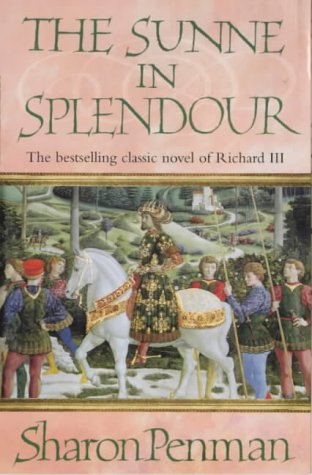
I also bought The Sunne in Splendour from Amazon. I’ve never read any of Sharon Kay Penman’s books before but I thought I would try this one as I’ve seen so many good reviews.

Synopsis:

A glorious novel of the controversial Richard III – a monarch betrayed in life by his allies and betrayed in death by history

In this beautifully rendered modern classic, Sharon Kay Penman redeems Richard III – vilified as the bitter, twisted, scheming hunchback who murdered his nephews, the princes in the Tower – from his maligned place in history with a dazzling combination of research and storytelling.

This magnificent retelling of his life is filled with all of the sights and sounds of battle, the customs and lore of the fifteenth century, the rigors of court politics, and the passions and prejudices of royalty.

Fiendish Fridays #1: Count Fosco

Fiendish Fridays is hosted here at She Reads Novels, profiling some of our favourite literary villains. You can see a complete list of previous Fiends and suggest one of your own here.

#1 – Friday 22 January 2010: Count Fosco

Name: Count Isodor Ottavio Baldassare Fosco

Appears in: The Woman in White by Wilkie Collins

Who is he? Count Fosco is an Italian friend of Sir Percival Glyde, a baronet who marries Laura Fairlie.

What is he like? He’s old and very fat with a fondness for wearing brightly coloured waistcoats and playing the concertina. Doesn’t sound like a typical villain, does he?

What makes him a Friday Fiend? Although Sir Percival is the nastier of the two and initially appears the more villainous, it quickly becomes obvious that Fosco is more dangerous due to his intelligence, charm and ability to fool people (even Laura’s half-sister Marian Halcombe originally admits to liking him, though her opinion changes drastically later on). Fosco is the brains behind the scheme to steal Laura’s identity and gain her inheritance.

Redeeming features: He shows tenderness towards his pet mice and birds, and admiration for Marian Halcombe (although this unfortunately doesn’t stop him trying to destroy her sister’s life!)

Fiendish Fridays

This feature is currently taking a break but will be back soon!


Have you ever noticed how the villains are often more interesting and more memorable than the heroes? In my new feature, Fiendish Fridays, I will profile a different literary villain every two weeks.

If you’d like to submit a Fiend of your own, you’re very welcome – send me an email at helenlovesbooks81[at]gmail[dot]com. I will be using the format shown below, but you can present the information in any other way you wish. Please try to avoid any major spoilers.

Name:
Appears in:
Who are they?
What are they like?
What makes them a Friday Fiend?
Redeeming features (if any):

Of course, you’re also welcome to comment on any existing Fiendish Friday posts. I hope you enjoy this new feature!

Friday Fiends

A new Fiend will be posted every other Friday.

#1 (22 January 2010) – Count Fosco from The Woman in White
#2 (29 January 2010) – Thenardier from Les Miserables
#3 (5 February 2010) – Biju Ram from The Far Pavilions
#4 (19 February 2010) – Waleran Bigod from The Pillars of the Earth
#5 (5 March 2010) – Black Jack Randall from the Outlander series
#6 (19 March 2010) – Mrs Danvers from Rebecca