Clairmont by Lesley McDowell

I have read several novels about the Romantic poets and their social circle, including Jude Morgan’s Passion and Guinevere Glasfurd’s The Year Without Summer, but Claire Clairmont has always seemed a shadowy character, who hasn’t come to life as strongly as other women such as Mary Shelley or Lady Caroline Lamb. This new novel by Lesley McDowell changes that by giving Claire a voice and placing her at the forefront of her own story.

Clairmont follows Claire throughout three different periods of her life, beginning in 1816 when she accompanies her stepsister Mary Godwin (later Mary Shelley) to Geneva. Claire, Mary and Mary’s married lover, Percy Bysshe Shelley, with whom she already has a baby son, are renting a house by the lake, while Shelley’s friend Lord Byron is staying at the nearby Villa Diodati with his doctor, John Polidori. Claire is pregnant with Byron’s child, but it’s becoming clear that he now views her as an inconvenience and would prefer it if the child was never born.

The Geneva episode taking place in 1816, the ‘year without a summer’ which followed a volcanic eruption in Indonesia, is the part of Claire’s life most people will be familiar with (if they’re familiar with her at all). It was during their stay at the Villa Diodati that Mary began to write her famous novel Frankenstein, and it’s through her own relationships with Byron and the Shelleys that Claire has gained historical significance. In addition, this novel also follows Claire during her time working as a governess in Russia in 1825 and later when she settles in Paris in the 1840s, and we gradually begin to see how those events of 1816 have impacted the rest of her life.

There were things that I liked about this book and things that I didn’t (more of the latter than the former, unfortunately). To start with a positive, I appreciated having the opportunity to learn more about Claire Clairmont, having previously known very little about her beyond her involvement with the Romantic poets. I had no idea what she did or where she went later in life, so I found that interesting. The story is not told in chronological order, but moves back and forth in time, with a Russia chapter followed by a Paris one then back to Geneva again, which I thought was quite confusing, particularly as the gaps between the timelines aren’t adequately filled in and no backstory is given for the characters prior to 1816. It felt as though half of the story was missing and it made it difficult to become fully immersed.

The writing is beautiful and dreamlike and at times reminded me of Maggie O’Farrell’s Hamnet (especially since, like the O’Farrell novel where Shakespeare is never referred to by name, here Byron is always referred to by his nickname, Albe, and never Byron). However, sometimes beautiful writing isn’t enough and I didn’t get on very well with Hamnet so maybe it’s not surprising that I didn’t get on with this book either. The constant jumping around in time and the vagueness of the plot made it hard for me to really get to know Claire and understand her actions. Although I had a lot of sympathy for her because of the terrible way Byron treated her during and after her pregnancy (which has been well documented, including in his own letters), I had no idea what attracted her to him in the first place or how their relationship had reached this point, because none of that is explained or touched upon. Throughout the book, we are continually being dropped into situations that don’t make much sense without being given the full context.

Don’t let me put you off this book if you want to try it – there are plenty of other books I didn’t care for that other people have loved! This will probably be a good read for the right reader; it just wasn’t for me.

Thanks to Headline for providing a copy of this book for review via NetGalley.

Book 7/50 for the Historical Fiction Reading Challenge 2024
Six Degrees of Separation: From Tom Lake to The Cellist of Sarajevo

It’s the first Saturday of the month which means it’s time for another Six Degrees of Separation, hosted by Kate of Books are my Favourite and Best. The idea is that Kate chooses a book to use as a starting point and then we have to link it to six other books of our choice to form a chain. A book doesn’t have to be connected to all of the others on the list – only to the one next to it in the chain.

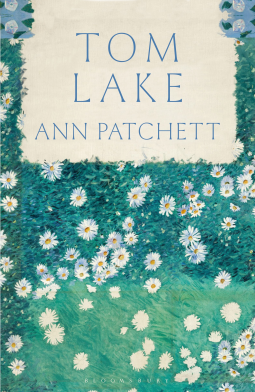
This month we’re starting with Tom Lake by Ann Patchett. I read this last year and liked it, although not as much as I hoped to. Here’s how I described it in my review:

“The title of Ann Patchett’s latest novel, Tom Lake, doesn’t refer to a person, as I’d assumed before I started reading, but to a place – a town in Michigan with a theatre overlooking the lake. One summer in the 1980s, a theatrical group gather at Tom Lake to rehearse the Thornton Wilder play, Our Town. The role of Emily has gone to Lara, a young woman who previously played that same part in a high school production. Here at Tom Lake, Lara meets and falls in love with the charismatic Peter Duke, the actor who plays her father in Our Town and who goes on to become a famous Hollywood star.

Many years later, in 2020, Lara and her husband, Joe, are living on a Michigan farm with their three adult daughters, Emily, Maisie and Nell, who have all come home to be with their parents as the Covid pandemic sweeps across the world. While they help to harvest cherries from the family orchard, the girls ask Lara to tell them about her relationship with Duke. As they listen to her story unfold, they discover things about their mother’s past that makes them reassess everything they thought they knew about her and about themselves.”

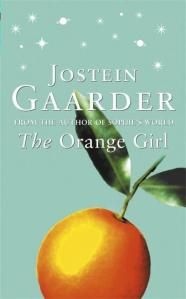
Using cherries as my first link takes me to another book featuring fruit: The Orange Girl by Jostein Gaarder (1), a novel first published in Norwegian and translated into English by James Anderson. Our narrator, a teenage boy whose father has died, reads a letter left to him by his father describing how, as a young man in 1970s Oslo, he had a series of encounters with a mysterious young woman wearing an orange dress and carrying a bag of oranges.

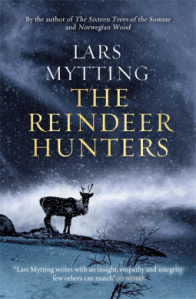
Another novel set in Norway and translated from Norwegian (this time by Deborah Dawkin) is The Reindeer Hunters by Lars Mytting (2). This is the second book in the Sister Bells trilogy about life in the remote village of Butangen where two church bells are said to have supernatural powers. I’ve just discovered that the final book, The Night of the Scourge, is being published in January next year, so that’s something to look forward to!

From reindeer hunting to fortune hunting now! Daisy Goodwin’s The Fortune Hunter (3) is the story of Empress Elizabeth of Austria (known as Sisi) and her relationship with Captain Bay Middleton, a British cavalry officer who acts as her ‘pilot’ (or guide) when she visits England for the hunting season in 1875. Bay, like Sisi, was a real person; he was a notable horseman and jockey who, in the novel, is preparing to race in the Grand National with his horse, Tipsy.

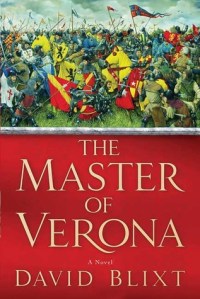
The Master of Verona by David Blixt (4) also features a horse race, in this case the Palio, the medieval race that still takes place today in Siena. The Palio is just one small part of this very entertaining novel set in 14th century Italy and inspired by both the story of Romeo and Juliet and the life of the poet Dante Alighieri. It’s the first in a series of which I’ve also read the second, but still need to finish the others.

A book with a shared word in the title is Madame Verona Comes Down the Hill (5) by Belgian author Dimitri Verhulst. This novella, translated from the original Dutch by David Colmer, is the story of a woman who lives alone in a cottage on a hill, waiting for a cello to be made from the wood of the tree from which her husband hanged himself. This is a beautifully written little book, but it wasn’t really for me.

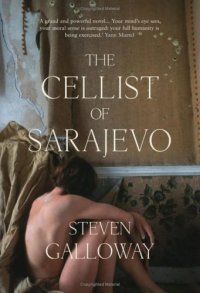
My final link is to another novel featuring cellos. The Cellist of Sarajevo (6) by Steven Galloway is set in 1992 during the Bosnian War. It tells the story of a cellist in the besieged city of Sarajevo, who plays his music in the street for twenty-two consecutive days as a message of hope and resilience.

~

And that’s my chain for March! My links have included fruit, Norway, hunting, horse races, Verona and cellos. It’s a very international chain this month, taking me from America to Bosnia via Norway, England, Italy and Belgium – and including three translated books.

In April we’ll be starting with any travel guide of our choice.

My Commonplace Book: February 2024

A selection of quotes and pictures to represent February’s reading:

commonplace book
noun
a book into which notable extracts from other works are copied for personal use.

~

Most men unconsciously judge the world from themselves, and it will be very generally found that those who sneer habitually at human nature, and affect to despise it, are among its worst and least pleasant samples.

Nicholas Nickleby by Charles Dickens (1839)

~

The way a family evolves is very organic, and to introduce a new element so abruptly is dangerous.

Sufferance by Charles Palliser (2024)

~

Blue Lias Cliffs at Lyme Regis

It irritates her when people speak of what they deserve; it’s perfectly obvious that getting what one deserves is not how life works.

The Bone Hunters by Joanne Burn (2024)

~

But perhaps I had better explain that an author’s consciousness does not work as smoothly and obediently as many people believe. Some, though not all, characters begin to dominate him, rather than the reverse. They ultimately possess him by creating their own characteristics, dictating their own movements, inventing their own habits. Creatures of the subconscious, they are conceived and grow in spite of, not because of, him.

The Undetective by Bruce Graeme (1962)

~

“What I think is a different matter. Maybe I think some rather curious things — but until thinking’s got you somewhere it’s no use talking about it.”

The Seven Dials Mystery by Agatha Christie (1929)

~

Claire Clairmont, by Amelia Curran

“If one only dared to be frank in this world and tell all one feels, how clear and comprehensible the world would become.”

Clairmont by Lesley McDowell (2024)

~

“Don’t science me, Iven. Magic’s just science we don’t understand. What if a man a thousand years ago saw one of the flying contraptions that we have winking about everywhere? He’d think it was magic.”

The Warm Hands of Ghosts by Katherine Arden (2024)

~

Being a child is about innocence, about not knowing the realities that adults deal with every day.

Doomed Romances: Strange Tales of Uncanny Love by various authors (2024)
Quote from Could You Wear My Eyes? by Kalamu ya Salaam

~

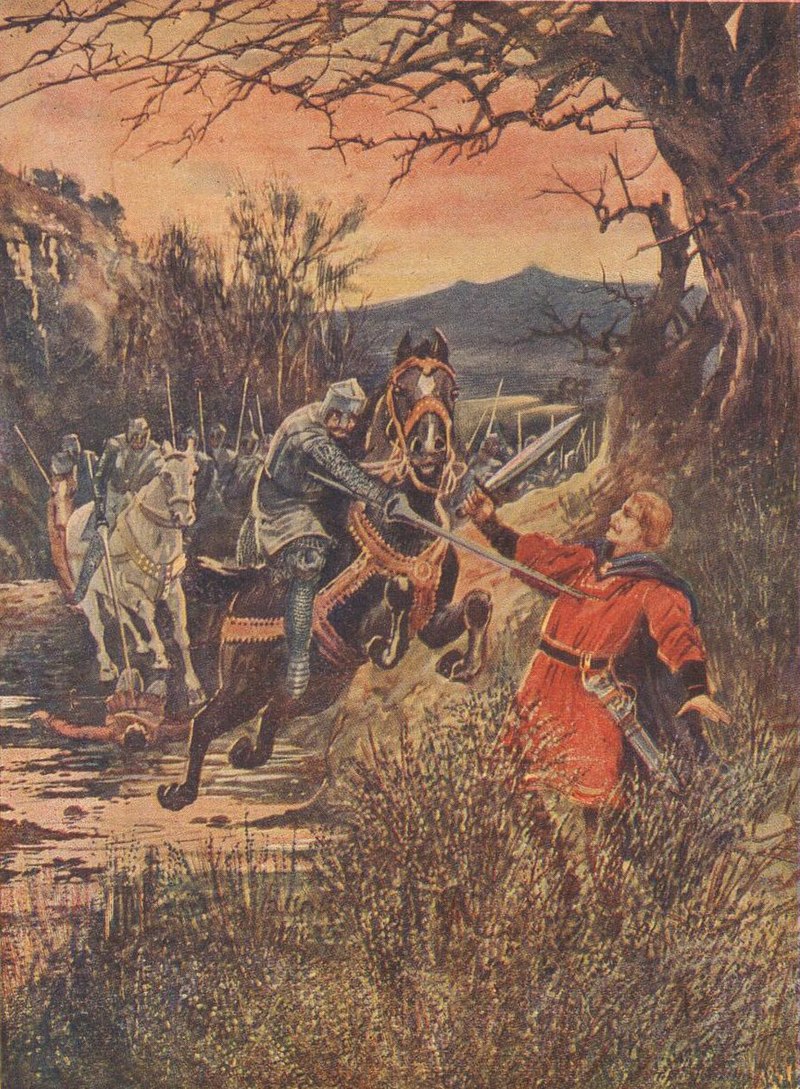
Death of Llewelyn, National Library of Wales

“I’ll admit that my garden now grows hope in lavish profusion, leaving little room for anything else. I suppose it has squeezed out more practical plants like caution and common sense. Still, though, hope does not flourish in every garden, and I feel thankful it has taken root in mine.”

The Reckoning by Sharon Penman (1991)

~

What is family? An anchor which holds us in place. It holds us secure in a storm. It holds us back in fair weather. It is a blessing and a burden – for the young, especially, and for those who seek freedom.

One of life’s astonishing moments is when we realise that we have suddenly become that anchor.

The Life of Rebecca Jones by Angharad Price (2002)

~

Favourite books read in February:

The Undetective, The Reckoning, Sufferance and The Warm Hands of Ghosts

Authors read for the first time in February:

Joanne Burn, Bruce Graeme, Lesley McDowell, Angharad Price, Ella D’Arcy, Alice Perrin, Nalo Hopkinson, Kalamu Ya Salaam, Tracy Fahey, V. Castro (last six all from Doomed Romances)

Places visited in my February reading:

England, Switzerland, France, Russia, Canada, Belgium, Wales, India, Jamaica, the Pacific

~

February reading notes: February was a good, varied month of reading for me. I read a Victorian classic, a short story collection, some classic crime, an Agatha Christie thriller, some historical fiction and three books that counted towards #ReadIndies month (as well as the British Library, I was pleased to be able to highlight two much smaller publishers, Bellows Press and Moonstone Press). In March, I’m hoping to take part in Reading Ireland and Reading Wales – in fact, I’ve already made a start! I also want to read at least one or two of the books from the recently announced Walter Scott Prize longlist.

How was your February? Do you have any plans for your March reading?

Doomed Romances: Strange Tales of Uncanny Love edited by Joanne Ella Parsons – #ReadIndies

This new short story collection, Doomed Romances: Strange Tales of Uncanny Love, is part of the British Library’s Tales of the Weird series. These books have been around for a few years now but I’ve let them pass me by as I’ve had enough to read with their Crime Classics series! I’m glad I’ve finally found time to try one as although this collection is a bit uneven I did find it entertaining.

The book contains twelve stories by different authors and includes an introduction by the editor, Joanne Ella Parsons. The stories were originally published between 1833 and 2022 and appear here in chronological order. All have a ‘doomed romance’ theme, with some being much darker than others. There are two that I’ve actually read before – one of them is Sheridan Le Fanu’s lesbian vampire novella, Carmilla, and the other is Angela Carter’s The Lady of the House of Love, also a vampire story, first published in The Bloody Chamber. I didn’t read Carmilla again as I just read it fairly recently, but I did re-read the Carter and was impressed again by the beautiful imagery and the atmospheric Gothic setting she creates.

The oldest story in the book is Mary Shelley’s The Invisible Girl, in which the narrator, out walking along the coast of Wales, finds a painting of a beautiful woman hanging on the wall inside a ruined tower. It was good to have the opportunity to try more of Shelley’s work, having only read Frankenstein so far, but I didn’t find this a particularly strong story. Two that I did enjoy were The Little Woman in Black by Mary Elizabeth Braddon and One Remained Behind by Marjorie Bowen. These are also authors I’ve read before; Braddon is a favourite Victorian author of mine and has a very readable writing style. Her story seemed as if it was heading in one direction, but then surprised me with an ending I wasn’t expecting at all! Bowen was a very prolific author of historical novels and supernatural tales – the story in this collection is a ghost story from 1936 and one of the highlights of the book for me.

Joanne Ella Parsons has clearly tried to include stories with a wide range of geographical settings, exploring different cultures, rather than just sticking with more traditional Gothic stories. Wilkie Collins, another Victorian author I usually enjoy, is represented here with Mr Captain and the Nymph, in which a ship’s captain lost on an unidentified Pacific island falls in love with the daughter of a local priest. It’s an interesting story, although not a good example of his best work. Alice Perrin’s The Tiger-Charm is set on safari in India, while Nalo Hopkinson’s The Glass Bottle Trick transposes the famous Bluebeard folktale to a Caribbean setting. The latter are two new authors for me and I found both stories entertaining, but I’m not sure if I would search out more of their work based on these.

Another highlight was Could You Wear My Eyes? by Kalamu ya Salaam, where a man whose wife has died agrees to have her eyes inserted into his face after her death, allowing him to see life from her perspective. It’s a strange story but a fascinating one! The collection is completed with another 19th century story, Ella D’Arcy’s White Magic, and two contemporary ones, I’ll Be Your Mirror by Tracy Fahey and Dancehall Devil by V. Castro.

Doomed Romances is a real mixed bag, then – there are some very strong stories and some much weaker ones, and including Carmilla seemed an odd decision to me, as it’s so much longer than any of the other stories and made the book feel unbalanced. I enjoyed the collection overall, though, and will probably consider reading more of them.

British Library Publishing publish a range of fiction and non-fiction including the Tales of the Weird, Crime Classics and Women Writers series. They are an independent publisher, so I’m counting this book towards #ReadIndies month, hosted by Kaggsy’s Bookish Ramblings and Lizzy’s Literary Life.

The Walter Scott Prize Longlist 2024

The longlist for the 2024 Walter Scott Prize for Historical Fiction has been announced today! Thanks to this prize, I have discovered lots of great books and authors and always look out for the longlists and shortlists; in fact, trying to read all of the shortlisted titles since the prize began in 2010 is a personal project of mine (you can see my progress here).

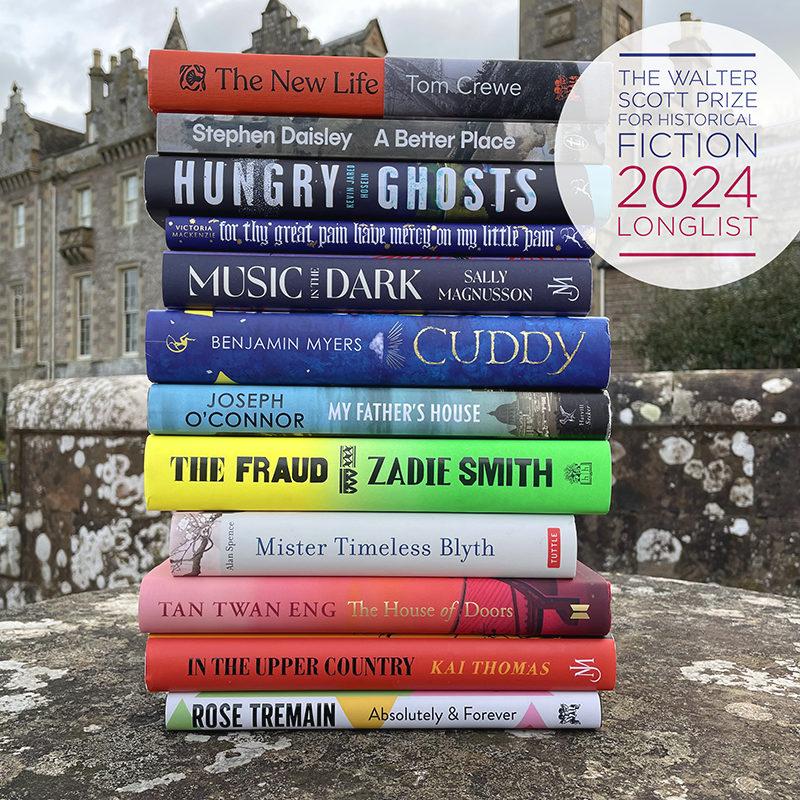
There are twelve books on this year’s longlist and here they are:

The New Life by Tom Crewe (Chatto & Windus)

A Better Place by Stephen Daisley (Text Publishing)

Hungry Ghosts by Kevin Jared Hosein (Bloomsbury)

For Thy Great Pain Have Mercy on My Little Pain by Victoria MacKenzie (Bloomsbury)

Music in the Dark by Sally Magnusson (John Murray)

Cuddy by Benjamin Myers (Bloomsbury)

My Father’s House by Joseph O’Connor (Harvill Secker)

The Fraud by Zadie Smith (Hamish Hamilton)

Mister Timeless Blyth by Alan Spence (Tuttle)

The House of Doors by Tan Twan Eng (Canongate)

In the Upper Country by Kai Thomas (Penguin Canada)

Absolutely and Forever by Rose Tremain (Chatto & Windus)

~

I’m delighted to see Cuddy on the longlist as I read it just a few weeks ago and predicted that it could be nominated. I’ve also read three others – Music in the Dark, For Thy Great Pain Have Mercy on My Little Pain and My Father’s House – and I’m not surprised to see any of these on the list either. Of those three, I particularly enjoyed My Father’s House. The Zadie Smith, Tan Twan Eng and Rose Tremain were already on my radar, but I’m not familiar with any of the others. Lots to investigate!

Have you read any of these books? Which do you think should win the prize?

The shortlist will be announced in May and the winner will be revealed in June at the Borders Book Festival in Melrose.

Nicholas Nickleby by Charles Dickens

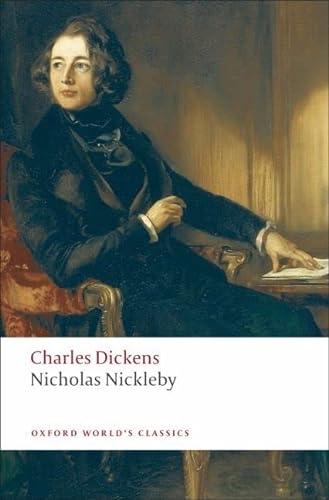
Nicholas Nickleby was the book chosen for me to read in the Classics Club Spin back in October 2023. It has taken me until now to finish it, partly because it’s a book with over 800 pages and also because I started to find it a bit tedious halfway through and kept putting it aside to read something else. I’m sorry to have to say that, as I know a lot of people consider it a favourite and I really did want to love it, but I just couldn’t. However, I did still find a lot to like, so I certainly don’t feel that I wasted my time reading it!

Originally published as a serial from 1838 to 1839, this is one of Dickens’ earliest novels and is very episodic, lacking any real overarching plot, (which I think is probably one of the reasons I had problems staying engaged with it – and the reason I have so far been avoiding The Pickwick Papers!). Therefore it’s difficult to give a summary, but I think all you really need to know is that at the beginning of the book Nicholas Nickleby’s father dies, leaving Nicholas, his mother and his sister Kate penniless and dependent on Uncle Ralph for support. Ralph is a rich but cold, uncaring man who has little compassion for his late brother’s wife and children. He finds Nicholas a low-paid position as an assistant at Dotheboys Hall, a grim and unpleasant school in Yorkshire, while Kate remains under his own ‘protection’ in London…

The most compelling part of the novel, I thought, was the section set at Dotheboys Hall, where Nicholas finds himself working for the evil Wackford Squeers, who claims to be a ‘schoolmaster’, although it quickly becomes obvious that the establishment he is running is not so much a school as a home for unwanted, neglected boys and that Squeers treats them harshly, starving and beating them. Dickens always includes a lot of social commentary in his novels and here he is clearly drawing attention to the terrible conditions found in 19th century boarding schools; apparently he personally visited Yorkshire in early 1838 to do some background research. It’s interesting to compare his portrayal of Dotheboys to Charlotte Brontë’s Lowood School in Jane Eyre. I was sorry that this only formed a relatively small portion of the novel, although it’s important not only for the social history, but also because it introduces Smike, a frail, badly abused young man whom Nicholas rescues from the school and who becomes his loyal friend and the heart of the most emotional scenes in the book.

I also enjoyed the episode where Nicholas, having fled Yorkshire, travels to Portsmouth and joins an acting troupe, run by the actor-manager Vincent Crummles. A lot of time is devoted to introducing the other members of the company – including Crummles’ daughter, the ‘Infant Phenomenon’, who has been acting in child roles for so long she can’t possibly still be an infant! – and although none of this really has much relevance to the rest of the book, I always like theatrical settings so I found it entertaining. Unfortunately, there were other subplots and characters that didn’t interest me at all, such as the Kenwigs family, Mr Lillyvick and Miss Petowker, and the implausibly saintly Cheeryble brothers. This is a book where the good characters are very good and the bad ones are very bad – although Uncle Ralph at least does have some nuance. I liked both Kate and Nicholas (who definitely fall into the ‘good’ category) and while Dickens isn’t really known for writing strong female characters, Kate is more sensible than some of his others.

This hasn’t become a favourite Dickens, then, but I’m still pleased to have read it! Now I can move on to my next Classics Club Spin book, The Trumpet-Major by Thomas Hardy.

This is book 42/50 read from my second Classics Club list.

The Seven Dials Mystery by Agatha Christie

The theme for the 2024 Read Christie challenge is Agatha Christie: Through the Decades and for the first quarter of the year we are reading books from the 1920s. In January I read The Secret of Chimneys (1925), so this month it made sense to read The Seven Dials Mystery, which was published four years later in 1929 and is loosely a sequel. I say ‘loosely’ because although this book features some of the same characters and is set at the same country house – Chimneys – it’s a completely separate mystery.

The Seven Dials Mystery begins with a house party being held at Chimneys while the house is being rented out to Sir Oswald and Lady Coote. The guests include a group of young people, one of whom, Gerry Wade, has a habit of sleeping very late in the mornings. As a joke, his friends hide eight alarm clocks in his room during the night, timed to go off one after another in the morning. However, things don’t go according to plan and the clocks fail to wake Wade…because he is already dead. The cause of death is thought to be an accidental overdose of a sedative, but how does that explain why there are now only seven alarm clocks in the bedroom instead of eight?

When Lord Caterham, the owner of Chimneys, returns home and hears the news, he is not at all pleased. “I don’t like anyone who comes and dies in my house on purpose to annoy me,” he says. His daughter, Lady Eileen, on the other hand, is more sympathetic, particularly when she discovers that she knows some of the people involved – and it’s not long before she has become involved herself. Lady Eileen – known as ‘Bundle’ to her friends and family – is on her way to London the next day when a man jumps into the road in front of her car. He has time to utter the words Seven Dials before dying of a gunshot wound. What or where is Seven Dials and is there some connection with the seven clocks found in Gerry Wade’s bedroom? Bundle is determined to find out!

This book has a very similar feel to The Secret of Chimneys and although it had seemed like a good idea to read them in consecutive months for the challenge, in hindsight I think I should have left a bigger gap and chosen something different for this month. Still, it was nice to meet Bundle again, who only played a small part in Chimneys but was much more prominent in this book. Superintendent Battle is also back again, but it’s really Bundle who is the ‘detective’ in this novel and she’s a very likeable one!

I didn’t manage to solve the mystery – if there were any clues pointing towards the culprit I must have missed them – but this is really more of a thriller than a conventional mystery novel anyway and I was content just to follow the twists and turns of the plot. There’s a secret society element that reminded me very much of GK Chesterton’s The Man Who Was Thursday, which I’m sure Christie must have read and been inspired by. It’s an entertaining novel but I think my next Read Christie book will be a mystery rather than another thriller.