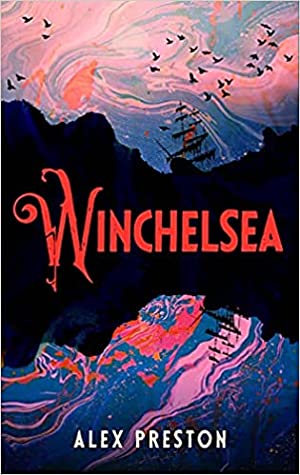
Winchelsea by Alex Preston

John Meade Falkner’s Moonfleet is a book I’ve been intending to read for a few years now – it’s on my Classics Club list – and I should probably have done so before picking up Winchelsea, a novel described by its author as “Moonfleet for grown-ups”. I often seem to do these things the wrong way round!

The novel takes its title from the seaside town of Winchelsea in East Sussex where the story is set. Our heroine, Goody Brown, rescued from drowning as a baby, is the adopted daughter of the physician Ezekiel Brown and his French wife, Alma. Goody has had a happy childhood and has grown to love her adoptive parents and her brother Francis, another adopted child, but in 1742, when she is sixteen years old, her life changes forever. Ezekiel, as well as being the town’s doctor, serves as ‘cellarman’ to a gang of smugglers, helping them to store their goods out of sight in the tunnels below the cliffs. When things go wrong and Ezekiel is murdered in the night by the gang, Goody and Francis begin to plot their revenge.

On the one hand, Winchelsea is a good old-fashioned adventure story, featuring not just smugglers but also pirates, espionage, political intrigue – yes, it’s the 1740s so the Jacobites and Bonnie Prince Charlie make an appearance – and all sorts of other swashbuckling escapades. On the other, it explores issues that the older novels it imitates would have swept over or not tackled at all, such as race (Goody’s adoptive brother escaped from a slave ship and is the only person in Winchelsea with dark skin) and gender (a cross-dressing storyline with a character who feels most comfortable ‘neither as woman nor man’). This mix of 18th century history and characters with 21st century sensibilities didn’t quite convince me, but other readers might enjoy seeing a modern take on an old story. The language was generally appropriate for the 1740s setting, anyway!

Goody’s name puzzled me slightly because it was historically a shortened form of Goodwife used to address older married women; it seemed a strange name to give a child. I suppose there’s no reason why it couldn’t be used as a first name as well. Most of the novel is written in the first person from Goody’s perspective and she’s a very engaging narrator. Later, two other characters take their turn to tell part of the story and although I found the change in narrators jarring at first, I soon settled into reading from a different point of view and I think the structure of the book was quite effective.

The best thing about Winchelsea, in my opinion, was the depiction of Winchelsea itself – the coastal landscape, the houses with large cellars, the underground network of tunnels known as the ‘Under-Reach’ – and nearby Rye and Romney Marsh. I haven’t read Russell Thorndike’s classic adventure novel Dr Syn: A Tale of the Romney Marsh, but I suspect that was another of Alex Preston’s influences.

Although this book wasn’t a complete success with me, it did keep me entertained for a while and I will try to read Moonfleet sooner rather than later!

This is book 25/50 read for the Historical Fiction Reading Challenge 2022.
My Commonplace Book: May 2022

A selection of words and pictures to represent May’s reading:

commonplace book
noun
a book into which notable extracts from other works are copied for personal use.

~

Sometimes the decisions of our lives, decisions affecting many lives in some cases, are made after reflection, conversation, correspondence, sleepless nights, the weighing of disparate elements amid doubt and uncertainty. Sometimes they come in a moment at a window, looking out on a springtime day.

All the Seas of the World by Guy Gavriel Kay (2022)

~

But with them went deference and courtesy, fidelity and faith, a belief in man’s work and the pride that goes hand in hand with that belief. These fundamental standards wove the pattern of a Victorian day, and the writers and artists of that day became part of the pattern and echoed it in print or upon canvas, stamping it with their individuality, their own genius, creating an era that was at once warm and colourful and prosperous, an age away from our present world of meagre mediocrity.

The Rebecca Notebook: and Other Memories by Daphne du Maurier (1981)

~

Lyudmila Pavlichenko

Because people love war heroes…but even in my own beloved homeland, war heroes are supposed to be clean and uncomplicated. Those urging me to write my memoir will want a patriotic young woman who fought to defend her country, a heroine to root for with a story clean and simple as a full moon – and I was that young woman, but I was more. My moon had a midnight side.

The Diamond Eye by Kate Quinn (2022)

~

‘Once you meet Miss Talbot, I’m sure you’ll adore her,’ Lady Radcliffe said reassuringly. ‘We all do – even Dottie.’

‘I’m sure I would like very much to meet her,’ he said quite affably, although inside, the flames of suspicion had been fanned. And after all, though Dottie was a discerning judge of character and admittedly difficult to impress, Dottie was also a cat.

A Lady’s Guide to Fortune-Hunting by Sophie Irwin (2022)

~

“My friend, in working upon a case, one does not take into account only the things that are “mentioned”. There is no reason to mention many things which may be important. Equally, there is often an excellent reason for not mentioning them.”

The Murder on the Links by Agatha Christie (1923)

~

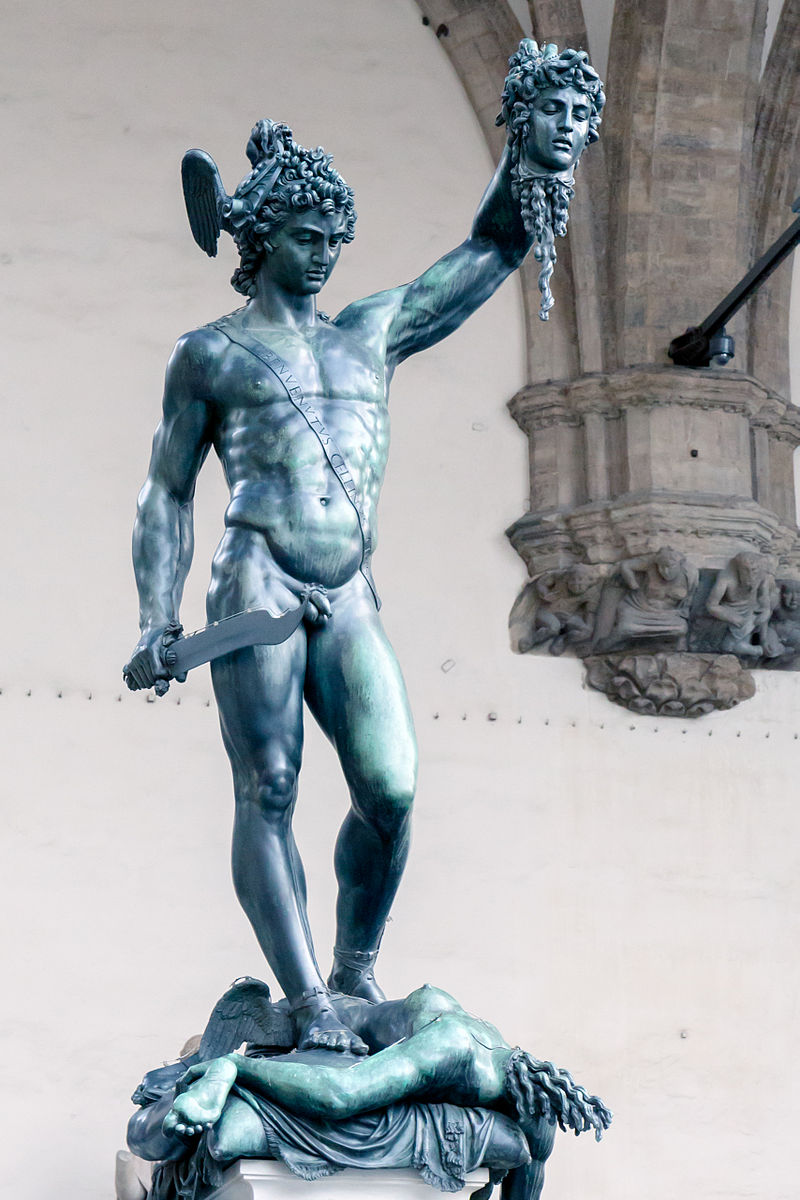
Perseus with the head of Medusa, (Benvenuto Cellini)

And while I am all in favour of using precision to describe something, might I suggest that you would be better off not doing something so dangerous so often that you need a specific word for it? Perhaps develop your self-control, rather than your vocabulary.

Stone Blind by Natalie Haynes (2022)

~

But there are temptations which it is not in the power of human nature to resist, and few know what would be their case if driven to the same exigencies. As covetousness is the root of all evil, so poverty is, I believe, the worst of all snares.

Moll Flanders by Daniel Defoe (1722)

~

Guilt was what kept you awake in the middle of the night or, if you managed to sleep, poisoned your dreams. Guilt intruded upon any happy moment, whispering in your ear that you had no right to pleasure. Guilt followed you down streets, interrupting the most mundane moments with remembrances of days and hours when you could have done something to prevent tragedy but chose to do nothing.

All the Broken Places by John Boyne (2022)

~

Favourite books read in May:

The Lady’s Guide to Fortune Hunting, Stone Blind and All the Broken Places

Places visited in my May reading:

England, US, Russia, France, Australia, Greece

Authors read for the first time in May:

Sophie Irwin

~

Reading notes: I haven’t read as many books in May as in previous months, but I still managed to take part in Daphne du Maurier Reading Week and Read Christie 2022, as well as getting ahead with some upcoming NetGalley reads. Tomorrow is the first day of this year’s 20 Books of Summer challenge (you can see my list here). Let’s see whether I can actually complete the challenge this time; I have my first book, Fortune by Amanda Smyth, ready to start!

How was May for you? What are you planning to read in June?

Moll Flanders by Daniel Defoe

This 1722 classic by Daniel Defoe is not a book I was planning to read this year, if at all; I’m not really a fan of 18th century literature (I prefer the Victorians) and I should really be concentrating on the classics on my Classics Club list anyway. Then I noticed that it was being serialised by Pigeonhole in daily instalments and I was tempted – although I ended up just reading it on my own, at my own pace. Although it’s not a particularly long book (by 18th century standards), my progress through it was very slow at first, until I hit a point somewhere near the middle where I became more engaged with the story and then flew through the rest of it.

Considering that this is one of the very earliest novels in the English language, it’s surprisingly readable, although like other early authors, Defoe never uses one word if he can use fifty and doesn’t bother with things like chapter breaks either. However, with a bit of concentration it’s easy enough to follow what is happening and I certainly found reading this book a more enjoyable experience than, for example, Samuel Richardson’s Clarissa!

It’s difficult to know how much I can say about the plot without spoiling it. I find that publishers of classic novels often give away too much on the back cover or in an introduction, but in my reviews I prefer to treat them like any other book and assume that readers know nothing about the story and don’t want me to tell them exactly what’s going to happen. Having said that, the full title of this particular novel, along with Defoe’s own preface, do give quite a detailed outline of the plot, so be aware!

I think I can safely tell you that our narrator, Moll Flanders (not her real name, but one she is given much later on), is born in Newgate Prison to a woman who is convicted of theft and transported to Virginia, leaving Moll to be raised by a foster mother. What follows is the story of Moll’s ‘fortunes and misfortunes’ as she reaches adulthood, has several marriages (some happy and some disastrous), gives birth to many children, most of whom are never mentioned again, falls into poverty and is drawn into a life of crime. Although Moll does some terrible things, whether she is driven to this by necessity or whether she could have chosen a different path is open to interpretation. Either way, she never quite loses her compassion and sense of humour and you can’t help but hope that she’ll find some happiness in the end.

What is certain is that the world Moll lives in is not an easy one for an unmarried, working class woman to navigate. It’s not hard to see why she places so much importance on finding a rich husband and why, when for one reason or another each marriage fails, she searches for other ways to survive. I found it interesting that Defoe chose to write a novel like this, from a female perspective, and that, although there’s obviously a moral to the story, he did seem to have a lot of sympathy with Moll’s situation. It’s also interesting that the novel is actually set in the 17th century rather than the 18th, something I hadn’t even been aware of until I came to the end where we are told that Moll had written this account of her life in the year 1683, at the age of around seventy.

Although I can’t say that I loved this book or that it’s become a favourite classic, I’m pleased I’ve read it. Maybe I’ll read something else by Daniel Defoe one day, but first I really need to concentrate on finishing my Classics Club list!

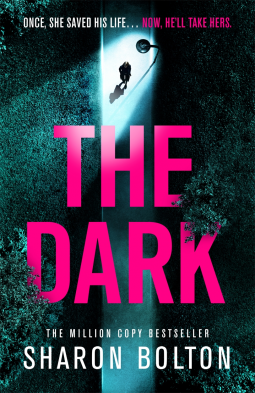
The Dark by Sharon Bolton

She’s back! After an eight year absence – during which time Sharon Bolton has written several excellent standalone crime novels – Lacey Flint has returned in possibly her darkest and most dangerous case yet. It’s the fifth book in the series and after such a long wait, I’m pleased to report that I think it’s as good, maybe even better, than the previous four.

In The Dark, Lacey is still working as a police constable for the Metropolitan Police Marine Unit, not yet ready to consider going back to her old role as a detective. When a baby is snatched from its parents and thrown into the River Thames, Lacey is there to prevent a tragedy, but the incident leaves the police and the public shocked and confused. Who would want to harm an innocent baby? They don’t have to wait long for an answer; it soon emerges that the attack was carried out by a newly formed terrorist group calling themselves MenMatter. The group believe that men’s rights are being pushed aside and that women’s freedoms need to be restricted so that ‘natural order’ can be restored. The abduction of the baby was just the first of several terrorist attacks aimed at gaining publicity for their cause.

As DCI Mark Joesbury and his team at the London Met race against time to discover who is behind MenMatter, on the streets of London tensions between men and women begin to grow. It seems the terrorists are succeeding at creating fear and division; nobody is safe, but with her heroics on the river Lacey appears to have made herself a particular target. As she and Joesburys’ team try to identify the leaders of the group, Lacey discovers that her own secrets are at risk of being exposed. Can she help bring the criminals to justice while also ensuring that Joesbury never learns the truth about her past?

The Dark has a very topical plot; I’m sure it must have been inspired by the debate surrounding the murder of Sarah Everard in the UK last year, when questions were raised over the safety of women on the streets, as well as other 21st century policing problems such as the use of the dark web to plan and launch terrorist attacks and the growing online community of ‘incels’ (involuntary celibates). The scenarios Bolton describes seem almost dystopian but also frighteningly believable and possible. However, she doesn’t try to paint all men as misogynistic or violent and fans of the series will be pleased to know that Mark Joesbury is as wonderful as ever!

As well as some heart-stopping dramatic sequences which really made me fear for some of the characters’ lives, the novel also has a mystery element, with the police trying to uncover the identity of the incel leader behind the attacks. I had my suspicions and was proved to be correct, but that didn’t take away any of the tension as I waited to see when Lacey and the others would come to the same conclusion! It was particularly fascinating to watch Georgie, one of Joesbury’s team, use her knowledge of psychology and language patterns to form theories about online identities.

Of course, one of the highlights of the Lacey Flint series is Lacey Flint herself! In this book, Lacey’s secretive nature makes her particularly vulnerable and leads her to make some decisions that at first seem stupid and reckless but are actually the result of her desperation to conceal the truth about her troubled past. I wonder if this really is the last book in the series this time; it has quite a satisfying ending but there are still plenty of loose ends that haven’t been tied up and I would love to read more. On the other hand, I also love Sharon Bolton’s standalones so will be very happy to read whatever she writes next!

If you’re new to this series, you might like to start with the first book – Now You See Me.

Thanks to Orion for providing a copy of this book for review via NetGalley.

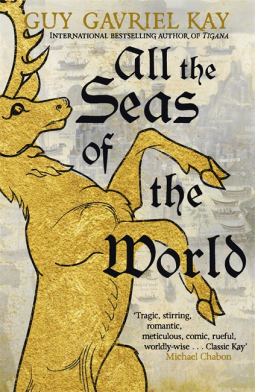
All the Seas of the World by Guy Gavriel Kay

Guy Gavriel Kay’s new novel is set in the same world as his previous two, Children of Earth and Sky and A Brightness Long Ago, but although the three books are closely linked, they are separate stories and I’m sure you could read this one as a standalone if you wanted to.

The world to which I’ve just referred is a fictional world which closely resembles the area surrounding the Mediterranean during the 15th century. Countries and cities are given different names (Italy becomes Batiara, Spain is Esperaña, Venice is Seressa) and the characters belong to one of three religions which clearly correspond to the main three religions in that part of the world at that time. The Asharites (Muslims) worship the stars, the Jaddites (Christians) worship the sun and the Kindath (Jews) worship the two moons, one blue and one white, which both shine in the sky. This third novel is set just after the Jaddite city of Sarantium has fallen to the Asharite Osmanlis, who have renamed it Asharias – like our own world’s Constantinople which fell to the Ottoman Empire in 1453 and would become Istanbul.

Some of the characters we met in A Brightness Long Ago appear again in this book, but the focus is mainly on two new characters. First, there’s Lenia Serrano, a young woman who was abducted by Asharite raiders as a child and raised as a slave. Now free, she longs to return home to Batiara but, convinced that her years in slavery will have brought shame upon her family, home is the one place she’s determined to avoid. Rafel ben Natan, our other protagonist, is a Kindath merchant whose family fled persecution in Esperaña some years earlier. Rafel’s brother has disappeared without trace, leaving Rafel responsible for his sister-in-law and her children.

As the novel opens, Lenia and Rafel have been hired by two pirate brothers to carry out the assassination of the khalif of Abeneven. Their decision to accept this assignment brings them life-changing wealth, but also has huge consequences for the balance of power between rival states, bringing the world to the brink of war.

Some readers may be put off by the labelling of Kay’s novels as ‘fantasy’, but other than the alternate names for people, places and religions, and one or two very subtle supernatural elements, this book (like most of his others) is much closer to historical fiction than it is to traditional fantasy. Setting his story in a thinly-disguised version of Renaissance Europe gives Kay an opportunity to explore that period of history while being freed from the constraints of having to stick to historical fact. However, in this particular book, there are also some obvious parallels with today’s world; exile and displacement are major themes, with various characters being forced to leave their own countries because of war, persecution or other reasons and then either searching for somewhere new to make their home or trying to find a way to return.

This is a beautifully written novel, but I do think Kay’s writing style is probably a bit of an acquired taste. Much as I like his books, I’m starting to find his habit of going off on tangents to explore the lives of minor characters and the heavy messaging around choices and the consequences of our actions very repetitive. These most recent books are not his best, in my opinion – his earlier ones seemed to have stronger plots and a tighter focus, so if you’re new to his work I would recommend starting with one of those; Tigana is my favourite and The Lions of Al-Rassan is also very good (and set in this same two-mooned world several centuries earlier). Readers who’ve already enjoyed some of his other historical fantasy novels should enjoy this one too; I did and am looking forward to reading the remaining ones I still haven’t read.

Thanks to Hodder & Stoughton for providing a copy of this book for review via NetGalley.

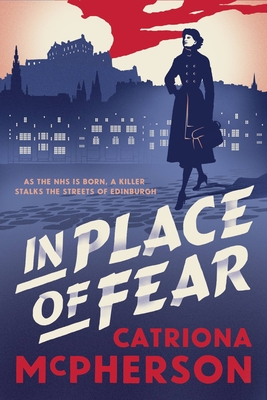
In Place of Fear by Catriona McPherson

Catriona McPherson is an author I’ve wanted to try for a while; I keep seeing her books on other blogs I follow and they always sound interesting. Her latest novel, In Place of Fear, turned out to be a good one for me to start with; it’s a fascinating historical mystery set in Edinburgh just after World War II.

It’s 1948 and Helen Crowther is about to start a new job as medical almoner for the newly formed National Health Service. Working alongside two doctors, Dr Deuchar and Dr Strasser, Helen will be making home visits to patients, giving them advice and ensuring that they get the help they need – a role similar to a modern-day social worker. She’s looking forward to the new job, but at the same time she knows there are going to be difficulties: first of all, she will have to convince the disbelieving public that healthcare under the new NHS really is free and they no longer need to worry about paying for their treatment; she also has to contend with the disapproval of her mother, who wishes she would get a job in a factory like other working class women. It comes as a relief when Dr Strasser offers Helen the upstairs flat in an empty building he owns, so that she and her husband, Sandy, can move out of her parents’ overcrowded house at last.

Helen’s marriage has not been a particularly happy one so far; Sandy has spent several years in a POW camp and since returning to Scotland has been struggling to cope with married life. Helen hopes the situation will improve now that they can be alone together, but just as she and Sandy are beginning to settle into their new home, she discovers the body of a young woman in the air raid shelter in the garden! The doctor is summoned and after examining the body he decides that it was suicide, but Helen is not convinced. Who is this young woman and how did she die? Helen is determined to find out, even though everyone else seems equally determined to cover up what has happened.

The mystery aspect of this novel takes a while to get started and never really becomes the main focus of the book until near the end when Helen begins to uncover some secrets that have remained hidden for several years. However, I thought it was a very intriguing mystery and although I had my suspicions as to who the culprit might be, I was unable to guess the other parts of the solution. Looking at other reviews of the book, it seems that a lot of readers were disappointed that the crime element wasn’t stronger but this didn’t really bother me as I was finding it so interesting to read about life in 1940s Edinburgh and the beginnings of the NHS. There’s also a heavy use of Scottish dialect which I suppose people will either like or they won’t, but I thought it added to the strong sense of time and place and I found it easy enough to follow what was being said.

A lot of time is spent on Helen’s visits to people in the community, particularly young mothers and those who are hoping to become mothers, so that she can advise them on diet and hygiene and make sure they are receiving the medical care they’re entitled to. I wasn’t familiar with the role of medical almoners before reading this book, so I found it fascinating to learn about what the job involved. Before 1948, the almoner would assess patients to decide how much they could afford to pay, but with the birth of a health service that was ‘free at the point of use’ this became unnecessary and the almoner could devote more time to actually helping the patients with their medical and welfare needs. However, Helen sometimes goes above and beyond what is required and sometimes she makes mistakes or is seen as interfering in things that are none of her business. It was watching her going about her daily work and trying to decide how to handle each difficult situation that I found particularly enjoyable, so it didn’t matter to me that the mystery was so slow to develop.

I would like to try more of Catriona McPherson’s books. If you’ve read any of them, please let me know which one I should read next!

Thanks to Hodder & Stoughton for providing a copy of this book for review via NetGalley.

This is book 24/50 read for the Historical Fiction Reading Challenge 2022.
20 Books of Summer – 2022

20 Books of Summer, hosted by Cathy at 746 Books, is a very simple idea: make a list of twenty books (there are also ten and fifteen book options) and read them during the summer months. However, it’s much more difficult than it sounds; I have taken part for the last five years and have never managed to complete it. I do usually read twenty books during the three month period – just not the twenty that were on my list! I should probably allow myself more flexibility and take advantage of the rule that says we can change our list halfway through.

This year’s 20 Books of Summer starts on Wednesday 1st June and finishes on Thursday 1st September. I have listed below the books I would like to read. These are a mixture of review copies from NetGalley, books from my Classics Club list, books for the Read Christie 2022 challenge (I’m planning to join in with the July and August Christies, but not the June one) and other books that have been waiting on my shelf for a long time.

~

1. Godmersham Park by Gill Hornby
2. The Colour Storm by Damian Dibben
3. Death on Gokumon Island by Seishi Yokomizo
4. At Bertram’s Hotel by Agatha Christie
5. Haven by Emma Donoghue
6. Pied Piper by Nevil Shute
7. Shadows and Strongholds by Elizabeth Chadwick
8. Death in the Andamans by MM Kaye
9. Summerhills by DE Stevenson
10. Fortune by Amanda Smyth
11. The Mirror and the Light by Hilary Mantel
12. A Pin to See the Peepshow by F Tennyson Jesse
13. Destination Unknown by Agatha Christie
14. The Fortune Men by Nadifa Mohamed
15. Excellent Intentions by Richard Hull
16. The Rose of Sebastopol by Katharine McMahon
17. Fool’s Quest by Robin Hobb
18. The Wolf Den by Elodie Harper
19. Something Light by Margery Sharp
20. The Flight Portfolio by Julie Orringer

~

Have you read any of these? Which should I read first? And are you taking part in 20 Books of Summer this year?