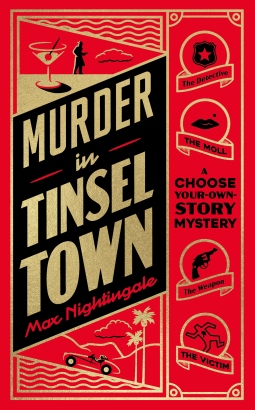
Murder in Tinseltown by Max Nightingale

I used to love Choose Your Own Adventure books as a child – who else remembers them? – so when I saw this new adult version of the same concept, I couldn’t wait to read it. Murder in Tinseltown is set in Los Angeles in the 1950s and the reader takes on the role of a detective investigating the murder of an actress. At various points in the story you’ll have the opportunity to choose your own actions and decide what happens next, either by turning to different numbered pages or, in the Kindle edition I read, simply clicking on a link.

You start your adventure at LAPD headquarters on the weekend of the Golden Star Awards when some of Hollywood’s biggest stars have descended on the city. It’s a busy day in the squad room, but when a disturbing call comes through from the Royal Premiere Hotel – “Trouble…hurt…not my fault…help…it’s them…I’m sorry…” – you head straight to the hotel to investigate. You arrive just in time to learn that one of the waiters has discovered Blanche Aikerman, probably the world’s most famous actress, stabbed to death in her room. After witnessing the dead body for yourself, you accompany the hotel manager to the suite of Peter von Hiltz, Blanche’s director, to give him the news. However, he doesn’t answer the door. What will you do next?

This is where the interactive part of the novel begins. Will you ask the manager to let you into von Hiltz’s room? Will you return to the crime scene to look for more clues? Or would you prefer to interview the waiter who found the body? Each option takes you to a different location in the book and the story continues from there until you reach another turning point and are presented with a new set of choices. It could and should have been a lot of fun working through the book and trying to solve the mystery – unfortunately, there were some problems with the structure which made the whole experience less satisfying than I’d hoped.

Maybe there was one route I could have followed through the novel where the story would have flowed perfectly, but surely somebody should have checked that all of the other possible routes also made sense. Early on, I saw a character die right in front of my eyes at an airport – then I returned to the hotel, where that same character was still walking around alive and well as if nothing had happened. Similarly, I found the murder weapon and then someone else found it again later in the book. Looking at other reviews, it seems that most of us noticed those same two things so I’m not sure how they weren’t picked up on by the author or an editor. Also, there are several outcomes where you die, but instead of the book ending as you would expect, you just come straight back to life and are directed to the ‘correct’ option so the story can continue.

From a nostalgia perspective, it was nice to have the opportunity to read a book like this, but I’m disappointed that it didn’t work as well as it could have done.

Thanks to HarperNorth for providing a copy of this book for review via NetGalley.

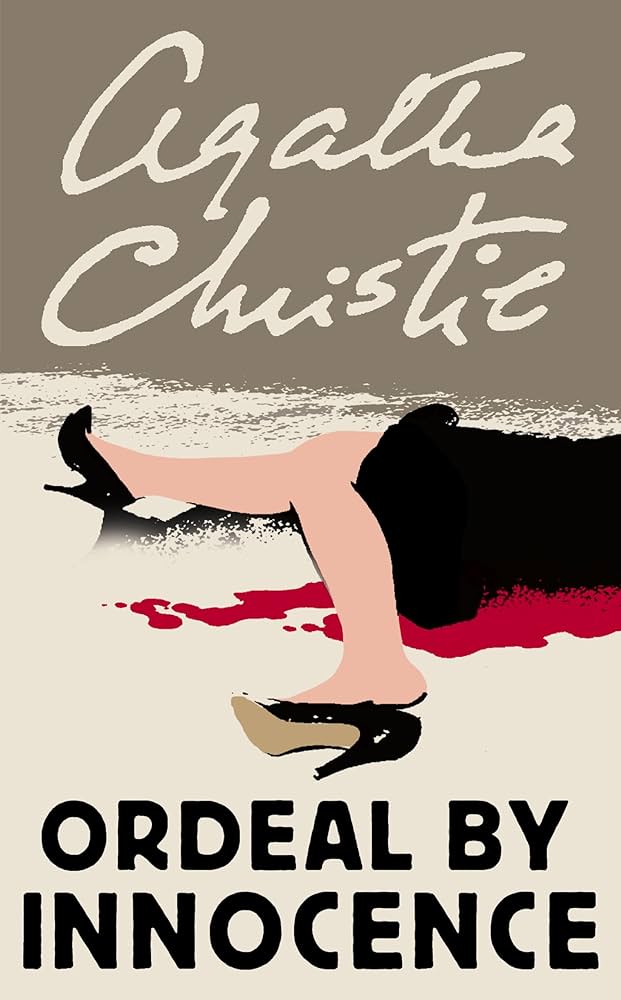
Ordeal by Innocence by Agatha Christie

The September choice for the Read Christie 2024 challenge is Ordeal by Innocence, a book which, along with Crooked House, Christie herself named as one she felt most satisfied with. It was first published in 1958 and is a standalone novel, with no Poirot, Miss Marple or any of Christie’s other recurring characters.

The novel begins with Dr Arthur Calgary visiting the Argyle family at their home, Sunny Point, to give them what he hopes will be some very welcome news. Two years earlier, Jacko Argyle was found guilty of the murder of his adoptive mother. Although he claimed to have an alibi, he was unable to prove it and was sentenced to life imprisonment. Now, Dr Calgary has come forward to confirm that he was with Jacko at the time of the murder, therefore he couldn’t have committed the crime. Calgary seems to have a valid reason for not speaking out sooner – a head injury affecting his memory, followed by a long trip to the Antarctic – but it’s now too late to help Jacko, who has died of pneumonia in prison. Still, Calgary hopes his belated evidence will bring some comfort to the family. However, it has the complete opposite effect…because if Jacko didn’t kill Mrs Argyle, who did?

This is a novel driven by characters, personalities and motives rather than one with a lot of plot. Most of the book is made up of conversations between various members of the Argyle household as they discuss amongst themselves and with Superintendent Huish the events that took place the night of Mrs Argyle’s murder and who they think could be responsible. There’s the dead woman’s husband, Leo Argyle, who is now planning to marry his secretary, Gwenda; there are the other four adopted Argyle children, Mary, Micky, Tina and Hester, all now adults who have had one reason or another to resent their adoptive mother; and Kirsten Lindstrom, their Swedish nurse who has been with the family for many years. It (unbelievably) doesn’t seem to occur to Dr Calgary, until it is pointed out to him, that by clearing Jacko’s name he has simply cast suspicion on the rest of the family again, but this becomes a major theme of the book – the idea that only the guilty person knows the truth, therefore it’s the innocent who suffer the most:

“The family would come under suspicion,” he said, “and it might remain under suspicion for a long time – perhaps for ever. If one of the family was guilty it is possible that they themselves would not know which one. They would look at each other and – wonder… Yes, that’s what would be the worst of all. They themselves would not know which…”

Another theme Christie tackles in this book is adoption and the question of nature vs nurture. Sadly, her opinion of adoption seems to be quite a negative one, with several characters stating that the relationship between a child and their adoptive mother can never be as strong as with their biological mother. It’s also strongly implied that some of the Argyle children have criminal tendencies because they’ve inherited those traits from their birth parents and are destined to be bad people regardless of how much love and attention they receive from their adoptive parents. These are not views I agree with, but clearly they are subjects Christie was interested in and wanted to explore in this novel.

As a standalone, I think this book suffers from not really having a character who does any ‘detecting’. Dr Calgary does take on this role eventually, wrapping things up for us in the final chapter, but otherwise we don’t see much of Superintendent Huish and the only member of the Argyle household who shows any interest in trying to solve the crime is Mary Argyle’s husband, Philip. There’s not much action until very late in the book, so most of the focus is on the characters discussing their memories of Mrs Argyle and what they were doing at the time of her death. In this respect, the book reminded me of Five Little Pigs, another Christie novel which deals with a mystery from the past.

Next month, and for the rest of the year, the Read Christie challenge will be moving on to books published in the 1960s and 1970s. I have plenty of those still to read!

I’m counting this as my first book towards this year’s RIP challenge.

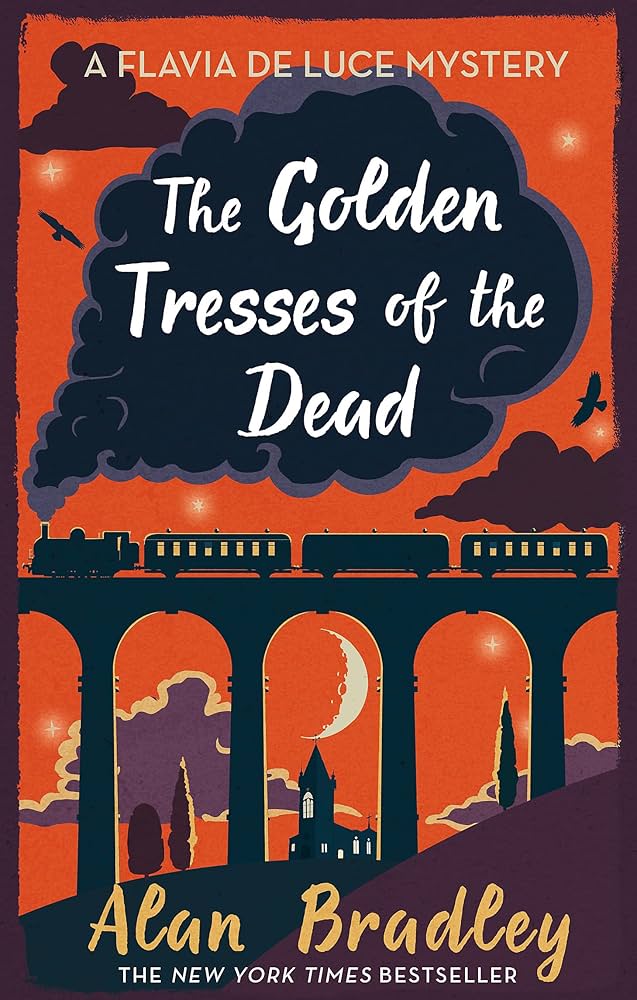
The Golden Tresses of the Dead by Alan Bradley

I had thought this book, published in 2019, was going to be the last in Alan Bradley’s Flavia de Luce series, so I hadn’t rushed to read it, thinking that once I had I would have no more to look forward to. Then I discovered that there’s actually another book coming in September – which will be the eleventh in the series – and decided to pick this one up now in preparation.

The Golden Tresses of the Dead begins in 1952 with our twelve-year-old heroine Flavia de Luce attending the wedding of her elder sister, Ophelia (known as Feely). I won’t tell you who she’s marrying, in case you haven’t reached this point in the series yet – or haven’t started at all. Everything is going well, apart from the usual naughtiness of Flavia’s annoying little cousin, Undine, but when Feely steps forward to cut into her wedding cake she screams in horror. There’s a human finger inside the cake! As Feely retreats to her room to recover from the shock, Flavia whisks the finger away to her laboratory so she can examine it and try to identify its owner.

The next day, Arthur W. Dogger & Associates, the new detective agency Flavia has formed with her father’s friend and manservant Dogger, receives its first client. A Mrs Prill is trying to track down some stolen letters and wants Flavia and Dogger to help. When they begin investigating, however, they discover that Mrs Prill hasn’t been entirely honest with them. Are the letters really missing – and could there be any connection with the severed finger in the cake?

As I’ve come to expect from the Flavia de Luce books, The Golden Tresses of the Dead (the title comes from Shakespeare’s Sonnet 68) is a quick, entertaining read; I did enjoy it, but it’s not one of the strongest and I think if I didn’t know there was another book on its way, I would have been disappointed with this one as a conclusion to the series. In general, I think the earlier books are more fun and have more charm than the later ones, so if you still haven’t tried one I would recommend going back to the beginning and starting with The Sweetness at the Bottom of the Pie.

Although this book has many of the same elements as most of the others in the series – it’s set, as usual, in and around the small English village of Bishop’s Lacey in the 1950s; Flavia still gets around on her trusty bicycle, Gladys; she still loves chemistry and conducting experiments in her fully equipped laboratory – there are also some differences. Feely leaves for her honeymoon early in the book and Flavia’s other sister, Daffy (Daphne), is tucked away working on her memoirs and only makes one or two brief appearances. The relationship between Flavia and her two sisters is one of the things that has always fascinated me about the series, so I was sorry that it’s not really explored any further here. We do see a lot of Undine, but I’ve never liked her and she doesn’t make up for the absence of Feely and Daffy! Also, as hinted at in the previous book, The Grave’s a Fine and Private Place, crime-solving is no longer a solitary activity for Flavia and she forms a new partnership with Dogger. It works well – Flavia does most of the trespassing, risk-taking and hunting for clues, but Dogger, with the benefit of age and life experience, knows how to interpret those clues. I’ve always loved him and was pleased to see him take such a prominent role in this book.

The mystery itself is complex, involving potential grave-robbing, poisonous plants and two missionaries who may not be quite what they seem, and I’ll admit that I found it confusing and didn’t really understand how everything tied together. I wondered if I just hadn’t been paying enough attention and had missed something, but looking at other reviews it seems that a lot of people had similar problems. This is not a favourite Flavia de Luce book, then, and I’m glad it’s not how the series ends! I’m looking forward to reading book eleven, What Time the Sexton’s Spade Doth Rust, and am hoping it will be better than this one.

Book 38/50 for the Historical Fiction Reading Challenge 2024

The Briar Club by Kate Quinn

Kate Quinn’s new novel, The Briar Club, begins with a murder in a Washington, D.C. boarding house on Thanksgiving, 1954. We don’t know who the victim is – that will be revealed later on – but it does seem that the killer is likely to be one of the seventeen people gathered in the kitchen waiting to be interviewed by the police. To get answers, we have to go back to the day four years earlier when Grace March arrives at Briarwood House and agrees to take the tiny apartment in the attic…

Grace is just one of several women living in the house, all of whom are hiding secrets and in some cases are not quite what they seem. There’s Nora, who works at the National Archives and is in love with a gangster; Bea, a former baseball player forced to give up her dreams; Claire, who is desperately trying to save to buy her own home; Fliss, an Englishwoman with a baby and an absent husband; unhappy, spiteful Arlene whom nobody likes; and Reka, an elderly Hungarian refugee. The novel unfolds through a series of interlinked short stories each focusing on one of these women, interspersed with chapters describing the aftermath of the Thanksgiving murder. The latter are narrated by Briarwood House itself, because the house knows better than anyone else what has been going on within its walls!

I enjoyed The Briar Club, but found some of the women’s stories much more engaging than others. Nora’s story came first and was completely gripping, which maybe raised my expectations too high for the rest of the book. By the time I reached Bea’s section in the middle, I was starting to get bored, although things did pick up again later on. Despite the brief chapters about the murder that are scattered throughout the book, I think anyone who starts to read this expecting a mystery novel or a thriller will be disappointed – but if you like character-driven novels with a slower pace it will probably be more to your taste. Speaking of taste, food and drink play a big part in the story, with each character sharing some of their recipes with us! So if you want to know how to make Bea’s ragù, Arlene’s candle salad or Claire’s potato pancakes, the instructions are all in the book (and even if you’re not a cook, I recommend skipping to the end of each recipe where you’ll find a suggestion for a suitable song to accompany the meal).

Although each woman in the house has her own individual story to tell, they all get together for weekly social gatherings in Grace’s attic room (the ‘Briar Club’ of the title) and over the years most of the women begin to form close bonds. A very different kind of relationship that also develops is between the women of the Briar Club and the two children of their landlady, Mrs Nilsson. Pete Nilsson gets a chapter of his own, but I particularly loved seeing how his younger sister, Lina, grows in confidence (and improves her baking skills) due to the friendship and support of the Briar Club. The novel also provides us with a snapshot of life in America in the early 1950s, with a focus on McCarthy and the fear of communism.

The Briar Club was an enjoyable read overall, but I would have preferred some of the women’s stories to be cut short or left out altogether. So far, The Rose Code is still my favourite of the three Kate Quinn books I’ve read (the other is The Diamond Eye).

Thanks to HarperCollins for providing a copy of this book for review via NetGalley.

This is book 16/20 of my 20 Books of Summer 2024.

Book 34/50 for the Historical Fiction Reading Challenge 2024

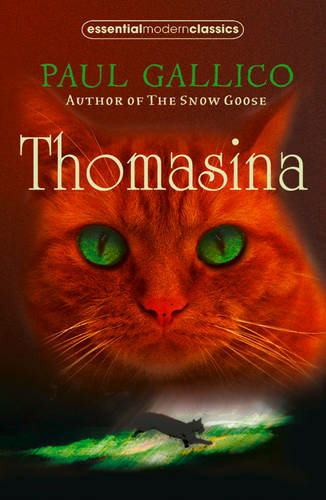
Thomasina by Paul Gallico – #ReadingtheMeow2024

When I saw that Mallika of Literary Potpourri was hosting her second Reading the Meow event this week – a celebration of cats in books – I knew exactly what I wanted to read. The Disney film The Three Lives of Thomasina was a favourite of mine as a child, but it never occurred to me to read the book on which it was based until I noticed that Lory of Entering the Enchanted Castle had read it for last year’s Reading the Meow so onto the list it went!

Published in 1957, Paul Gallico’s Thomasina is set in the fictional Scottish town of Inveranoch. Having lost his wife a few years earlier, veterinarian Andrew MacDhui has moved to the town from Glasgow and opened a surgery there, where he treats the pets of the townspeople, as well as looking after the health of the livestock on the surrounding farms. When the novel begins, MacDhui has only been living in Inveranoch for eighteen months and has already gained a reputation as a cold, bitter man who is good at his job but not mentally suited for it:

The gossips allowed that Andrew MacDhui was an honest, forthright and fair-dealing man, but, and this was the opinion of the strictly religiously inclined, a queer one to be dealing with God’s dumb creatures, since he appeared to have no love for animals, very little for man, and neither the inclination nor the time for God.

Since his wife’s death it seems that MacDhui has given what little love he still possesses to his seven-year-old daughter, Mary Ruadh, who is devoted to her ginger cat, Thomasina. When Thomasina becomes ill with a suspected meningeal infection, Mary takes her next door to her father’s surgery and begs him to save her pet’s life. Not pleased at being interrupted at his work and distracted by a difficult operation on a blind man’s dog, MacDhui tells her that Thomasina can’t be cured and orders his assistant to put the cat to sleep. Heartbroken, Mary vows never to speak to her father again and seems to really mean what she says. As the days go by and Mary’s silence continues, a desperate MacDhui pays a visit to Lori, a young woman who lives alone in the forest and is said to be a witch. Can Lori help repair the relationship between father and daughter or has too much damage been done?

Although I was already familiar with the plot, I found that this novel had far more depth than the Disney version and also a stronger religious element. There’s a lot of focus on MacDhui’s internal struggles as he tries to confront the loss of faith that has been with him since his wife died and on the efforts of Lori and the minister, Angus Peddie, to restore his belief in God and the power of love. Lori, a gentle, compassionate woman who tries to heal injured wild animals that others see as worthless, is a lovely character and reminded me a lot of Froniga in The White Witch by Elizabeth Goudge. However, I didn’t find the book overly sentimental because it’s balanced by the darker themes of loss and grief, as well as animal cruelty and its consequences for those who perpetrate it.

I’m sure younger readers will enjoy the chapters written from Thomasina’s own perspective, where she gives amusing descriptions of life in the MacDhui household, but I never really felt that I was reading a ‘children’s book’ and I think there’s enough here for readers of all ages to enjoy. Finally, without wanting to spoil too much, if you think Thomasina’s fate sounds too sad, I can assure you that her story is a happier one than you might expect.

This is book 3/20 of my 20 Books of Summer 2024.

Opening Night by Ngaio Marsh

Opening Night (also published as Night at the Vulcan) is the sixteenth book in Ngaio Marsh’s Inspector Roderick Alleyn series and like many of her novels has a theatrical setting, which makes it perfect for Reading the Theatre, hosted this month by Lory of Entering the Enchanted Castle.

Published in 1951, the novel opens with Martyn Tarne, a young woman from New Zealand, arriving in London to look for acting work. After an exhausting day of unsuccessful auditions and meetings with agents, she eventually finds herself at the door of the Vulcan Theatre where rehearsals are about to begin for a new play, Thus to Revisit. Disappointingly, the play has already been cast, but there’s a vacancy for a dresser to the leading actress, Helena Hamilton, and Martyn finds herself accepting the job.

The next 100+ pages (of a 240 page book) are devoted to describing the backstage preparations for the play, Martyn’s work as first a dresser and then an understudy, and the relationships and interactions between the various members of the cast. There is no hint of any crime until we reach the middle of the book and no sign of Inspector Alleyn either until after the halfway point. I think how much you enjoy this novel will depend on whether you picked it up just because you wanted to read a murder mystery or because you were drawn to the setting.

The crime, when it eventually occurs, involves the death on opening night of one of the actors, Clark Bennington, who is found unconscious backstage after inhaling gas. Suicide is assumed – everyone knows that Bennington has been unhappy and has a drinking problem – but when Alleyn arrives to investigate, he quickly decides that the man was murdered. There are plenty of suspects and motives; for a start, Bennington was married to Helena Hamilton, who has openly been having an affair with one of the other actors, Adam Poole. Also, Bennington is known to have had several heated arguments and altercations before and during the opening night. And to complicate things further, Martyn Tarne’s arrival at the Vulcan has not been welcomed by everyone, least of all Gay Gainsford, a young actress who feels that her role in the company is threatened by Martyn.

Although I would have preferred the murder to have come earlier in the book, once it does happen and Alleyn’s investigation gets under way, the mystery becomes quite an interesting and compelling one. I guessed who the murderer was, but not the motive – and I think it would be very difficult to work that out before it’s revealed right at the end of the book. The mystery is definitely secondary to the setting in this novel, though; Ngaio Marsh herself was a theatre director and her love and knowledge of the theatre comes through very strongly.

Have you read any of Marsh’s Inspector Alleyn novels, theatrical or otherwise? I’ve read very little of her work compared to other Golden Age crime writers so would love to hear your recommendations.

Impact of Evidence by Carol Carnac

“The snow and the floods have been abnormal even for these parts,” said Rivers. “I’ve had several investigations in country areas, but I admit I’ve never struck anything quite like St Brynneys. It has a secret quality, and its remoteness affects all the people who live in it.”

First published in 1954, Impact of Evidence has recently been reissued as a British Library Crime Classic. It’s my first Carol Carnac book – I haven’t read Crossed Skis, the other one currently in print – but she also published as E.C.R. Lorac and I’ve read her before under that name. This one is subtitled A Welsh Borders Mystery and is part of a series featuring Chief Inspector Julian Rivers and his sidekick, Inspector Lancing.

The novel begins with a car accident near the village of St Brynneys in the hills of the Welsh borders. Elderly Dr Robinson – whom everyone agrees was too old to be driving – has collided with Bob Parsons’ jeep, with both vehicles being thrown off the road by the impact. Parsons has been lucky and escaped with minor injuries and concussion, but the doctor, whose car has ended up in a stream, has been killed. The Lambton family, who live on a farm nearby, hear the crash and hurry to the rescue, but after retrieving the doctor’s body from the car, they make a shocking discovery. There’s a second body in the back of the car – a man none of the local people have seen before, and as St Brynneys has been cut off from the world for the last few days due to extreme winter weather, nobody knows where he came from.

A local police inspector visits the doctor’s house to try to get to the bottom of the mystery, but when he suffers a fatal accident on the stairs, the mystery only deepens. Chief Inspector Julian Rivers and Inspector Lancing are called in from Scotland Yard, and with the roads still impassable they require the help of the army to access the area. Once they reach St Brynneys, Rivers and Lancing begin their investigations and uncover tensions between the local farming families, the possibility of blackmail and a range of theories to explain the presence of the unidentified corpse.

As my first Carol Carnac book, I’m not sure if there’s anything significantly different between these and her books published as E.C.R. Lorac. The writing style feels very much the same but I haven’t really read enough of her under either name to be able to comment on any other differences. What struck me most about this particular book was the setting and the wonderful atmosphere Carnac creates. The novel is set in a place that has experienced several days of very heavy snowfall, followed by a thaw that has caused flooding, destroying bridges and blocking roads. Carnac’s descriptions of the flooded countryside, the damaged infrastructure and the effect all of this has on a small community really convey a sense of isolation and remoteness. Also, with no routes in or out, this means the suspects (and for that matter, the victims) are limited to people who were already in the area when the snow began.

The actual mystery, I felt, took second place to the setting – which is not to say that it wasn’t interesting, because it was, but I think the descriptions of the snow and the thaw and a society severed from the outside world are what I’ll remember about this book rather than the plot. I’ll try to get round to Crossed Skis at some point and hopefully some more of the Lorac books as well.