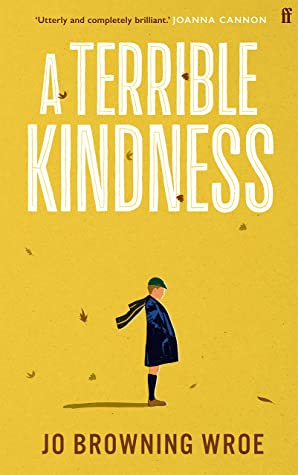
A Terrible Kindness by Jo Browning Wroe

The Welsh village of Aberfan is a place many of us associate with the 1966 mining disaster where a landslide of coal waste collapsed onto the village school, killing 116 children and 28 adults. Among the many volunteers who arrived in Aberfan to help deal with the aftermath of the tragedy were several hundred embalmers. A Terrible Kindness imagines the story of one of these embalmers, the fictional William Lavery.

William is just nineteen years old and newly qualified when the disaster happens, but he works tirelessly alongside older and more experienced embalmers to help identify and tend to the bodies of the victims. Not surprisingly, this will have a profound effect on him and leave him psychologically damaged for years to come. It also brings back memories of other traumatic moments that occurred earlier in William’s life – including one particular incident that led to the breakdown of his relationship with his mother. This incident is only hinted at throughout the book and it’s not until the final chapters that we find out what happened.

The Aberfan disaster is something that is still within living memory for a lot of people, so it’s important that authors handle things like this with care and sensitivity – and I think Jo Browning Wroe does this very well. These scenes are naturally very sad and moving, but also filled me with admiration for these people who voluntarily carried out such an unpleasant, difficult but essential task. However, Aberfan is only the starting point for William’s story and apart from two or three chapters, the rest of the book is set elsewhere.

A lot of time is spent on William’s years as a young chorister at a choir school in Cambridge, the friendships he made there and the events that made him abandon his promising singing career and go into the family embalming business instead. The complex relationships between William, his mother, his uncle and his uncle’s partner are also explored and this is the real focus of the book rather than what happened at Aberfan. I did have a lot of sympathy for William, who was clearly struggling, but I wished he had been able to get help and find a way to move on rather than making life so unhappy for himself and his loved ones for so many years. His mother, Evelyn, also frustrated me with her inability to consider other people as well as herself and I felt that the revelation of the incident that caused her estrangement from William was a bit of an anticlimax.

I think the inclusion of the Aberfan storyline will draw a lot of readers to this book, but will also put other readers off and I do wonder whether a fictional tragedy would have served the purpose of the plot just as well. As an exploration of grief and forgiveness, though, it’s an excellent read and an impressive first novel by Jo Browning Wroe.

Thanks to Pigeonhole for the opportunity to read this book.

This is book 2/50 read for the Historical Fiction Reading Challenge 2022.

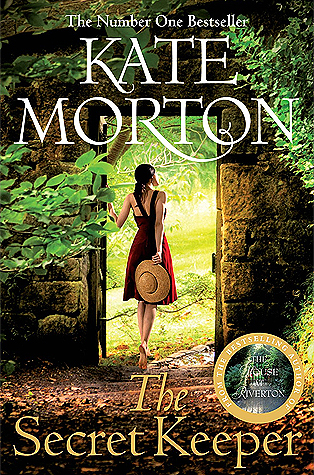
The Secret Keeper by Kate Morton

There are many events taking place in the book blogging calendar this month and AusReading Month hosted by Brona’s Books is one of them. I have a few books by Australian authors waiting to be read, but I decided to read one that has been waiting a long time: Kate Morton’s 2012 novel, The Secret Keeper. I’ve previously read three books by Morton and had mixed experiences with them; I loved The Forgotten Garden but was slightly disappointed in both The Distant Hours and The Clockmaker’s Daughter, so wasn’t sure whether I wanted to bother with this one. I’m pleased I did, because I enjoyed it much more than I expected to.

Like Morton’s other books, The Secret Keeper is set in multiple time periods. It begins in 1961, with sixteen-year-old Laurel Nicolson hiding in a wooden tree house during a family celebration. Laurel just wants some time alone to think, but this means that, from her position in the tree, she is able to see a strange man approaching the Nicolson farmhouse – and is witness to a violent crime involving her mother, Dorothy. We then jump forward fifty years to 2011, when the Nicolsons are gathering at their childhood home for Dorothy’s ninetieth birthday. Laurel, now a successful actress, is still haunted by what she saw on that long ago day and decides that, with Dorothy in poor health, she needs to find out what really happened before her mother dies and takes her secrets with her.

As Laurel begins to investigate her mother’s past, the novel moves back and forth between 2011 and 1940s London where the young Dorothy is looking forward to marrying war photographer Jimmy as soon as their financial situation improves. Dorothy has also made a new friend (or so she thinks): the beautiful, wealthy Vivien, who lives in the house opposite. But when she is betrayed by Vivien, Dorothy puts together a plan of revenge – with unexpected and tragic results.

As is usually the case when I read books set in more than one time period, it was the historical one I enjoyed the most. The present day story was interesting – I enjoyed Laurel’s interactions with her younger brother Gerry, who helps her to uncover the truth about their mother – but I felt that it was effectively just a frame for the much more compelling story of Dorothy, Jimmy and Vivien. I was surprised by how absorbed I became in these parts of the novel, considering that I found Dorothy a particularly unpleasant and irritating character! I did like Jimmy, was intrigued by Vivien and loved the wartime setting, especially as things build to a climax during the London Blitz.

Somewhere in the second half of the book I started to have some suspicions regarding Laurel’s mother and the secrets she was hiding, but this came late enough that it didn’t spoil my enjoyment of the story and I was pleased to find that my guess was correct. Of Kate Morton’s other books, I only have The House at Riverton and The Lake House left to read. Which should I read first?

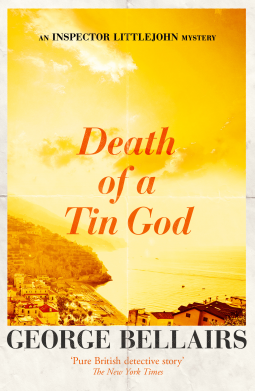
Death of a Tin God by George Bellairs

This is the fourth book I’ve read from George Bellairs’ Inspector Littlejohn series and although I haven’t been reading them in order, it doesn’t seem to matter at all. Each novel works as a standalone mystery and there’s very little focus on Littlejohn’s personal life so you can easily jump around from an early book to a later one and back again without feeling that you’ve missed anything important.

Death of a Tin God was first published in 1961 and begins with Thomas Littlejohn (now a Superintendent rather than an Inspector) flying from Dublin to the Isle of Man to visit his friend, Caesar Kinrade, the Archdeacon of Man. Littlejohn is looking forward to a quiet break, but his arrival coincides with the death of Hal Vale, a Hollywood star who has been filming on the island. Hal is found electrocuted in the bath in his hotel room and the circumstances suggest that it was not an accident. Littlejohn finds himself assisting the local police with their investigations and as the mystery deepens, he travels to the South of France to look for the answers.

I enjoyed this book but found the solution a bit predictable as the murderer turned out to be the person I had suspected from the beginning. There were some clever twists and red herrings along the way that did put some doubt into my mind, but I still wasn’t at all surprised when the truth was revealed. However, I very rarely manage to solve a mystery before the detective does, so I don’t mind too much when it occasionally happens! And I do like spending time with Littlejohn and watching him carry out his investigations; he’s not the most memorable of fictional detectives, but that means the focus stays firmly on the plot without his own personality getting in the way. His usual sidekick Sergeant Cromwell is absent for most of the book, but instead he teams up with Inspector Knell of the Manx police and Inspector Dorange in Nice who I believe are also recurring characters in the series and have good working relationships with Littlejohn.

One of the things I’ve loved about the other Bellairs novels I’ve read is the way he creates such a strong cast of supporting characters and suspects. In Dead March for Penelope Blow and A Knife for Harry Dodd in particular, there are some very colourful, larger than life characters who could almost have jumped straight out of the pages of a Dickens novel. In this book, I found the characterisation more bland and less interesting, but maybe that was a reflection of the shallow, vapid celebrity world Bellairs has chosen as the setting for this particular novel. Littlejohn is described several times as feeling slightly out of his depth amongst this assortment of glamorous film stars, ruthless publicity agents and millionaire bankers with yachts, so perhaps the reader is intended to feel the same.

I liked the idea of the book being set on the Isle of Man, as it’s not a common setting for mystery novels (or fiction in general), but it turned out that half of the story actually took place in Aix-en-Provence in France – and neither setting was described as vividly as I would have liked. I know Bellairs set some of the other Littlejohn books on the Isle of Man too, so maybe some of those have more local colour than this one. Although this is not one of my favourite books in the series so far, I’m still looking forward to reading more of them.

Thanks to Agora Books for providing a copy of this book for review via NetGalley.

Book 5 for R.I.P. XVI

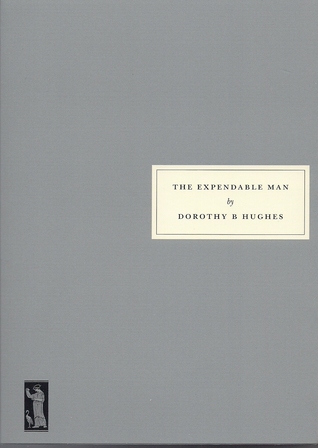
The Expendable Man by Dorothy B Hughes

This weekend Jessie of Dwell in Possibility has been hosting another Mini Persephone Readathon and it seemed like the perfect opportunity to read The Expendable Man, one of the thrillers published by Persephone and a book that I’ve been meaning to read for a long time. It turned out to be a great choice.

Published in 1963, the novel opens with a young doctor, Hugh Densmore, driving from Los Angeles to a family wedding in Phoenix. On the way, he spots a teenage girl standing alone at the side of the road. Hugh doesn’t usually stop for hitchhikers but this time he finds himself slowing down…

He simply could not in conscience go on, leaving her abandoned, with twilight fallen and night quick to come. He had sisters as young as this. It chilled him to think what might happen if one of them were abandoned on the lonesome highway, the type of man with whom, in desperation, she might accept a lift. The car was stopped. He shifted to reverse and began backing up.

Hugh quickly begins to regret this impulsive act of kindness. The girl is rude, ungrateful and, when he questions her about who she is and where she is going, it is clear that she is telling lies. When they arrive in Phoenix, Hugh leaves his hitchhiker at a bus station and doesn’t expect to see her again, but that night the girl tracks him down at his hotel, setting in motion a series of events that could ruin the life and career he has built up so carefully for himself.

There’s really not much more I can say about the plot or the characters. If you think you might want to read this book, it’s best that you know as little as possible before you begin. And I do highly recommend reading it! I was completely gripped from beginning to end; when I first picked it up on Friday and started reading, I didn’t expect to actually finish it before the Readathon was over, but as it happened that wasn’t a problem at all. I couldn’t bear to put the book down until I knew what was going to happen to Hugh.

There’s an element of mystery-solving to the novel, but The Expendable Man is much more than a straightforward crime story. A few chapters into the book, there’s a twist – or maybe revelation is a better word to use – that changed the way I felt about what I had read so far and showed me that I had made an unfair assumption without even being aware that I had made it. It was so cleverly done and provided answers to some of the things I’d been wondering about as I read those earlier chapters.

I also loved the author’s beautifully written descriptions of the landscape, particularly near the beginning when Hugh is driving into Arizona. This is the first book I’ve read by Dorothy B Hughes and I was very impressed with every aspect of it! I would like to read more of her books, so if there’s one you would recommend please let me know.

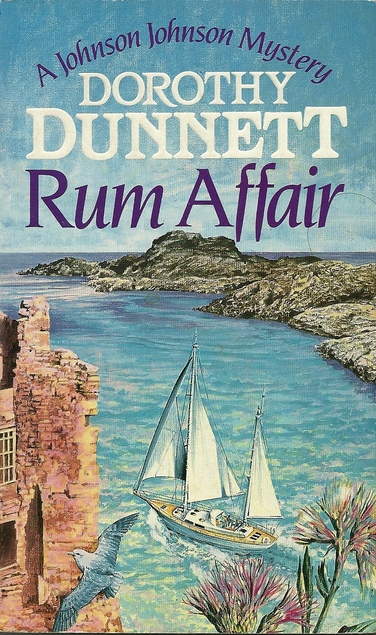
Rum Affair by Dorothy Dunnett – #1968Club

I am, after all, the only really photogenic coloratura soprano alive. My only problem, just about then, was in staying alive.

It’s been a while since I read my first of Dorothy Dunnett’s Johnson Johnson mysteries and this week’s 1968 Club (hosted by Simon and Karen) seemed the perfect opportunity to read another one. Rum Affair – originally titled Dolly and the Singing Bird and then The Photogenic Soprano – was the first in the series to be published (in 1968 obviously), although Tropical Issue, the other one I’ve read, was the first chronologically.

Dunnett is better known for her historical novels, some of which have recently been reissued, but the seven books in her mystery series have contemporary settings. They are each narrated by a different young woman and all feature the portrait painter Johnson Johnson and his yacht Dolly.

Rum Affair opens with Tina Rossi, a Polish-Italian opera singer, arriving in Scotland where she is due to give two performances at the Edinburgh Festival. During a break in her schedule, she has arranged to meet her lover, Kenneth Holmes, at his friend’s Rose Street flat. However, there’s no sign of Kenneth – just a card with the three handwritten words, “Darling, I’m sorry”. Searching for clues to explain his absence, Tina opens a wardrobe door to reveal the body of a man, a stranger, who has been shot in the chest. When the police unexpectedly arrive, making enquiries about a robbery in the neighbourhood, she quickly makes the decision to conceal what has happened – to try to save her own reputation, she tells us, and Kenneth’s.

Instinct is a marvellous thing, I dare say; but I prefer to use my good sense. You, perhaps, with a strange man lying dead at your feet would have welcomed the police with an exhibition of nervous relief. I, on the other hand, kept my head.

On the same night, Tina’s path crosses for the first time with that of Johnson, who is staying nearby. Tina is immediately intrigued by Johnson, a mysterious man who wears bifocals and introduces himself as “thirty-eight. Painter. London. On holiday.” When Johnson invites her to join him on a yacht race to the Isle of Rum, she is quick to accept. Rum is where Kenneth is currently based, working on a highly sensitive project for his employers, although she doesn’t admit this to Johnson. However, it seems that Johnson has a reason of his own for wanting Tina to sail with him on board Dolly – and it’s not just so that he can paint her portrait!

I won’t go into any more detail regarding the plot because I wouldn’t like to inadvertently give too much away and spoil the mystery – and I don’t want to say much more about Tina Rossi either as I’m finding that part of the fun of reading the Johnson novels is in getting to know the woman who is narrating the story. What I will say is that Tina is very different from Rita Geddes of Tropical Issue and that their narrative voices reflect their different personalities and backgrounds (while I liked Rita immediately, I never connected with Tina at all, but I suppose you can’t like every character in every book). As for Johnson himself, even though I have now read two books in this series, he is still very much an enigma to me. Of course, we only see him through the eyes of the narrators so we only know what they choose to tell us and are reliant on their observations and interpretations of his character, which may not always be correct or true.

I also found the setting interesting; the race in which Johnson and Tina are participating takes them around the west coast of Scotland, visiting several islands of the Inner Hebrides, of which Rum is one.

In the summer night, the Inner Hebrides lay all about us, black on the indigo sea. Above us, the uninterrupted sky stretched, a light, dense ultramarine, its ghostly clouds and small, sharp white stars suspended over the bright winking lights, near and far, of a constellation of lighthouses, and the grey, dimly voyaging waves here below.

I particularly enjoyed the scenes set at Fingal’s Cave on the island of Staffa!

Although I don’t think these books come close to the brilliance of Dunnett’s Lymond or Niccolò series, or King Hereafter, they are still quite enjoyable in a different way. I am looking forward to reading the rest and meeting the other five narrators.

A French Trio: Mediterranean Summer; Eugenie; A Week in Paris

Coincidentally, three of my recent reads have been set in France, so I thought I would combine my thoughts on them into one French-themed post. It’s a good way for me to get through my review backlog too!

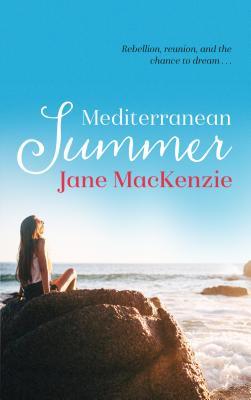
Mediterranean Summer by Jane MacKenzie was a nice surprise; a book I knew nothing about, by an author I’d never come across before, but one that I ended up really enjoying. It tells the story of Laure, a young art student who finds herself caught up in the excitement of the 1968 student demonstrations at her university in Paris. When the rebellion is over, with her future as an artist in doubt due to her involvement in the protests, Laure returns home for the summer to her parents’ house in the Mediterranean village of Vermeilla. Here, in the small Catalan community of her childhood, she is reacquainted with old friends as well as making new ones – and with the help of Robert, a lawyer, she begins to search for a way to rescue her career.

This is a lovely summer read; the descriptions of the fictional Vermeilla and the surrounding area are so beautiful I wished I could go and spend the rest of the summer there myself! There’s an interesting selection of characters to get to know too, mostly very likeable, but with one or two who could be considered villains. As for the historical background, I knew almost nothing about the Paris student protests in the 1960s, so I learned something new there, and I was also interested to read about the Nobel dynamite factory in Paulilles and the shocking lack of regard for the health and safety of the employees. I loved Mediterranean Summer and would be happy to try Jane MacKenzie’s previous novels.

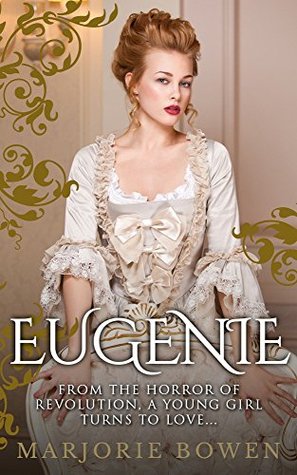
The next book I want to talk about takes us further back in time, to the French Revolution. Published in 1917 (originally titled The Third Estate), Eugenie by Marjorie Bowen introduces us to two sisters, Eugenie and Pélagie Haultpenne. Pélagie, the eldest, is heiress to a fortune and, at the beginning of the book, is engaged to a handsome young nobleman, the Marquis de Sarcey. As soon as the Marquis sees her beautiful sister Eugenie, however, Pélagie is forgotten. Can he find a way to be with Eugenie without giving up his claim to the Haultpenne fortune?

I have read a few of Marjorie Bowen’s other historical novels and have found them to vary widely in style and quality. This is not one of the better ones, but despite the off-putting cover, it’s still an entertaining read. The historical aspect of the story is interesting; it focuses less on the Revolution itself than on the factors leading to it, such as the Estates General and the role of the Comte de Mirabeau. This is a novel that you would read more for the plot than because you wanted to learn some history, though. It reminded me slightly of Louisa May Alcott’s A Long Fatal Love Chase; it’s fun, as long as you don’t mind lots of melodrama, swooning heroines and an anti-hero who is “a creature expert in every vice, used to every dishonour, useless, arrogant, a parasite on the labour of others!”
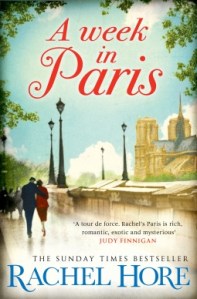
Finally, I read A Week in Paris by Rachel Hore, a dual timeline novel. One thread of the story is set in 1961 and follows music student Fay Knox who is in Paris for a week with her orchestra. Fay has grown up knowing very little about her early childhood as her mother refuses to talk about it or to tell her what happened to her father, other than that he was killed during the war. However, when memories start coming back to her, she has reason to believe that the first years of her life may have been spent in France. Over the course of her week in Paris, Fay decides to find out the truth about her past – and is shocked by what she discovers. Meanwhile, she is reacquainted with an old friend, Adam, but could he also be hiding secrets?

The other storyline is written from the perspective of Fay’s mother, Kitty, who falls in love with Gene, an American doctor, during World War II. The two end up trapped in occupied Paris – and their actions during this period will have consequences that live on into the next generation.

I found this an enjoyable novel, after a slow start, though not as good as similar books by other authors such as Lucinda Riley or Susanna Kearsley. The 1940s storyline is much more engaging than the 1960s one, not just because of the drama of the war itself, but also because the romance between Kitty and Gene is more convincing than the one between Fay and Adam (and less reliant on coincidence and chance meetings). I really cared about what happened to the wartime characters and was gripped by the details of life in a city under Nazi occupation, but I wouldn’t have minded if the framing story involving Fay had been left out altogether.

Three very different books, but I found different things to like about all of them!

Thanks to Jane MacKenzie for the copy of Mediterranean Summer; the other two were both taken from the outstanding titles on my NetGalley shelf.
Exposure by Helen Dunmore

Exposure What a great book! I have to admit, I wasn’t sure about reading it; I thought Helen Dunmore’s previous novel, The Lie, was disappointing, and the descriptions of this one as a Cold War spy novel didn’t sound very appealing to me. I wanted to give Dunmore another chance, though, so I decided it would be worth giving Exposure a try.

The first thing I need to say is that although Exposure certainly is a Cold War spy novel of sorts, it’s also a compelling story of love and betrayal, secrets and lies, as seen through the eyes of a wonderful cast of strong and complex characters. One of them, Simon Callington, is a quiet, unambitious young man who works for the Admiralty in London and who looks forward to coming home to his wife and children at the end of each day. The last thing he wants is to be involved in any controversy, but that is exactly what happens one night in November 1960 when he receives a call for help from his friend and colleague, Giles Holloway.

As a student, Simon had been drawn to Giles because he was older and more sophisticated; now, however, Giles is a rather sad and lonely man with a drink problem, and when he falls down the stairs and ends up in hospital with a broken leg, Simon is the only person he feels he can trust. Just before he fell, Giles was working on a secret file – a file he should never have brought home from work – and he needs Simon to retrieve it from his desk and return it to the office before anyone notices it was missing. Simon agrees, but unknown to him, Giles’s home is being watched.

The decisions Simon makes on that fateful night and in the days which follow will have serious consequences for both Simon himself and for his family – his wife, Lily, and their three children, Paul, Sally and Bridget. It’s Lily, in my opinion, who is the real star of this novel. Having fled to England with her mother as Jewish refugees in the 1930s, she has spent her whole adult life trying to hide her German origins and now, with Simon in trouble, it’s more important than ever that her past is kept a secret. Lily is put under a huge amount of pressure, yet remains strong, resourceful and determined to do whatever it takes to protect her husband and children.

Simon also has a secret which he has been concealing even from Lily and if it is revealed his situation will become even more precarious than it already is. With all three of our main characters – Giles, Simon and Lily – at risk of exposure, the tension and the atmosphere of darkness and danger build and build throughout the story. The writing and structure of the novel are both excellent, dipping into the past where necessary to explore a character’s background, helping us to understand the person they are in the present. Dunmore also includes just enough period detail to set the story firmly in the early 1960s without going into an excessive amount of description.

Some elements of the novel made me think of the plot of E. Nesbit’s The Railway Children (and I’m sure we’re supposed to make the connection) but Exposure is also an exciting and original novel in its own right. I loved it and am so pleased I didn’t let The Lie put me off reading more of Helen Dunmore’s books!