The Sun Walks Down by Fiona McFarlane

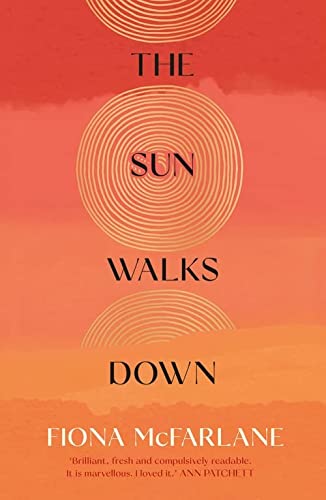
The Sun Walks Down by Australian author Fiona McFarlane is not a book I had considered reading until it appeared on this year’s shortlist for the Walter Scott Prize for Historical Fiction. Attempting to read all the shortlisted books for the prize is one of my ongoing personal projects and this is the third I’ve read so far from this year’s list (the others are Act of Oblivion and These Days).

The novel is set in South Australia and takes place over a period of seven days in September 1883. On the first day, a dust storm sweeps through the small town of Fairly in the Flinders Ranges and after it has passed, six-year-old Denny Wallace is found to have gone missing. As the whole community becomes caught up in the search for him, McFarlane introduces us to each resident of the town in turn, exploring their lives and the ways in which they are touched by Denny’s disappearance.

As well as Denny’s parents and siblings, we also meet a Pashtun cameleer, a Ramindjeri tracker, a Swedish painter and his English wife, a pair of newlyweds and an assortment of farmworkers and housemaids. Each has their own story to be told and some are given their own chapter, written in the form of a dream, a confession, a prayer or a set of notes. In this way, McFarlane looks at various aspects of life in colonial Australia and the relationships between the Indigenous people and the European newcomers. Although I did find this interesting (I’ve read shamefully little about 19th century Australia) I felt that there were too many characters in the book and the viewpoint changed from one to another too quickly, preventing me from forming a strong connection with any of them. I would also have preferred a tighter focus on the search for Denny as this seemed to get pushed aside for long periods.

I did love the beautiful descriptions of the Flinders Ranges and the way McFarlane uses colours to bring to life images of the sun, sky and clouds. 1883 was the year when Krakatoa erupted and caused a ‘volcanic winter’ with unusually vivid sunsets:

The sky burns and leaps, it gilds and candles – every drenched inch of it, until the sun falls below the ranges. Then the sky darkens. The red returns, stealthy now, with green above and lilac higher still. It deepens into purple. Here’s the strange new cloud, hovering in its own grey light. Then night comes in, black and blue and grey and white, and the moon in its green bag swings heavy over the red nation of the ranges.

I think I would describe The Sun Walks Down as a book that I admired rather than one that I particularly enjoyed. I can see why other people have given it glowing reviews and why it’s being nominated for awards, but it just wasn’t for me. That probably means it will win the Walter Scott Prize this year – not long until we find out!

This is book 20/50 read for the 2023 Historical Fiction Reading Challenge.

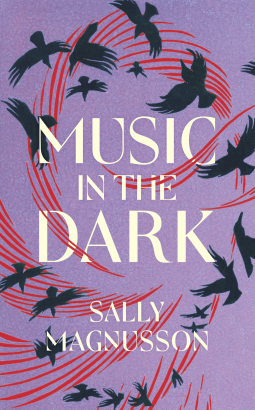
Music in the Dark by Sally Magnusson

This is the third novel by Scottish author Sally Magnusson and although I had a few problems with her first two – The Sealwoman’s Gift, the story of an Icelandic woman sold into slavery in Algeria, and The Ninth Child, about the construction of the Loch Katrine Waterworks – I still wanted to read this one because it sounded so interesting.

It begins in 1884 in a tenement in Rutherglen, a town near Glasgow, where the widowed Jamesina Bain is taking in a new lodger. The lodger is a man, newly arrived from America, where he has lived for many years. At first he has no idea who the Widow Bain is, but as he and Jamesina spend more time together, they discover that they have a shared past – they both lived through the forced eviction of Greenyards in Strathcarron.

The eviction was part of the Highland Clearances, the period when landowners in Scotland removed tenants from their estates so the land could be used for more profitable purposes – which, in the case of Greenyards, meant sheep farming. The clearances of Greenyards in 1854 and nearby Glencalvie a few years earlier, were particularly shocking, for reasons I won’t go into here as the novel will probably have more impact if you don’t already know what happened.

Sally Magnusson doesn’t delve too deeply into the politics surrounding the clearances or the reasons behind them – although Jamesina and her friends believe it was due to the Celtic people being considered inferior – and she acknowledges in her author’s note that it’s a very complex subject. Instead, she concentrates on exploring the long-term effects of the clearances, physically, emotionally and mentally, on the evicted people.

The novel is written from the perspectives of both Jamesina and her lodger, moving between the two as well as jumping backwards and forwards in time between 1884 and 1854. This structure is ultimately quite rewarding as things do eventually fall into place and we come to understand what happened during the Greenyards eviction and the sequence of events that sent Jamesina to Rutherglen and her lodger to America. However, it also means that the first half of the novel is slightly confusing and lacks focus, something that isn’t helped by the style in which Jamesina’s sections are written – often descending into a jumble of thoughts, word association and stream of consciousness. There was a reason for that style, which I understood later on, but it didn’t make this an easy book for me to get into.

I found this book very evocative of time and place, whether I was reading about Jamesina’s childhood in Greenyards or her life in the Rutherglen tenement, taking in laundry to earn a living and sleeping in the ‘kitchen bed’ to keep the bedroom available for lodgers. Magnusson also incorporates lots of other interesting issues, such as the healing power of music, the devastating impact of dementia and the joys of education. I found it very sad that the adult Jamesina, who had been such a bright child and was being taught Latin by the local minister, questions the point in being educated if you’re only going to be leading a life of drudgery.

I have deliberately not provided the name of Jamesina’s lodger, as we don’t immediately know who he is or how he fits into her life and I thought I would leave you to make that discovery for yourself. This is a fascinating novel in many ways and I did enjoy it once I got past the halfway point, which is why I don’t like abandoning books too early!

Thanks to John Murray Press for providing a copy of this book for review via NetGalley.
This is book 17/50 read for the 2023 Historical Fiction Reading Challenge.
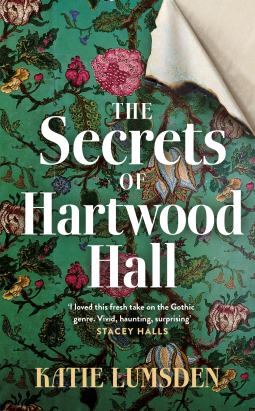
The Secrets of Hartwood Hall by Katie Lumsden

It’s 1852 and the recently widowed Margaret Lennox has just arrived at Hartwood Hall to take up a new position as governess to ten-year-old Louis Eversham. Margaret worked as a governess before her marriage, so has plenty of experience, but she quickly discovers that the Evershams are not quite like any other family she has worked for. Mrs Eversham is secretive and overprotective, isolating herself and Louis from their neighbours, and in the village rumours are spreading that Hartwood Hall is haunted. Although this makes Margaret feel uneasy – and the hostility she faces from one of the maids, Susan, doesn’t help – she does her best to settle into her new job, while also trying to conceal the truth about her own past.

The Secrets of Hartwood Hall is Katie Lumsden’s debut novel and is obviously heavily influenced by the work of the Brontës, particularly Jane Eyre, The Tenant of Wildfell Hall and Agnes Grey. One character turns out to be an author not dissimilar to Charlotte, Emily and Anne, while others are seen reading Brontë novels – and of course, there are elements of the plot and setting that feel very familiar as well. The descriptions of the locked east wing of Hartwood Hall, off-limits to Margaret, with its strange noises and flickering lights made me think of Jane Eyre’s ‘madwoman in the attic’ and had me wondering what exactly was going on in there! Of course, this is a book written in the 21st century, not the 19th, and I could never quite forget that; some parts of this story could never have been written by the Brontës – or would have had to be alluded to much more vaguely.

This is not the only recently published book to be inspired by classic Gothic novels and at first I thought it was going to be very similar to Stacey Halls’ Mrs England, Marianne Ratcliffe’s The Secret of Matterdale Hall or Beth Underdown’s The Key in the Lock, to name a few. However, although I think readers of those books would enjoy this one too, it’s still different enough to be a satisfying story in its own right. I didn’t guess the solutions of all the mysteries hinted at in the book – although I was convinced at one point that I’d worked it all out, some of the revelations still took me by surprise!

There’s a romantic thread to the novel too, as Margaret begins to form a relationship with a male member of the Hartwood Hall staff. However, I found this the least successful aspect of the story. I sensed very little chemistry between the two of them, neither was honest with the other and I felt that Margaret treated him unfairly. For this reason, the later stages of the novel didn’t have the emotional impact they probably should have done. I did enjoy watching Margaret’s relationship with the Evershams develop, as she gained the trust and respect of Louis and Mrs Eversham – and I was angry on Margaret’s behalf about the treatment she received from the scheming Susan! Although I didn’t always agree with Margaret’s decisions, I found her quite an engaging heroine and narrator.

This was an entertaining novel and while not every part of it worked for me, I would be happy to read more books by Katie Lumsden, particularly if they fall into this same subgenre.

Thanks to Michael Joseph for providing a copy of this book for review via NetGalley.

This is book 11/50 read for the 2023 Historical Fiction Reading Challenge.
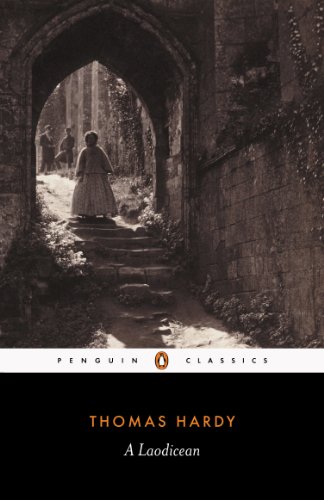
A Laodicean by Thomas Hardy

First published in Harper’s New Monthly Magazine in 1880-81, A Laodicean; or, The Castle of the De Stancys: A Story of To-Day is one of Thomas Hardy’s lesser known novels and one that I very much enjoyed.

Architect George Somerset is exploring the countryside near the village of Sleeping-Green one evening when he stumbles upon a castle. He learns that this is Stancy Castle, the ancestral home of the De Stancy family which has recently been purchased by the wealthy railway contractor, John Power. Mr Power has since died, leaving the castle to his daughter, Paula, who is planning to carry out extensive renovations on the ancient building. When Paula is introduced to Somerset she considers commissioning him to do the work on the castle, but before the restoration even begins Somerset finds himself falling in love with her.

It seems that Somerset has a rival for Paula’s love, however – Captain De Stancy, an impoverished descendant of the aristocratic family who once owned the castle. The Captain’s son, William Dare, has seen a chance to get his hands on some of the Power fortune and is determined that his father must marry Paula, no matter what.

Paula herself is the Laodicean of the title, described by the local minister as ‘lukewarm, and neither cold nor hot’, like the people of the church of Laodicea in the Bible. Throughout the novel she vacillates between Somerset and De Stancy, attracted to both of them in different ways and unwilling to fully commit to one or the other. This reflects the way she feels about society in general. As an industrialist’s daughter who has installed a telegraph wire and a new clock at Stancy Castle, Paula represents science and progress but at the same time she likes the idea of marrying into an aristocratic family and becoming a De Stancy. The clash between tradition and a new way of life is one of the recurring themes that comes up again and again in Hardy’s novels.

Although Paula irritated me with her inability to make up her mind and give either man a definite answer, I found Somerset’s infatuation with her quite annoying as well – I wanted him to notice Paula’s friend, Charlotte, who I think would have been a much better choice for him! Irritating characters aside, I found the story very entertaining, mainly because of the machinations of William Dare, who will stop at nothing to ensure Paula chooses his father. He uses forged telegrams, fake photographs and all sorts of other devious tricks to try to get what he wants and this makes the book more of a pageturner than I’d expected at first.

A Laodicean doesn’t really have the pastoral feel of most of Hardy’s other novels; in fact, most of the second half is set in Europe where the various sets of characters wander around the casinos of Monte Carlo, the spas of Baden and the busy streets and squares of Strasbourg. Things do become a bit far-fetched in this section, with lots of coincidental meetings, but I enjoyed reading something different from Hardy after so many books set in his Wessex countryside.

Although this hasn’t become one of my favourite Hardy novels, it’s still a very good one. I think I only have three more of them to read, as well as some of his short story collections. Have you read this one? What did you think?

This is book 36/50 from my second Classics Club list.

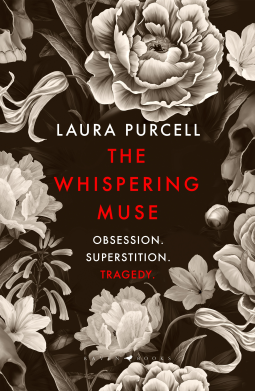
The Whispering Muse by Laura Purcell

This is the second book I’ve read by Laura Purcell; I liked, but didn’t love, the first one I read, Bone China, so was hoping for better things from this one. It certainly sounded good – a Gothic novel set in the theatres of Victorian London – and I wasn’t disappointed at all. I was gripped from start to finish!

Our narrator is Jenny Wilcox, a young woman who has been left to support herself and her younger siblings after her brother Gregory ran off to America with an actress, taking the family savings with him. Jenny is deeply grateful when Gregory’s former employer, Mrs Dyer of the Mercury Theatre, offers her a job as dresser to the new leading lady, Lilith Erikson. Before she even begins work, however, Jenny discovers that Mrs Dyer has not just offered her the position out of kindness – she believes that her husband is having an affair with Lilith and she wants Jenny to spy on them.

At first, Jenny shares Mrs Dyer’s dislike of Lilith, but gradually she becomes concerned about the behaviour of the beautiful young actress. Why is she so obsessed with a watch engraved with the face of Melpomene, Muse of Tragedy – a watch that once belonged to the actor Eugene Grieves, who died on stage while performing Dr Faustus? Could Lilith have formed some sort of pact with Melpomene, to help her achieve her dream of becoming London’s greatest tragic actress? And if so, what will Melpomene demand in return?

The Whispering Muse is divided into five acts, mirroring the five tragedies performed by the Mercury Theatre Company over the course of the novel, beginning with Macbeth. Theatrical settings are usually atmospheric and this one is no exception! I loved the insights we are given into what goes on behind the scenes and the descriptions of Lilith’s powerful stage performances are so vivid I could almost imagine I was watching them from a seat in the front row. The book is wonderfully creepy in places – and a bit gory in others, although not excessively so. What makes it so compelling is that we’re never quite sure whether Lilith really has made a pact with her muse and supernatural forces are at work within the Mercury Theatre or whether the strange events that begin to take place have a more human explanation.

As well as enjoying the fascinating plot, I also found it interesting to see how Jenny’s relationships with the other characters change over the course of the novel. Although I didn’t always agree with Jenny’s decisions, I had some sympathy for her situation – she needs to keep Mrs Dyer happy in order to stay in her job and earn money to support her younger brothers and sister, but the closer she becomes to Lilith the more she starts to feel that Mrs Dyer’s hatred of the actress is unreasonable and the more her conscience begins to bother her. The dynamics between these three characters add extra depth to the story and make it something special. I loved it and look forward to reading Laura Purcell’s other books!

Thanks to Raven Books for providing a copy of this book for review via NetGalley.

This is book 5/50 read for the 2023 Historical Fiction Reading Challenge.
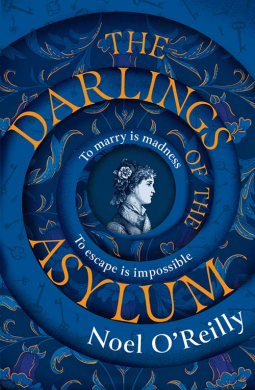
The Darlings of the Asylum by Noel O’Reilly

I have read several novels that tackle the subject of Victorian women locked away in asylums, sometimes due to depression, anxiety or ‘hysteria’, but often simply because they were an inconvenience to their husbands or families. The Asylum by John Harwood, The Crow Garden by Alison Littlewood and The Girl Who Couldn’t Read by John Harding are a few examples and I was keen to see how Noel O’Reilly would approach the same topic in his new novel, The Darlings of the Asylum.

The story begins in Brighton in 1886 with a marriage being arranged between our narrator Violet Pring and the wealthy Felix Skipp-Borlase. Violet is fond of Felix but she knows she doesn’t love him and doesn’t want to marry him – what she really wants is to be free to pursue a career as an artist and she’s not ready to give up on her dream. The more her mother tries to push her into the marriage, the more Violet tries to resist until things finally reach a climax and a tragedy occurs. The next day, with no memory of what happened, Violet wakes up to find herself incarcerated in Hillwood Grange Lunatic Asylum.

Getting to know the other inhabitants of Hillwood Grange, Violet finds that many of them do have genuine mental health issues – although nothing to warrant the kind of treatment they are receiving in the asylum – but she has no idea why she has been sent here herself. She knows she must have done something terrible, but nobody will tell her what it was and she can barely remember her last night of freedom at all. Allowed only limited contact with family and friends and banned from drawing and painting, Violet is miserable and frightened – particularly when she discovers that the sinister Dr Rastrick may have his own reasons for wanting her in the asylum. Violet must find a way to prove that she is sane and escape from Hillwood Grange, but how can she do that when everyone around her seems to be part of a conspiracy to keep her imprisoned forever?

The Darlings of the Asylum is a fascinating novel, although quite similar to the books I’ve mentioned and others with a Victorian asylum/mental hospital element. Still, whether or not you’ve read much on this topic before, the portrayal of Violet’s plight is disturbing and at times horrifying, as she desperately tries to make herself heard and free herself from the clever and manipulative Dr Rastrick. Violet also makes an effort to befriend some of the other women in Hillwood Grange who are even less fortunate than herself and have been dismissed as insane or used as subjects for experiments rather than receiving the sort of care we would expect them to be given today.

Noel O’Reilly has written the book from Violet’s perspective and although sometimes I find that male authors don’t write in a convincing female ‘voice’ and vice versa, I thought he did a good job here. I could believe in Violet as a Victorian woman, albeit a slightly unconventional one. I was also happy with the way her story ended. It wasn’t quite what I’d expected, but better than some of the alternatives would have been! Now I’ll have to read Noel O’Reilly’s first novel, Wrecker, about shipwrecks on the Cornish coast.

Thanks to HQ for providing a copy of this book for review via NetGalley.

Book #63 read for the Historical Fiction Reading Challenge 2022.

The Secret of Matterdale Hall by Marianne Ratcliffe

The Secret of Matterdale Hall is Marianne Ratcliffe’s new novel and the first book to be published by Bellows Press, a small independent publisher who describe themselves as ‘championing unagented writers of speculative & historical fiction, particularly queer, POC & marginalised authors’. In many ways Matterdale Hall seems like a traditional Victorian Gothic novel, but it also has some fresh new elements that make it feel original and different.

Our heroine, Susan Mottram, is a young woman whose family has fallen into poverty following her father’s death. Looking for a way to support her mother and younger sister, Susan finds work as a teacher at Matterdale Hall, a girls’ boarding school run by Dr and Mrs Claybourn in a remote part of Yorkshire. Susan immediately likes the eccentrically dressed doctor, who treats psychiatric patients in his infirmary within the hall, but she has a more difficult relationship with his wife and their daughter Marion, whose views on teaching and discipline conflict with Susan’s own. Some of the children also prove challenging, particularly the badly-behaved Isabella and the silent, withdrawn Mary.

One day, Susan crosses paths with Cassandra, a young woman from a neighbouring estate. At first Cassandra seems strangely hostile, but when Susan discovers that Cassandra is both mixed-raced and deaf, able to communicate only through sign language, she understands that what she had mistaken for hostility is actually shyness and a lack of trust. Gradually, a friendship begins to form between the two of them – and Susan finds that she desperately needs a friend to help her unravel the mysteries that are beginning to emerge at Matterdale Hall. What happened to Susan’s predecessor, who disappeared without trace? Why does little Mary never speak? And what is really going on in Dr Claybourn’s ‘infirmary’?

Although I found some of the secrets of Matterdale Hall quite easy to guess, there was still plenty of suspense as I waited to see whether I was right and how and when Susan would also discover the truth. The lonely Yorkshire setting, with much of the story taking place in the winter, added to the atmosphere and it was difficult not to think of Jane Eyre and Wuthering Heights, while I was also reminded of Stacey Halls’ Mrs England. But as well as the secrets and mysteries, I was fascinated by the portrayal of a small school in the 19th century and the attitudes to education and methods of teaching.

Despite the darkness and the sense of foreboding, there are still some moments of happiness for Susan. The patience and kindness she offers to the girls in her care is rewarded when they begin to open up to her and allow her to help them and her relationship with Cassandra also starts to flourish, first as a simple friendship and then as something more. I liked the way the two women’s feelings for each other develop slowly and realistically rather than being a love at first sight romance, giving the reader time to get to know them both and become invested in their stories. Deaf people don’t get a lot of attention in historical fiction (Shadow on the Highway by Deborah Swift is the only other book I can think of with a deaf heroine) so I found that aspect of the book interesting too.

The Secret of Matterdale Hall is written in a formal style that mimics the Victorian novels that have obviously influenced it and the long chapter titles, giving us an idea of what the following pages will contain, also add to the 19th century feel. It’s an entertaining read and I’ll be interested to see what Marianne Ratcliffe writes about in her next book.

Thanks to the author for providing a copy of this book for review.

Book #60 read for the Historical Fiction Reading Challenge 2022.