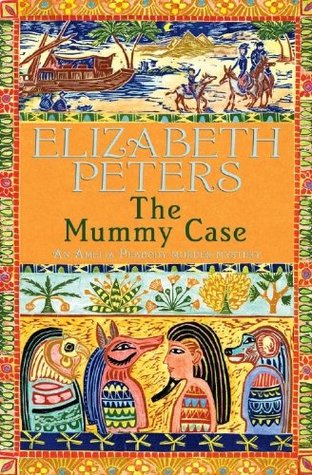
The Mummy Case by Elizabeth Peters

It’s been years since I last read an Amelia Peabody mystery and when I picked up The Mummy Case, the third in the series, I was concerned that I had left too big a gap between books. Luckily, this seems to be a series you can easily return to after a long absence as each book, at least so far, has worked as a standalone mystery.

The Mummy Case is set in 1894 and opens with married Egyptologists Amelia Peabody and Radcliffe Emerson at home in England planning their next trip to Egypt. Amelia dreams of exploring the pyramids of Dahshoor on this visit, but her hopes are shattered with the discovery that her husband has left it too late to submit their application and permission has already been granted to another archaeologist. Amelia and Emerson are offered Mazghunah instead – a barren and uninspiring site believed to be of little historical significance – and they reluctantly accept.

Despite their lack of enthusiasm, the expedition proves to be much more exciting than either of them had expected. Before they even reach their destination, they become caught up in the murder of an antiquities dealer in Cairo who is found dead in his own shop – and when they eventually arrive at Mazghunah, Amelia becomes convinced that somebody connected with the murder has followed them there. When a scrap of papyrus is stolen from their camp and an entire mummy case belonging to a visiting tourist also disappears, even Emerson has to agree that they have stumbled onto the trail of a clever and ruthless Master Criminal!

Unlike their first two mysteries (described in Crocodile on the Sandbank and The Curse of the Pharaohs), Amelia and Emerson have help in solving this one. For the first time, their young son Ramses has accompanied them on a dig and while he often proves to be more of a hindrance, getting into trouble at every opportunity, he also manages to appear at several crucial moments to save the day. Described as ‘catastrophically precocious’ by Amelia, he sounds more like a seventy-year-old professor with a speech impediment than a seven-year-old child and although I’ve been told that he improves as a character later in the series, in this book I found him extremely irritating. However, he’s clearly not meant to be taken too seriously – and to be fair, Amelia finds him irritating too:

The old woman’s cacodemonic laughter broke out again…”The wisdom of the Prophet is yours, great lady. Accept an old woman’s blessing. May you have many sons – many, many sons…”

The idea was so appalling I think I turned pale.

I enjoyed this book, despite Ramses, but I don’t think it was as strong as the previous two in the series. The plot seemed to meander all over the place and it was easy to lose sight of what the central mystery was that the characters were trying to solve. I do still love Amelia and Emerson, though – their good-natured bickering is always entertaining! It was also interesting to learn a little bit about Mazghunah and its disappointingly incomplete ‘pyramids’ and to meet the real-life archaeologist Jacques de Morgan – although seeing him only through Amelia’s eyes gives us a slightly biased impression as he is their rival and the man who is excavating the much more attractive site of Dahshoor!

I am looking forward to continuing with the fourth book in the series, Lion in the Valley.
Book 43/50 read for the 2021 Historical Fiction Reading Challenge.

Book 2 read for R.I.P. XVI

Carmilla by Sheridan Le Fanu

My first book for this year’s RIP challenge is Irish author Joseph Sheridan Le Fanu’s classic vampire novella, Carmilla. First published in 1872, it is thought to have influenced Bram Stoker’s Dracula, which came more than twenty years later, and is one of the earliest examples of vampire fiction (although John Polidori’s The Vampyre and Byron’s Fragment of a Novel were written earlier still).

My previous experience with Le Fanu has been limited to his Victorian Gothic novel, Uncle Silas, and one of his short stories, Laura Silver Bell, both of which I read ten years ago. I’ve always intended to read more of his work, so when I saw Carmilla available through NetGalley (a new Deluxe Edition is being published by Pushkin Press this week) it seemed the perfect opportunity.

The story is narrated by nineteen-year-old Laura, who lives in a lonely castle in Styria, Austria, with only her father and governesses for company. Laura longs for a friend her own age and it seems she may get her wish when a young woman is injured in a carriage accident near the castle. Her name is Carmilla and her mother, who is desperate to continue on her journey, asks Laura’s father to take care of her daughter until she returns. Laura is delighted to have Carmilla staying with them, but also feels uneasy, because she has seen Carmilla before – in a dream that has haunted her since her childhood.

As this is a very short book, if I say much more I will be giving away the entire plot – and anyway, as I’ve already said that this is a vampire novel, you can probably guess what Carmilla really is and how the rest of the story will unfold. For the modern day reader there are no big surprises here, although I’m sure that at the time when it was published, as one of the first of its kind, it would have felt much more original and shocking. However, there are still plenty of things that make this book an entertaining and worthwhile read.

First of all, it’s interesting to read Carmilla while keeping in mind its place in history and its influence on later vampire fiction – there are some very obvious similarities with Dracula and Anne Rice has cited it as an inspiration for her Vampire Chronicles. It can also be read as an early example of a lesbian romance; although the constraints of 19th century fiction prevent Le Fanu from being too explicit, the relationship between Laura and Carmilla is clearly based upon physical attraction and we learn that Carmilla always chooses young women as her prey. Finally, with its sinister atmosphere, remote castle setting and other elements of classic Gothic literature, it’s the perfect choice if you’re taking part in the RIP event or just looking for something dark and spooky to read as we head towards Halloween!

Thanks to Pushkin Press for providing a copy of this book for review via NetGalley.

Book 1 read for R.I.P XVI

A Corruption of Blood by Ambrose Parry

This is the third book in Ambrose Parry’s historical mystery series featuring Dr Will Raven and Sarah Fisher. The first two are The Way of All Flesh and The Art of Dying, but if you haven’t read either of those it shouldn’t be a problem – although I would still recommend reading them in order if possible so that you can understand the background of the relationship between Will and Sarah.

Ambrose Parry is a pseudonym used by husband and wife team Chris Brookmyre and Marisa Haetzman; Brookmyre is an experienced crime novelist while Haetzman is an anaesthetist and medical historian, which explains why the 19th century world of murder and medicine portrayed in the books feels so real and convincing.

At the beginning of A Corruption of Blood, Sarah travels to Paris and Gräfenberg hoping for a meeting with Elizabeth Blackwell, the first woman to obtain a medical degree in America and become a doctor. Sarah has an interest in medicine herself and is sure that she could achieve the same as Dr Blackwell if given the chance, but things don’t go as planned and Sarah goes back to Edinburgh feeling disillusioned and frustrated. On returning home, she receives more bad news when she learns that Dr Will Raven has just become engaged to another woman, Eugenie Todd. Sarah has always resented Will for being able to take advantage of the opportunities that have been denied to her because of her gender, but recently they have been on friendlier terms and she is disappointed to hear of his engagement.

Meanwhile, Will is having problems of his own. Through his work with the famous Scottish obstetrician Dr James Simpson, he has become used to witnessing the trauma of childbirth and, sadly, the deaths of children – however, even he is not prepared for the sight of a dead baby wrapped in a parcel being fished out of the river. Soon after this, Will’s new fiancée asks for his help; her friend Gideon has been accused of murdering his father, Sir Ainsley Douglas, and she wants to prove that he is innocent. Will knows and dislikes Gideon from his student days, but agrees to investigate. Could both deaths somehow be connected?

This is such an interesting series, not so much because of the murder mystery aspect (which I don’t think is particularly strong) but because of the Victorian Edinburgh setting and all of the information we are given on the medical science of the period, as well as the challenges faced by women like Sarah and Dr Blackwell who wanted to make a career for themselves in a field dominated by men. This particular novel also includes a storyline involving the unpleasant, distressing but sadly quite common practice of baby farming, where unwanted or illegitimate children were sold to a ‘baby farmer’, who in theory would look after the child in return for a payment, although it was often more profitable for the baby farmer if the child conveniently died while in her care.

It took me a while to get into this book; the pace is very slow at the beginning and it takes a while for the plot to take shape and the different threads of the story to start coming together. Things improve in the second half, though, and there are a few surprises and plot twists that I hadn’t really expected. The relationship between Sarah and Will continues to develop, with the way each of them feels about Eugenie adding some extra interest, and I will look forward to seeing how this progresses in the next book. I hope there is going to be a next book and I hope we don’t have to wait too long for it!

Thanks to Canongate Books for providing a copy of this book for review via NetGalley.

Book 11/20 of my 20 Books of Summer.

Book 39/50 read for the 2021 Historical Fiction Reading Challenge.

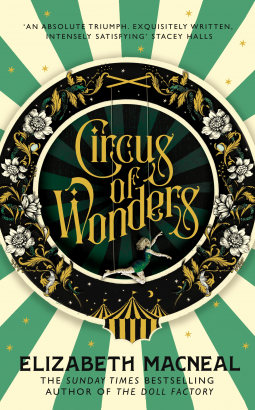
Circus of Wonders by Elizabeth Macneal

I enjoyed Elizabeth Macneal’s first novel, The Doll Factory, so was looking forward to reading her new one, Circus of Wonders.

Beginning in the year 1866, Circus of Wonders tells the story of Nell, a young woman who has always been made to feel like an outsider in her small village on the south coast of England. The unusual birthmarks which cover her skin set her apart from the rest of the community and although her brother does his best to protect her, Nell knows she will never fit in. When Jasper Jupiter’s travelling circus arrives in the village, Nell is horrified to learn that her father has sold her to Jasper, who is looking for a new ‘curiosity’ to draw in the crowds. Once she settles into her new life, however, she begins to think that joining Jasper’s show is the best thing that could have happened to her. Her performance as ‘the Queen of the Moon and Stars’ proves to be a huge success, but how will Jasper feel if she becomes a bigger star than he is himself?

Nell’s story alternates with chapters written from the perspectives of two other characters, Jasper and his brother Toby. There’s a strong bond between the brothers, but they are two very different men. Jasper is very much the leader, an ambitious and ruthless businessman who sees the exploitation of other people as his way to fame and fortune. Toby, who helps him to run the circus, is a gentle, compassionate man desperate to find a way out from his brother’s shadow, but still haunted by his experiences as a photographer in the recent Crimean War. As the novel progresses we learn more about all three main characters as each of them tries to find their place in the world.

Although this is not always a very comfortable book to read, I think Macneal handles a sensitive topic very well. Nell and the other ‘circus attractions’ are treated as commodities to be bought and sold by collectors and showmen, but they are all presented as fully developed characters who, despite their unusual appearances, are normal human beings like anyone else. I have read a few other novels that deal with the same subject, so I was pleased to come across references to Charles Stratton, who appears in The Autobiography of Mrs Tom Thumb by Melanie Benjamin and Julia Pastrana from Orphans of the Carnival by Carol Birch. Unlike Stratton and Pastrana, who both really existed, Nell is a fictional character but her story is no less moving and believable. I was also interested in the flashbacks to the Crimean War, where we gradually find out what really happened to Jasper and Toby, shaping them into the men they are when we meet them at the beginning of the novel.

Of Elizabeth Macneal’s two books, I think I preferred The Doll Factory, but I enjoyed both and will be looking out for whatever she writes next.

Thanks to Picador for providing a copy of this book for review via NetGalley.

Book 25/50 read for the 2021 Historical Fiction Reading Challenge.

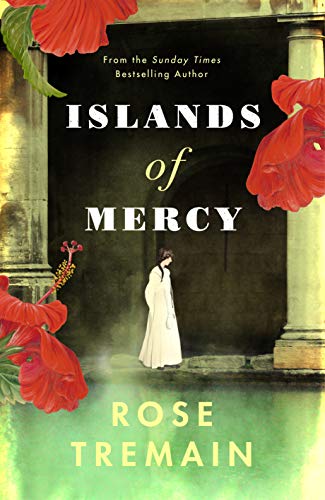
Islands of Mercy by Rose Tremain

I’ve found this a difficult book to write about because, although it is undoubtedly very well written and has a lot of the elements I would usually find interesting, for some reason I just didn’t like it very much and have struggled to explain why. It was particularly disappointing as I’ve enjoyed the other Rose Tremain books I’ve read – Restoration, Merivel and The Gustav Sonata – so I had high hopes for this one too.

Anyway, Islands of Mercy begins in 1865 in Bath, ‘a place where very many rich people assembled, to take the waters, or simply to take their leisure’. Jane Adeane is the twenty-four-year-old daughter of a renowned Bath surgeon and works with him as a nurse, gaining a reputation for herself as The Angel of the Baths. She has caught the eye of her father’s fellow doctor and business partner, Dr Valentine Ross, but his attentions are unwelcome to her and she decides to go to London for a while to stay with her Aunt Emmeline, an artist. Here she meets one of Emmeline’s friends, the beautiful Julietta Sims, and feels an instant attraction to her. Soon, Jane finds that she is falling in love with Julietta, and when she returns to Bath she must decide whether she wants the security that marriage to Dr Ross could give her or whether she would prefer to be free to pursue her relationship with Julietta.

Jane’s story alternates with that of Sir Ralph Savage, an eccentric Englishman who lives on the island of Borneo with his servant and lover, Leon, and calls himself ‘the Rajah of the South Sadong Territories’. Leon is an ambitious and resourceful young man who is always coming up with new money-making schemes, but he is also a jealous man and is not at all happy when Edmund Ross, a naturalist who has come to Borneo in search of new species, arrives on Sir Ralph’s estate.

Edmund is the younger brother of Valentine Ross and this provides a link between the two storylines – however, it is a very weak link and for most of the novel they seem like two completely different, unconnected stories. Borneo is certainly a fascinating and unusual setting, but I didn’t have any interest in Sir Ralph and Leon and felt that their chapters could probably have been left out entirely as they added very little to the overall plot of the novel. This made the whole experience of reading this book feel disjointed and every time the narrative switched to Borneo I couldn’t wait for it to return to Bath again.

Although I found Jane’s chapters much more compelling, I was disappointed by the character arc Valentine Ross goes through; I did have some sympathy for him at first after Jane’s initial rejection of him, but he quickly becomes so unpleasant and controlling that he feels like a stereotypical villain rather than a believably flawed character. I didn’t doubt Jane’s love for Julietta, so I don’t really think it was necessary to make Valentine so needlessly cruel and selfish – in fact, I think it would have been more interesting if Jane had faced a choice between the woman she loved and a man whom she at least liked.

There is a third thread to the novel that I haven’t mentioned yet and this follows the story of Clorinda Morrissey, a woman from Dublin who opens a tea shop in Bath, where she gets to know Jane and her father. Clorinda was the one character in the book I really liked and would have been happy to visit for a cup of tea and a cake! I wished we had spent more time with her rather than some of the other less engaging characters.

I will continue to read Rose Tremain’s books as it’s only this one so far that I haven’t enjoyed. Luckily there are plenty of her earlier novels left for me to explore.

Book 2/50 read for the Historical Fiction Reading Challenge.

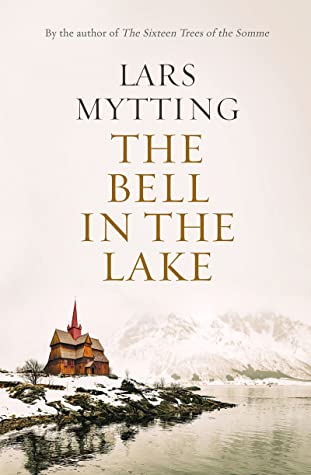
The Bell in the Lake by Lars Mytting

This beautifully written novel, translated from the original Norwegian by Deborah Dawkin, is the first in a planned trilogy based around the legend of the Sister Bells. The bells commemorate conjoined twin sisters Gunhild and Halfrid Hekne, who lived in the remote village of Butangen and died within hours of each other. Their family donated the bells to the local church in memory of the twins and they are still hanging there, in the bell tower, in 1880 when the novel begins…

As the rest of the world heads towards the twentieth century, Butangen appears to be frozen in time, a place where life is still ruled by superstition and folklore, where people still believe in evil spirits and ill omens. When Kai Schweigaard, an ambitious young pastor, arrives in the village he despairs of ever bringing change to a population so resistant to progress and modern ways of thinking.

If only people had light, he thought. If there was a strong lamp in every home, which could illuminate faces and edifying books, I could banish these mad notions in a few years. But at sunset the village grew dark, and with it folk’s minds, and these unknown powers ruled until sunrise.

One of the ways in which Kai hopes to improve life in the village is by replacing the ancient 12th century stave church where a parishioner actually froze to death during Mass with a larger, warmer, more comfortable building. The old church, complete with its pagan carvings and twin bells, is to be dismantled and reconstructed in Dresden, and a young German architect – Gerhard Schönauer – has arrived to make drawings of the church before it is taken down. However, Kai and Gerhard face opposition not only from the people of Butangen, who are suspicious and resentful of anything new, but also from the Sister Bells themselves. The bells are said to have supernatural powers and to ring on their own when danger is approaching – and it seems that the bells don’t want to be removed.

As well as the two men, a large part of the story is also written from the perspective of twenty-year-old Astrid Hekne, who works as a maid in Kai Schweigaard’s household at the parsonage. Despite the differences in their social standing, Kai is considering making Astrid his wife, but complications arise when Astrid finds herself drawn to Gerhard Schönauer. Meanwhile, as a descendant of the twins Halfrid and Gunhild, Astrid feels a responsibility for the bells and decides she must do whatever it takes to prevent Gerhard from transporting them to Dresden with the rest of the church.

The Bell in the Lake is a wonderfully atmospheric novel thanks to Lars Mytting’s beautiful descriptions of the landscape around Butangen, particularly in winter with its frozen lakes and snow-covered hills and valleys, while the supernatural elements and the role of the Sister Bells legend give the story an eerie and mysterious feel. The sense of time is as strong as the sense of place and the characters feel like real 19th century people, rather than modern day people dropped into a random historical setting. However, I think the decision to have Astrid and the other villagers speak in a dialect which seems to be mainly Scottish is a bit strange. I suppose the translator had to find a way to differentiate between the speech of the local people and the outsiders (who speak in standard English), and using Scottish words makes sense because of the close ties with Norway, but I found it slightly distracting and kept forgetting that Astrid was actually Norwegian!

One of my favourite themes in fiction is the conflict between old ways of life and new, and in this novel we see how the inhabitants of Butangen are reluctant to move away from the traditions they have always followed and try to resist any kind of social, scientific or religious progress. Although Astrid has been brought up with the same beliefs, she has a more adventurous spirit than most of her neighbours and longs to see more of the world, which is what draws her to Gerhard. The demolition of the old church, which Gerhard has come to oversee, and the building of the new one is symbolic of all of this. If you’ve never seen a Norwegian stave church, by the way, I recommend googling them – they look amazing and it’s sad to think that there are so few of them left.

Having enjoyed The Bell in the Lake so much, I am looking forward to the other two books in the trilogy and hope we won’t have to wait too long for the next one!

Thanks to Quercus Books for providing a copy of this book for review via NetGalley.

Shadowplay by Joseph O’Connor

Having enjoyed one of Joseph O’Connor’s earlier novels, Ghost Light, about the relationship between the playwright John Millington Synge and the actress Molly Allgood, I was looking forward to reading his newest book, Shadowplay, which was shortlisted for this year’s Walter Scott Prize for Historical Fiction. Like Ghost Light, this book explores the lives of several real historical figures from the literary and theatrical worlds – in this case, the Irish author Bram Stoker and the English stage actors Henry Irving and Ellen Terry.

Bram Stoker, of course, is best known for his 1897 novel Dracula, which is written in an epistolary style and O’Connor uses a similar format in Shadowplay, telling the story through a series of imagined diary entries, letters and transcripts of recordings. Beginning with his life in Dublin and marriage to Florence Balcombe, the novel takes us through Stoker’s meeting with the great Shakespearean actor Sir Henry Irving and his move to London to become the manager of Irving’s Lyceum Theatre. Stoker’s involvement with Irving and the Lyceum leads to a friendship with Ellen Terry, the leading actress of her time, and the relationship between these three characters forms the heart of the novel.

While much of Stoker’s time is taken up with managing the theatre and trying to deal with Irving’s eccentricities, sudden rages and heavy drinking, he also continues to work on his own career as an author. Sadly he won’t achieve the fame he deserves until after his death, but in Shadowplay we see him drawing on his experiences and the people and places around him to put together the various parts of the novel that will become Dracula. I should point out, though, that this book is a work of fiction and Joseph O’Connor finds some very creative ways to weave Dracula allusions into the plot. They are not necessarily things that influenced the real Stoker, but I thought it was fascinating and cleverly done. Jonathan Harker appears, and Mina, although not quite in the way you might expect, a visit to an asylum inspires the creation of the insect-eating Renfield, and with Jack the Ripper haunting the streets of London at that time, it’s easy to see why themes of death and darkness wouldn’t be far from an aspiring author’s mind.

Despite all the interesting ideas explored in this novel, I can’t really say that I loved it. I thought the format and structure of the book made it feel slightly disjointed; a more conventional narrative would have worked better for me and would have made it easier for me to connect with the characters and become more fully asbsorbed in their stories. Still, this is an entertaining and very imaginative novel and I’m pleased to have had the opportunity to learn a little bit more about Bram Stoker, Henry Irving and Ellen Terry!