Why Didn’t They Ask Evans? by Agatha Christie

Continuing my recent forays into the novels of Agatha Christie, Why Didn’t They Ask Evans? is another one that I’ve really enjoyed and one of my favourites so far. This is one of Christie’s standalone novels (i.e. not Poirot, Marple or any other series).

Bobby Jones, son of the vicar of Marchbolt, is playing golf near the sea one day when he discovers that a man has fallen over the cliff. Left alone with the body while his friend goes to get help, Bobby is the only person who hears the man’s dying words: “Why didn’t they ask Evans?” As soon as Bobby informs the dead man’s family of his last words, a number of strange incidents start to occur, ending in Bobby’s beer being poisoned. After consulting with his friend Lady Frances Derwent (known as Frankie), they decide that someone must be trying to silence Bobby before he uncovers the truth behind the man’s death. As Frankie and Bobby attempt to find out what’s going on, they find themselves caught up in a mystery which leads them to a sanatorium run by the sinister Dr Nicholson.

The plot quickly becomes very far-fetched and ridiculous with lots of disguise-wearing, last-minute rescues and amazing coincidences. Frankie and Bobby constantly stumble upon clues and it seems that people give confidential information to them very freely – if it was really that easy to get people to tell you things, every crime would be solved in no time! Frankie and Bobby themselves even remark on the unreality of the situation and that they feel as if they’ve fallen into the pages of a novel.

Due to the number of red herrings and twists in the plot, the mystery is a more complex one than I thought it would be at first. If you could work out the significance of the phrase “why didn’t they ask Evans?” before it is revealed you must be a genius! I would never in a million years have guessed who Evans would turn out to be as it’s not something that can easily be deduced until you’ve been given all the pieces of the puzzle.

Why Didn’t They Ask Evans? is a fast-paced, light-hearted read with a very likeable pair of amateur detectives (particularly the courageous, quick-thinking Frankie). The melodrama and silliness are all part of the fun – this book never takes itself too seriously and despite topics of murder, drug use and kidnapping it never becomes too dark. Be prepared to suspend disbelief for a while, then sit back and be entertained.

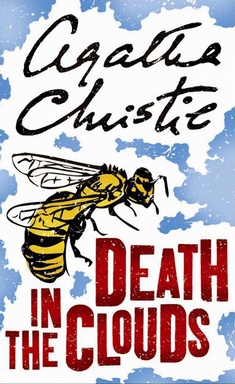
Death in the Clouds by Agatha Christie

Death in the Clouds, first published in 1935, is one of Agatha Christie’s many novels featuring the Belgian detective Hercule Poirot.

Ten people are travelling on a plane flying from Paris to London. During the flight a woman is found dead in her seat – apparently a murder has taken place without anyone seeing it happen. Among the other passengers is Poirot, who can’t believe a crime has taken place right under his nose! The mystery proves a difficult one to solve and after landing in England the suspects are allowed to go back to their everyday lives. As Poirot continues to investigate, he uncovers some secrets about the murdered woman and discovers that more than one of her fellow passengers had a reason to want her dead…

Like many classic mysteries, the crime takes place in a confined space so that we know from the beginning who the suspects are. The fact that this novel is set on a plane makes a nice change from the usual country house! The suspects include a beautiful aristocrat with a cocaine addiction, two prominent archaeologists, a doctor, a dentist, a businessman, a hairdresser – and my personal favourite, a crime novelist, whose inclusion gives Christie a chance to have some fun at the expense of her own genre. The characters don’t have a lot of depth and there are only a few that we get to know well, yet Christie makes it easy to remember who is who. There are plenty of red herrings to make the reader suspect first one person and then another; it’s even possible that Poirot himself could have committed the murder!

I enjoyed studying the seating plan at the front of the book and the list of the contents of the passengers’ luggage in an attempt to work out what had happened – but as usual, I didn’t even come close to solving the mystery. In a way I’m glad that my crime-solving skills are so bad because it means I can be surprised by all the twists and turns of the plot as the author intended.

I’m having fun working through all the Agatha Christie books available from my library’s ebook section, so you can expect some more Christie posts from me in the near future. It’s funny because her books had never held much appeal for me in the past, though maybe I was just unlucky with the ones I was choosing to read. Although Death in the Clouds is not one of the best that I’ve read so far, it was still an enjoyable read.

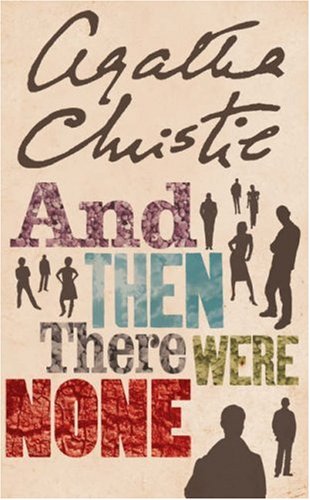
And Then There Were None by Agatha Christie

Although I usually enjoy mysteries, I’ve never considered myself to be a big fan of Agatha Christie. I didn’t really like the Poirot books I’ve read (though admittedly I’ve only tried a few of them) and Miss Marple didn’t appeal to me either. If only I had started with this one instead!

At the beginning of the book we are introduced in quick succession to ten people who have all been invited to a house on Soldier Island, off the coast of Devon. Each person has been given a different reason as to why their presence on the island is required, but on arriving at the house the group discover that their hosts are mysteriously absent. When, one by one, they begin to suffer gruesome deaths in accordance with the children’s rhyme “Ten Little Soldiers” it becomes obvious that one of the ten is a murderer.

The thing that makes this book such an exciting and suspenseful read is that all ten characters seem suspicious and the more you learn about them the more it appears that any one of them could be the killer. Halfway through the book I thought I had worked it out as there was one character in particular that I had suspected from the start (although it was more just an instinct rather than anything specific that he or she had done). As the story moved towards the conclusion it looked as if I was going to be right…

Do I need to tell you that I got it entirely wrong? I admit that solving whodunits is not one of my strong points, but I think most people would be baffled by this one! Christie expertly leads you to believe one thing, then a few pages later proves you wrong. I was sure that as more and more of the ten were eliminated one of them would emerge as the most obvious suspect, but that didn’t happen.

Have you read this book? Did you guess the solution to the mystery?