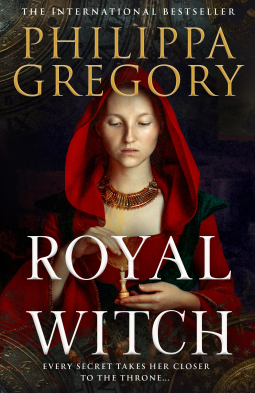
 It’s been years since I last read anything by Philippa Gregory, so I decided to try her latest novel, Royal Witch. It’s the story of Eleanor Cobham, Duchess of Gloucester, a woman who has appeared as a secondary character in other books I’ve read (including Gregory’s own The Lady of the Rivers), although this is the first one I’ve read that focuses on her specifically.
We first meet Eleanor in 1421 as a young woman of twenty arriving at Westminster Palace to become a lady-in-waiting to Jacqueline, Countess of Hainault. Jacqueline has taken refuge at the English court after being betrayed by members of her own family who have seized her lands. She is looking for help to regain them and marries Humphrey, Duke of Gloucester, in the hope that he can provide the military support she needs in Hainault. Humphrey, however, is having problems in his own country – although he has been named Protector of England until his baby nephew, Henry VI, is old enough to rule, he faces opposition in government from his Beaufort rivals.
As the daughter of a minor nobleman, Eleanor arrives at court wanting nothing more than to marry well, but once she grows close to the strong and determined Jacqueline and sees what it’s possible for a woman to do, she starts to believe she should be aiming higher. She turns for help to Margery Jourdemayne, known as the Witch of Eye, but if it becomes known that Eleanor has been meddling in the dark arts, it could lead to her downfall rather than her glory.
I enjoyed Royal Witch; I love this period of history and it was good to see it through the eyes of a woman I haven’t read very much about. The events taking place in England are significant because they lead directly to the Wars of the Roses and the founding of the Tudor dynasty, but I also found Jacqueline interesting to read about – her campaign to reclaim her lands forms a big part of the first half of the novel and I kept thinking that maybe Gregory should have just written Jacqueline’s story instead of Eleanor’s! Eleanor’s own story doesn’t really start to gain momentum until halfway through the book when she sets her sights on the throne of England and begins to set her plans in motion.
Gregory often seems to enjoy making her heroines as unpleasant as possible (like Margaret Beaufort in The Red Queen); Eleanor is another example of this – she’s ambitious, vain, selfish and vindictive, with few, if any, redeeming qualities. Despite this, it’s impossible not to feel for her when she is rejected by the man she loves, Owen ap Maredudd, who chooses another woman over her, an incident which is the source of a lot of her anger and resentment in the second half of the novel. You may already know who Owen is and who he marries instead, but if not I’ll let you find out for yourself! As Eleanor plots revenge on Owen and his new lover, her outward actions become more cruel and her inner thoughts more bitter, which makes her both an entertaining narrator and quite a chilling one as well. Not even the young king is safe from her plots and machinations.
Margery Jourdemayne is another interesting character. She’s portrayed mainly as a herbalist and fortune teller who becomes caught up in Eleanor’s scheming, along with the astrologer Roger Bolingbroke, leading to accusations of witchcraft, treason and necromancy. This is the climax of the story which everything that comes before was building towards, but we have to wait a long time for it – and that’s my only real criticism of the novel; it often felt longer than it really needed to be and the earlier sections could probably have been condensed to improve the pacing. Otherwise I found this very enjoyable and I wish more authors would write about lesser known Plantagenet women rather than the Tudors!
Thanks to HarperCollins for providing a copy of this book for review via NetGalley.

