Written on the Dark by Guy Gavriel Kay

It seems to me that most moments in a life can be called interludes: following something, preceding something. Carrying us forward, with our needs and nature and desires, as we move through our time. It also seems to me that it is foolish to try to comprehend all that happens to us, let alone understand the world.
This is a beautiful historical fantasy novel loosely inspired by the life of the poet François Villon. It takes us to a world that will be familiar to Kay readers – a world with two moons, one blue and one white, where the three main religions are Asharite, Jaddite and Kindath, corresponding to Islam, Christianity and Judaism – but where his most recent novels have been set in thinly disguised versions of Venice, Dubrovnik and Constantinople, this one takes place in Ferrieres, based on medieval France.

On a freezing cold night in the city of Orane, the young poet Thierry Villar steps out of the tavern in which he’s been staying to find that he is surrounded by armed horsemen. He’s convinced that he’s going to be arrested – desperate for money, Thierry had become embroiled in a plot to rob a sanctuary – but to his surprise, he is escorted through the streets to where a man lies dead, brutally stabbed. This is the Duke de Montereau, one of the most powerful noblemen in Ferrieres and the younger brother of King Roch, who is struggling to rule due to mental illness. In return for not arresting Thierry, the provost of Orane asks him to help discover who murdered the Duke by listening to gossip in the city’s shops and taverns.

If you know your French history, you may have guessed that King Roch is based on King Charles VI, nicknamed ‘the Mad’ due to his episodes of mental instability and a belief that he was made of glass. Montereau, then, is a fictional version of the King’s brother, the Duke of Orléans, who was assassinated in 1407. Other people and incidents in the novel can also be connected to real characters and events from the Hundred Years’ War, which adds an extra layer of interest to the story if you’re familiar with this period of history. If not, it doesn’t matter at all since, as all the names have been changed, the book can also be read as a work of pure fiction.

Written on the Dark is a shorter novel than is usual for Kay and feels more tightly plotted than his other recent books, with a stronger focus on the main character and fewer diversions into the stories of minor characters. This probably explains why I thought this book was more enjoyable than the last two or three. Although I know nothing about the real François Villon so can’t say how his story may correspond with Thierry Villar’s, I found Thierry a likeable character; he has his flaws and sometimes makes mistakes, but this just makes him feel more relatable and human. An overarching theme of the book (and of Kay’s work in general) is the idea that even people who are considered ordinary or insignificant can play a key role in important events and influence not only their own fate but the fates of many others.

The fantasy aspect of the novel is limited mainly to the alternate version of France and to a mysterious character known as Gauvard Colle who can communicate with the ‘half-world’. There are also some surprising twists where things like the Battle of Agincourt and the story of Joan of Arc don’t go in quite the direction you would expect! I loved this one and am looking forward to reading his earlier book inspired by medieval France, A Song for Arbonne, which is one of a small number of Kay novels I haven’t read yet.

Thanks to Hodderscape for providing a copy of this book for review via NetGalley.

The Summer Tree by Guy Gavriel Kay

Having read most of Guy Gavriel Kay’s more recent novels, I decided it was time to go back to the beginning and read his earliest work, The Fionavar Tapestry, a fantasy trilogy published between 1984 and 1986. I had been warned that this was very different from his later books, and now that I’ve read the first volume, The Summer Tree, I would agree, but I was pleased to find that I enjoyed it anyway.

The Summer Tree begins with five Canadian students – Kevin Laine, Paul Schafer, Kimberly Ford, Jennifer Lowell and Dave Martyniuk – attending a lecture by Professor Lorenzo Marcus at Toronto University. After the lecture, the Professor invites the five of them back to his hotel, where he reveals to them that his true identity is Loren Silvercloak, a mage from the land of Fionavar. His High King, Ailell of Brennin, is celebrating his fiftieth year on the throne, and Loren has been sent to our world to bring five guests to the celebrations. Once in Fionavar, however, the five find themselves caught up in the politics of this other land and discover that each of them will have a part to play in the upcoming battle against the evil god Rakoth Maugrim, the Unraveller.

I was already familiar with Guy Gavriel Kay’s incredible worldbuilding from his other books – the way he plunges the reader straight into fully formed landscapes based on thinly disguised versions of real historical settings (such as China’s Song Dynasty in River of Stars or medieval Spain in The Lions of Al-Rassan). The worldbuilding is just as strong in this novel, but although he does draw on the mythology of our own world (particularly Celtic and Norse), this time he relies much more heavily on Tolkien and traditional high fantasy. That’s not surprising as Kay did work with Tolkien’s son Christopher on the editing of Tolkien’s posthumous book The Silmarillion. And so, in The Summer Tree we have Loren Silvercloak in the role of Gandalf the Grey, Rakoth Maugrim who resembles Sauron, an exiled Dwarf king, and the Elf-like lios alfar and their counterparts the svart alfar. There’s also a CS Lewis influence, I think, as there’s a character with the name Maugrim in the Narnia books and the Fionavar city of Paras Derval made me think of Narnia’s Cair Paravel.

With such a vast and complicated world to explore, Kay gives each of his five main characters individual storylines, taking them to different areas of Fionavar and allowing them to interact with different groups and tribes. For example, Dave Martyniuk becomes separated from the others early on and spends most of the novel getting to know the Dalrei, a plains-dwelling tribe of hunters, while Kim Ford discovers that she has the powers to become a Seer. However, I felt that some of the characters lacked depth and the novel as a whole feels less mature and polished than his later books.

I didn’t love The Summer Tree, but I liked it enough to want to continue with the second book in the series, The Wandering Fire – and as this one ended on a cliffhanger I probably shouldn’t wait too long before picking the next one up! I also still have A Song for Arbonne and The Sarantine Mosaic left to read, although at this point I’ll be surprised if anything surpasses Tigana as my favourite book by Kay.

This is book 4/20 of my 20 Books of Summer 2023

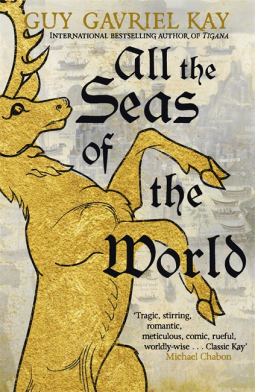
All the Seas of the World by Guy Gavriel Kay

Guy Gavriel Kay’s new novel is set in the same world as his previous two, Children of Earth and Sky and A Brightness Long Ago, but although the three books are closely linked, they are separate stories and I’m sure you could read this one as a standalone if you wanted to.

The world to which I’ve just referred is a fictional world which closely resembles the area surrounding the Mediterranean during the 15th century. Countries and cities are given different names (Italy becomes Batiara, Spain is Esperaña, Venice is Seressa) and the characters belong to one of three religions which clearly correspond to the main three religions in that part of the world at that time. The Asharites (Muslims) worship the stars, the Jaddites (Christians) worship the sun and the Kindath (Jews) worship the two moons, one blue and one white, which both shine in the sky. This third novel is set just after the Jaddite city of Sarantium has fallen to the Asharite Osmanlis, who have renamed it Asharias – like our own world’s Constantinople which fell to the Ottoman Empire in 1453 and would become Istanbul.

Some of the characters we met in A Brightness Long Ago appear again in this book, but the focus is mainly on two new characters. First, there’s Lenia Serrano, a young woman who was abducted by Asharite raiders as a child and raised as a slave. Now free, she longs to return home to Batiara but, convinced that her years in slavery will have brought shame upon her family, home is the one place she’s determined to avoid. Rafel ben Natan, our other protagonist, is a Kindath merchant whose family fled persecution in Esperaña some years earlier. Rafel’s brother has disappeared without trace, leaving Rafel responsible for his sister-in-law and her children.

As the novel opens, Lenia and Rafel have been hired by two pirate brothers to carry out the assassination of the khalif of Abeneven. Their decision to accept this assignment brings them life-changing wealth, but also has huge consequences for the balance of power between rival states, bringing the world to the brink of war.

Some readers may be put off by the labelling of Kay’s novels as ‘fantasy’, but other than the alternate names for people, places and religions, and one or two very subtle supernatural elements, this book (like most of his others) is much closer to historical fiction than it is to traditional fantasy. Setting his story in a thinly-disguised version of Renaissance Europe gives Kay an opportunity to explore that period of history while being freed from the constraints of having to stick to historical fact. However, in this particular book, there are also some obvious parallels with today’s world; exile and displacement are major themes, with various characters being forced to leave their own countries because of war, persecution or other reasons and then either searching for somewhere new to make their home or trying to find a way to return.

This is a beautifully written novel, but I do think Kay’s writing style is probably a bit of an acquired taste. Much as I like his books, I’m starting to find his habit of going off on tangents to explore the lives of minor characters and the heavy messaging around choices and the consequences of our actions very repetitive. These most recent books are not his best, in my opinion – his earlier ones seemed to have stronger plots and a tighter focus, so if you’re new to his work I would recommend starting with one of those; Tigana is my favourite and The Lions of Al-Rassan is also very good (and set in this same two-mooned world several centuries earlier). Readers who’ve already enjoyed some of his other historical fantasy novels should enjoy this one too; I did and am looking forward to reading the remaining ones I still haven’t read.

Thanks to Hodder & Stoughton for providing a copy of this book for review via NetGalley.

River of Stars by Guy Gavriel Kay

River of Stars is a sequel to an earlier novel by Guy Gavriel Kay, Under Heaven, but being set several centuries apart, the two books stand alone and it’s not essential to read them in order. However, the world Kay creates in this novel has been shaped by the events of the previous one, so that’s something worth bearing in mind.

The world to which I’m referring is a thinly disguised version of China during the time of the Song Dynasty – or Twelfth Dynasty, as it is called in the novel. Since the fall of the glorious Ninth Dynasty, described in Under Heaven, Kitai (the name given to China) has been in decline; their Fourteen Prefectures have been lost to barbarians from the northern steppes, and their once mighty empire is no more. With the army greatly weakened, military decisions are now made by government ministers while bad news is hidden from the emperor who immerses himself in poetry, calligraphy and the creation of a magnificent garden.

As the story of this fallen empire unfolds, we are introduced to a large number of characters. Two of the most prominent are Ren Daiyan, who believes his purpose in life is to reclaim the lost Fourteen Prefectures and restore Kitai to its former glory, and Lin Shan, a woman who writes poetry and thinks for herself, at a time when women are not expected to do either of those things. The paths of Ren Daiyan and Lin Shan cross now and then and their actions carry the story towards its conclusion, but along the way we meet an assortment of emperors and barbarians, prime ministers and war-leaders, diplomats and poets, some of whom have a big part to play in the story and some a small one, but all are significant in one way or another.

Although Kay’s novels are usually described as historical fantasy, most of them have very few traditional elements of fantasy – in this particular book I only noticed two or three, including an encounter with a fox-woman and a few mentions of ghosts. His books are much closer to historical fiction, which is probably one of the reasons why I enjoy them so much (along with the beautiful, lyrical writing). Before starting this one, I knew nothing at all about the Song Dynasty, so despite Kay’s renaming of people and places, it’s good to know that I now have at least a small amount of knowledge of the period, of the Disaster of Jingkang and the Jin-Song Wars.

River of Stars is a fascinating novel and one that requires some patience; it’s not a book that you can rush through, as every character, every conversation, every decision could be important later on. In case we might be in danger of forgetting this, Kay gives us frequent reminders:

It was possible for people to enter your life, play a role, and then be gone. Although if you could sit on a horse in a wood under dripping leaves years after and think about them, about things they’d said, were they really lost?

And:

He ought to feel sympathy. He didn’t. You said certain things, damaged someone’s life, and your own fate might take a different course because of it.

However, although this is an impressive novel and I did enjoy it, I think his two books set in China are my least favourites so far. The characters in them just didn’t seem to come to life for me the way they did in books like Tigana and The Lions of Al-Rassan and I think the constant foreshadowing and discussions of fate and consequences made me too aware of the structure of the novel rather than allowing me to become completely immersed in the story. At least I still have plenty of Kay’s earlier books left to look forward to: The Fionavar Tapestry trilogy, Ysabel, The Sarantine Mosaic duology and A Song for Arbonne.

A Brightness Long Ago by Guy Gavriel Kay

Guy Gavriel Kay’s newest novel, A Brightness Long Ago, is a prequel to 2016’s Children of Earth and Sky but although they are set in the same world and share one or two characters, each book also works as a standalone. I think this is probably my favourite of the two, although I enjoyed both.

Like most of Kay’s novels, A Brightness Long Ago takes place in a land which closely resembles a real historical setting – in this case, Renaissance Italy. Our narrator is Guidanio Cerra of Seressa, a city which, with its lagoon and canals, clearly corresponds to Venice. Guidanio is looking back at events from his past, beginning with his time at the court of Uberto of Mylasia, a cruel tyrant who once ‘sealed an enemy in a cask to see if he might observe the soul escaping when his prisoner died’ and who has become known as the Beast due to his treatment of the young girls and boys he summons to his chamber at night. As the son of a humble Seressan tailor, Guidanio knows it is a great honour to have been given a position at Uberto’s court but he quickly discovers what sort of man he is serving and so he is not at all sorry when the Beast is assassinated one night by the latest young woman who has been brought to his rooms.

Her name is Adria Ripoli, the Duke of Macera’s daughter, and she is acting on the orders of her uncle, Folco Cino, a leader of mercenaries. Having witnessed Adria enter Uberto’s chamber to carry out the assassination, Guidanio helps her to escape before she can be captured. He expects never to see her again, but as chance would have it their paths do soon cross again and Guidanio finds himself drawn into the conflict between Folco Cino and his rival mercenary commander, Teobaldo Monticola, two powerful men whose actions could determine the fate of Batiara (Italy).

A Brightness Long Ago explores some of Kay’s favourite themes, such as chance encounters, the spinning of Fortune’s Wheel, and the idea that the small decisions each of us make every day of our lives could have wider repercussions, affecting not only our own future but the future of others too – in other words, that everything we do matters. These are topics that Kay returns to again and again in his novels but they seemed particularly dominant in this one and that was my only slight criticism of the book – not the ideas themselves, but the way the authorial voice is constantly reminding us that ‘things matter’. I would have preferred a more subtle approach, I think! Anyway, the writing was still as beautiful as I’ve come to expect; as some of you will know, I choose a quotation from every book I read for my end-of-month Commonplace Book posts – I will have a difficult choice when I come to put this month’s post together as almost every sentence in this book was worthy of being quoted!

The 15th century Italian (or Batiaran) setting was already familiar to me from Children of Earth and Sky, but even if you haven’t read that book, if you have any knowledge of Renaissance Italy you will probably be able to draw parallels between some of Kay’s characters and members of the Medici, Borgia and Sforza families, among others. There’s a dramatic horse race – one of the most memorable set pieces in the book – inspired by the real life Palio race which has taken place in Siena for centuries, and the fall of Sarantium (Constantinople) is also covered. The different names Kay uses for these people, places and events, along with the two moons in the sky – one blue and one white – mean this book can be classed as ‘historical fantasy’, but there aren’t really any other fantasy elements in the story at all. That’s not a problem for me, but if you’re new to Guy Gavriel Kay and hoping for something with magic and wizards, I would recommend starting with Tigana instead.

Thanks to Hodder & Stoughton for providing a copy of this book for review via NetGalley.
Under Heaven by Guy Gavriel Kay

I am looking forward to reading Guy Gavriel Kay’s new novel, A Brightness Long Ago, which will be published in May, but before starting that one I wanted to finally read a different book by Kay which has been on my shelf unread for a few years now. That book is Under Heaven, the first of two novels (the second is River of Stars) inspired by two different Chinese dynasties, Tang and Song.

Kay writes a type of historical fantasy where the emphasis is usually more on the historical than the fantasy. With most of his novels, I at least have a little bit of familiarity with the period on which his setting is based (Renaissance Italy, medieval Spain, the Vikings etc) but the setting of Under Heaven – a fictionalised Tang China – is one I’ve never read about before and of which I have absolutely no knowledge. That made this particular book a slightly more challenging read for me than the others I’ve read by Kay, but it has also left me wanting to know more about the real history of China during this period.

In the book, China is referred to as Kitai, with Tagur (Tibet) to the west. The novel opens with Shen Tai travelling to the battle site of Kuala Nor, where his father, an army general, once led the Kitan to victory against the enemy Taguran. Now his father is dead and Tai plans to spend the two year mourning period laying to rest the bones of the forty thousand dead, both Kitan and Taguran. It seems an impossible task, but Tai is determined to try anyway:

There were too many. It was beyond hope to ever finish this: it was a task for gods descending from the nine heavens, not for one man. But if you couldn’t do everything, did that mean you did nothing?

To acknowledge his efforts, the Empress of Tagur, once a Kitan princess, promises him two hundred and fifty magnificent Sardian horses as a reward – but Tai is not as delighted as you might expect him to be at receiving such a lavish gift. As he knows, ‘You gave a man one of the Sardian horses to reward him greatly. You gave him four or five of those glories to exalt him above his fellows, propel him towards rank – and earn him the jealousy, possibly mortal, of those who rode the smaller horses of the steppes.’ Imagine the danger a man could be in who possesses not just four or five but two hundred and fifty of these legendary animals! This is a life-changing moment for Tai and on his return journey to the imperial capital of Xinan he finds that he has become the centre of attention, with various factions at court all vying to take possession of the horses for themselves. These include An Li, a powerful military leader; Wen Zhou, the Prime Minister; and Wen Jian, the ‘Precious Consort’ of the elderly Emperor Taizu.

In a parallel storyline, Tai’s sister Li-Mei is being sent north beyond the Long Wall to Bogü (possibly Mongolia) where she is to marry the son of the Bogü leader. Marriage to a barbarian is not what Li-Mei had in mind for herself, but a chance to escape this fate comes when she is rescued by the mysterious Meshag, who takes her across the steppes on a journey as eventful and dangerous as Tai’s.

Kay’s female characters are always strong and interesting and I enjoyed following Li-Mei’s story as much as Tai’s. I’ve already mentioned Wen Jian, the emperor’s consort, who is a match for any of the men when it comes to manoeuvring her way through court politics, but my favourite of the women in the novel is Wei Song, the Kanlin warrior who is sent to protect Tai and takes her duties very seriously, even if it means putting her own life at risk. Of the male characters, apart from Tai himself, I particularly liked Bytsan sri Nespo, his Taguran friend who brings him the message about the Sardian horses, and Sima Zian, the famous poet who accompanies him to Xinan and becomes one of the few men he can trust.

Poetry runs through the novel, as does superstition, myth, legend and political intrigue – but there are only one or two small elements that you could really describe as fantasy (mainly at the beginning, with the ghosts of Kuala Nor – ‘outside in all seasons, moonlit nights and dark, as soon as the sun went down’). Most of the other Guy Gavriel Kay novels I’ve read are set in a world with one white moon and one blue, but the world of Under Heaven has only one (he makes a point of telling us that the poet Sima Zian has often dreamed of having another moon to write about). I’m curious to know why he decided to set this one in a different world to the others, especially as we were back to the two moons again in his most recent book, Children of Earth and Sky.

I will have to find out more about the Tang Dynasty and the An Shi Rebellion, but I’m also looking forward to reading River of Stars which is set four hundred years later, during the Song Dynasty. First, though, on to A Brightness Long Ago!

Children of Earth and Sky by Guy Gavriel Kay

children-of-earth-and-sky I love Guy Gavriel Kay’s books, so I really don’t know why it is that I’ve read so few of them! I’ve had Under Heaven waiting on my Kindle since finishing The Last Light of the Sun more than a year ago, but for some reason there always seems to be something else that needs to be read first. When I noticed his latest novel, Children of Earth and Sky, in the library I decided to forget Under Heaven for now and read this one first, while I was in the mood for it.

Guy Gavriel Kay’s books are a wonderful and unique blend of fantasy and historical fiction. Children of Earth and Sky is set in the same world as several of his other novels, including The Lions of Al-Rassan – a world with two moons, one blue and one white, in which the three main religious groups are the sun-worshipping Jaddites, the Asharites who pray to the stars and the Kindath who worship the moons (corresponding to Christians, Muslims and Jews respectively). The action in this book takes place mainly in thinly disguised versions of Venice, Dubrovnik and Constantinople – which Kay renames Seressa, Dubrava and Asharias – in what is clearly supposed to be the Renaissance period.

The plot is quite a complex one, with multiple storylines which meet and intersect from time to time, so rather than attempting to describe it in any detail, I’m just going to mention a few of the characters we meet.

First, there’s Pero Villani, a young artist from Seressa, who has been sent on a mission to the Osmanli (Ottoman) court at Asharias with a commission to paint a portrait of the Grand Khalif, Gurçu the Destroyer. However, Seressa’s Council of Twelve have another task in mind for Pero to carry out at Asharias, one which could put his life in danger. The Council are also keen to place a spy in the rival republic of Dubrava and enlist the services of Leonora Valeri, a woman with a troubled past who welcomes the chance to escape from Seressa.

The ship on which Pero and Leonora embark on the first stage of their journey is owned by the family of Marin Djivo. As the younger son of a Dubrava merchant, Marin has a lot of experience of the world of trade and shipping, but this particular voyage is about to change his life. Sailing from Seressa to Dubrava, his ship is boarded by pirates from the walled town of Senjan, and among them is the archer Danica Gradek, a young woman who is desperate to prove herself as a warrior and avenge her family against the Osmanli. Finally, there’s Damaz, who was captured as a child and trained to fight in the Osmanli army.

The lives of these five characters become closely entwined as their paths cross, then part, then cross again, and the actions of one may have consequences – sometimes unintentional – which affect the lives of one or all of the others. Now that I’ve read several of Kay’s novels, I can see that this seems to be a recurring theme in his work.

I have been to both Venice and Dubrovnik – and would highly recommend visiting them if you haven’t already – and even though Kay’s versions have different names, the descriptions of both locations are still clearly recognisable. If you have a good knowledge of the history of Renaissance Europe, you should be able to draw historical parallels, as well as geographical, between this fantasy world and the real one – but remember that it is a fantasy world (even though the magical elements are small and understated), which gives Kay the freedom to take the story in any way he wishes without sticking rigidly to historical fact.

I found a lot to love about this book; my only disappointments were the ending and the lack of emotional engagement I felt with the characters. When I think of the thought-provoking epilogue that ended Tigana, or the dramatic conclusion of The Lions of Al-Rassan, that’s what was missing from Children of Earth and Sky. The novel’s various storylines were wrapped up too neatly and too completely at the end of the book and didn’t make much of an emotional impact on me, which was a shame after spending so long getting to know this set of characters.

This is not one of my favourite Kay novels so far, but I did enjoy it and am looking forward to reading the rest of his work, probably beginning with Under Heaven!