Six Degrees of Separation: From Seascraper to The Night Circus

It’s the first Saturday of the month which means it’s time for another Six Degrees of Separation, hosted by Kate of Books are my Favourite and Best. The idea is that Kate chooses a book to use as a starting point and then we have to link it to six other books of our choice to form a chain. A book doesn’t have to be connected to all of the others on the list – only to the one next to it in the chain.
This month we’re starting with Seascraper by Benjamin Wood. I read it last month for Novellas in November and loved it. Here’s what it’s about:

Thomas lives a slow, deliberate life with his mother in Longferry, working his grandpa’s trade as a shanker. He rises early to take his horse and cart to the grey, gloomy beach to scrape for shrimp; spending the rest of the day selling his wares, trying to wash away the salt and scum, pining for Joan Wyeth down the street and rehearsing songs on his guitar. At heart, he is a folk musician, but it remains a private dream.

When a striking visitor turns up, bringing the promise of Hollywood glamour, Thomas is shaken from the drudgery of his days and begins to see a different future. But how much of what the American claims is true, and how far can his inspiration carry Thomas?

Haunting and timeless, this is the story of a young man hemmed in by his circumstances, striving to achieve fulfilment far beyond the world he knows.

~

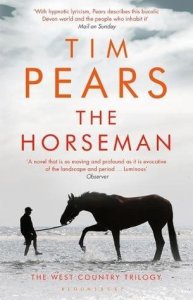
Seascraper reminded me very much of The Horseman by Tim Pears (1), first in a trilogy of novels set in Devon in the early 20th century. They are both quiet, gentle novels with rural settings and descriptions of the protagonist’s daily work (catching shrimp for Thomas, farming tasks for Leo in The Horseman). Horses also play an important role in both novels. I still haven’t continued with the trilogy and haven’t decided if I want to as I didn’t enjoy the first book as much as I’d hoped.

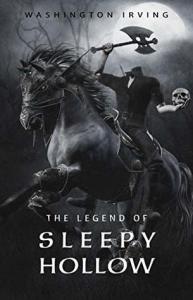
The title of the Tim Pears book made me think of the headless horseman in Washington Irving’s classic short story The Legend of Sleepy Hollow (2). First published in 1820, it’s set in an old Dutch settlement in New York and revolves around the legend of a ghostly soldier who lost his head in battle and rides through Sleepy Hollow every night in search of his missing head. You may have seen the 1999 Tim Burton adaptation, but the original story is definitely worth reading as well.

Another book with the word ‘hollow’ in the title is The Hollow by Agatha Christie (3). The Hollow is the name of a country house where a group of people have gathered for the weekend when a murder takes place. This is a Poirot novel although he doesn’t play as big a part in it as he usually does and Christie herself described it as “the one I ruined by the introduction of Poirot”.

The Hollow was published in 1946 and so was Ride the Pink Horse by Dorothy B. Hughes (4). The novel is set in Santa Fe during the Fiesta festival, which ends with the burning of Zozobra, a wooden effigy symbolic of worries and gloom. The story follows Sailor, a blackmailer on the trail of a senator whose wife has been murdered. I loved this book mainly for the setting but was also gripped by the plot.

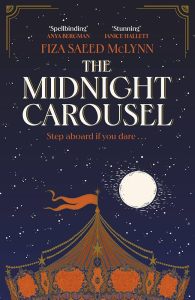
The cover of the Hughes novel brings to mind the carved wooden horses on the carousel in Fiza Saeed McLynn’s The Midnight Carousel (5). The carousel of the title was built for the Grand Exhibition in Paris by Gilbert Cloutier and gains a sinister reputation when Gilbert disappears immediately afterwards. As the years go by and more people disappear while riding the carousel horses, Detective Laurent Bisset begins to investigate. I read this book earlier this year and really enjoyed it.

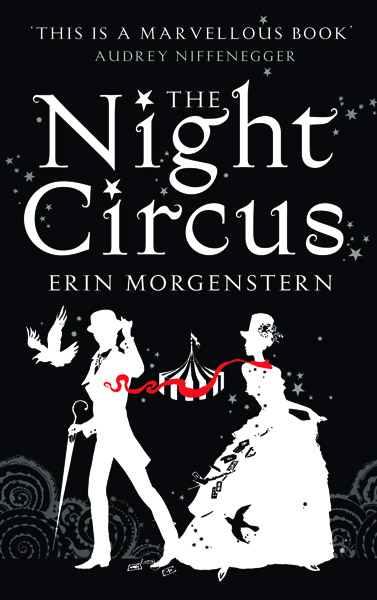
The Night Circus by Erin Morgenstern (6) is the obvious next link. Both books have fairground/circus settings and a similar magical atmosphere, although this one is more fantasy whereas the Saeed McLynn is a mystery. Although I found the plot and characters slightly disappointing, I loved the vivid descriptions of Le Cirque des Rêves, or the Circus of Dreams, and wished I could visit it myself!

~

And that’s my chain for December! My links have included: rural life, horsemen, the word ‘hollow’, books published in 1946, carousel horses and fairground/circus settings.

Nest month is a wildcard to begin the year. We can either start with the book we finished this month’s chain with or, if we didn’t participate in December, begin with the last book we read.

Six Degrees of Separation: From We Have Always Lived in the Castle to The Confessions of Frannie Langton

It’s the first Saturday of the month which means it’s time for another Six Degrees of Separation, hosted by Kate of Books are my Favourite and Best. The idea is that Kate chooses a book to use as a starting point and then we have to link it to six other books of our choice to form a chain. A book doesn’t have to be connected to all of the others on the list – only to the one next to it in the chain.

This month we’re starting with We Have Always Lived in the Castle by Shirley Jackson. For once, this is a book that I’ve actually read – and also one that I enjoyed. Here’s my synopsis of the plot, taken from my review posted in 2011:

The book is narrated by eighteen-year-old Mary Katherine Blackwood, or ‘Merricat’, who lives with her sister Constance, their Uncle Julian, and Jonas the cat in a big house on the edge of town. Near the beginning of the story we see Merricat walking home with some shopping, being taunted and chanted at by everyone she passes. It seems the Blackwoods are very unpopular, but at first we don’t know why.

When Merricat returns home, it becomes even more apparent that something is wrong. Merricat herself does not seem like a normal eighteen-year-old – she likes to bury things in the grounds of the Blackwood house and believes that using magic words and rituals will protect her home and family. Constance is agoraphobic and afraid to walk any further than the garden. Uncle Julian, confined to a wheelchair, is obsessed with the book he’s writing about a tragedy that occurred six years earlier. And what exactly has happened to the rest of the Blackwood family?

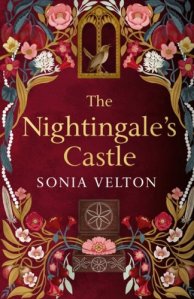
We Have Always Lived in the Castle is a dark, unsettling novel. My first link is to another dark novel with the word ‘castle’ in the title: The Nightingale’s Castle by Sonia Velton (1). This is a reimagining of the story of Countess Erzsébet Báthory (often anglicised to Elizabeth Bathory), thought to be a possible inspiration behind Bram Stoker’s Dracula. Bathory and her servants were accused of murdering hundreds of Hungarian peasant girls, making her one of the most notorious serial killers in history.

The Angel Makers by Patti McCracken (2) is a nonfiction book about another Hungarian serial killer. Zsuzsanna Fazekas, known in the book as Auntie Suzy, was a midwife and the ringleader of a circle of women responsible for the deaths of over one hundred men between 1914 and 1929. Suzy was the one who sold bottles of arsenic to the other women in her village and, in the absence of a village doctor, the one who dictated the causes of death to be put on the death certificates.

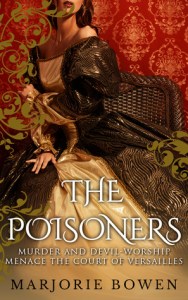
Poisoning also plays a big part in Marjorie Bowen’s The Poisoners (3), originally published in 1936. The book is set in 17th century Paris during the reign of the Sun King, Louis XIV, and revolves around a famous murder scandal known as L’affaire des poisons. I described it in my review as a story featuring “fortune tellers and spies, counterfeiters and apothecaries, an empty house which hides sinister secrets, mysterious letters marked with the sign of a pink carnation, and a society thought to be involved in black magic.”

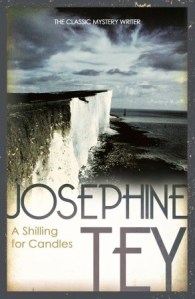
I don’t want a whole chain full of serial killers, so I’ll try to send things in a slightly different direction now. Another book published in 1936 is A Shilling for Candles by Josephine Tey (4). This is one of Tey’s Alan Grant mysteries (of which I’m sorry to say I’ve still only read two) and was adapted for film by Alfred Hitchcock under the title Young and Innocent.
A shilling is a coin, so that leads me to Sugar Money by Jane Harris (5). This novel is set in the Caribbean in the year 1765. Our narrator, teenage Lucien, and his older brother Emile are slaves working on a sugar plantation in French-ruled Martinique. It’s a fascinating book exploring some aspects of slavery I had never read about before – and it’s also partly based on a true story.

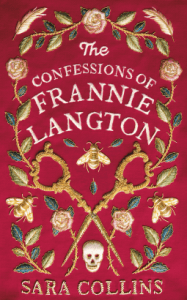
The final book in my chain is The Confessions of Frannie Langton by Sara Collins (6). The book begins with Frannie, a former slave, awaiting trial in London for the murder of her employers (sorry, it seems I couldn’t get away from murderers this month after all). However, the crime element is only one small part of the story – a large part of the novel is devoted to Frannie remembering her childhood on a sugar plantation in Jamaica and her experiences on arriving in England.

~

And that’s my chain for November! My links have included: The word ‘castle’, Hungary, female poisoners, 1936, money and sugar plantations.

In December we’ll be starting with Seascraper by Benjamin Wood.

Six Degrees of Separation: From I Want Everything to Soot

It’s the first Saturday of the month which means it’s time for another Six Degrees of Separation, hosted by Kate of Books are my Favourite and Best. The idea is that Kate chooses a book to use as a starting point and then we have to link it to six other books of our choice to form a chain. A book doesn’t have to be connected to all of the others on the list – only to the one next to it in the chain.

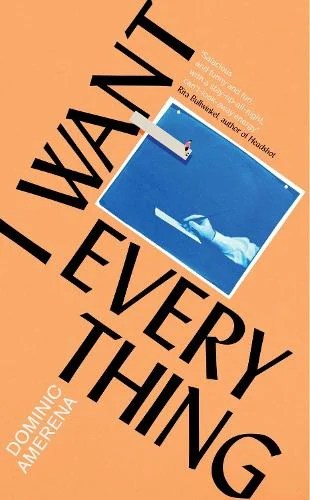
This month we’re starting with I Want Everything by Dominic Amerena. I haven’t read it, but here’s what it’s about:

You all know this, of course, but years and years ago, acclaimed Australian novelist Brenda Shales went missing. After two explosive, controversial books that would shape the literary canon of the country for decades to come — and that terrible legal scandal about plagiarism, of course — she was simply gone.

That was, right up until a frustrated young writer sees an elderly woman swimming at his local pool in Melbourne. She looks familiar…very familiar in fact. No. It couldn’t be. Stunned, he returns home to confirm the impossible truth; it’s Brenda Shales, now in her old age and stranded in a retirement home. He’s determined to pursue her, to discover what happened to her all those years ago, and to possibly fulfil his dreams of literary stardom through a tell-all biography. But when he finds her, a case of mistaken identity and Brenda’s own terrible secrets begin to derail his ambitions, and ultimately, his entire life.

~

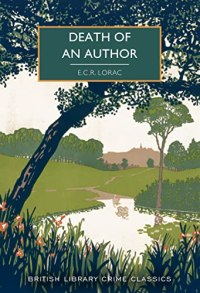
I’m going to begin this month’s chain with another book about an author who goes missing. In Death of an Author by ECR Lorac (1), the reclusive crime writer Vivian Lestrange disappears without trace, leaving the police questioning whether he ever really existed in the first place. This is the only book I’ve read by Lorac so far and I enjoyed it, although I think it probably wasn’t the best one I could have started with – I must read another one soon!

Now a simple link using the word ‘Death’. Death in Cyprus by MM Kaye (2) is one of a series of romantic suspense novels set in different parts of the world. In this one, Amanda Derington visits Cyprus while accompanying her uncle on a business trip. Before the ship even arrives at the port, a murder has taken place and Amanda finds herself the next target. The books are all standalone stories and can be read in any order – this is one of my favourites.

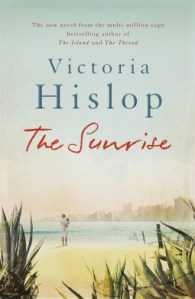
Another book set in Cyprus is The Sunrise by Victoria Hislop (3). The story takes place in Famagusta in 1974, when a luxury hotel, the Sunrise, is evacuated during a Greek military coup and Turkish invasion. Although I found the book quite unevenly paced, I did love the setting and the descriptions of the abandoned city in the aftermath of the invasion.

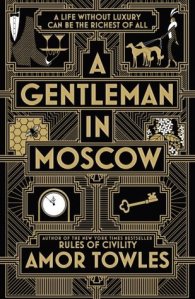
Amor Towles’ A Gentleman in Moscow (4) is another book with a hotel setting. It tells the story of a Russian Count who is sentenced to spend the rest of his days under house arrest in Moscow’s Metropol Hotel. I loved this book and found it very inspiring to see how the Count managed to lead such a fulfilling life during his confinement.
Room by Emma Donoghue (5) also deals with confinement. It’s narrated by five-year-old Jack, who is being held captive with his mother inside a single room and has never seen the outside world. Although the plot is quite disturbing and it also took me a while to get used to Jack’s narrative voice, I eventually became gripped.
Like Room, Andrew Martin’s Soot (6) has a four letter title with a double o in the middle. This is the only similarity, though, as this book is a mystery set in 18th century York and revolving around the murder of a painter of silhouettes. I really enjoyed this book, so it’s a good place to end my chain!

~

And that’s my chain for this month. My links have included: missing authors, the word ‘death’, Cyprus, hotels, confinement and four letter titles.

In November we’ll be starting with We Have Always Lived in the Castle by Shirley Jackson – at last, a book that I’ve actually read!

Six Degrees of Separation: From Ghost Cities to Major Pettigrew’s Last Stand

It’s the first Saturday of the month which means it’s time for another Six Degrees of Separation, hosted by Kate of Books are my Favourite and Best. The idea is that Kate chooses a book to use as a starting point and then we have to link it to six other books of our choice to form a chain. A book doesn’t have to be connected to all of the others on the list – only to the one next to it in the chain.

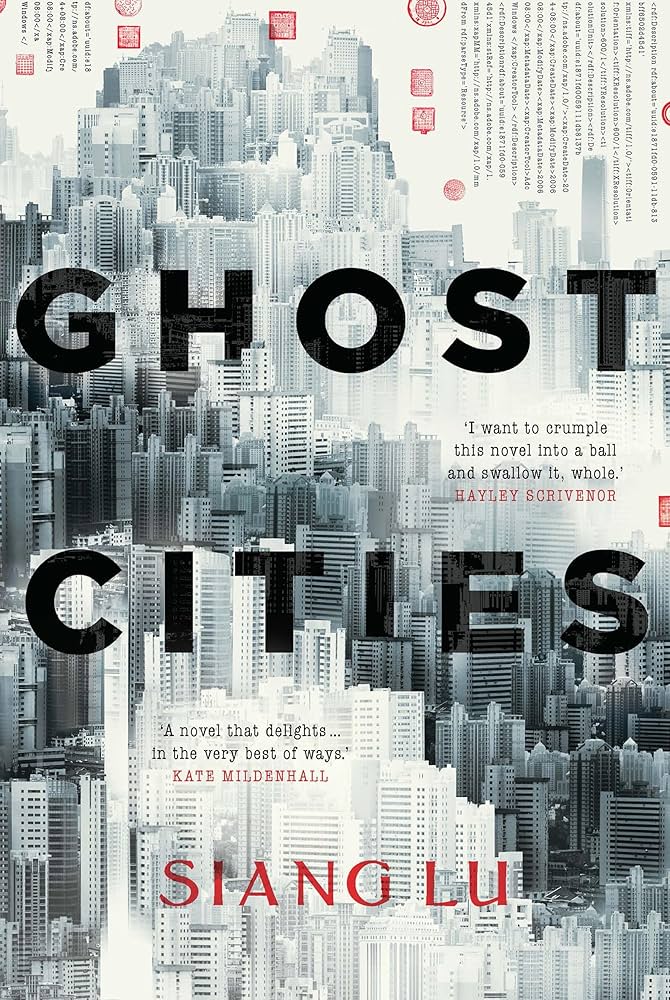
This month we’re starting with Ghost Cities by Siang Lu. It’s not a book that I’ve read, but here’s what it’s about:

Ghost Cities – inspired by the vacant, uninhabited megacities of China – follows multiple narratives, including one in which a young man named Xiang is fired from his job as a translator at Sydney’s Chinese Consulate after it is discovered he doesn’t speak a word of Chinese and has been relying entirely on Google Translate for his work.

How is his relocation to one such ghost city connected to a parallel odyssey in which an ancient Emperor creates a thousand doubles of Himself? Or where a horny mountain gains sentience? Where a chess-playing automaton hides a deadly secret? Or a tale in which every book in the known Empire is destroyed – then re-created, page by page and book by book, all in the name of love and art?

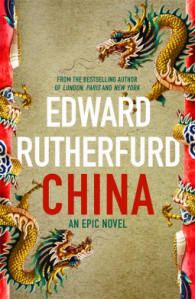
I had trouble thinking of a first link this month, so I’ve just gone for something very obvious – another novel about China! Edward Rutherfurd’s China (1) tells the story of 19th century China, covering key events such as the Opium Wars and the Boxer Rebellion through the lives of several fictional families.

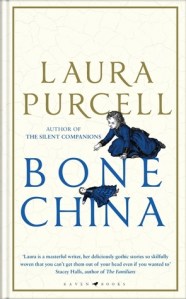
The word ‘China’ also appears in the title of Bone China by Laura Purcell (2), but this time it refers not to the country but the type of porcelain. This is a Gothic novel set in the 19th century on the coast of Cornwall where our narrator has taken a new position as nurse to Louise Pinecroft, a woman who spends her days sitting silently in a room surrounded by china cups and plates. This book was published in the US as The House of Whispers, just in case there’s any confusion!

One of the characters in Bone China is a doctor who is carrying out research into consumption (tuberculosis). The Victorian Chaise-longue (3), an unsettling novella by Marghanita Laski, features a young woman recovering from tuberculosis in 1950s London. Falling asleep on a chaise-longue in the drawing room, she wakes up to find herself in the year 1864.

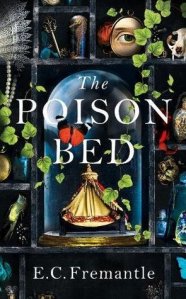
Staying with a furniture theme, my next book is The Poison Bed by Elizabeth Fremantle (4). This is a fictional account of the real-life Thomas Overbury murder case, a poisoning which took place in the early 17th century and implicated Robert Carr, a favourite of King James VI and I, and his wife, Frances Howard.

Cyanide is a type of poison, so my next link leads me to Sparkling Cyanide by Agatha Christie (5), in which a beautiful heiress is poisoned while celebrating her birthday in a restaurant. No Poirot or Miss Marple in this one, but it does feature one of Christie’s other recurring characters, Colonel Race.

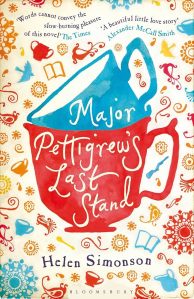
I looked for another book I’d read with a glass on the cover but struggled to find one, so I’m linking to one with teacups on the cover instead. Major Pettigrew’s Last Stand by Helen Simonson (6) is a lovely book about the relationship between a retired British Army officer and a widowed Pakistani woman.

~

And that’s my chain for September! My links included: Books about China, the word ‘China’, tuberculosis, furniture, poison and pictures of drinks.

In October we’ll be starting with I Want Everything by Dominic Amerena.

Six Degrees of Separation: From The Safekeep to Enlightenment

It’s the first Saturday of the month which means it’s time for another Six Degrees of Separation, hosted by Kate of Books are my Favourite and Best. The idea is that Kate chooses a book to use as a starting point and then we have to link it to six other books of our choice to form a chain. A book doesn’t have to be connected to all of the others on the list – only to the one next to it in the chain.

This month, we’re starting with The Safekeep by Yael van der Wouden. I haven’t read it yet but do have a copy and am hoping to read it soon. Here’s what it’s about:

It is fifteen years after the Second World War, and Isabel has built herself a solitary life of discipline and strict routine in her late mother’s country home, with not a fork or a word out of place. But all is upended when her brother Louis delivers his graceless new girlfriend, Eva, at Isabel’s doorstep – as a guest, there to stay for the season…

In the sweltering heat of summer, Isabel’s desperate need for control reaches boiling point. What happens between the two women leads to a revelation which threatens to unravel all she has ever known.

I’ve read a lot of books about the war so it would have been easy to go down that route, but I was drawn to the phrase ‘the sweltering heat of summer’ so decided to use that as my first link instead. The Hounding by Xenobe Purvis (1), about five young women who don’t fit in with their small community in 18th century England, is a book I read recently that is also set during a hot summer. It’s so hot that the river starts to dry up, affecting the trade of Pete Darling, the ferryman, who takes out his frustration on the girls, claiming he has seen them turn into dogs.

Once Upon a River by Diane Setterfield (2) follows the story of a child rescued from a river on the evening of the winter solstice in 1887. The legend of Quietly, a ghostly ferryman said to guide those in danger on the river to safety, plays an important part in the novel.

The name ‘Quietly’ leads me to The Quiet Gentleman by Georgette Heyer (3). I loved this one – it’s one of Heyer’s Regency novels but has a strong mystery element (involving a series of accidents that befall Gervase Frant, 7th Earl of St Erth) as well as a romance. I wish we saw more of the heroine, though!

The Temporary Gentleman by Sebastian Barry (4) is another book with ‘gentleman’ in the title. Barry’s novels are always beautifully written and this one is no exception. It’s set in 1950s Ghana, where Jack McNulty is writing his memoirs, looking back on his early life in Ireland and his difficult relationship with his wife.

I don’t seem to have reviewed any other books by authors with the name Sebastian, but I did find one by a Seb: The Light Ages by Seb Falk (5). This is a non-fiction book in which Falk looks at some of the advances in science, mathematics and astronomy during the medieval period and tries to dispel the idea that the Dark Ages were a time of little progress.

A similar title and a shared theme of astronomy brings me to the final book in my chain: Enlightenment by Sarah Perry (6). Perry’s novel explores the relationship between two members of a Strict Baptist community in Essex, tied together through the story of a 19th century female astronomer, Maria Vǎduva, whose ghost is said to haunt a local manor.

~

And that’s my chain for August! My links have included: hot summers, ferrymen, the word ‘quiet’, the word ‘gentleman’, Sebs and Sebastians, and astronomy.

Next month we’ll be starting with Ghost Cities by Siang Lu.

Six Degrees of Separation: From Theory & Practice to Murder in the Crooked House

It’s the first Saturday of the month which means it’s time for another Six Degrees of Separation, hosted by Kate of Books are my Favourite and Best. The idea is that Kate chooses a book to use as a starting point and then we have to link it to six other books of our choice to form a chain. A book doesn’t have to be connected to all of the others on the list – only to the one next to it in the chain.

This month we’re starting with Theory & Practice by Michelle de Kretser. As usual, this is a book I haven’t read! Here’s what it’s about:

In the late 1980s, the narrator of Theory & Practice — a first generation immigrant from Sri Lanka who moved to Sydney in her childhood — sets up a life in Melbourne for graduate school. Jilted by a lover who cheats on her with another self-described “feminist,” she is thrown into deeper confusion about her identity and the people around her.

The narrator begins to fall for a man named Kit, who is in a “deconstructed relationship” with a woman named Olivia. She struggles to square her feminism against her jealousy toward Olivia—and her anti-colonialism against her feelings about Virginia Woolf, whose work she is called to despite her racism.

What happens when our desires run contrary to our beliefs? What should we do when the failings of revered figures come to light? Who is shamed when the truth is told? In Theory & Practice, Michelle de Kretser offers a spellbinding meditation on the moral complexities that arise in this gap. Peopled with brilliantly drawn characters, the novel also stitches together fiction and essay, taking up Woolf’s quest for adventurous literary form.

I’m going to use an immigrant from Sri Lanka as my first link. The Swimmer by Roma Tearne (1) begins with Ria, a woman in her forties, discovering a young man swimming in the river behind her house in Suffolk. His name is Ben and he’s a Tamil refugee who has fled violence in Sri Lanka and made his way to England. I enjoyed watching Ria and Ben’s relationship develop until a sudden change of narrator sent the story in a different direction.

Staying with the theme of swimming, Wonder Girls by Catherine Johnson (2) is set in 1928 and tells the story of Ida Gaze, who at the age of sixteen sets out to become the first person ever to swim the Bristol Channel between Wales and England. Although it’s a fictional story, it’s still a very inspirational one!

Another book with ‘wonder’ in the title is The Wonder by Emma Donoghue (3), a dark but fascinating novel about an eleven-year-old girl in 19th century Ireland whose parents claim she has eaten nothing at all for four months. To prove whether the girl really is a miracle or whether it’s a hoax, a nurse, Lib Wright, is hired to watch over her and see if the claims are true. Lib has been serving in the Crimean War and was trained by Florence Nightingale, which leads me to the next book in my chain…

The Nightingale Girls by Donna Douglas (4) is the first in a series about a group of student nurses at London’s Nightingale Hospital in the 1930s. I enjoyed meeting the three main characters and stated in my review that I was looking forward to the rest of the series – well, that was twelve years ago and I still haven’t picked up any of the others!

Nightingale is the name of the author of the next book in my chain. Murder in Tinseltown by Max Nightingale (5) sounded fun, but was a disappointment. It’s an interactive ‘choose your own adventure’ style book, where you play the role of a detective investigating a murder and at various points in the story you choose what happens next by turning to different pages. A good idea, but it needed a lot more editing, unfortunately.

A book starting with the same two words in the title is Murder in the Crooked House by Soji Shimada (6). This is one of several Japanese crime novels I’ve read over the last few years, but not one of my favourites as I found the mystery far too convoluted and too concerned with alibis, timings, room layouts and other little details rather than the characters and their motives. It was originally published in 1982 but I read a reissue in an English translation by Louise Heal Kawai.

~

And that’s my chain for July. My links have included: Sri Lanka, swimming, the word ‘wonder’, Florence Nightingale, the name Nightingale and titles beginning with ‘Murder in’.

In August we’ll be starting with The Safekeep by Yael van der Wouden. I have that book on my TBR – I wonder if I’ll be able to read it before August!

Six Degrees of Separation: From All Fours to A God in Every Stone

It’s the first Saturday of the month which means it’s time for another Six Degrees of Separation, hosted by Kate of Books are my Favourite and Best. The idea is that Kate chooses a book to use as a starting point and then we have to link it to six other books of our choice to form a chain. A book doesn’t have to be connected to all of the others on the list – only to the one next to it in the chain.

This month we’re starting with All Fours by Miranda July. I haven’t read it and probably won’t as it doesn’t really appeal to me, but here’s what it’s about:

A semi-famous artist announces her plan to drive cross-country from LA to NY. Thirty minutes after leaving her husband and child at home, she spontaneously exits the freeway, beds down in a nondescript motel and immerses herself in a temporary reinvention that turns out to be the start of an entirely different journey.

Miranda July’s second novel confirms the brilliance of her unique approach to fiction. With July’s wry voice, perfect comic timing, unabashed curiosity about human intimacy and palpable delight in pushing boundaries, All Fours tells the story of one woman’s quest for a new kind of freedom. Part absurd entertainment, part tender reinvention of the sexual, romantic and domestic life of a 45-year-old female artist, All Fours transcends expectations while excavating our beliefs about life lived as a woman. Once again, July hijacks the familiar and turns it into something new and thrillingly, profoundly alive.

I had no idea how to get started with this month’s chain – I couldn’t think of anything similar I’ve read and nothing in the blurb inspired me. Eventually, I decided to go with another book written by a Miranda: in this case Miranda Malins, author of two historical novels about the family of Oliver Cromwell. Set in the years of Cromwell’s Protectorate following the English Civil War, The Puritan Princess (1) tells the story of his youngest daughter, Frances.

Act of Oblivion by Robert Harris (2) is the story of a manhunt involving two former soldiers who fought in Oliver Cromwell’s New Model Army and signed the death warrant that led to the execution of King Charles I. When the monarchy is restored several years later, the two men flee to New England to go into hiding in the new Puritan colonies of Connecticut, Massachusetts Bay and New Haven.

Another book with the word ‘act’ in the title is Three Act Tragedy by Agatha Christie (3). This is a Poirot novel which also features one of her other recurring characters, Mr Satterthwaite. The two investigate the death of a guest who drops dead at a party hosted by an actor. The book was originally published in 1934.

Also published in 1934 was A Pin to See the Peepshow by F. Tennyson Jesse (4), now available as part of the British Library’s Women Writers series. Part of the novel is based on a true crime known as the Thompson-Bywaters case which took place in 1922. However, the crime element of the story was not as strong as I’d expected and I found it more of a character study of the main character, Julia Almond.

The Paying Guests by Sarah Waters (5) is set in London in 1922 and is also inspired by the Thompson-Bywaters case. The ‘paying guests’ of the title are Leonard and Lilian Barber, a married couple who become lodgers in the home of Frances Wray and her mother. What seems at first to be a quiet domestic novel slowly becomes something much more dramatic.

The Paying Guests appeared on the longlist for the 2015 Walter Scott Prize for Historical Fiction but didn’t make the shortlist. A book that did get shortlisted that year was A God in Every Stone by Kamila Shamsie (6). Set in the early 20th century, it follows three characters – a British archaeologist, a Pashtun soldier and a twelve-year-old-boy – who are linked by a search for the legendary Circlet of Scylax.

~

And that’s my chain for this month! My links have included: the name Miranda, Oliver Cromwell, the word ‘act’, books published in 1934, the Thompson-Bywaters case and the 2015 Walter Scott Prize.

In July we’ll be starting with Michelle de Kretser’s Theory & Practice.