Six Degrees of Separation: From Long Island to The White Devil

It’s the first Saturday of the month which means it’s time for another Six Degrees of Separation, hosted by Kate of Books are my Favourite and Best. The idea is that Kate chooses a book to use as a starting point and then we have to link it to six other books of our choice to form a chain. A book doesn’t have to be connected to all of the others on the list – only to the one next to it in the chain.
This month we’re starting with Long Island by Colm Tóibín. I haven’t read it, but it’s a sequel to Brooklyn, which I have read and enjoyed. Here’s what it’s about:

A man with an Irish accent knocks on Eilis Fiorello’s door on Long Island and in that moment everything changes. Eilis and Tony have built a secure, happy life here since leaving Brooklyn – perhaps a little stifled by the in-laws so close, but twenty years married and with two children looking towards a good future.

And yet this stranger will reveal something that will make Eilis question the life she has created. For the first time in years she suddenly feels very far from home and the revelation will see her turn towards Ireland once again. Back to her mother. Back to the town and the people she had chosen to leave behind. Did she make the wrong choice marrying Tony all those years ago? Is it too late now to take a different path?

~

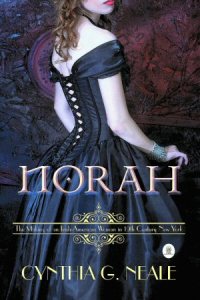
There are lots of directions I could have gone in from this month’s starting point, but I’ve decided to link to another novel about an Irish immigrant living in New York: Norah by Cynthia G. Neale (1). It’s set in the 1850s, much earlier than the Tóibín novels, and follows the story of Norah McCabe who left Ireland during the Great Famine to start a new life in America. This is actually Neale’s third book about Norah, but I hadn’t read the first two and that didn’t seem to be a problem.

Almost the same name but a different spelling: my second book is Nora Bonesteel’s Christmas Past by Sharyn McCrumb (2). This is a novella set in the Appalachian Mountains and blending crime, history and folklore. Nora Bonesteel, an elderly woman with ‘the Sight’ is helping her new neighbours celebrate a traditional mountain Christmas when they are interrupted by the arrival of the Sheriff who has come to make an arrest. It’s part of McCrumb’s Ballad series and I read some of the full-length novels in the series years ago, before I started blogging.

The word Ballad leads me to Lyrical Ballads by William Wordsworth and Samuel Taylor Coleridge (3), a collection of poetry first published in 1798 and revised in 1802. This edition of the book contains both the original and revised versions, which I think will be of more interest to the academic reader than the casual one. It includes some of both poets’ most famous poems, including The Rime of the Ancient Mariner and Lines Written a Few Miles above Tintern Abbey.

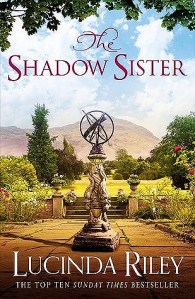
Wordsworth and Coleridge, along with Robert Southey, were known as the Lake Poets because they lived in England’s Lake District. In The Shadow Sister by Lucinda Riley (4), our narrator, Star D’Aplièse, investigates the story of an ancestor who grew up in the Lake District and was a friend of the children’s author Beatrix Potter. This is one of my favourite books from Riley’s Seven Sisters series in which each book focuses on one of the adopted daughters of the mysterious Pa Salt.

A simple link to another novel with the word ‘shadow’ in the title next – Shadow Girls by Carol Birch (5). This is a ghost story set in a school in 1960s Manchester. I enjoyed it, but the supernatural element is only introduced very late in the novel and it’s much more ‘school story’ than ‘ghost story’ which won’t appeal to everyone.

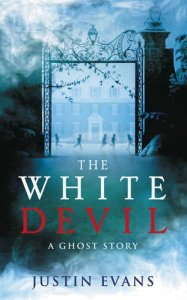
The White Devil by Justin Evans (6) is also a ghost story set in a school – the famous boys’ school, Harrow. One of the new boys at Harrow discovers that he closely resembles Lord Byron, who attended the same school two centuries earlier. I loved the setting, the atmosphere and the Byron connection, but felt that the lack of strong characters let the book down.

~

And that’s my chain for October! My links have included: Irish immigrants in New York, the name Nora/Norah, ballads, the Lake District, the word Shadow and ghost stories set in schools.

In November we’ll be starting with Intermezzo by Sally Rooney.

Six Degrees of Separation: From After Story to The Testaments

It’s the first Saturday of the month which means it’s time for another Six Degrees of Separation, hosted by Kate of Books are my Favourite and Best. The idea is that Kate chooses a book to use as a starting point and then we have to link it to six other books of our choice to form a chain. A book doesn’t have to be connected to all of the others on the list – only to the one next to it in the chain.

This month we’re starting with After Story by Larissa Behrendt. As usual, I haven’t read it, but here’s what it’s about:

When Indigenous lawyer Jasmine decides to take her mother, Della, on a tour of England’s most revered literary sites, Jasmine hopes it will bring them closer together and help them reconcile the past. Twenty-five years earlier the disappearance of Jasmine’s older sister devastated their tight-knit community. This tragedy returns to haunt Jasmine and Della when another child mysteriously goes missing on Hampstead Heath. As Jasmine immerses herself in the world of her literary idols – including Jane Austen, the Brontë sisters and Virginia Woolf – Della is inspired to rediscover the wisdom of her own culture and storytelling. But sometimes the stories that are not told can become too great to bear. Ambitious and engrossing, After Story celebrates the extraordinary power of words and the quiet spaces between. We can be ready to listen, but are we ready to hear?

I was drawn to the line ‘to rediscover the wisdom of her own culture and storytelling’, which reminded me of The Story Keeper by Anna Mazzola (1) in which a young woman applies for a job as assistant to a folklorist and travels to the Isle of Skye to collect folk tales from the local people. I enjoyed this book, with its wonderfully atmospheric setting.

To the Lighthouse by Virginia Woolf (2) is also set on the Isle of Skye, where the Ramsay family have a summer home. The novel begins with six-year-old James Ramsay being promised a trip to the lighthouse the next day if the weather is fine – but the weather is not fine and James won’t get to visit the lighthouse until ten years later. Although this is one of her best known books, it wasn’t really for me and I’ve enjoyed others by Woolf much more.

Another book featuring a lighthouse is The Light Between Oceans by ML Stedman (3). Tom Sherbourne is a lighthouse keeper on the island of Janus Rock, off the coast of Australia. When a boat is washed up on the shore with a baby girl inside, Tom and his wife decide to keep her and raise her as their own child. This is a beautiful, thought-provoking novel which perfectly captures the isolation endured by lighthouse keepers and their families, as well as the guilt experienced after making an impulsive decision that you know was wrong.

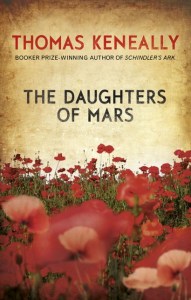
The Daughters of Mars by Thomas Keneally (4) is also set, at least partly, in Australia. It tells the story of two sisters who join the Australian Army Nursing Service during the First World War and serve on a hospital ship in the Dardanelles and on the Western Front. It’s a fascinating novel but was spoiled for me by the unconventional punctuation and the distance I felt from the two main characters.

Another book about nursing during the Great War is Testament of Youth by Vera Brittain (5). This is the only non-fiction book in my chain and is Brittain’s memoir covering the years 1900-1925 and describing her experiences as a VAD nurse during the First World War. I highly recommend reading this book if you haven’t already, but be warned that it’s completely heartbreaking in places!

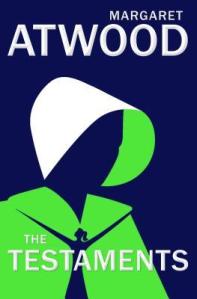
My final book has a shared word in the title. Margaret Atwood’s The Testaments (6) is a sequel to her earlier novel, The Handmaid’s Tale and is again set in Gilead, a dystopian community ruled by a patriarchal regime. The novel is made up of the ‘testaments’ of three characters, giving us three different perspectives of life in Gilead. I didn’t like it as much as the first book, but still found it interesting.

~

And that’s my chain for this month. My links have included: Collecting stories, the Isle of Skye, lighthouses, Australia in WWI, wartime nursing and the word ‘testament’. In October, we’ll be starting with Colm Tóibín’s Long Island.

Six Degrees of Separation: From Kairos to Weyward

It’s the first Saturday of the month which means it’s time for another Six Degrees of Separation, hosted by Kate of Books are my Favourite and Best. The idea is that Kate chooses a book to use as a starting point and then we have to link it to six other books of our choice to form a chain. A book doesn’t have to be connected to all of the others on the list – only to the one next to it in the chain.

This month we’re starting with the 2024 winner of the International Booker Prize, Kairos by Jenny Erpenbeck (translated by Michael Hofmann). I haven’t read it, but here’s what it’s about:

Berlin. 11 July 1986. They meet by chance on a bus. She is a young student, he is older and married. Theirs is an intense and sudden attraction, fuelled by a shared passion for music and art, and heightened by the secrecy they must maintain. But when she strays for a single night he cannot forgive her and a dangerous crack forms between them, opening up a space for cruelty, punishment and the exertion of power. And the world around them is changing too: as the GDR begins to crumble, so too do all the old certainties and the old loyalties, ushering in a new era whose great gains also involve profound loss.

From a prize-winning German writer, this is the intimate and devastating story of the path of two lovers through the ruins of a relationship, set against the backdrop of a seismic period in European history.

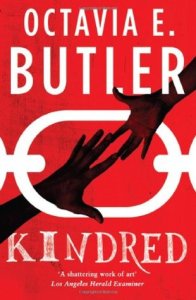
I struggled to get started with this month’s chain. I know I have already used Berlin as a link in several previous chains, so I wanted to do something different. Eventually I decided to go with another book with a one-word title beginning with K: Kindred by Octavia E. Butler (1). This is a fascinating novel exploring slavery on a Maryland plantation through the eyes of a woman from 1976 who travels back in time to the 1800s.

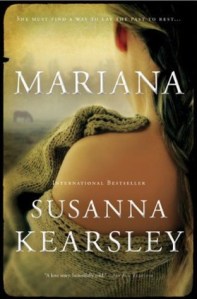
Another time travel novel, also with a one-word title, is Mariana by Susanna Kearsley (2), although the setting is quite different. Our heroine, Julia Beckett, moves into a lonely farmhouse and finds that her life has become linked with the life of a woman who lived there centuries earlier, during the aftermath of the English Civil War. This was one of my first Susanna Kearsley novels and still a favourite.

Staying with women’s names, my next link is to Theodora by Stella Duffy (3). This novel is set in 6th century Constantinople and tells the story of Empress Theodora, wife of Justinian I. Theodora begins life as an actress and entertainer, before rising to become one of the most powerful women in the Byzantine Empire.

Booth by Karen Joy Fowler (4) also has a theatrical theme (and another one-word title). I loved this fictional biography of the 19th century theatrical family, the Booths, which focuses not just on the infamous John Wilkes Booth, the assassin of Abraham Lincoln, but also on his parents, brothers and sisters.

Junius Brutus Booth and Edwin Booth were renowned Shakespearean actors, which leads me to a play by William Shakespeare himself: Macbeth (5). I could have picked any play here, but my reasons for selecting Macbeth are simple – it’s one of the few Shakespeare plays I’ve actually posted about on my blog and, most importantly, it has a one-word title which keeps that theme going throughout my chain!

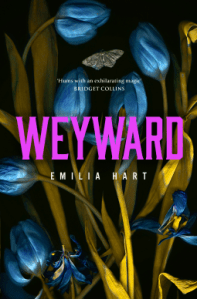
The three witches in Macbeth are referred to as the ‘weyward sisters’ in Shakespeare’s First Folio (and later, the ‘weird sisters’) so my final link is to Weyward by Emilia Hart (6). In this novel, Hart explores the stories of women from three generations of the same family who are connected through witchcraft and the power of nature.

~

And that’s my chain for July! My links have included titles beginning with K, time travel, women’s names, acting, Shakespeare and witches. As an extra challenge to myself I only used books with one-word titles in this month’s chain.

In August we’ll be starting with The Museum of Modern Love by Heather Rose.

Six Degrees of Separation: From Butter to The Land of Green Ginger

It’s the first Saturday of the month which means it’s time for another Six Degrees of Separation, hosted by Kate of Books are my Favourite and Best. The idea is that Kate chooses a book to use as a starting point and then we have to link it to six other books of our choice to form a chain. A book doesn’t have to be connected to all of the others on the list – only to the one next to it in the chain.

This month we’re starting with a Japanese novel, Butter by Asako Yuzuki. I haven’t read it and probably won’t, but here’s what it’s about:

Gourmet cook Manako Kajii sits in Tokyo Detention Centre convicted of the serial murders of lonely businessmen, who she is said to have seduced with her delicious home cooking. The case has captured the nation’s imagination but Kajii refuses to speak with the press, entertaining no visitors. That is, until journalist Rika Machida writes a letter asking for her recipe for beef stew and Kajii can’t resist writing back.

Rika, the only woman in her news office, works late each night, rarely cooking more than ramen. As the visits unfold between her and the steely Kajii, they are closer to a masterclass in food than journalistic research. Rika hopes this gastronomic exchange will help her soften Kajii but it seems that she might be the one changing. With each meal she eats, something is awakening in her body, might she and Kaji have more in common than she once thought?

Inspired by the real case of the convicted con woman and serial killer, “The Konkatsu Killer”, Asako Yuzuki’s Butter is a vivid, unsettling exploration of misogyny, obsession, romance and the transgressive pleasures of food in Japan.

Butter is a dairy product, which makes me think of Nick Davenant, a character in Bee Ridgway’s The River of No Return (1) who owns a dairy farm in Vermont and is anxiously awaiting a visit from the cheese inspector at the beginning of the book. Nick is not just a dairy farmer, however – he is also a time traveller and was once an English nobleman who fought in the Napoleonic Wars. I think this book was intended to be the first in a series, but a sequel has never appeared.

Next is a simple link to another book with ‘river’ in the title: River of Stars by Guy Gavriel Kay (2). This novel is set in an alternate world based on China during the time of the Song Dynasty. Although Kay’s books are often described as historical fantasy, there are very few actual fantasy elements in this one, apart from some mentions of the spirits and fox-women who are part of Chinese myth.

Fox spirits also feature heavily in The Fox Wife by Yangsze Choo (3), set in Manchuria in 1908. The novel follows the dual stories of an elderly private detective investigating a suspicious death and a white fox spirit who has taken the form of a human woman while she searches for the man who killed her daughter. I found this book very slow, but enjoyed the details of Chinese myth and foklore.

The title character in the Yangsze Choo novel is called Snow, so my next book is one in which snow features heavily in the plot: The Sittaford Mystery by Agatha Christie (4). The village of Sittaford is cut off by snow, making it the perfect setting for a murder mystery to unfold. This is a wonderful standalone Christie novel and I loved the heroine, Emily Trefusis.

Like my edition of The Sittaford Mystery, Benighted by J.B. Priestley (5) also has a picture of a house on the cover. A married couple and their friend get caught in a storm while driving through the Welsh countryside one night and take shelter in a crumbling old mansion inhabited by a very strange family! This was my first book by Priestley and I’m sure I’ll be looking for another one.

Benighted was published in 1927, so the final book in my chain is another published in that same year. The Land of Green Ginger by Winifred Holtby (6) is about a missionary’s daughter who is born in South Africa but comes to England to be raised by her aunts in a small rural community in Yorkshire. I’ve read nearly all of Holtby’s novels now and this is probably my least favourite, but it still explores some interesting topics.

~

And that’s my chain for June! My links have included: Dairy products, the word ‘river’, fox-women, snow, pictures of houses and the year 1927.

In July we’ll be starting with Kairos by Jenny Erpenbeck.

Six Degrees of Separation: From The Anniversary to Wild Swans

It’s the first Saturday of the month which means it’s time for another Six Degrees of Separation, hosted by Kate of Books are my Favourite and Best. The idea is that Kate chooses a book to use as a starting point and then we have to link it to six other books of our choice to form a chain. A book doesn’t have to be connected to all of the others on the list – only to the one next to it in the chain.

This month we are starting with The Anniversary by Stephanie Bishop. It’s not a book I’ve read – or had even heard of until now – but here’s what it’s about:

Novelist J.B. Blackwood is on a cruise with her husband, Patrick, to celebrate their wedding anniversary.

Patrick is older than J.B., formerly her professor. But now his success is starting to wane and hers may overshadow his.

For days they sail in the sun. They lie about drinking, reading, sleeping, having sex. There is nothing but dark water all around them.

Then a storm hits, and Patrick falls off the ship. J.B. is left alone, as the search for what happened to Patrick – and the truth about their marriage – begins.

With a stay-up-all-night plot and breathtaking prose, this is the haunting and unforgettable story of a marriage and a death.

~

I’m using the idea of ‘falling off the ship’ as my first link. Someone else who was swept overboard on a cruise is Nona Ranskill in Miss Ranskill Comes Home by Barbara Euphan Todd (1). Stranded on a desert island just before the start of World War II, Miss Ranskill is rescued after almost four years and returns to England to find that war has broken out in her absence and life has changed almost beyond recognition. I loved this book; it was one of the first books published by Persephone that I read and still one of my favourites.

Another novel set on an island is Haven by Emma Donoghue (2). In 7th century Ireland, three monks set out on a pilgrimage to look for an isolated place to build a monastery. Their search takes them to the steep, rocky island of Skellig Michael, uninhabited except for thousands of birds. The novel follows the monks as they try to establish their new settlement and prepare for a life of seclusion. It’s more interesting than it sounds, although I’ve preferred other books by Donoghue.

A pilgrimage of a very different sort takes place in Jerome K. Jerome’s Diary of a Pilgrimage (3). First published in 1891, the Diary is narrated by J, an Englishman who travels to Germany with a friend to see the famous Passion Play at Oberammergau. Although it’s not as funny as Jerome’s Three Men in a Boat, it is written in a similar style, with J sharing amusing anecdotes about the things he experiences and people he meets during the journey.

Staying with books set in Germany, my next link is to Nightmare in Berlin by Hans Fallada (4). Despite the title, there’s no connection to Fallada’s more famous book, Alone in Berlin, and this is a completely separate novel, following the story of Dr Doll and his wife Alma in post-war Berlin. Apparently the book is very autobiographical, as Fallada himself, like Dr Doll in the novel, was appointed mayor of a small rural town after the war and later struggles with a serious morphine addiction. I read a translation by Allan Blunden from 2016 (the first time the book was made available in English).

Nightmares are bad dreams and the title of my next book is the opposite – Dreams of Joy by Lisa See (5). Set in the 1950s, this is the sequel to See’s Shanghai Girls and follows nineteen-year-old Joy Louie as she leaves her home in Los Angeles to travel to Shanghai, full of enthusiasm for Chairman Mao’s new communist China. As you can imagine, the story isn’t very joyful at all and Joy eventually begins to learn that the new regime isn’t as wonderful as she hoped.

Another book about Communist China, a non-fiction one this time, finishes my chain. It’s Wild Swans (6), Jung Chang’s autobiography, telling the stories of her grandmother, mother and finally herself and taking us on a journey through the history of 20th century China. I found this book fascinating and was able to learn a lot from it; it’s also one of the most gripping non-fiction books I’ve ever read.

~

And that’s my chain for May! My links have included: falling overboard, islands, pilgrimages, books set in Germany, good and bad dreams and Communist China.

In June we’ll be starting with Butter by Asako Yuzuki.

Six Degrees of Separation: From Black Lamb and Grey Falcon to The Map of Lost Memories

It’s the first Saturday of the month which means it’s time for another Six Degrees of Separation, hosted by Kate of Books are my Favourite and Best. The idea is that Kate chooses a book to use as a starting point and then we have to link it to six other books of our choice to form a chain. A book doesn’t have to be connected to all of the others on the list – only to the one next to it in the chain.

This month we were told we could begin with any travel guide of our choice. Coincidentally, I have just begun reading Black Lamb and Grey Falcon, Rebecca West’s 1941 travel book about her journey through the former Yugoslavia. I’ve wanted to read this for years and have been put off by the length, but I’ve finally decided to just plunge in.

Rebecca West’s epic masterpiece not only provides deep insight into the former country of Yugoslavia; it is a portrait of Europe on the brink of war. A heady cocktail of personal travelogue and historical insight, this product of an implacably inquisitive intelligence remains essential for anyone attempting to understand the history of the Balkan states, and the wider ongoing implications for a fractured Europe.

Girl at War by Sara Nović (1) is set in Croatia in 1991, during the breakup of Yugoslavia. As the country descends into war, we see events unfold through the eyes of a ten-year-old girl. I found this a very moving and emotional novel and enjoyed reading it during a trip to Dubrovnik.

A book with a shared word in the title is War Horse by Michael Morpurgo (2). It’s a children’s book, but can also be appreciated by adults; I read it in preparation for going to see the Steven Spielberg film version in 2012. The story is narrated by Joey, a young horse who serves in the cavalry on the battlefields of World War I.

Lean on Pete by Willy Vlautin (3) is also a book about a horse. It’s the story of fifteen-year-old Charley, who gets a job at the Portland Meadows race track in Oregon and forms a close bond with the racehorse, Lean on Pete.
As well as being an author, Vlautin is currently the guitarist and vocalist with the American country soul band The Delines.

Another author who is also a musician is Mat Osman, the bassist in the band Suede (and brother of author and TV presenter Richard Osman). I have read his second novel, The Ghost Theatre (4), which is set in an alternate history version of Elizabethan London, where one of our protagonists belongs to a community of bird-worshippers known as Aviscultans.

Birds provide the link to my next book, The Bird King by G Willow Wilson (5), in which a mapmaker accused of sorcery and the ability to draw magical maps flees across 15th century Spain in search of the legendary island of Qaf, said to be the home of the King of the Birds. I found this a very unusual novel, combining history, myth and fantasy.

In Kim Fay’s novel, The Map of Lost Memories (6), a woman dreams of making an important historical discovery and establishing her own museum. Setting off on an expedition to Cambodia, she begins a search for ten lost copper scrolls recording the history of the Khmer people. I think this is possibly the only book I’ve read set in Cambodia!

~

And that’s my chain for April. My links have included: books set in the former Yugoslavia, books with war in the title, horses, authors who are musicians, birds and maps. Staying with the ‘travel’ theme, my chain this month has taken me to Croatia, France, USA, England, Spain and Cambodia.

In May we’ll be starting with a novel longlisted for the 2024 Stella Prize – The Anniversary by Stephanie Bishop.

Six Degrees of Separation: From Tom Lake to The Cellist of Sarajevo

It’s the first Saturday of the month which means it’s time for another Six Degrees of Separation, hosted by Kate of Books are my Favourite and Best. The idea is that Kate chooses a book to use as a starting point and then we have to link it to six other books of our choice to form a chain. A book doesn’t have to be connected to all of the others on the list – only to the one next to it in the chain.

This month we’re starting with Tom Lake by Ann Patchett. I read this last year and liked it, although not as much as I hoped to. Here’s how I described it in my review:

“The title of Ann Patchett’s latest novel, Tom Lake, doesn’t refer to a person, as I’d assumed before I started reading, but to a place – a town in Michigan with a theatre overlooking the lake. One summer in the 1980s, a theatrical group gather at Tom Lake to rehearse the Thornton Wilder play, Our Town. The role of Emily has gone to Lara, a young woman who previously played that same part in a high school production. Here at Tom Lake, Lara meets and falls in love with the charismatic Peter Duke, the actor who plays her father in Our Town and who goes on to become a famous Hollywood star.

Many years later, in 2020, Lara and her husband, Joe, are living on a Michigan farm with their three adult daughters, Emily, Maisie and Nell, who have all come home to be with their parents as the Covid pandemic sweeps across the world. While they help to harvest cherries from the family orchard, the girls ask Lara to tell them about her relationship with Duke. As they listen to her story unfold, they discover things about their mother’s past that makes them reassess everything they thought they knew about her and about themselves.”

Using cherries as my first link takes me to another book featuring fruit: The Orange Girl by Jostein Gaarder (1), a novel first published in Norwegian and translated into English by James Anderson. Our narrator, a teenage boy whose father has died, reads a letter left to him by his father describing how, as a young man in 1970s Oslo, he had a series of encounters with a mysterious young woman wearing an orange dress and carrying a bag of oranges.

Another novel set in Norway and translated from Norwegian (this time by Deborah Dawkin) is The Reindeer Hunters by Lars Mytting (2). This is the second book in the Sister Bells trilogy about life in the remote village of Butangen where two church bells are said to have supernatural powers. I’ve just discovered that the final book, The Night of the Scourge, is being published in January next year, so that’s something to look forward to!

From reindeer hunting to fortune hunting now! Daisy Goodwin’s The Fortune Hunter (3) is the story of Empress Elizabeth of Austria (known as Sisi) and her relationship with Captain Bay Middleton, a British cavalry officer who acts as her ‘pilot’ (or guide) when she visits England for the hunting season in 1875. Bay, like Sisi, was a real person; he was a notable horseman and jockey who, in the novel, is preparing to race in the Grand National with his horse, Tipsy.

The Master of Verona by David Blixt (4) also features a horse race, in this case the Palio, the medieval race that still takes place today in Siena. The Palio is just one small part of this very entertaining novel set in 14th century Italy and inspired by both the story of Romeo and Juliet and the life of the poet Dante Alighieri. It’s the first in a series of which I’ve also read the second, but still need to finish the others.

A book with a shared word in the title is Madame Verona Comes Down the Hill (5) by Belgian author Dimitri Verhulst. This novella, translated from the original Dutch by David Colmer, is the story of a woman who lives alone in a cottage on a hill, waiting for a cello to be made from the wood of the tree from which her husband hanged himself. This is a beautifully written little book, but it wasn’t really for me.

My final link is to another novel featuring cellos. The Cellist of Sarajevo (6) by Steven Galloway is set in 1992 during the Bosnian War. It tells the story of a cellist in the besieged city of Sarajevo, who plays his music in the street for twenty-two consecutive days as a message of hope and resilience.

~

And that’s my chain for March! My links have included fruit, Norway, hunting, horse races, Verona and cellos. It’s a very international chain this month, taking me from America to Bosnia via Norway, England, Italy and Belgium – and including three translated books.

In April we’ll be starting with any travel guide of our choice.