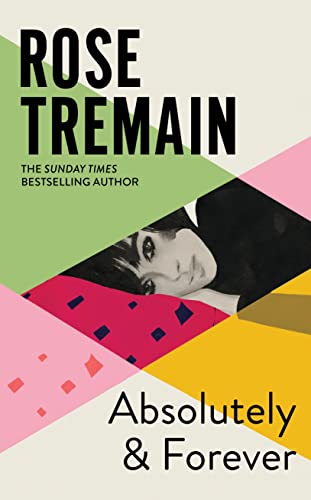
 I’ve had mixed experiences with Rose Tremain’s books, enjoying some and struggling with others. Absolutely and Forever was shortlisted for last year’s Walter Scott Prize for Historical Fiction and as it’s a personal project of mine to try to read all of the shortlisted titles, I decided to read this one despite it not sounding particularly appealing to me. It’s a short book (under 200 pages), so at least it wouldn’t be too big a commitment if I didn’t like it.
Here’s how the book begins:
When I was fifteen, I told my mother that I was in love with a boy called Simon Hurst and she said to me, ‘Nobody falls in love at your age, Marianne. What they get are “crushes” on people. You’ve just manufactured a little crush on Simon’.
What Marianne Clifford has manufactured, however, is more than just a little crush. It’s an obsession. She knows she’s going to love Simon Hurst ‘absolutely and forever’ and at first it seems that he feels the same way about her – but when he leaves for Paris to study at the Sorbonne and never returns, Marianne’s heart is broken. As the years go by, Marianne tries to move on and build her own life, but she can never quite let go of her love for Simon and the dreams she once had.
The book is set in the 1950s and 1960s and Marianne narrates the story of her life during and after her relationship with Simon. A lot happens to her over the years – she attends secretarial college in London, has several jobs, gets married and makes new friends – but all the time she’s pining for Simon, which holds her back from finding happiness and contentment. It’s understandable that she would be upset for a while, but when she continues to grieve for years and years afterwards, it quickly becomes frustrating, particularly as it’s so one-sided and Simon clearly doesn’t care as much as she does. But Marianne herself is naïve, innocent and childlike, never really seeing the world as other people see it, so it’s maybe not surprising that she reacts the way she does. Although she grows from a teenager into an adult over the course of the book, she doesn’t develop very much as a person and the Marianne at the end is not a lot different from the Marianne at the beginning.
Although I didn’t dislike Marianne and found her story quite sad, it was Hugo, the man she marries, who had my sympathy. Hugo is completely devoted to Marianne and she does like him very much, but her feelings for Simon prevent her from loving anybody else. At least Marianne is lucky enough to have a close female friend in Petronella, a sensible, practical Scottish woman she’s known since their school days, and Petronella does her best to help her move on with her life, but ultimately she can’t control whether Marianne chooses to take her advice.
The time period the story covers is the period when Rose Tremain herself was a teenager and young adult and I’m sure she’ll have drawn on some of her own personal memories and experiences of that era. Having read her memoir, Rosie: Scenes from a Vanished Life, however, this novel seems to be only partly autobiographical – Marianne’s life follows a different course from Rose’s own, but there are also some similarities, such as Marianne’s desire to be an author (for much of the book she’s working on a novel narrated by an Argentinian horse).
As I’ve mentioned, Absolutely and Forever appeared on the Walter Scott Prize shortlist in 2024, but it didn’t win and I think I can see why. Although I found it quite an easy, enjoyable read (despite Marianne being a bit irritating), sometimes the more readable books aren’t the ones that win prizes and this one doesn’t really tackle important or topical issues like the others on the list. I have the final shortlisted title, The New Life by Tom Crewe, to read soon.
 She Reads Novels
I haven’t read much 1950s historical fiction and none of Tremaine’s novels. I’m intrigued by your observation that the husband engenders sympathy, which must really change the reading experience. In general, I like complicated, messy protagonists, but it gets tricky when there is a character who threatens to become her victim. I think I’ll read it.
I didn’t dislike Marianne but she was frustrating. I thought her husband was very patient and understanding! I don’t read much historical fiction set in the 1950s either so I found it interesting. If you decide to read it I hope you enjoy it!
I don’t know why I haven’t yet tried any Tremain, Emily has a number of her titles and occasionally suggests I should try her so I’m sure I’ll have a browse on her shelves at some stage or other!
I’ve enjoyed quite a few of Rose Tremain’s books, although I wouldn’t describe her as a favourite author. I agree with Emily that she’s definitely worth trying!
Interesting. This is the only one I haven’t read yet for this year, although I haven’t posted my review of The New Life yet. I have a bit rockier relationship with Tremain, though. I haven’t liked anything I’ve read by her that much.
I’ll look out for your review of The New Life. I hope you enjoy this one, despite not liking Tremain much so far.
The New Life is coming up in early February.
I have enjoyed several Tremain books but this wasn’t one of them. As you say, an easy read but I found this a little dull.
I quite enjoyed it, but there was nothing particularly outstanding or memorable about it. Some of her other books are a lot better, I think.
This is probably not a book I would enjoy. I prefer characters I can like, and that change and grow at least a little bit over the course of the story. And obsessing over a guy like she does is not my favorite thing to read about either.
She was very frustrating! I like to see some development in a character too.
I didn’t think of this when I was reading this book, but I was just writing up my review, and I looked up Rose Tremain’s birth year, as I do when I’m trying to decide if something is a historical novel. Well, it’s entered into the Walter Scott prize, so it was obviously accepted as a historical novel, but she was born in 1943, which means she was 15 when the book starts, in the late 1950s, when Marianne is also 15. In your opinion, does this make it a historical novel or not? I think it isn’t. The definition I have been using is that it’s historical if it takes place before the author could have coherent memories of the time. This one, actually, could be more autobiographical than historical, although I have no way of knowing that. What do you think?
The Walter Scott Prize uses the definition that the book (or most of it) must be set at least 60 years before the publication date, so they would consider this one a historical novel. I agree, though, that if an author is writing about a time they can remember that could make it more autobiographical. I’ve read one of Rose Tremain’s memoirs and there are definitely some similarities between her life and Marianne’s. But then, if you use the author’s age as the definition, does that mean a book set in the 1990s would be historical fiction as long as the author is just 25? I suppose it would, but that feels too recent to me.
Yes, it’s a difficult question. I don’t know if a book would be autobiographical or not if it was written within the time of the person’s memory, but I would consider it contemporary to her time. Maybe you have to combine that rule with, say, a fifty-year rule, because 1990s doesn’t seem historical to me, either. On the other hand, I’m older, so when a book about the 60s, when I was a teenager, is classified as historical (and of course by now I have read many that are), it makes me feel weird.
I think the main point with figuring in the author’s age is that if she can remember it, she probably doesn’t have to do historical research, or at least not as much.
Hello. I’m doing my English A-level coursework on this book and I’d really like to cite you for my bibliographic overview. Do you have a surname I should use, or would you prefer to be cited as anonymous?
Thank you.
Hi, you can cite me as Helen Skinner. Good luck with the coursework!