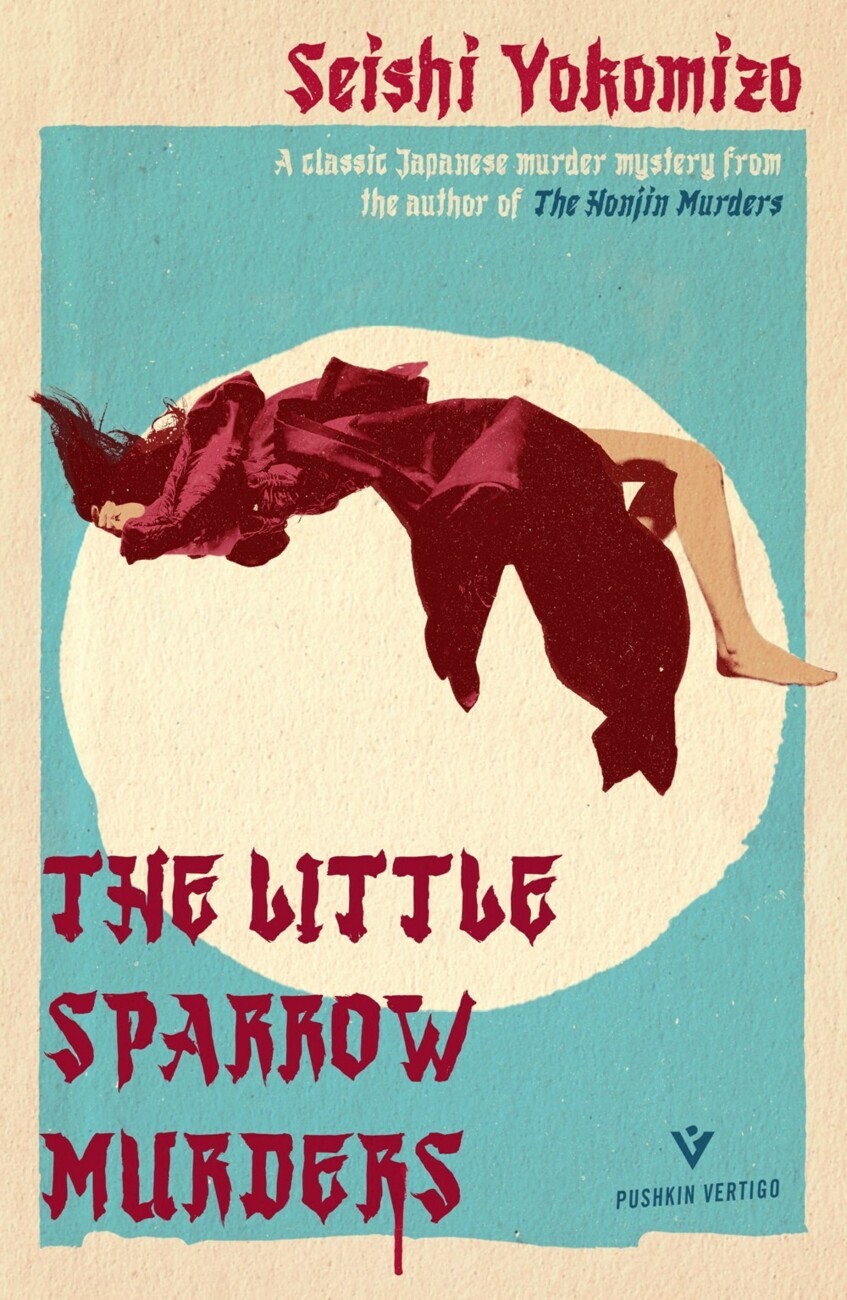
 Translated by Bryan Karetnyk
I’ve read all five of Seishi Yokomizo’s Kosuke Kindaichi mysteries that have previously been published by Pushkin Press in new English translations. This is the sixth, with another due later this year, and I decided to read it for the Japanese Literature Challenge being hosted this month and next by Dolce Bellezza.
The Little Sparrow Murders was originally published in Japanese in 1959 and is set a few years earlier in the village of Onikobe in Okayama Prefecture. Private detective Kosuke Kindaichi is taking a break from crime-solving and has decided to travel to Okayama to visit his old friend, Inspector Isokawa, at the prefectural police headquarters. Isokawa gives him the address of a nearby inn to stay at, run by Rika Aoike, a widowed friend. Although Kindaichi had been hoping to relax and avoid any mysteries for a while, he finds himself drawn into one when he learns that Rika’s husband, Genjiro, was murdered twenty years earlier – and the killer was never found.
As Kindaichi hears more about the events before and after Genjiro’s death and gets to know some of the people involved, another murder takes place, coinciding with the disappearance of the village chieftain and a sighting of a mysterious old woman on a mountain path. It seems that Kindaichi’s relaxing break is over before it even started. He and Isokawa begin to investigate, convinced that the key to the present day mystery lies in determining what really happened to Rika’s husband all those years ago.
Having read a lot of older Japanese crime novels over the last few years, thanks mainly to Pushkin who are doing a wonderful job with their new translations, I’ve found that many of them – most notably the ones I’ve read by Yukito Ayatsuji and Soji Shimada – are more concerned with solving seemingly impossible crimes and complex puzzles than with characters and motives. Yokomizo, I think, usually finds a better balance between the two; although his books still have intricate plots, the focus is often not so much on working out how the murders were committed, but rather on why they were committed and who could have had a reason for doing so. The impossible crime books can sometimes be fun as well, but I personally prefer the more character-driven ones. In this particular novel, the murders take place out in the open, not in locked rooms, and there’s almost no discussion of alibis, timings or similar things that can sometimes bog down a plot.
One thing I loved about The Little Sparrow Murders is that Yokomizo builds the story around a children’s rhyme – a device that Agatha Christie also often used. The killer in this novel is inspired by a temari song (a song sung by children in Japan while bouncing colourful embroidered temari balls). It begins “In the trees in the garden behind our house, Three little sparrows came to stay” and goes on to describe three young women from different families, who were “all of them sent away” – in other words, murdered. The deaths in the book correspond to the rhyme, which adds some extra interest to the mystery. I hadn’t heard of temari songs or balls before so, as always, a Yokomizo novel has contributed to my knowledge of Japanese culture.
 This is one of my favourite Yokomizo novels so far, along with The Honjin Murders and The Inugami Curse, but I did have one problem with it – trying to keep track of the huge number of characters! There are five families in the book and it’s not easy to remember which family each character belongs to and how they’re connected to people in the other families. If you’re reading the ebook version (or maybe even if you’re not), I recommend taking the time to draw some family trees using the character list at the front of the book before you start, then you can easily refer to them as you read. I would have been lost otherwise, I think.
I’m now looking forward to the next Yokomizo book, Murder at the Black Cat Café, coming in September. Pushkin Vertigo also have another Ayatsuji novel, The Clock House Murders, on the way, as well as others by authors I haven’t tried yet, so 2025 should be a good year if you’re a fan of Japanese mysteries!
 She Reads Novels
A lovely review, Helen. This is one I’m looking forward to as well having enjoyed all the Kindaichi books I’ve read so far. Pushkin has a fair few Japanese mysteries listed for the year including a couple of new to me authors, Yasuhiki Nizhizawa and Taku Ashibe, who I’m looking forward to trying.
I hope you like this one, Mallika – I’m sure you will, as you’ve enjoyed all the others in the series. I’m looking forward to trying some of the new to me Japanese authors Pushkin are publishing this year too.
Looking forward to reading it soon, and the others too!
I have read mixed views about this book, which I have sitting on my TBR pile. So I was a little put off from trying it. But I am glad I have read your review, it makes me feel more hopeful that I might enjoy this book.
I hope you like it. I enjoyed it, which isn’t really surprising as I’ve enjoyed all of the books in this series, but it does seem to be dividing opinion.
One of my reading goals for this year is to read some Japanese crime novels, and Yokomizo is at the top of my list of authors to try. 😀
I think he’s one of the best I’ve tried so far.
I hope to read this, which I own, and understand it! So often this particular author has me lost well before the mystery is solved. And, I like mysteries! Intriguing how he uses the nursery rhyme such as Agatha Christie often did. Perhaps I could follow it, then. 😉
I hope you enjoy it! I like Yokomizo’s books, but they do tend to be quite complicated and I often struggle to keep track of all the characters.
Your post reminded me of the challenge, which I will certainly try to do this year.
Harvee https://dolcebellezza.blogspot.com/
The challenge runs until the end of February, so still plenty of time!