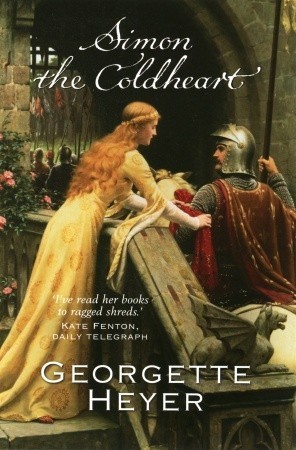
 This week, Karen of Kaggsy’s Bookish Ramblings and Simon of Stuck in a Book are hosting another of their very popular clubs, where we all read and write about books published in the same year. This time it’s 1925! When deciding what to read for the clubs, I usually start by looking to see whether any of my favourite authors had a book published in that year. Georgette Heyer had such a long career there’s nearly always something suitable for whichever year it is and she didn’t disappoint this time.
Simon the Coldheart, published (obviously) in 1925, is one of several straight historical novels Heyer wrote, rather than one of the Georgian or Regency romances for which she’s most famous. It does feel very different and I don’t think it will necessarily appeal to fans of her other books, but I still liked it.
We first meet Simon in the early 1400s when, at the age of fourteen, he presents himself at the castle of Fulk of Montlice, demanding to join his service. Simon is the illegitimate son of Fulk’s bitter enemy, Lord Geoffrey of Malvallet, but Fulk is impressed by his confidence and determination and offers him a position as page. As the years go by, Simon repays Fulk’s faith in him, serving him well for several years before being knighted by the King and gifted lands of his own.
Now known as Sir Simon of Beauvallet (a play on the name of his father, Malvallet, and on the name of his lands, Fair Pastures), Simon has his life in order, exactly as he wants it. His friend Alan, Fulk’s son, and his half-brother Geoffrey, however, believe there’s still something missing from Simon’s life: a wife. Simon insists that he has no interest in women and no plans to get married. But when he meets Lady Margaret of Belrémy, it seems he may have met his match.
I’ve been meaning to read Simon the Coldheart since I read Heyer’s Beauvallet a few years ago – technically a sequel to this book, although it’s set several generations later and features completely different characters. I didn’t find this one as much fun as Beauvallet, which is an Elizabethan pirate novel, but I still found it quite enjoyable. Simon is a strong character, if not particularly easy to like at first – he becomes known as Coldheart for a reason – but later in the book we start to see a more human side to him, first in the close friendships he forms with Alan and Geoffrey, then in his kindness to children and finally his romance with Margaret, which forms a relatively small part of the novel. I also loved his relationship with Fulk, who comes to love him like a son (sometimes, it seems, more than his real son).
 As she always does, Heyer attempts to write using language appropriate to the era, which in this case means lots of ‘thees’ and ‘thous’. Today’s historical fiction authors tend not to do this, so it does make the book feel dated – which again won’t be to everyone’s taste, but I didn’t have a problem with it. I didn’t find the romance element of the book particularly satisfying, though; Margaret is introduced quite late in the novel and Heyer’s usual witty dialogue between hero and heroine isn’t much in evidence here. I found Margaret a more interesting character when she’s away having adventures on her own than I did in her scenes with Simon.
Apparently Simon the Coldheart was one of six books Heyer tried to suppress in the 1930s (the others were another historical novel, The Great Roxhythe, and four contemporary novels) as she considered them inferior early works. In 1977, a few years after her death, her son gave permission for this one to be republished. In general I believe an author’s wishes should be respected, but I also think she was maybe being too hard on Simon the Coldheart – it obviously isn’t one of her best, but it’s not a bad book at all. It got my 1925 Club reading off to a good start and I hope to post another review later in the week, as well as looking at some of my favourite reads from previous club years.
 She Reads Novels
I’ve got Simon the Coldheart in my shelves waiting for a re-read (it must be 35 years at least since I’ve read it), and your review makes me want to put aside everything else I’m reading in favour of it! I do love the fun of the Regency romances, but it is so exciting to see a new side if a favourite author.
I wonder what Georgette Heyer particularly disliked about Simon the Coldheart? I have a copy of Helen, which I believe was suppressed because the author felt it mirrored her own life too closely. I’ve had it since I was in my early teens, someone was throwing it out and I ended up with it. It wasn’t until quite recently that I realised the author had later suppressed the book.
I love the Regency romances too but, as you say, it’s interesting to see a different side of her writing. I’m not sure why she apparently disliked this book so much – obviously it’s a very early one, but it’s well written and entertaining. I can understand why she may have wanted to suppress the more biographical books, though.
It sounds as if she might have been her own harshest critic when it came to Simon the Coldheart, which I think you suggested in your review.
I’m in the middle of rereading Simon the Coldheart and it does feel very much like an early Heyer. Fulk is definitely recognisable as one of her typical father figures though.
It’s definitely not as strong as her later books, but I did still find it quite entertaining. I loved Simon’s relationship with Fulk.
That is really interesting about the suppressed novels. I agree an author’s wishes should be respected but it is hard to claim restrictions on the future forever and this book is obviously giving many people enjoyment.
I haven’t tried any of the other books she wanted to suppress, but yes, I think this particular book deserves to be read and enjoyed!
I’m glad you enjoyed it, and it certainly does sound an earlier period than I would usually expect from Heyer. As for the suppression of early works, it’s a knotty topic. Although we should respect what the author wanted to do, sometimes they’re not necessarily the best judge of their own work! And if we accept following their orders to the letter, we would have no Kafka!!
Yes, it seems a shame for books to be hidden away forever when they could be giving pleasure to so many people.
Well, isn’t that interesting. I have read both Beauvallet and Simon the Coldheart but far enough apart that I had no idea one was a sequel to the other one. I think Heyer is too restrained in her straight historical novels. However, I think I have copies of both of these. I should reread them sometime.
The only real connection between the two books is that the main characters are from different generations of the same family. I liked both, but I think Beauvallet was more fun.
Well, that’s what she did with These Old Shades and The Devil’s Cub except that the main characters from These Old Shades were in both.
I didn’t know Heyer even wrote this kind of historical novel. One of these days I really need to investigate all the different books she wrote. It’s interesting that she tried to ‘suppress’ this one later in her life.
She wrote five or six historical novels, I think, as well as detective novels and some contemporary books. I don’t think this one deserved to be suppressed!
I like this too although as I recall Fulk is the most appealing character!
Yes, I loved Fulk!
I like the sound of this book! Thank you for the review. 😊⭐️
It was fun! I love Georgette Heyer’s books.