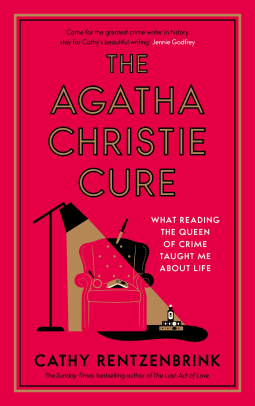
 If you’ve been following my blog for any length of time, you’ll have noticed that I read a lot of Agatha Christie books! In fact, I’ve now read most of her work and only have a few more novels and some short story collections left to read. It’s taken me many years to get this far, though, and I’ve been reading the books in a very haphazard way, picking them up in no particular order as I come across them or to fit the monthly themes for the Read Christie challenge. In The Agatha Christie Cure, Cathy Rentzenbrink describes her own journey through Christie’s work, which is much more structured than mine!
Rentzenbrink’s project begins at Christmas. She’s feeling tired and miserable – she and her husband, Erwyn, are considering separating; their son Matt is unhappy at school; and because of the Christmas holidays, Cathy has none of her usual work activities to keep herself occupied. Reading all of Agatha Christie’s books in the order they were published seems like the perfect distraction – a way to escape from real life for a while and also a fascinating opportunity to watch the 20th century unfold through Christie’s eyes. Deciding to start immediately, she gets into a warm bath, picks up The Mysterious Affair at Styles, and begins.
The Agatha Christie Cure incorporates a lot. There are discussions of Christie’s novels (usually quite brief but sometimes a whole chapter devoted to one book); other sections take the form of a memoir, with Rentzenbrink talking about her personal life, her family and her relationship with Christie; and we also learn a lot about Christie herself, drawing on her own autobiography, with a focus on her sudden disappearance for several days in December 1926. There’s a good balance between these three different elements of the book, with some crossover between them, for example when Cathy looks for parallels between her own life and Christie’s. I particularly enjoyed Rentzenbrink’s interactions with her son, Matt, discussing Christie’s books with him and sometimes reading or listening to them together. Despite his problems at school, Matt is an intelligent, observant boy and often picks up on details in the books that his mother has missed.
You may be wondering about spoilers. Unfortunately, I thought they were handled quite inconsistently throughout the book. In the chapter on The Murder of Roger Ackroyd, for example, Rentzenbrink provides a spoiler warning before going on to discuss the solution to the mystery, but later in the book she casually names the culprit from Roger Ackroyd again without repeating the spoiler warning. Because I’ve already read so much of Christie’s work, I mostly felt safe (although I skipped over the sections on the few books I still haven’t read, such as Elephants Can Remember and Curtain) but this could be more of a problem for readers who’ve read less Christie than I have.
I’ve often wished that I had tried to read Christie’s novels in order from the beginning as it sounds like such an interesting, rewarding approach to an author’s work. Not only can you watch the author grow and develop with each book, but when their work spans several decades, as Christie’s does, you can also look out for hints of social and cultural change and technological advancement. Of course, there can also be some disadvantages to reading in order – as Rentzenbrink discovers, most of Christie’s better books were written earlier in her career and the later ones tend to be weaker. Maybe my random approach is better after all, as it provides more variety and keeps things fresh.
I found The Agatha Christie Cure very enjoyable, but if you’re just beginning your own Christie journey (or haven’t started yet) then it would probably be wise to wait until you’ve read more of her books. Definitely read The Murder of Roger Ackroyd first!
Thanks to Canongate Books for providing a copy of this book for review via NetGalley.


This does sound interesting, though it’s a great shame about the spoilers. I can remember the ending of Roger Ackroyd, but other books I’ve forgotten so I might have to think about whether I’ll read this or not!
I hate having anything spoiled, so I just skipped over the discussions of books I haven’t read yet or have forgotten, but it seemed so unnecessary to include spoilers at all – particularly without warnings. Apart from that, it was a fascinating book!
I have this on my list so I’m glad you enjoyed it but that’s dreadful about the spoilers you’d think someone would have noticed!
I couldn’t see the point in giving spoiler warnings for some of the spoilers but not all of them! I did enjoy the book apart from that, so I hope you like it as well.
Fascinating!
I have also read a lot, especially her series.
Years ago, I listened to all the Hercule Poirot canon: https://wordsandpeace.com/2021/12/06/may-2020-november-2021-19-months-with-hercule-poirot/
I still have four or five Poirot novels left to read, I think, and some short stories. Well done for listening to them all!
My ‘plan’ is to read all of the Miss Marple books in publication order – at least eventually! 8 down, 5 still to go. I have a few books about Christie too which I also need to get around to!
I only have one Miss Marple novel left to read – The Moving Finger, which I’m hoping to read this month – and a few short story collections. I do wish I’d read them in publication order, but too late now!
Shame about the spoilers!
It seemed so unnecessary and I can’t understand why some of the spoilers came with warnings and not others!
My approach has been similar to yours, in fact my first – and almost the last! – Christie read was one of her final few titles, Nemesis (1971) which I found disappointing at the time. I’m not generally a completist, though, nor a researcher-writer like Rentzenbrink, so I’m happy to take them as they appear in front of my nose!
Nemesis is one of the weaker Miss Marple novels, so I can see why it wouldn’t be a good starting point. I’m glad it didn’t put you off completely, though!
I’ve dipped into some of Christie’s novels but in a very haphazard manner. It would be interesting though to read them in order to see how they reflected social change. another project to add to my already long list maybe??
Reading Christie in order would be a fascinating project and I wish I’d tried to do that from the beginning!