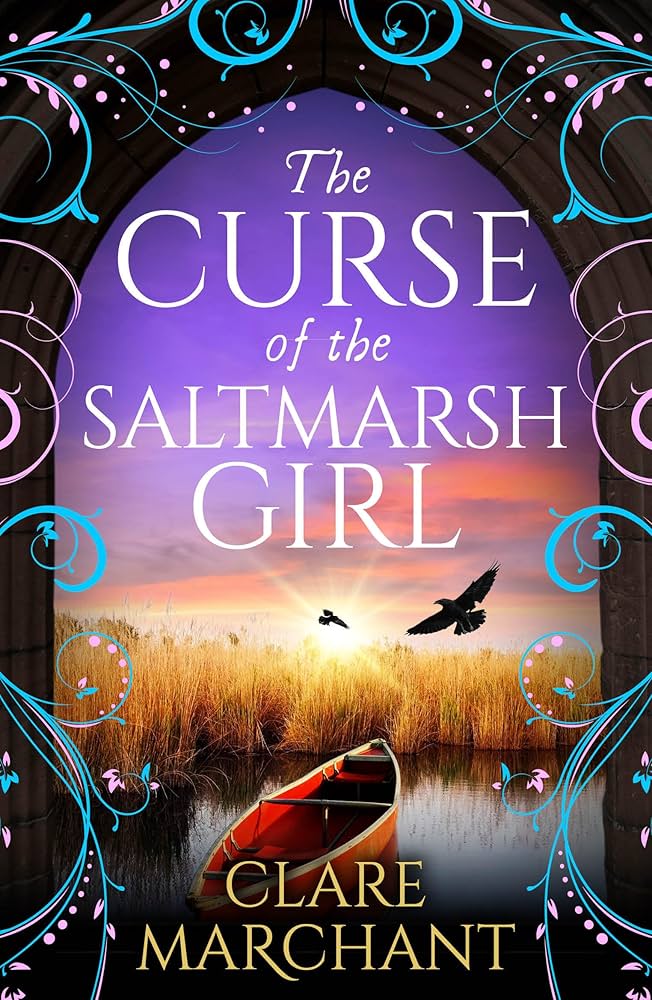
 This is my second Clare Marchant book, following The Alchemist’s Secret which I read earlier this year. It’s also my favourite of the two – although I enjoyed both books, I found this one darker, more atmospheric and more gripping. Although I’m often critical of dual timeline novels (which this is), I thought that format worked quite well here as the modern day character has a well developed storyline of her own rather than just providing a frame for the historical thread.
The first chapter sets the tone for the rest of the book as Angel drives through a heavy sea fog on her way to stay with her brother on the North Norfolk coast. Convinced first that an animal of some kind is running along beside her car and then that the vague, murky figure of a human is actually inside the car with her, Angel begins to question why Dan has chosen to live in such an isolated, unsettling place. His home is a converted barn on the outskirts of Saltmarsh, a ruined village abandoned during an outbreak of plague in the 17th century and although Angel had wanted a quiet place to escape from her personal problems for a while, this isn’t quite what she’d expected.
In 1665, however, Saltmarsh is still a busy, thriving village. Margery has just arrived there in search of her mother who left their home in nearby Kelveton five weeks earlier to visit her other daughter who lives in Saltmarsh. She never returned, so Margery has decided to walk to the village herself to look for her – but she’s not prepared for what awaits her there. Her sister is dead and no one can tell her what has happened to her mother; in fact, the villagers are so hostile, Margery is sure they know more than they’re admitting. Lodging with Bridget and Anne, two healers who live just outside Saltmarsh, Margery is determined to get to the bottom of her mother’s disappearance, but when bubonic plague reaches the village, Margery is blamed for bringing the disease with her in the form of the mythical black dog, Black Shuck.
Black Shuck – who, depending on the legend, can be either a malicious demon or a protective creature – appears in both the historical and present day threads of the novel. Other pieces of Norfolk folklore are also woven in, such as the legend of the Lantern Men, marsh spirits associated with ghostly lights and the sound of whistling. I found the book genuinely creepy in places and although there are rational explanations for some of the things that happen, others aren’t fully explained, leaving a sense of the supernatural. There are also lots of vivid, evocative descriptions of the Norfolk coastal landscape with its treacherous marshes, all adding to the atmosphere.
Although Margery’s story was more exciting, it was interesting to see Angel uncovering the secrets of Saltmarsh. I liked the idea of symbols carved into the altar of the ruined church describing what happened in the village and Angel trying to interpret them – at first I thought it seemed a bit too convenient that anyone would do that, but then I remembered that of course there are real cases of what’s known as ‘historical graffiti’ recording important events. There are several other things tying the two narratives together as well. First, there’s a mother/daughter theme in each one. Angel, who was abandoned as a baby and adopted by two loving parents, has been contacted by a woman claiming to be her sister; Angel now has to decide whether to meet her (and potentially get to know her biological mother) but is struggling with the decision. Meanwhile, Margery, who has lost her own mother, finds that her new friends, Bridget and Anne, have become as close to her as family. There’s also a hint of romance for both Angel and Margery, but I liked the way it was only briefly touched upon in both cases, rather than becoming a big part of the plot.
I’ll look forward to Clare Marchant’s next book and will try to investigate some of her earlier ones as well.
Thanks to Boldwood Books for providing a copy of this book for review via NetGalley.
Reviewed for RIPXXI hosted by @perilreaders


Black Shuck, eh? I like the sound of this and of hints of symbols, misty fens and human mysteries to be explored. It reminds me a bit of Michelle Paver’s Wakenhyrst set across the border in the Cambridgeshire fens and with hidden symbols in church art …
I loved the folklore element of this book, particularly the exploration of how myths and legends can mean different things to different people. There are definitely some similarities with Wakenhyrst in terms of setting and atmosphere at least.
Good to know this one was so good. I’ll have to see if my library has a copy.
I really enjoyed it!
This does sound creepy but also quite fun as I know the salt marshes well!
I think you would appreciate the setting, then! There’s a very strong sense of place.
Definitely need to check this one out soon, I love the sound of the folklore inclusions and the fact that one of them features in both storylines. The setting sounds very atmospheric and I’m intrigued to see where the more mysterious threads lead. Lovely review.
I think you might enjoy this one. The setting is great – very creepy and atmospheric. The folklore aspect is fascinating as well and helped to tie the two storylines together.
This book certainly seems to fit into RIP!
Just a note. My internet has been down for a week, so I am just on my phone, and for some reason WordPress makes me log in every time I comment or like another WP blog. Then after two or three times, it tells me to wait, so it’s been difficult to comment or like. So if you don’t see much of me for the next week (I hope it’s just that long), you’ll know why. I’m still reading the blogs, though.
I hope you get your internet back soon. I hate having to do everything on my phone.
Yes, it’s hard because everything is so small.
I’m not a big fan of dual timelines either, but this one does sound interesting – and atmospheric! One for the wishlist, I think!
I nearly always prefer the historical timeline and find the modern day one unnecessary, but in this case I thought the two worked well together. I loved the setting as well!