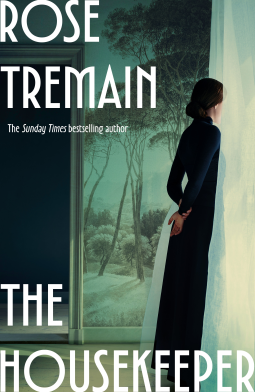
 Daphne du Maurier’s Rebecca is one of my favourite books, so I was intrigued when I saw that it was the inspiration for Rose Tremain’s new novel, The Housekeeper. I’ve had mixed experiences with Tremain’s books in the past, but I knew I would have to try this one.
The Housekeeper is set in the 1930s at Manderville Hall, a large country house in Cornwall. Lilianne Maria Danowski has been housekeeper there for several years, having left Poland with her father as a young girl. Danni, as she is known – or sometimes Mrs D – is happy with her job and fond of her employer, Lord Grenville-Whithers, an elderly widower. However, the old man is starting to think about the future and as he has no heir of his own, he invites his niece Adelaide to come and stay, with the intention of leaving the house to her. Adelaide is an unpleasant, overbearing woman and Danni knows she will have to tread carefully around her, particularly as she’s currently in a relationship that could cost her her job if discovered…
Danni’s lover is the author Daphne du Maurier, who has come to research her new novel and has been given permission to use Lord Grenville-Whithers’ boathouse to do her writing. The two women are immediately drawn to each other; for Danni it’s a passionate love affair and she assumes Daphne feels the same, but when Daphne’s new novel is published, Danni is left feeling hurt and betrayed by what she reads.
Lilianne Maria Danowski was not a real person; she’s a fictional character invented by Rose Tremain, but if you’ve read Rebecca you’ll be able to see the parallels with Mrs Danvers, the housekeeper at Manderley, referred to by Rebecca as Danny. Tremain imagines that Danowski was du Maurier’s inspiration for Mrs Danvers and explores how she may have felt at seeing an unflattering portrayal of herself in a book. If you haven’t read Rebecca you’re probably wondering if you need to do so before reading The Housekeeper. My answer would be no, it’s not essential, but it would definitely be a good idea as then you would be able to spot all the little echoes of Rebecca that Tremain weaves into the story.
The Housekeeper is a beautifully written novel, but I did have a few problems with it. I felt that Danni and Daphne’s relationship began very suddenly with no real build and I just didn’t feel very convinced by it. I know quite a lot about Daphne du Maurier’s history and background, having read her autobiography Myself When Young, as well as Jane Dunn’s biography Daphne du Maurier and Her Sisters, and the impression I got from those books is that she was a complex person – shy, private and reclusive, which could make her come across as distant or aloof, but also loyal and affectionate towards her close friends. There’s not much of that complexity in Tremain’s novel; her Daphne is cold, manipulative and selfish, caring more about her reputation than Danni’s feelings.
Although I didn’t care for the portrayal of Daphne, I did like Danni. I loved the little glimpses we get of her childhood growing up as a Jewish girl in Radom, Poland, and I would have liked more of that. I also enjoyed the sections of the book set after Danni’s relationship with Daphne ends and she sets up her own business as a seamstress; there’s an interesting little subplot here involving a girl for whom Danni is asked to make a wedding dress, and another featuring two other former servants from Manderville Hall.
Apparently The Housekeeper, which began as a short story several years ago, is already being adapted for film and will star Caitriona Balfe and Emma Laird as Danni and Daphne, Anthony Hopkins as Lord Grenville-Whithers and Helena Bonham Carter as Adelaide.
Thanks to Chatto & Windus for providing a copy of this book for review via NetGalley.


I’m currently reading this and I agree with a lot of your points. I like the idea of creating a back story for Mrs Danvers but I’m not really convinced by the relationship with Daphne. Why not explore the relationship between Rebecca & Mrs Danvers which is hinted at in the book? I’m not sure how a film could be made out of such slight material either.
I’m glad it’s not just me who didn’t feel convinced by Danni and Daphne’s relationship. I think I would have preferred a book about Rebecca and Mrs Danvers as well.
I like the sound of this and am intrigued by a film adaptation. Anything with Anthony Hopkins is fine with me!
I’m looking forward to seeing the film. I think Anthony Hopkins will make a great Lord Grenville-Whithers!
Hm…I think I’d be more likely to read this if it didn’t have Daphne du Maurier as a character. That sounds like it altered reality in ways I wouldn’t enjoy so much. Though I would like to go back to Manderley again!
I didn’t feel comfortable with the portrayal of Daphne, particularly as it was so negative and she does still have family members still living.
I find Tremain problematic anyway, but not only does she reinterpret (sort of) Rebecca but actually makes Du Maurier a character. Sometimes I can take or even enjoy reinterpretations, but I don’t think I like real people being brought into novels that much unless they are incidental or at least true to the person’s identity, or it’s biological fiction.
I don’t mind real people from centuries ago being in novels, but I have more of a problem when they lived more recently and still have family and friends who remember them. Du Maurier is portrayed in a very negative way in this book as well.
That’s a good point, and although I understand that she used to refer to a male part of herself, I don’t think there’s any evidence that she had a lesbian affair.
Ive seen an adaptation of Rebecca but I think I’d rather read it too before checking this one out. Its a shame it didnt do Daphne du Maurier justice but other than that it sounds like an interesting read. I think I did see the adaptation mentioned elsewhere recently thinking about it so I better hurry up and get to both books sooner rather than later. Lovely review.
I would definitely recommend reading Rebecca – it’s such a great book. Daphne du Maurier is one of my favourite authors and I thought it was a bit unfair to portray her so negatively in this novel, but otherwise I did enjoy it.
Thank you for your review – it is super interesting as I really loved Rose Tremain and have read so many of her books that I raced out and got ‘Always and Forever’ when it came out a few years ago, and I found it dreary, nothing like her past works, so I haven’t bothered with this one… but perhaps I will read it after I read Rebecca.
I think this book is definitely worth trying – it’s completely different from Absolutely and Forever. Read Rebecca first, though!
I hadn’t heard of this before reading your review and I am intrigued, because, like you Rebecca is one of my favourite books. I’ve read it many times. I must say I can understand your point about not liking the portrayal of Daphne. I’m currently reading a series of books about Jane Austen (another favourite author of mine) in which she investigates murders and at first she seemed so giddy that I felt almost affronted!
I must check this out though.
Thanks
Lynn 😀
I would still recommend reading this book, despite the negative portrayal of Daphne. I think you would appreciate all the little references to Rebecca she works into the plot. It seems that books using real life authors as detectives are very popular at the moment, although I don’t think I’ve read any of them.
I love Rebecca, so this book is tempting to me, but Rose Tremain has been hit and miss for me too!
Thanks for sharing your review with the Historical Fiction Reading Challenge!
I’ve enjoyed some of her books but not others. This one mainly interested me because of the Rebecca references.