Top Ten Tuesday: Upcoming releases

This week’s topic for Top Ten Tuesday, hosted by Jana of That Artsy Reader Girl, is “Most Anticipated Books Releasing In the Second Half of 2022”.

Here are ten books due to be published in the second half of this year that I’m looking forward to reading. Publication dates were correct for the UK as of today, but could change.

1. The Blood Flower by Alex Reeve (7 July) – The fourth book in the Leo Stanhope series, one of my current favourite historical mystery series.

2. The Bewitching by Jill Dawson (7 July) – A novel about the 16th-century case of the witches of Warboys. I have a copy of this one from NetGalley and have just started reading it.

3. The House of Fortune by Jessie Burton (7 July) – Has it really been eight years since The Miniaturist was released? I hope the sequel will be just as good!

4. The Twist of a Knife by Anthony Horowitz (18 August) – The next book in the Horowitz and Hawthorne mystery series. I’ve enjoyed all of the previous three (my review of the third one should be up in the next few weeks).

5. The Marriage Portrait by Maggie O’Farrell (30 August) – I didn’t love Hamnet as much as most people did, but I thought it was beautifully written and would like to try Maggie O’Farrell’s new book, set in Renaissance Italy.

6. Act of Oblivion by Robert Harris (1 September) – Robert Harris is one of my favourite authors, so a new book by him is always something to look forward to!

7. Ithaca by Claire North (6 September) – This Greek myth retelling about Penelope, Odysseus’ wife, is another book I have from NetGalley and will read nearer the publication date.

8. The Hidden Palace by Dinah Jefferies (15 September) – I’ve read all of Dinah Jefferies’ books and this one will be the second in her new World War II trilogy, which began last year with Daughters of War.

9. Shrines of Gaiety by Kate Atkinson (27 September) – Kate Atkinson is another author I always look forward to reading. I don’t know much about her new book but I’m sure it will be great.

10. Blue Water by Leonora Nattrass (20 October) – I enjoyed the debut novel by Leonora Nattrass, Black Drop, so I’m interested in reading this sequel.

~

Will you be reading any of these? Which new releases are you looking forward to in the second half of 2022?

Six Degrees of Separation: From Wintering to The Strangers in the House

It’s the first Saturday of the month which means it’s time for another Six Degrees of Separation, hosted by Kate of Books are my Favourite and Best. The idea is that Kate chooses a book to use as a starting point and then we have to link it to six other books of our choice to form a chain. A book doesn’t have to be connected to all of the others on the list – only to the one next to it in the chain.

This month we’re starting with Wintering by Katherine May – yet another book that I haven’t read! This is what it’s about:

In Wintering, Katherine May recounts her own year-long journey through winter, sparked by a sudden illness in her family that plunged her into a time of uncertainty and seclusion. When life felt at is most frozen, she managed to find strength and inspiration from the incredible wintering experiences of others as well as from the remarkable transformations that nature makes to survive the cold.

This beautiful, perspective-shifting memoir teaches us to draw from the healing powers of the natural world and to embrace the winters of our own lives.

Although I haven’t read Wintering, it seems that Katherine May is using the idea of ‘winter’ as a metaphor for depression. In Mr Chartwell by Rebecca Hunt (1), depression is represented by a black dog. The ‘black dog’ is how Winston Churchill referred to his own periods of depression and in this very unusual novel, Rebecca Hunt brings the dog to life, giving him the name Mr Chartwell and describing his visits to Churchill’s home.

My next link is simply to another book with an author whose surname is Hunt: The Seas by Samantha Hunt (2), a novel about a young woman who lives in an isolated town by the sea and believes she is a mermaid. This is a beautifully written novel which combines mermaid mythology with the Iraq War, post traumatic stress disorder and the creation of a new dictionary, but it was a bit too strange for me and not a book I particularly enjoyed.

The sea also plays a part in the plot of The Sea Change by Joanna Rossiter (3). This is a novel set in two different countries and two different time periods: India in 1971 where a newly married couple are separated by a tsunami, and England during World War II, where the village of Imber is evacuated for use by the Army (and remains uninhabited to this day).

Some of the events of The Sea Change take place in 1971, so my next link is to a book that was published in 1971: Nemesis by Agatha Christie (4). This is a late Miss Marple novel in which Marple agrees to investigate a crime for an old friend – without having any idea of what the crime is or what she will need to do. During a coach tour of Britain’s historic houses and gardens, the details of her mission begin to unfold.

Strangers in Company by Jane Aiken Hodge (5) is also a mystery that takes place on a bus tour – this time it’s a tour of Greece’s famous archaeological sites. I’ve read quite a lot of Hodge’s novels now and this is the only contemporary one (the others I’ve read have been Gothic or Regency novels). It reminded me of Mary Stewart’s or M.M. Kaye’s romantic suspense novels, although I didn’t enjoy it quite as much as those.

My final link takes us to another book with ‘Strangers’ in the title: The Strangers in the House by Georges Simenon (6). This is one of Simenon’s romans dur, or ‘hard novels’; I have read a few of them over the last year or two and enjoyed them (I’m actually reading another one at the moment which I’ll be reviewing soon). The Strangers in the House is about a lawyer who fell into a depression and became an alcoholic after his wife left him. When his daughter becomes implicated in a murder investigation, he finds that he has a chance to redeem himself and repair his damaged relationships.

The theme of depression and finding a way to heal links back to Wintering, so I’ve managed to bring the chain full circle this month!

In August we’ll be starting with the winner of the 2022 Women’s Prize, The Book of Form and Emptiness by Ruth Ozeki.

Top Ten Tuesday: A Journey Through Time

This week’s topic for Top Ten Tuesday, hosted by Jana of That Artsy Reader Girl, is “Books With a Unit of Time In the Title (seconds, minutes, hours, days, weeks, months, years, eternity, etc.) (Submitted by RS @ The Idealistic Daydream)”.

I decided to make things more interesting by starting with a very short period of time and becoming gradually longer! All of the titles on my list are books that I’ve read and reviewed on my blog.

1. The Second Sleep by Robert Harris – I’m starting with a title which includes the word ‘second’. Robert Harris is a favourite author of mine and I usually love his books, but I found this one a bit disappointing. It seems at first to be a conventional historical novel set in rural England in the year 1468, but it turns out to be something very different! A fascinating idea, but not what I had expected.

2. Ten-Second Staircase by Christopher Fowler – I don’t seem to have reviewed any books with ‘minute’ in the title, so I’m going with something longer than a second but not as long as an hour. This is the fourth novel in Fowler’s Bryant and May series which follows the investigations of two octogenarian detectives working for London’s Peculiar Crimes Unit.

3. The Distant Hours by Kate Morton – I’ve read most of Kate Morton’s books, although this isn’t one of my favourites. Moving between the 1990s and 1940s, the novel has lots of gothic elements from crumbling castles to family secrets and I did find it entertaining, but much longer than it really needed to be.

4. The Day of the Triffids by John Wyndham – I don’t read a lot of science fiction, but I’ve enjoyed everything I’ve read by John Wyndham. In The Day of the Triffids, after an unusual display of meteors throws the world into chaos, an aggressive species of tall and vicious plants begin to dominate. A fascinating, but unsettling read.

5. A Week in Paris by Rachel Hore – In this dual timeline novel, the ‘modern’ storyline is set in 1961 and follows music student Fay Knox who is spending a week in Paris trying to discover the truth about her childhood. The other narrative tells the story of Fay’s mother during the occupation of Paris during World War II. I enjoyed this book, but much preferred the wartime storyline to the 1960s one.

6. The Nine Day Queen by Ella March Chase – Lady Jane Grey lasted slightly longer than a week on the throne of England. Her nine day reign in July 1553 is the subject of this historical novel which also gives plenty of attention to the stories of Jane’s two younger sisters, Katherine and Mary.

7. Around the World in Eighty Days by Jules Verne – I didn’t have any books with ‘month’ in the title, so am skipping ahead to ‘eighty days’ instead. This classic adventure novel follows the journey of Phileas Fogg who attempts to travel around the world in eighty days in order to win a bet. It’s an entertaining story, but it seemed such a waste to pass through so many countries without having time to explore them!

8. The Year Without Summer by Guinevere Glasfurd – This fascinating novel is set in 1816, the year after the eruption of Mount Tambora, an Indonesian volcano. Glasfurd tells the stories of six people, some real and some fictional, whose lives were affected by the extreme weather that followed the eruption.

9. Twenty Years After by Alexandre Dumas – This is the second book in Dumas’ d’Artagnan series and, as the title suggests, takes place twenty years after the events of The Three Musketeers. I loved this one every bit as much as the first book and I think it’s a shame it’s so much less well known.

10. Like This, For Ever by Sharon Bolton – For the final title on my list, I couldn’t decide between this one and Sebastian Barry’s Days Without End. Which is the longer period of time? They’re both the same, surely. Anyway, I settled on this one, which is the third novel in Bolton’s wonderful Lacey Flint crime series and one of my favourites!

~

Have you read any of these? Which other books with units of time in the title can you think of?

Six Degrees of Separation: From Sorrow and Bliss to Long Summer Day

It’s the first Saturday of the month which means it’s time for another Six Degrees of Separation, hosted by Kate of Books are my Favourite and Best. The idea is that Kate chooses a book to use as a starting point and then we have to link it to six other books of our choice to form a chain. A book doesn’t have to be connected to all of the others on the list – only to the one next to it in the chain.

This month we’re starting with Sorrow and Bliss by Meg Mason. I haven’t read it, but here’s what it’s about:

Everyone tells Martha Friel she is clever and beautiful, a brilliant writer who has been loved every day of her adult life by one man, her husband Patrick. A gift, her mother once said, not everybody gets. So why is everything broken? Why is Martha – on the edge of 40 – friendless, practically jobless and so often sad? And why did Patrick decide to leave?

Maybe she is just too sensitive, someone who finds it harder to be alive than most people. Or maybe – as she has long believed – there is something wrong with her. Something that broke when a little bomb went off in her brain, at 17, and left her changed in a way that no doctor or therapist has ever been able to explain.

Forced to return to her childhood home to live with her dysfunctional, bohemian parents (but without the help of her devoted, foul-mouthed sister Ingrid), Martha has one last chance to find out whether a life is ever too broken to fix – or whether, maybe, by starting over, she will get to write a better ending for herself.

It can be hard to find that all-important first link when the starting book is one you haven’t read, so I often take a word from the title for inspiration. In Tess of the d’Urbervilles by Thomas Hardy (1), ‘Sorrow’ is the name Tess Durbeyfield gives her baby son. I won’t tell you why, except that the circumstances of his birth are not very happy. Poor Tess has very little happiness in her life at all; this is a heartbreakingly bleak novel, but one that I loved. Many of Hardy’s books have been adapted for film and television and the edition of Tess I read is a tie-in with the BBC adaptation from 2008 – which has a screenplay written by the author David Nicholls, whose most recent book is coincidentally called Sweet Sorrow.

But that’s not my next link! The same adaptation starred Gemma Arterton as Tess, who also played Sister Clodagh in the BBC’s version of Rumer Godden’s novel Black Narcissus (2) in 2020 – and that’s the next book in my chain. Black Narcissus tells the story of a group of Anglican nuns who set out to establish a new convent in an abandoned palace in Mopu, high in the Himalayas. It’s the only Rumer Godden book I’ve read so far, but I loved the atmosphere she created and the way she wrote about the tensions between the nuns as their repressed feelings and desires rose to the surface in the isolation of Mopu. I’m sure I’ll be reading more of her novels.

Another book that features a nunnery is The Lady Agnes Mystery by Andrea Japp (3). I read this a few years ago for the Women in Translation month that takes place every August – it’s a French historical crime novel translated into English by Lorenza Garcia. The story is set in the Perche region of France in 1304 and follows the adventures of Lady Agnes de Souarcy, a young widow who is arrested for heresy by the Inquisition and becomes embroiled in a series of poisonings taking place at nearby Clairets Abbey. This was an entertaining read but the introduction of another storyline involving a secret prophecy gave it too much of a Da Vinci Code feel for my taste. This edition of the book only contains Volume 1 of the mystery; there is a sequel, Volume 2, which I haven’t read and probably won’t.

The Travels of Daniel Ascher by Déborah Lévy-Bertherat (4), is another French novel I read in translation for an earlier Women in Translation month. The translator this time is Adriana Hunter. In this book, a young archaeology student sets out to discover the truth about her mysterious great-uncle Daniel, the author of a series of adventure novels known as The Black Insignia. This was a short novel, which I think was probably aimed at younger readers. I found it quite an interesting, unusual read, but the way the dialogue was written spoiled it for me – no quotation marks and no breaks between sentences to indicate who was speaking. Why do authors do it?

By Gaslight by Steven Price (5) is another book where the author has chosen not to use punctuation correctly. Again, this irritated me because this was otherwise a fascinating novel! Set in the 19th century, it follows an American detective who travels to London in pursuit of a mysterious criminal known only as Edward Shade. It’s a very autumnal novel and in my review I said the following: “…not only are gaslights mentioned frequently, the whole novel feels misty and murky and everything seems to happen either at night or in the fog and rain.”

Well, here we are at the beginning of June, the start of summer, and hopefully we won’t be seeing too much mist, fog and rain for a while yet! So, for my last book (and I know this is a bit of a tenuous link), I have chosen something more appropriate to the season: Long Summer Day by RF Delderfield (6). This is the first in Delderfield’s A Horseman Riding By trilogy, a wonderful family saga set in a farming community in rural Devon during the first half of the 20th century. I loved all three books and am hoping to read more by Delderfield soon.

~

And that’s my chain for June! My links have included ‘sorrow’, Gemma Arterton, nuns, women in translation, punctuation (or lack of it) and seasons.

In July we’ll be starting with Wintering by Katherine May.

Top Ten Tuesday: Famous Authors in Fiction

This week’s topic for Top Ten Tuesday (hosted by Jana of That Artsy Reader Girl) is “Bookish Characters (these could be readers, writers, authors, librarians, professors, etc.)”

There were lots of ways to approach this topic, but I’ve decided to list ten historical fiction novels about the lives of real authors. I have read all of them apart from the last one, which I’m reading now. Let me know if you can think of any more!

1. Daphne du MaurierDaphne by Justine Picardie
I’m starting with one of my favourite authors, who is being celebrated this week in a Reading Week hosted by Heavenali. Picardie’s novel follows Daphne through the period when she was working on her biography of Branwell Brontë, while in the modern day we meet a PhD student who is writing a thesis on Daphne and the Brontës.

2. Charles Dickens and Wilkie CollinsDrood by Dan Simmons
This Gothic mystery is supposedly narrated by Wilkie Collins as he and Dickens (the two authors were good friends in real life) search Victorian London for a mysterious figure known only as Drood. There were some things I loved about the book – the setting, atmosphere and biographical information – but I was disappointed by the negative portrayal of Collins, who I confess to liking more than Dickens!

3. Charlotte, Emily and Anne BrontëA Taste of Sorrow by Jude Morgan
I’ve read a few other books about the Brontë sisters (and their brother Branwell), but didn’t enjoy any of them as much as Jude Morgan’s beautifully written novel. He captures the personalities of the three sisters so well.

4. William ShakespeareThe Tutor by Andrea Chapin
I’ve read other fictional portrayals of Shakespeare too – including one by Jude Morgan, in fact – but I decided to feature this one, in which Andrea Chapin explores a possible theory to explain what Shakespeare was doing during his ‘lost years’ of 1585-1592.

5. DH LawrenceZennor in Darkness by Helen Dunmore
Zennor is a village on the coast of Cornwall and this novel is set during the period when DH Lawrence and his wife Frieda lived there towards the end of World War I. I loved the way Dunmore wrote about life in a small village during wartime, but found the parts of the book about the Lawrences less interesting.

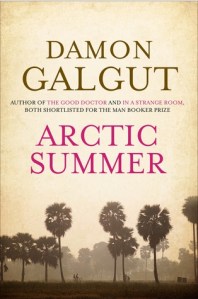
6. EM ForsterArctic Summer by Damon Galgut
This novel follows Forster’s visits to India and Egypt and the relationships he forms there that will influence his novels. Although I found a lot to admire about this book, I think I would probably have enjoyed it more if I’d read more of Forster’s own work first.

7. Jakob and Wilhelm GrimmThe Wild Girl by Kate Forsyth
This book takes a fascinating look at the inspiration behind the Brothers Grimms’ well-known fairy tales. Forsyth writes the novel from the perspective of Dortchen Wild, a young woman who grows up next door to the Grimm family in the small German state of Hessen-Cassel.
8. Bram StokerShadowplay by Joseph O’Connor
The Irish author Bram Stoker’s story unfolds alongside the lives of English stage actors Henry Irving and Ellen Terry in this epistolary novel written in the form of diary entries, letters and transcripts of recordings. O’Connor weaves lots of allusions to Dracula into the plot and shows how Stoker could possibly have drawn on his own experiences to help write his most famous novel.

9. Geoffrey Chaucer and John GowerA Burnable Book by Bruce Holsinger
We’ve all heard of Chaucer, author of The Canterbury Tales, but his friend, the poet John Gower, is much less well-known. The two of them team up to solve some intriguing mysteries in A Burnable Book and its sequel The Invention of Fire.

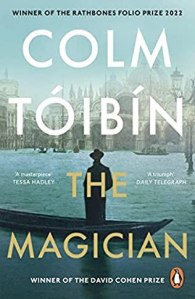
10. Thomas MannThe Magician by Colm Tóibín
I don’t have much to say about this one as I’m only a few chapters into it, but I’m already learning a lot about the life of Thomas Mann. This is one of the shortlisted titles for this year’s Walter Scott Prize and is maybe not a book I would have chosen to read otherwise.

~

Have you read any of these? Which other novels featuring famous authors can you recommend?

Six Degrees of Separation: From True History of the Kelly Gang to The Moonlit Cage

It’s the first Saturday of the month which means it’s time for another Six Degrees of Separation, hosted by Kate of Books are my Favourite and Best. The idea is that Kate chooses a book to use as a starting point and then we have to link it to six other books of our choice to form a chain. A book doesn’t have to be connected to all of the others on the list – only to the one next to it in the chain.

This month we’re starting with True History of the Kelly Gang by Peter Carey. I haven’t read it and it doesn’t really appeal to me, but here’s what it’s about:

To the authorities in pursuit of him, Ned Kelly is a horse thief, bank robber and police-killer. But to his fellow Australians, Kelly is their own Robin Hood. In a dazzling act of ventriloquism, Peter Carey’s Booker Prize-winning novel of adventure and heroism brings the famous bushranger wildly and passionately to life.

The title of the Peter Carey book immediately made me think of The True and Splendid History of the Harristown Sisters by Michelle Lovric (1). This unusual novel tells the story of Manticory Swiney and her six sisters who escape from poverty in 19th century Ireland to find fame on stage with their song and dance act, ending each performance by letting down their ankle-length hair. The book is not quite the ‘true history’ it claims to be, as the Swineys are fictional characters – but they are based on the real-life American singing group, the Sutherland Sisters, who really were famous for their very long hair.

And long hair is my next link! Bitter Greens by Kate Forsyth (2) is a retelling of the fairy tale, Rapunzel. Rapunzel, of course, is famously locked in a high tower by a witch and throws her long hair out of the window to form a rope that the witch can climb up and down. In Bitter Greens, she is given the name Margherita and her story alternates with the story of Charlotte-Rose de Caumont de La Force, the real historical woman who wrote Persinette, the original fairy tale on which Rapunzel was based. Even if you don’t like fantasy, I think this novel is still worth reading for the fascinating details of Charlotte-Rose’s life at the 17th century French court.

Another book in which fairy tales play a part is Gretel and the Dark by Eliza Granville (3). This very dark and unsettling novel opens in 1890s Vienna with a psychoanalyst treating a patient who claims to be a machine, not a human being. Several decades later in Nazi Germany, we meet a little girl who is neglected by her father, another doctor, and entertains herself by remembering the fairy tales her nurse read to her – including her favourite, Hansel and Gretel. The two storylines seem unrelated at first but do come together towards the end! I remember finding this a very disturbing book, but also a clever one with some surprising twists.

Madensky Square by Eva Ibbotson (4) is also set in Vienna, where our narrator, Susanna Weber, is a dressmaker with a busy shop on the city’s Madensky Square. Beginning in the spring of 1911, Susanna keeps a journal in which she writes about the daily lives of her friends, customers and neighbours. It’s a lovely novel and I enjoyed getting to know all of the characters – I particularly loved Susanna’s relationship with Sigismund, a lonely Polish orphan. Including this book in my chain has reminded me that I really need to read more by Eva Ibbotson!

I’m going to stay with books about dressmakers and link to a non-fiction book this time: The Dressmaker of Khair Khana (5). In this book, journalist Gayle Tzemach Lemmon describes her trip to Afghanistan in 2005 in order to report on female entrepreneurs working in war zones. Here she meets Kamila Sidiqi, a young Afghan woman who started her own dressmaking business with her sisters and friends in an attempt to make money while also staying on the right side of the Taliban. Kamila’s story is fascinating and a real inspiration! She even opens a school to teach other women to sew, so that they can also support themselves and their families.

Back to fiction, now. I’ve read a few other books set in Afghanistan and I’m going to finish my chain with one that I particularly liked, The Moonlit Cage by Linda Holeman (6). I read a lot of Holeman’s novels a few years ago and enjoyed them all, but she seems to have stopped writing now. The Moonlit Cage is the story of Darya, a 19th century Afghan woman who escapes from an arranged marriage and flees through the Hindu Kush mountains to India. I loved the descriptions of Afghan life and culture, as well as finding Darya’s story quite moving. I still need to read The Linnet Bird, which I think is the only one of Holeman’s adult novels I haven’t read.

~

And that’s my chain for May! My links included: ‘true history’ titles, long hair, fairytales, Vienna, dressmaking and Afghanistan.

In June we’ll be starting with Sorrow and Bliss by Meg Mason.

Top Ten Tuesday: One-word reviews

This week’s topic for Top Ten Tuesday (hosted by That Artsy Reader Girl) is “One-Word Reviews for the Last Ten Books I Read”.

The ten books I’m listing below are not technically the last ten I read, but they are ten that I haven’t yet reviewed on my blog. Full reviews for most of these should appear over the next few weeks, but for now I have chosen one word to represent each book:

1. Infuriating
The Trial of Lotta Rae by Siobhan MacGowan

2. Sadness
The Night Ship by Jess Kidd

3. Adventure
Winchelsea by Alex Preston

4. Dickensian
The Second Sight of Zachary Cloudesley by Sean Lusk

5. Immersive
The Fugitive Colours by Nancy Bilyeau

6. Surprises
The Vanished Days by Susanna Kearsley

7. Freedom
Privilege by Guinevere Glasfurd

8. Secrets
In Place of Fear by Catriona McPherson

9. Complex
All the Seas of the World by Guy Gavriel Kay

10. Insightful
The Rebecca Notebook: and Other Memories by Daphne du Maurier

~

Are you interested in reading any of these? Which would you like to know more about?