Top Ten Tuesday: My Winter TBR

This week’s Top Ten Tuesday, hosted by Jana at That Artsy Reader Girl, asks us to list ten books on our Winter TBR. As usual, I have a lot more than ten books that I’m hoping to read in the next few months, but I have chosen a selection of them to list below.

~

1. The Pale Horse by Agatha Christie – This is December’s book for the Read Christie 2019 Challenge and one that I was planning to read anyway as there’s a new BBC adaptation coming in 2020. I’ve enjoyed taking part in the challenge this year and was pleased to discover that it’s happening again next year!

2. The Ten Thousand Doors of January by Alix E. Harrow – I picked this up to start reading a month or two ago, but decided the time wasn’t right. I do still want to read it as I’ve heard so many positive things about it, so it is going to be a winter read now instead of an autumn one.

3. Big Sky by Kate Atkinson – In November I finally managed to catch up with the fourth book in the Jackson Brodie series, Started Early, Took My Dog, and now I have the fifth book, Big Sky, from the library so will need to read it soon.

4. The Wheel of Fortune by Susan Howatch – I don’t do nearly enough re-reading these days, but Susan Howatch’s Penmarric was a re-read for me in 2018 and Cashelmara in 2019, so it makes sense to pull this one off my shelf for a re-read in 2020!

5. The Sun Sister by Lucinda Riley – This is the sixth book in the Seven Sisters series and is set partly in Kenya. I’ve been putting off starting this one because of the length, but I’ll have some time off work over Christmas so will probably read it then.

6. The Dutch House by Ann Patchett – This will be my first Ann Patchett book so I don’t know what to expect, but it does sound good!

7. Greenwitch by Susan Cooper – After enjoying Over Sea, Under Stone and The Dark is Rising earlier this year, I’m looking forward to moving on to Greenwitch, the third book in the sequence.

8. The Brothers York by Thomas Penn – Most of my reading tends to be fiction, but I wanted to include at least one non-fiction book on my Winter TBR too. This book is about one of my favourite periods of history, the Wars of the Roses, so I’m looking forward to reading it.

9. The Hardie Inheritance by Anne Melville – This is the final book in a trilogy and as I loved the first two, both of which I’ve read this year, I’m hoping this will be another enjoyable read.

10. My Classics Club Spin book! I’ll find out on Sunday which book I’m going to be reading from the Spin list I posted two days ago.

~

Have you read any of these? What did you think? And what is on your own winter TBR?
Six Degrees of Separation: From Sanditon to The Song of Achilles

It’s the first Saturday of the month which means it’s time for another Six Degrees of Separation, hosted by Kate of Books are my Favourite and Best. The idea is that Kate chooses a book to use as a starting point and then we have to link it to six other books of our choice to form a chain. A book doesn’t have to be connected to all of the others on the list – only to the one next to it in the chain.

This month we are starting with Sanditon by Jane Austen. I haven’t read it – I do like Austen but am not as big a fan as many people are and haven’t yet ventured past her main six novels. However, I do know that Sanditon was unfinished at the time of her death.

Thinking about other unfinished novels, The Mystery of Edwin Drood by Charles Dickens immediately came to mind, but I used that one in another Six Degrees post quite recently, along with another, Elizabeth Gaskell’s unfinished Wives and Daughters. This made me think a bit harder and then I remembered Lord Byron’s Fragment of a Novel (1), his attempt at writing a vampire story which he never completed. I’m particularly pleased with this link because apparently Sanditon was also first published under the title Fragment of a Novel.

The stories of Byron and his fellow Romantic Poets, Keats and Shelley, are told in Passion by Jude Morgan (2). I love Morgan’s writing and I thought this was an excellent book, focusing on the roles women such as Mary Shelley, Caroline Lamb and Augusta Leigh played in the poets’ lives.

Another book about poets is Possession by AS Byatt (3), although the poets in this one – Randolph Henry Ash and Christabel LaMotte – are fictional. The novel follows two modern day academics as they study the lives of Ash and LaMotte, delving into letters, poems, fairy tales and journal entries, which Byatt presents as if they were authentic Victorian documents.

My copy of Possession has butterflies on the cover. So does The Specimen by Martha Lea (4), a book which had many of the elements I usually enjoy in a book – a mystery to be solved, a Victorian setting, strong female characters – yet it turned out to be disappointing. You can’t love every book you read, I suppose.

The main character in The Specimen is a young woman called Gwen who travels to Brazil to study and draw plants and insects. Another book about a woman trying to break into the male-dominated field of natural sciences is Song of the Sea Maid by Rebecca Mascull (5), set in Portugal and the Berlengas islands in the middle of the 18th century. I did love that book!

For my final link, I’m taking the word ‘song’ in the title. I had a few books to choose from here, but decided on The Song of Achilles (6), Madeline Miller’s beautiful retelling of the Iliad, told from the perspective of Patroclus, who is portrayed in the novel as Achilles’ lover.

~

Well, that’s my chain for this month. My links included unfinished novels, poets, butterflies and songs. In January, we’ll be starting with Daisy Jones and the Six by Taylor Jenkins Reid which, coincidentally, I just started to read yesterday.

Six Degrees of Separation: From Alice’s Adventures in Wonderland to Uprooted

It’s the first Saturday of the month which means it’s time for another Six Degrees of Separation, hosted by Kate of Books are my Favourite and Best. The idea is that Kate chooses a book to use as a starting point and then we have to link it to six other books of our choice to form a chain. A book doesn’t have to be connected to all of the others on the list – only to the one next to it in the chain.

This month we are starting with the children’s classic Alice’s Adventures in Wonderland by Lewis Carroll. It’s not often that I have read the first book in the chain, but this is one that I have read several times, although not for years.

The character of Alice was inspired by a real life child, Alice Liddell. Melanie Benjamin’s novel, Alice I Have Been (1), is a fictional account of Alice Liddell’s life, with a focus on her relationship with Charles Lutwidge Dodgson (Lewis Carroll) and how her connection with his book changed her life forever.

I have read a few of Melanie Benjamin’s other books and enjoyed them. The Aviator’s Wife (2) is my favourite. It tells the story of Anne Morrow Lindbergh, wife of the famous American aviator Charles Lindbergh and later an accomplished aviator in her own right, as well as a successful author.

Another novel I’ve read about a female aviator, a fictional woman this time, is The Wild Air by Rebecca Mascull (3). Although I’m not particularly interested in aviation myself, I loved Rebecca Mascull’s book – it really made me appreciate just how brave those early pioneers of flying were.

My next link takes the word ‘Wild’ and leads me to The Wilding by Maria McCann (4), a historical mystery set in 17th century England and narrated by a young man who works as a cider-maker.

With its recreation of life in a small rural community and the descriptions of orchards and trees and apple-pressing, The Wilding shares some themes with The Woodlanders by Thomas Hardy (5). The Woodlanders is one of my favourite Hardy novels; I loved getting to know the people who built their lives in and around the woods of Little Hintock.

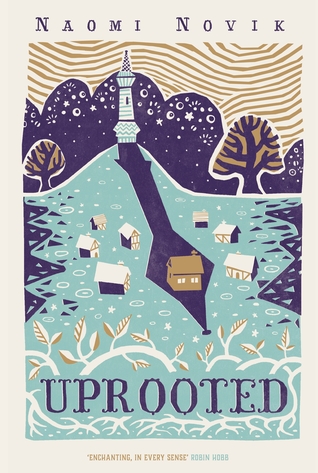
My final link is to another book in which a wood plays an important part in the story: Uprooted by Naomi Novik (6). Uprooted is a fantasy novel set in a village under threat from evil forces gathering in The Wood, a sinister place which is much more than just a collection of trees!

~

Well, that’s my chain for this month, with links including Alice Liddell, female aviators, the word ‘Wild’, apples and woods. Next month we will be starting with Jane Austen’s unfinished manuscript, Sanditon.

Six Degrees of Separation: From Three Women to The Mysteries of Udolpho

It’s the first Saturday of the month which means it’s time for another Six Degrees of Separation, hosted by Kate of Books are my Favourite and Best. The idea is that Kate chooses a book to use as a starting point and then we have to link it to six other books of our choice to form a chain. A book doesn’t have to be connected to all of the others on the list – only to the one next to it in the chain.

This month we are starting with Three Women by Lisa Taddeo, a book I haven’t read. Goodreads tells me that it’s ‘a record of unmet needs, unspoken thoughts, disappointments, hopes and unrelenting obsessions’. I don’t think I’m interested in reading it, but I know a lot of people have enjoyed it.

Although I haven’t read Three Women, the title immediately makes me think of one of the books I am currently reading – Big Sister, Little Sister, Red Sister by Jung Chang (1), a biography of the three Soong sisters who became three of the most powerful women in 20th century China. I chose to read this book because I loved Jung Chang’s earlier biography, Wild Swans, which was also about three women (herself, her mother and her grandmother). So far I am enjoying this new one as well, although I think it will take me a while to finish it.

The word sister provides my next link and leads me to The Sisters Brothers by Patrick deWitt (2), a novel set in 1850s Oregon and California and telling the story of two hired killers, Charlie and Eli Sisters. I liked this book much more than I had expected to and was so glad I didn’t let the ‘western’ label put me off.

It’s fair to say that I don’t usually choose to read westerns but sometimes it’s good to try something different. Another genre I don’t often read is science fiction, but I’ve enjoyed a few of John Wyndham’s books in the last few years – most recently, Chocky (3), a short but fascinating novel about a boy who appears to have an imaginary friend, which I read for Karen and Simon’s ‘1968 Club’ back in 2017.

Another book I’ve read published in 1968 is Cousin Kate by Georgette Heyer (4). Like many of Heyer’s novels, this one is set in the Regency period but has a slightly different feel from most of the others because of the Gothic elements, which include storms, locked doors, noises in the night and family secrets waiting to be uncovered.

Looking back at my review of Cousin Kate, I said it reminded me of Northanger Abbey by Jane Austen (5) which has some of the same elements – and a heroine, Catherine Morland, who loves reading Gothic novels. At one point in Northanger Abbey, Catherine is given a list of seven ‘horrid novels’. I haven’t read any of the horrid novels, which is a shame as I could have used one of them as my next link!

I have, however, read another book which is alluded to several times in Northanger Abbey – Ann Radcliffe’s The Mysteries of Udolpho (6). Published in the 18th century and set in France and Italy, it is the story of Emily St Aubert, a French orphan who is imprisoned in the remote and gloomy castle of Udolpho where she is subjected to lots of seemingly supernatural terrors. I read this before I started blogging, but if you want to see my thoughts on some other Ann Radcliffe books, I have reviewed both A Sicilian Romance and The Romance of the Forest.

~

Well, that’s my chain for this month, with links including three women, the word sister, books outside my comfort zone, 1968 and gothic novels. Next month we will be starting with Alice’s Adventures in Wonderland by Lewis Carroll.

Top Ten Tuesday: My Autumn TBR

This week’s Top Ten Tuesday, hosted by Jana at That Artsy Reader Girl, asks us to list ten books on our Autumn TBR. As usual, I have a lot more than ten books that I’m hoping to read in the next few months, but I have chosen a selection of them to list below.

Two books I’m hoping to get to soon for the R.I.P. XIV event:

1. The Dark is Rising by Susan Cooper

2. Tombland by CJ Sansom

A book left over from my 20 Books of Summer List:

3. The Doll Factory by Elizabeth Macneal

My Classics Club Spin result, announced yesterday:

4. Two on a Tower by Thomas Hardy

Some review copies I haven’t read yet:

5. To Calais, in Ordinary Time by James Meek

6. A Single Thread by Tracy Chevalier

For the Read Christie 2019 Challenge:

7. Five Little Pigs by Agatha Christie

Next in a series started earlier this year:

8. Dragon Haven by Robin Hobb

Non-fiction, because I don’t read enough of it:

9. The Brothers York by Thomas Penn

10. Following in the Footsteps of Henry Tudor by Phil Carradice

~

Have you read or will you be reading any of these? Which books are on your autumn/fall TBR?

Six Degrees of Separation: From A Gentleman in Moscow to Poor Miss Finch

It’s the first Saturday of the month which means it’s time for another Six Degrees of Separation, hosted by Kate of Books are my Favourite and Best. The idea is that Kate chooses a book to use as a starting point and then we have to link it to six other books of our choice to form a chain. A book doesn’t have to be connected to all of the others on the list – only to the one next to it in the chain.

This month we are starting with A Gentleman in Moscow by Amor Towles, a book I read a few years ago – it’s not often that I’ve read the starting book in one of these chains and it does make things slightly easier! It tells the story of a Russian Count who is sentenced to spend the rest of his days under house arrest in Moscow’s Metropol Hotel. I really enjoyed this book and found it quite inspiring that the Count managed to lead such a fulfilling life during his confinement.

Another novel set in and around a hotel, this time in Cyprus, is The Sunrise by Victoria Hislop (1). The story takes place in Famagusta in 1974, when the Sunrise Hotel is evacuated during a Greek military coup and Turkish invasion. I found the book a bit uneven, but loved the setting and the vivid descriptions of the abandoned city.

Famagusta already had a troubled history, long before the events of The Sunrise. In Dorothy Dunnett’s Race of Scorpions (2), the third in her House of Niccolò series, our hero Nicholas arrives in Cyprus in the early 1460s just as the island is torn apart by the conflict between Queen Carlotta and her half-brother James de Lusignan and the city of Famagusta finds itself under siege.

The Niccolò series takes us all over 15th century Europe and Africa, but the first book, Niccolò Rising, is set mainly in Bruges. I can’t think of many other books I’ve read that have Bruges as a setting, apart from an obvious one: The Master of Bruges by Terence Morgan (3). This novel is presented as the fictional memoirs of the 15th century artist Hans Memling who becomes acquainted with Edward IV and the future Richard III during their exile in Flanders.

My next link is to another book with Master in the title. There were a few I could have chosen, but I decided on The Master and Margarita by Mikhail Bulgakov (4). I remember feeling intimidated by this book before I started to read it, but I needn’t have worried because I absolutely loved this weird and wonderful Russian classic.

A famous phrase from the book is “manuscripts don’t burn”, which makes my next link a very easy one. A Burnable Book by Bruce Holsinger (5) follows the poet John Gower as he searches 14th century London for a missing book of prophecies which predicts the death of the King of England. John Gower was a real person and although there’s not much biographical information on him available, we do know that he became blind in later life and in the sequel, The Invention of Fire, we see him trying to cope with his loss of sight.

Poor Miss Finch by Wilkie Collins (6) is a novel with a blind heroine and it handles the subject of blindness in a way that is both sensitive and fascinating. It’s not quite as ‘sensational’ as some of his other novels (and has a very strange subplot involving twins with blue skin), but I still enjoyed it!

And that’s my chain for this month. In October we’ll be starting with Three Women by Lisa Taddeo.

Six Degrees of Separation: From House of Names to Rebecca

Thanks to everyone who wished me luck with my house move last week. I am starting to get settled in the new house but still have a lot to do! I’m a few days late with my Six Degrees of Separation post for August (I usually try to have my post ready for the first Saturday of the month) as I’m still waiting for my broadband to be activated so am having to do things where and when I can, but I’m hoping everything will be back to normal soon.

Six Degrees of Separation is hosted by Kate of Books are my Favourite and Best. The idea is that Kate chooses a book to use as a starting point and then we have to link it to six other books of our choice to form a chain. A book doesn’t have to be connected to all of the others on the list – only to the one next to it in the chain.

This month we are doing something slightly different; instead of Kate giving us the first title, we are starting with the book with which we finished last month’s chain! In my case, that was House of Names by Colm Tóibín, a novel which retells the tragic story of the House of Atreus from Aeschylus’ trilogy, the Oresteia.

I have used the title ‘house of names’ as my first link and have chosen a book with a person’s name in its title. There are lots of those, so I had plenty of choice, but the one I’ve decided on is Grace Williams Says It Loud by Emma Henderson. This is the story of a young woman growing up in the 1950s who struggles to communicate verbally and is sent to live in a residential home for people with disabilities, the Briar Mental Institute. I found it both moving and inspirational – not the sort of book to be easily forgotten.

Another novel about a young woman who is considered to be ‘different’ is Harriet by Elizabeth Jenkins (another name in the title too). First published in 1934, it is based on a real life crime which took place in 1877 and is a very dark and disturbing story. It’s published by Persephone and I read it last year for a Persephone Readathon.

There are several other Persephones with names in the titles, including Virginia Woolf’s Flush. Flush is the name of the poet Elizabeth Barrett Browning’s dog and the novel is written from his perspective. It’s a fascinating and creative combination of fact and fiction; I loved it!

Virginia Woolf also wrote Orlando. It was the first of her books that I read and I remember finding it surprisingly accessible and entertaining. Orlando is the name of a very unusual protagonist: a character who lives for four hundred years and changes gender along the way!

Another novel which plays with time in an interesting way is Mariana by Susanna Kearsley. In Mariana, we meet Julia Beckett, who moves into a lonely farmhouse called Greywethers and becomes obsessed with the life of Mariana Farr, a woman who lived in the house during the 17th century.

One of my favourite novels, Rebecca by Daphne du Maurier, also features a house (Manderley) and a former resident whose presence is still strongly felt. And, of course, the title of the book is a name – which links back to the first book in this chain, House of Names.

And that’s my chain for this month! Have you read any of the books I’ve mentioned?

Next month we’ll begin with A Gentleman in Moscow by Amor Towles.