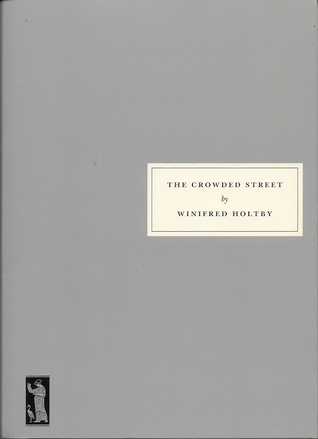
The Crowded Street by Winifred Holtby

The Crowded Street is on my Classics Club list, so when I saw that Jessie of Dwell in Possibility was hosting a Persephone Readathon this week, my choice was obvious. This particular book has also been published as a Virago Modern Classic, but my edition is the Persephone one, with the endpapers pictured below. Having already enjoyed several of Holtby’s books – South Riding, The Land of Green Ginger and Poor Caroline – I’ve been looking forward to this one for a while and I’m pleased to say that I loved it even more than I hoped I would.

The novel was published in 1924, at a time when it was assumed that most young women wanted nothing more than to find a husband and then stay at home to raise their children. In The Crowded Street, Holtby looks at what it was like to be a woman who, for one reason or other, was unable to conform to these expectations. Through the stories of Muriel Hammond, her sister Connie and her friends Clare and Delia, she explores the very different routes through life taken by four very different women.

We first meet Muriel in December 1900 when she is eleven years old and attending her first ‘grown-up’ party. Her excitement soon turns to shame when she finds that none of the boys want to dance with her and her dance card remains almost blank. Muriel is confused: The unforgivable sin at a party is to have no partners. To sit quietly in the drawing-room at home was a virtue. The sense that she has somehow let her mother down is a feeling which will stay with her for the next two decades as she continues to go through life partnerless, waiting and hoping for something to happen. She does initially have ambitions – to study astronomy, to go to college – but she doesn’t pursue these as she receives no encouragement from her mother or from her school teacher, who says:

“Character, my dear, to be a fine womanly woman, that matters so much more than intellectual achievement. To serve first your parents, then, I hope, your husband and your children, to be pure, unselfish and devoted, that is my prayer for each one of my girls.”

As a single woman myself, there were times when Muriel’s story resonated with me, but thankfully not all the time! I may not be married, but nobody ever prevented me from going to university or getting a job. Muriel watches with envy as Delia, another unmarried girl from the same Yorkshire village, goes off to Cambridge University, then heads for London and throws herself into political activism.

“But then, she has her work. Women who have their work have an immense thing, even if they are unfortunate in the people whom they love. It is when you have nothing, neither work, nor love, nor even sorrow, that life becomes rather intolerable.”

Of course, some women today are happy to stay at home with their parents, there are some who find plenty of fulfilment in marrying and having children, while others want to move away to pursue their career. There is no right or wrong way to live, but the point is that we have a choice. What makes Muriel’s story so tragic is that she feels she has no choice. She believes that marriage is the only possible way to escape, but if that doesn’t happen, all she can do is continue to help her mother around the house, doing what she sees as her duty (even though her help isn’t particularly necessary). As a result, she becomes more and more depressed, feeling that life is passing her by but lacking the confidence to do anything about it and making excuses to justify why she can’t.

Her younger sister, Connie, tries to break away from the stifling confines of life in Marshington, but she is so desperate that she makes a bad decision which has disastrous consequences. It seems that the only one who is likely to be happy is Muriel’s old school friend, the cheerful and sophisticated Clare, who goes through life without a care in the world and catches the eye of Godfrey Neale, the one man Muriel dreams of as her own potential husband. Clare, though, has the opposite problem. Having had a very different upbringing from Muriel and Connie, will she be able to adapt to living in a small Yorkshire village?

At one point, Muriel thinks to herself:

“All books are the same – about beautiful girls who get married or married women who fall in love with their husbands. In books things always happen to people. Why doesn’t somebody write a book about someone to whom nothing ever happens – like me?”

Well, Winifred Holtby has written that book and I don’t think it’s quite true that nothing happens to Muriel. She does develop as a person as the novel progresses and, although it takes a long time, she slowly becomes aware that if she is to have any happiness she will have to take matters into her own hands. I loved the way her story ended: she has an important decision to make and in my opinion she does the right thing.

As well as following the characters I’ve mentioned above, we are also given some insights into the effects of the First World War on small communities like the fictional Marshington. I particularly enjoyed the vivid depiction of the bombardment of Scarborough in 1914, something Winifred Holtby could draw on personal experience to describe. The Crowded Street is a wonderful book in so many ways and a great choice for both the Classics Club and the Persephone Readathon!

This is Book 2/50 from my second Classics Club list
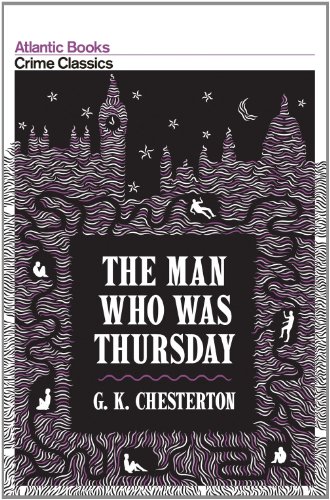
The Man Who Was Thursday by GK Chesterton

This 1908 novel from the author of the Father Brown mystery series is subtitled A Nightmare and it certainly does have a dreamlike feel. I picked it up expecting a vintage detective novel and emerged at the other end wondering what on earth I had just been reading and what it meant.

The novel opens with a conversation between two men who meet for the first time one evening in Saffron Park in London. One, Lucian Gregory, is an anarchist poet; the other, Gabriel Syme, is a member of the secret anti-anarchist police. They spend the whole of the first chapter debating the meanings of anarchy and of law and order, using arguments like this:

Gregory struck out with his stick at the lamp-post, and then at the tree. “About this and this,” he cried; “about order and anarchy. There is your precious order, that lean, iron lamp, ugly and barren; and there is anarchy, rich, living, reproducing itself—there is anarchy, splendid in green and gold.”

“All the same,” replied Syme patiently, “just at present you only see the tree by the light of the lamp. I wonder when you would ever see the lamp by the light of the tree.”

And this:

“An artist disregards all governments, abolishes all conventions. The poet delights in disorder only. If it were not so, the most poetical thing in the world would be the Underground Railway.”

“So it is,” said Mr. Syme.

“Nonsense!” said Gregory, who was very rational when anyone else attempted paradox.

It seems they will never agree, but to at least prove that he is serious about his cause, Gregory invites Syme to accompany him to an underground meeting of anarchists. Gregory gets more than he bargained for, however, when Syme puts himself forward for a position in which he himself had been interested: one of seven coveted seats on the Council of the Seven Days, the central council of the European anarchists.

Elected to the council and given the code name Thursday, Syme is introduced to his fellow days of the week, but will he be able to prevent them from guessing that he is an undercover policeman? And who is Sunday, their mysterious and sinister leader who is so big, so powerful and so much larger than life?

I don’t think there is much more I can say about the plot without spoiling the story. I can’t discuss the themes of the novel either, or the symbolism it contains, because those things are also spoilers. It’s such a strange and unusual book that I really think it’s best not to know too much about it before you begin. Just be aware that it’s not a conventional mystery or detective novel (or a conventional anything). There are parts that I loved, such as a scene where Syme is followed through the streets of London in the snow; there are funny moments too, some witty and amusing dialogue, and lots of thought-provoking philosophical ideas. At other times it becomes a little bit too bizarre, particularly after the action moves to France halfway through the book.

There are plot twists throughout the novel, some of which are quite predictable – but the revelations near the end of the book were not what I had been expecting at all. Looking back, there were plenty of hints and clues, but I didn’t pick up on them. I’m sure I didn’t fully grasp what Chesterton was trying to say, but I think there are probably different ways to interpret this book anyway. It certainly left me with a lot to think about and I love it when that happens – when you continue to engage with a story even after you’ve turned the final page.

I don’t have any more of Chesterton’s books, but I see there are some I could read for free at Project Gutenberg. I have previously read two of his Father Brown short stories (included in Miraculous Mysteries and Murder Under the Christmas Tree); should I read more of those or is there another of his books that you would recommend?

Death Comes for the Archbishop by Willa Cather

This is the first book I’ve read from my new Classics Club list and my third by Willa Cather. I’m grateful to the recent Classics Spin for choosing it for me because although I do like Cather’s writing I seem to need something to push me into picking up her books. This one could have lingered on my list for a long time otherwise, which would have been a shame as once I started reading it I loved it. It’s certainly my favourite of the three I’ve read so far (the others are The Professor’s House and My Ántonia).

Death Comes for the Archbishop is set in the nineteenth century and follows the stories of Bishop Jean Marie Latour and his friend Father Joseph Vaillant, two French missionaries who have been sent into the newly formed diocese of New Mexico – territory which has recently been acquired by America. As they begin their work of spreading their faith to the people of New Mexico, they face a number of challenges. The landscape, although beautiful, is harsh and often inhospitable; the railroad has not yet arrived so travel must be by mule over difficult terrain. When they do eventually reach other settlements, they are disappointed to find that the Catholic priests already established in these communities are, in most cases, not suitable for the job. They are either corrupt, greedy, too powerful, too weak or insufficiently devoted to their religion.

It is the task of Father Latour, with the help of Father Vaillant, to decide how to tackle these problems, while also learning to love his new home and getting to know the people who have lived there for generations. These include not only Americans and Mexicans, but also the Hopi, Navajo and other Native American people, whom Cather writes about with sensitivity and sympathy. Each group have their own customs, traditions, stories, histories and superstitions and as all of these things are new to the Bishop and his friend, the reader is able to learn along with them.

I have never been to New Mexico so as I read I found myself turning to Google for images of the deserts and hills, mesas and pueblos, plants and trees that are mentioned in the novel. After Latour visits the pueblo of Acoma and hears about the legend of the Enchanted Mesa, for example, I wanted to see what it would be like to live in such a harsh and isolated location. Cather writes beautifully about the New Mexico landscape; her use of colour is wonderful, helping to bring her descriptions to life. Here is the moment when Latour arrives at Santa Fé for the first time:

As the wagons went forward and the sun sank lower, a sweep of red carnelian-coloured hills lying at the foot of the mountains came into view; they curved like two arms about a depression in the plain; and in that depression was Santa Fé, at last! A thin, wavering adobe town…a green plaza…at one end a church with two earthen towers that rose high above the flatness. The long main street began at the church, the town seemed to flow from it like a stream from a spring. The church towers, and all the low adobe houses, were rose colour in that light,–a little darker in tone than the amphitheatre of red hills behind; and periodically the plumes of poplars flashed like gracious accent marks,–inclining and recovering themselves in the wind.

My favourite aspect of the novel is the relationship between Bishop Latour and Father Vaillant. The two men have known each other since they were students together at the seminary in France and I found the depiction of their friendship very moving, particularly later in the book when Father Vaillant has the chance to take up a new mission far away; the Bishop, who can’t bear to lose his companionship, must decide whether to keep his friend with him for selfish reasons or to let him go and give him the chance to develop his own career elsewhere and carry out the work which will make him happy. The characters are based on real historical figures – Jean-Baptiste Lamy and Joseph Projectus Machebeuf – but I like the names Cather has chosen for them. Vaillant, meaning ‘valiant’, is perfect for Joseph, who is brave and energetic, warm and friendly, while Latour (‘the tower’) is quieter and more reserved, finding it more difficult to open up and make friends. Their different qualities, different strengths and weaknesses are what make them such a successful partnership.

Death Comes for the Archbishop has no real plot, being more a series of little stories and vignettes spread across a number of years and describing the various experiences Latour and Vaillant have as they travel around the New Mexico diocese. I do prefer novels that strike a balance between the plot-driven and the character-driven, but I still thoroughly enjoyed this book – it got my new Classics Club journey off to a great start! I’m looking forward to reading more Willa Cather and I think the next one I pick up will be either Shadows on the Rock or A Lost Lady.

~

Book 1/50 from my second Classics Club List

The Count of Monte Cristo by Alexandre Dumas (re-read)

When I joined the Classics Club in 2012 and put together the list of books I wanted to read, I decided that, whichever order I read the others in, I would save my re-read of The Count of Monte Cristo until last. It’s one of my favourite books (I had already read it twice) and I thought it would be something to look forward to, even if some of the other classics on my list turned out to be disappointing.

Picking it up to start reading for the third time, I did have a few doubts – there’s always a chance that a book you once loved might have lost its magic – but of course I needn’t have worried. The opening line (“On the 24th of February 1815, the lookout at Notre-Dame de la Garde signalled the arrival of the three-master Pharaon, coming from Smyrna, Trieste and Naples”) is hardly the most scintillating or memorable in literature but reading it, knowing what is to come, gives me the same feeling as when I re-read the first line of other favourite books, such as Rebecca (“Last night I dreamt I went to Manderley again”), Jane Eyre (“There was no possibility of taking a walk that day”) or Watership Down (“The primroses were over”).

Anyway, back to The Count of Monte Cristo! Our hero, or anti-hero (he can be considered to be both), is Edmond Dantès, a young sailor who, at the beginning of the novel, feels that he is the luckiest man in the world. Not only is his marriage to the beautiful Mercédès approaching, but following the death of his captain, he is also about to be given a ship to command. Things couldn’t be better…until the day of his wedding, when he is arrested on suspicion of conspiring against the king with the exiled Napoleon Bonaparte. Of course, Edmond has done nothing of the sort – it is all part of a plot by his jealous shipmate, Danglars, and his rival for Mercédès’ love, Fernand Mondego.

A third man, Villefort, has reasons of his own for wanting Dantès imprisoned and safely out of the way, so with these three enemies ranged against him, Edmond is thrown into a dungeon in the Château d’If where he remains for the next fourteen years. Although he does eventually find a way to escape, his life has been ruined: all of his hopes and dreams have been destroyed, Mercédès is lost to him and he can never get back the years of his youth that have been stolen from him. Vowing to punish his enemies for what they have done, Edmond transforms himself into the Count of Monte Cristo and launches an intricate and carefully planned system of revenge.

The events I have described above take up only a relatively small section of the novel; most of the book is devoted to following the Count as he sets his plans into action. It takes a long time before he begins to see results, but if there is one thing he has learned in prison it is how to be patient – and so he is prepared to spend years devising the perfect methods of revenge. This means the reader is faced with a series of seemingly unrelated subplots and a huge cast of characters; it can be quite overwhelming on a first read, but when you’re reading for the second or third time you can appreciate how things that appear to be irrelevant actually have great significance. This time round, without the same urgency to turn the pages to ‘see what happens next’, I was able to read at a slower pace and enjoy some of the episodes I had previously seen as unnecessarily long digressions, such as Franz and Albert’s adventures in Rome, La Carconte and the diamond ring, and the story of the bandit Luigi Vampa.

Does the Count achieve his aims – and is he happy with the final outcome? I’m not going to tell you (and if you haven’t read the book I’m sure you don’t want me to) but I will say that he does have some doubts along the way, particularly when he discovers that innocent people he never intended to hurt have also become caught up in his web of revenge. “What a fool I was,” said he, “not to tear my heart out on the day I resolved to avenge myself”. I always find it sad to see how he has changed as a result of his imprisonment – when we first meet him again after his escape from the Château d’If, the lively, optimistic young man has disappeared, to be replaced by someone much more cynical and bitter – but towards the end of the book there are signs that the old Edmond is still there, beneath the surface. Most people think of this as a revenge novel, which it certainly is, but we should remember that the Count also takes care to help and reward the friends who stayed loyal to him throughout everything.

Although The Count of Monte Cristo was published around the same time as Dumas’ d’Artagnan series, I think this is a much more mature novel, dealing with serious issues and raising some thought-provoking questions. There are moments of reflection and philosophy like this:

“The friends that we have lost do not repose in the bosom of the earth, but are buried deep in our hearts, and it has been thus ordained that we may always be accompanied by them.”

And this:

“It is the way of weakened minds to see everything through a black cloud. The soul forms its own horizons; your soul is darkened, and consequently the sky of the future appears stormy and unpromising.”

And this:

“Joy to hearts which have suffered long is like the dew on the ground after a long drought; both the heart and the ground absorb that beneficent moisture falling on them, and nothing is outwardly apparent.”

The novel takes the reader through a range of emotions, from anger to pity to frustration to sadness (some of Edmond’s scenes with a certain other character always bring tears to my eyes, thinking of everything he has lost and can never regain). As always with Dumas, though, you can expect an exciting and entertaining read, so there are also murders, poisonings, court cases and duels, thefts, anonymous letters, illegitimate children and searches for buried treasure. Not everything that happens feels entirely realistic and you do need to suspend disbelief now and then, but I don’t mind that when a book is so enjoyable to read.

I haven’t said very much about the other characters in the book (and apart from Edmond Dantès himself, whom I have always found fascinating and complex), I have to admit that most of them don’t have a lot of depth. There are two, however, that I do particularly love. The first is the Abbé Faria, a fellow prisoner of Edmond’s in the Château d’If, an extraordinary man who acts as inspiration, adviser and teacher to Edmond and without whom he would have lost the will to live. The other is Monsieur Noirtier, an elderly man who has been left unable to walk and talk, but who devises an unusual form of communication and forms a special bond with his granddaughter, Valentine.

There is so much more I would like to say about this wonderful book, but I would have to give spoiler warnings, and I think this post is long enough now anyway! I will leave you to read The Count of Monte Cristo for yourself, if you haven’t already. I know the length of the book can seem off-putting, but I wouldn’t recommend reading an abridged edition as the story is so complex I think you would be missing out on a lot.

This is book 100/100 read for the Classics Club, which means I have now completed my list! I’ll be posting a summary of my Classics Club experience soon.

Rebecca by Daphne du Maurier (re-read)

Sometimes re-reading a favourite book can be a disappointment; perhaps you’ve changed too much as a person since the last time you read it and the story and characters no longer have the appeal they used to have – or maybe it just loses some of its magic because you’ve read other books in the meantime that are similar and better. Luckily, I experienced none of that disappointment when I picked up Rebecca for a re-read recently. I fell in love with it all over again!

For those of you who have not yet read Rebecca, I’ll give a brief summary of the plot – and the first thing I should probably say is that we never actually meet Rebecca herself. She dies a year before the novel opens, although with her bright and vibrant personality she is a very strong presence throughout. Our narrator, in contrast, is a shy and awkward young woman who remains nameless from beginning to end; our only clue is that she has a ‘lovely and unusual’ name and one which is difficult to spell. It is while working as a companion to the overbearing Mrs Van Hopper in Monte Carlo that the narrator meets and falls in love with Rebecca’s widowed husband, Maxim de Winter, who is thought still to be grieving for his wife. The last thing she expects, then, is to receive a proposal of marriage from Maxim and to be whisked off back to England to his house in Cornwall.

Although the narrator is captivated by the magnificence of her new home, Manderley, and its beautiful surroundings, she also feels intimidated and out of place. She knows that Rebecca lived here with Maxim for years and that Rebecca was so much better at everything than she will ever be – something the housekeeper, Mrs Danvers, won’t let her forget. It’s not long before the narrator begins to tell herself that her marriage is a mistake…she’s convinced that Maxim still loves Rebecca, but is there more to this situation than meets the eye?

I’m not sure whether this is the third or the fourth time I have read Rebecca, but I do know that it must be at least ten years since I read it last – long enough that I can remember the outline of the plot but not every little detail. Reading it again was a wonderful experience, right from the famous opening line, “Last night I dreamt I went to Manderley again”. As I’ve said before, du Maurier is one of the most atmospheric writers I’ve ever come across; she makes it so easy to picture every scene in vivid detail. All of her novels are beautifully written, but this one particularly so.

I know a lot of readers find the second Mrs de Winter frustrating, but I have never had a problem with her, probably because when I first read this book as a teenager I was also a shy, sensitive person so I found it easy to understand and sympathise with her. It’s worth remembering that she is only twenty-one, completely alone in the world (to the point where, when she sits down at her new writing desk at Manderley, she can think of no one to write to but Mrs Van Hopper) and has never been taught to manage servants, host a party or do any of the other things that are suddenly required of her. Not everyone can be as confident as Rebecca, after all, and it is the narrator’s sense of inferiority whenever Rebecca is mentioned which drives the plot forward and adds to the feeling of tension and claustrophobia.

I didn’t care for Maxim this time round, though. I know his distant, brooding nature is as important to the plot as his wife’s uncertainty and paranoia – and if they had been different people the story would not have worked – but I thought he could have been much more supportive of her, particularly after (trying not to spoil too much here) the white dress scene. It’s sad that she seems so much more comfortable and at ease with Maxim’s friend, Frank Crawley, than she does with her own husband. On the other hand, I felt slightly more sympathetic towards Mrs Danvers this time; I can see that she’s much more complex than I’d thought on my earlier reads.

Finally, I want to say that this is one of the few cases where I think the film (the 1940 one with Joan Fontaine and Laurence Olivier) is as good as the book. What do you think?

This re-read means that I’m coming to the end of a little project I have been working on over the last few years. In 2009, having previously only read Rebecca and Jamaica Inn, I decided I wanted to read the rest of du Maurier’s novels and I have now read all of them, with the exception of Castle Dor which I’m hoping to read soon (after I’ve read that one I’ll do a round-up post and pick out some of my favourites). I do still have some of her short story collections and most of her non-fiction books to look forward to, though!

This is book 8/20 of my 20 Books of Summer – and also book 99/100 from my Classics Club list.

Hemmed In edited by M.R. Nelson

This is another collection of classic short stories edited by M.R. Nelson. I have previously read two of her others – Love and Other Happy Endings and Small and Spooky – and enjoyed them both, so I was looking forward to finding out what was in store this time! Nelson calls her collections ‘taster flights’ because they give us a taste of each author’s writing; this particular book contains only one author (Willa Cather) whose work I have previously read – the other five were new to me. Although the stories are very different, they are all linked by a common theme. The title, Hemmed In, should be a clue as to what that theme is!

The opening story is A Jury of Her Peers (1917) by Susan Glaspell, in which a sheriff and a witness are accompanied by their wives on a visit to a house where, it appears, a woman has murdered her husband. This is a cleverly written story, showing how men and women can perceive the same situation differently. The two wives in the story pick up on things that their husbands would never have noticed and are able to use their own knowledge and experience to understand the misery and oppression that may have led the accused woman to commit murder. I have never read anything by Susan Glaspell before but I’m aware that two of her novels have been published by Persephone and now I’ll have to consider reading them.

Kate Chopin’s A Pair of Silk Stockings (1897) appears next and follows the story of Mrs Sommers, who unexpectedly finds herself in possession of fifteen dollars and the luxury of deciding what to spend the money on. She knows she should be sensible and buy things for her children, but when a pair of beautiful silk stockings catches her eye, she finds it hard to resist. Despite being so short, this is a powerful story about how a woman reacts when given the chance to escape her responsibilities and have just one day to herself.

The next story – probably the most famous of the six – is one that I’ve wanted to read for a while and I’m pleased that I’ve finally had the opportunity. It’s The Yellow Wallpaper (1892) by Charlotte Perkins Gilman, in which a woman is prescribed a rest cure for a ‘nervous complaint’. Spending hour after hour alone in a room at the top of the house, the narrator becomes obsessed with the patterns on the yellow wallpaper because she has nothing else to stimulate her mind. This is a disturbing and unsettling story, but also a fascinating one and I can see why it is considered a feminist classic.

In Little Selves (1916) by Mary Lerner we meet Margaret O’Brien, an elderly woman who is dying and looking back on her earlier life. Not having had any children, she thinks instead about the little girls who were her own younger selves and laments the fact that ‘there’s all those poor dear lasses there’s nobody but me left to remember, and soon there’ll not even be that’. This is an interesting and unusual story by an author I’ve never come across before.

Edna Ferber is yet another author I’ve never read until now and although her story The Leading Lady (1912) is probably my least favourite in this collection, I did still enjoy it. The main character is an actress on tour with a small company and suffering from loneliness and boredom. Like the woman in Kate Chopin’s story, she jumps at the chance to break out and do something different for the day.

Finally, we have a story by Willa Cather, The Bohemian Girl (1912). This one feels slightly different from the previous five as it features a male protagonist, Nils Ericson, who is returning to his hometown after an absence of many years. However, once his sister-in-law Clara Vavrika arrives on the scene and we learn a little bit about her life, I could see why this story had been included along with the others. It’s the longest and most developed story in the book – more of a novella, I would say – and I found it very reminiscent of My Ántonia.

I loved reading Hemmed In. It contains a great selection of stories, all six of which could be considered important works of feminist literature. Of course, I could have read them at any time as they have all been published in other books or are in the public domain and available online, but I wouldn’t have read them all together and that’s what makes M.R. Nelson’s anthologies so good. It’s always interesting to read her thoughts at the back of the book on why she chose each particular story and how it fits with the overall theme. Best of all, I have now been introduced to five new authors, all of whom I would like to explore further!

The Leopard by Giuseppe Tomasi di Lampedusa

This novel by Italian author Giuseppe Tomasi di Lampedusa, published posthumously in 1958, is one I had been interested in reading for a few years, having seen lots of very positive reviews, but it was including it on my 20 Books of Summer list that pushed me into picking it up towards the end of June. I have to confess, when I first started reading it I wasn’t at all sure whether I was going to like it, but I think that was mainly because I had no understanding of the historical context. Google came to the rescue and after I’d familiarised myself with the background to the novel I found it much easier to follow what was happening.

The Leopard is set in 19th century Sicily during the Risorgimento (the movement for the unification of Italy). We explore this period of Italian history through the eyes of a Sicilian nobleman, Don Fabrizio Corbera, Prince of Salina, who is forced to watch as the world around him changes beyond his control. Beginning in 1860, the year Garibaldi lands on the coast of Sicily, we see the gradual decline of the Prince’s family and the nobility as a whole.

While Don Fabrizio regrets the loss of values he once held dear and hopes that somehow, once Italy has been united, the class system will be able to survive, his nephew Tancredi has a very different outlook, explaining that “everything needs to change, so that everything can stay the same”. The relationship which develops between Tancredi and the beautiful Angelica, daughter of a wealthy businessman, is only possible because of the breakdown in the class structure; characters like Angelica represent the future, whereas those like Don Fabrizio are becoming part of history.

Although the novel is set in the past – and does immerse the reader in another time and place, with some elegant and vivid descriptive writing – the author occasionally reminds us that he is viewing events from a point many years in the future. For example, he lets us know that the palace he is describing with painted gods on the ceiling will be destroyed by a bomb in 1943. It all adds to the poignancy and to the atmosphere of decay and decline.

If you’re wondering about the title, it refers to the symbol of the Salina dynasty and, I think, the power and grace of the aristocracy. As the Prince himself muses, “We were the Leopards, the Lions; those who’ll take our place will be little jackals, hyenas…” The whole novel is rich in symbolism: a stone leopard above the door has the legs broken off in a sign of things to come, while the initals engraved on Don Fabrizio’s wine glass are fading away and even the fate of his dog Bendico is another reminder that everything must come to an end.

The Leopard is a beautifully written book and although it’s surprisingly short, there’s so much packed into its pages I think a re-read would be necessary to be able to fully appreciate it. After an uncertain start, I was very impressed with this book and can see why it is considered a classic Italian novel.

This is Book 4/20 for my 20 Books of Summer challenge.