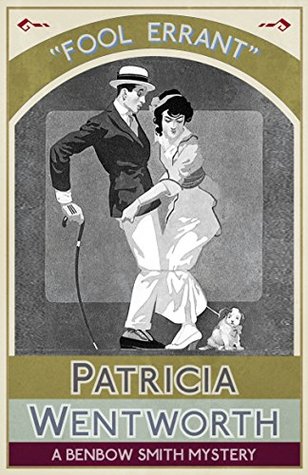
Fool Errant by Patricia Wentworth – #1929Club

This week Karen and Simon are hosting 1929 Club, the latest of their biannual events where we all read and write about books published in the same year. 1929 turns out to have been a particularly great year for publishing, with lots of tempting titles to choose from, but I decided to start with a book by an author I had never read but had been intending to try for a long time.

Patricia Wentworth is better known for her Miss Silver mystery series, but Fool Errant is the first of four novels featuring a different crime-solving character – Benbow Collingwood Horatio Smith. Named after three famous British admirals, the mysterious Mr Smith lives in London with his very talkative parrot, Ananias, and carries out some sort of espionage work for the Foreign Office. We learn little more than that about him in this book – in fact, he only makes two or three brief appearances and remains an eccentric, shadowy character in the background.

The novel opens with a nervous, stammering young man, Hugo Ross, arriving at Meade House, the home of the inventor Ambrose Minstrel. He is hoping to apply for the position of secretary and is surprised when Minstrel immediately offers him the job despite his lack of qualifications and experience. Before he even starts work, however, he has an encounter with a young woman in the street who is running away from home to avoid marriage with a distant cousin. When she hears that Hugo is planning to join Minstrel’s household, she is horrified and advises him to leave at once, but rushes off to catch her train before Hugo can ask for an explanation.

Taking up his new position as Minstrel’s secretary, Hugo soon begins to feel that something is not quite right at Meade House. Following a series of strange occurrences – and another warning from the young woman, whose name he discovers to be Loveday Leigh – Hugo decides to consult his brother-in-law’s uncle, Benbow Smith. It seems that he has stumbled upon a plot that could have serious implications for the government – and for his own safety if Minstrel finds out that he has guessed the truth. With the help of Smith and Loveday, Hugo must try to foil the plot while convincing Minstrel and his accomplices that he really is the timid, gullible idiot they believe him to be.

Fool Errant turned out to be a good choice for my first Patricia Wentworth novel; I expect it’s quite different from the Miss Silver books, being much more of a thriller than a mystery, but it was fun to read and the exciting plot kept me turning the pages. My only real problem was with the ridiculous characterisation of Loveday Leigh who, although she saves the day on one or two occasions, behaves like a child, is unable to have a serious conversation and expects kisses at the most inappropriate moments. Women like Loveday are quite common in books from that era, of course, but she has to be one of the worst I’ve come across!

This probably isn’t a book I’ll want to read again, but I did enjoy it and will look forward to reading the other three Benbow Smith novels…eventually!

~
Other 1929 books previously reviewed on my blog:

A Room of One’s Own by Virginia Woolf

A Farewell to Arms by Ernest Hemingway

Beauvallet by Georgette Heyer

Dickon by Marjorie Bowen

Partners in Crime by Agatha Christie

~

This is also book #6 read for R.I.P. XVII
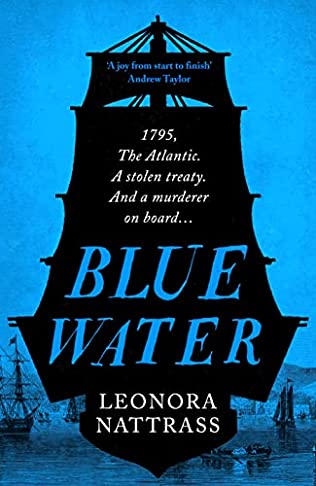
Blue Water by Leonora Nattrass

This is the sequel to Black Drop, Leonora Nattrass’ 2021 debut novel which introduced us to the character of Laurence Jago. Blue Water works well as a standalone historical mystery, but I would recommend reading both books in order if you can.

It’s December 1794 and former government clerk Laurence Jago has just left Britain aboard the packet ship Tankerville. The ship’s destination is Philadelphia, where one of Jago’s fellow passengers, Theodore Jay, will deliver a treaty to President Washington. The Jay Treaty, negotiated by Theodore’s father, the American envoy John Jay, is designed to promote peace between the two nations and prevent America from joining forces with France against Britain. War Office official Mr Jenkinson, also on board the Tankerville, has offered to hide the Treaty in a safe place, but when he is found dead and the papers disappear Jago realises it’s up to him to find them and prevent them from falling into French hands.

Well, I enjoyed Black Drop but this second book is even better! With almost the entire story taking place at sea and therefore with a limited number of characters, the mystery has a ‘locked room’ feel and kept me guessing until the end. Leonora Nattrass very skilfully casts suspicion on first one character then another and it soon appears that almost everyone on the ship has a secret to hide. Although I correctly predicted a few of the plot twists (and was impatiently waiting for Jago to discover them too) the eventual revelation of the fate of the Treaty came as a complete surprise to me. I was also surprised when I read the author’s note at the end and saw that some parts of the plot were based on historical fact, although the details have been added to and embellished using the author’s imagination.

Laurence Jago continues to be an engaging narrator, though not always the most reliable one due to his occasional poor judgement, the secret sympathies we learned about in the previous book and his tendency to succumb to the temptations of ‘black drop’ laudanum. I was pleased to see the return of some other characters from the first book including the journalist William Philpott (whose attempts to compile a dictionary of seafaring superstitions add some humour to the book) and Theodore Jay’s slave and companion Peter Williams, always a calm and wise presence amid the onboard chaos. And of course, there are plenty of colourful new characters amongst the passengers, including two French aristocrats, an American plantation owner and an Irish actress with a dancing bear!

Choosing to set this novel at sea gives it a very different feel from Black Drop. Apart from a few glimpses of Madeira and then Praia, capital of Cape Verde, the whole story unfolds aboard the Tankerville and we are given lots of insights into life during a long sea voyage. The use of nautical terminology never becomes too overwhelming but it all feels authentic and due to the setting, time period, elegant prose and frequent encounters with French warships, I was strongly reminded of Patrick O’Brian’s Aubrey/Maturin series. I was quite sure Leonora Nattrass must have read O’Brian and when I reached the acknowledgements at the end of the book I found that I was right!

If it’s not already clear, I loved this book and hope there’s going to be a third in the series.

Thanks to Viper for providing a copy of this book for review via NetGalley.

Book #5 read for R.I.P. XVII

Book #56 read for the Historical Fiction Reading Challenge 2022.

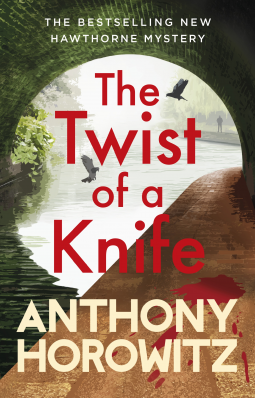
The Twist of a Knife by Anthony Horowitz

This series, of which The Twist of a Knife is the fourth book, takes as its premise the idea that the author Anthony Horowitz himself is one of the main characters, enlisted by the fictional detective Daniel Hawthorne to write books about the cases he investigates. It’s a concept that some people love and others hate, but if you have followed this series through to its fourth outing you probably, like me, fall into the first category. If you’re yet to read any of these books, you could start with this one if you want to as it does stand alone, but I would recommend beginning with the first, The Word is Murder, if you can. Either way, try one and see what you think!

The Twist of a Knife begins with Hawthorne trying to persuade Horowitz to write another book about him, but Anthony has other plans. He had only agreed to a three-book deal and that is now complete; now he’s working on a different novel – Moonflower Murders – and preparing for the London opening of his play, Mindgame. However, as Anthony himself then admits, the fact that we, the reader, are holding a fourth Hawthorne novel in our hands proves that somehow Hawthorne must get what he wants!

The story then moves on to the first night of Mindgame at London’s Vaudeville Theatre. The play has been very well received on tour and Horowitz is hoping that London audiences will like it just as much. Everything goes smoothly on that first night, but as Anthony and the cast get together in the green room after the play, the first review comes in – and it’s a bad one. In fact, it couldn’t be much worse. Written by the critic Harriet Throsby for the Sunday Times, the review is rude, scathing and insulting, placing most of the blame on Horowitz’s writing. When Harriet is found stabbed to death the next morning, suspicion immediately falls on Horowitz and he is arrested for murder. His only hope is that Hawthorne can find the real culprit and clear his name – but what will Hawthorne expect in return?

I think this could be my favourite of the four books in this series. I loved the theatrical setting and I found the mystery a particularly interesting one. Just about everyone involved with the play Mindgame has both the motive and the opportunity to have killed Harriet and I enjoyed learning more about each of the suspects – I did pick up on some of the clues, but certainly not all of them and I didn’t guess who the murderer was until the truth was revealed in an Agatha Christie-style denouement at the end of the book. Mindgame is a real play written by Horowitz which was first performed in 1999, although in this book it’s presented as a new work and the actors, director and events of the opening night are fictional. It sounds like a fascinating play and I’m tempted to read it, although it sounds like one that would have to be seen on stage to fully appreciate.

Daniel Hawthorne remains a private, secretive person, as he has from the beginning of the series, but with each book a few more facts about him are uncovered. In this book, Horowitz has the chance to spend some time in Hawthorne’s home and makes one or two intriguing discoveries which I’m sure will be explored further in the next book. I’m assuming there will be a next book – in fact, there were hints at the end of this one that we could have several more to look forward to. I hope so, although I would still prefer another book about Susan Ryeland and Atticus Pünd to follow Magpie Murders and Moonflower Murders!

Thanks to Century for providing a copy of this book for review via NetGalley.

Book #1 read for R.I.P. XVII

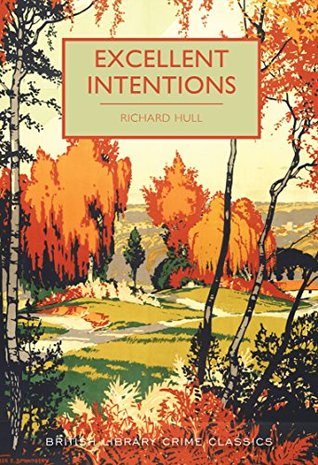
Excellent Intentions by Richard Hull

Richard Hull’s The Murder of My Aunt is one of the best books I’ve read from the British Library Crime Classics series. I’ve since read some of his others, available from a different publisher (Agora Books) and apart from Left-Handed Death, which was quite entertaining, they were disappointing in comparison. I hoped for better things from Excellent Intentions, another BLCC book. If nothing else, it has a lovely autumnal cover!

First published in 1938, Excellent Intentions begins in the courtroom. We know that someone is on trial for murder – but who is it? We will have to wait until the end of the book to find out; it’s a clever and unusual structure, with the details of the crime unfolding through a series of flashbacks as the witnesses provide the evidence and the jurors listen to the cases put forward by prosecution and defence. This format works very well as it allows us to see the story from lots of different angles and look for clues that will help us to guess who it is that has been accused.

We do know that the victim is Henry Cargate, a rude and unpleasant man who has made himself very unpopular since moving into the ‘big house’ in the village of Scotney End. On the day of his death a problem with his car forces him to take a train into town and just as the train leaves the station he is seen by another passenger to take a large pinch of snuff. Seconds later he is dead. As Cargate was known to have a weak heart, it is at first assumed that he has died of natural causes – until his snuff is found to have been laced with potassium cyanide, bought by the victim himself to destroy a wasps’ nest.

Because Cargate is such a horrible man – a man who ‘wanted to do nobody any good’ – there are plenty of people who could have had a reason for wanting him dead. However, there are only four who could have had access to the snuffbox and the poison, both of which were kept in Cargate’s own study. There’s Mr Yockleton, the vicar, whom Cargate had accused of stealing an emerald the day before the murder; Raikes the butler and Miss Knox Forster, the secretary, both members of Cargate’s household; and finally, Andrew Macpherson, a dealer in stamps. Cargate is a keen stamp collector and he and Macpherson had recently had a disagreement over whether some of the stamps in his collection were fakes. I should warn you here that we learn a huge amount about different types of stamps and their colours, markings and perforations, which you may or may not find interesting!

Any of these four people could have committed the murder, but only one has been accused and it’s up to the jury to decide whether this person really is the culprit. As the trial continues, we hear how Inspector Fenby, the detective investigating the crime, has decided who he thinks was responsible – and this is where I started to lose interest a little bit. There’s a lot of focus on alibis, timings, the positions of the snuffbox and the poison on Cargate’s desk, and who could have been in certain rooms during certain periods without being seen. This is never my favourite kind of mystery as I find it difficult to keep all of these things straight in my mind; I tend to prefer books that concentrate more on the motives of the characters and less on the technicalities of the crime.

I loved the ending, though. Even after we find out who it is that’s on trial, there’s another twist to come! This was an entertaining read overall and I would still like to read Keep It Quiet and Murder Isn’t Easy, the only other two Hull novels currently in print that I haven’t read yet.

This is book 16/20 from my 20 Books of Summer list.

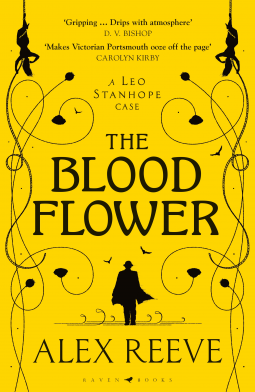
The Blood Flower by Alex Reeve

The Blood Flower is the fourth book – and sadly, the last – in Alex Reeve’s Leo Stanhope mystery series. I’ve been following this series since the first book was published and am sorry there won’t be any more to look forward to, but the author has stated that he has achieved what he set out to achieve with these novels and is ready to move on to other things.

The four novels in this series all work as standalone mysteries, but if you want to get to know Leo properly and understand his history and relationships with the other characters, I would recommend starting with The House on Half-Moon Street and reading the books in order if you can.

In The Blood Flower, set in the late Victorian period, Leo and his wife, Rosie, are heading for the south coast of England, where Leo, in his position of journalist with a London newspaper, has been asked to cover a murder case in Portsmouth. Rosie’s sister, Viola, happens to live in Portsmouth with her husband and Leo is looking forward to seeing them for the first time – but Rosie seems strangely reluctant for him to meet his in-laws. He doesn’t have too much time to wonder about this, however, because work must come first and soon Leo is being updated by the local police on the deaths of two young people, both found by the Portsmouth docks with their throats slit.

When Sergeant Dorling dismisses the two victims as misfits and outcasts and seems more concerned with how Leo is planning to portray the police in his newspaper article, Leo knows that if the murderer is going to be brought to justice he will have to solve the mystery himself. His investigations lead him to the notorious Papaver nightclub and a circus at the New Hippodrome theatre in search of the mysterious Blood Flower which seems to have played a part in both murders. But Leo has a secret of his own: he was born and raised as Charlotte Pritchard, before leaving his old life behind to live as the man he knows he really is. Only his closest friends know he is transgender, but if this information falls into the wrong hands he could find himself in serious danger.

I think this is the best book in the series; I enjoyed it even more than the last one, The Butcher of Berner Street. The Portsmouth setting makes a nice change from the Victorian London of the previous three books and Alex Reeve brings it vividly to life, with a contrast between the tourist areas with their colourful beach huts, bathing machines and shops selling postcards, and the darker side of the city which is where most of the story is played out. It was good to meet some of Leo’s old friends again – the actor Peregrine Black; Alfie the pharmacist and his young daughter, Constance; the elderly Jacob and his wife, Lilya – but moving the action away from London also allows Leo to meet lots of new people. Of the new characters, one I found particularly interesting was Olga Brown, or Miss La La, a black acrobat from Prussia and a real historical figure (her portrait was painted by Edgar Degas).

Leo himself continues to be a very likeable and engaging narrator, liable to make mistakes or say and do the wrong thing, but that only makes him feel more human. His transgender status is just one part of who he is and never really dominates the story; this, like the other books in the series, is a mystery novel first and foremost and the mystery is always at the centre of the plot. It’s quite a complex one and there are some interesting twists and turns towards the end as we discover what the Blood Flower is and who was responsible for the murders. Once the mystery was solved, I was sorry to have to say goodbye to Leo and his friends but I respect the author’s decision to move on and will be interested to see what he writes next!

Thanks to Raven Books for providing a copy of this book for review via NetGalley.

This is book 43/50 read for the Historical Fiction Reading Challenge 2022.

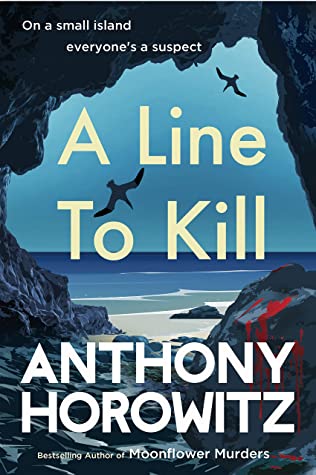
A Line to Kill by Anthony Horowitz

This is the third book in the Hawthorne and Horowitz mystery series; I enjoyed the first two, The Word is Murder and The Sentence is Death, and when I saw that the fourth book, The Twist of a Knife, is coming out in August it reminded me that I needed to catch up with this one.

If you’re not familiar with this series, I should start by telling you that it’s based around an unusual concept: the author Anthony Horowitz himself is one of the main characters, enlisted by the detective Daniel Hawthorne to write books about the cases he investigates. In this third novel, Horowitz and Hawthorne have been invited to attend a literary festival on the island of Alderney, one of the Channel Islands. There has never been a murder on Alderney before, as the islanders are quick to assure them, but this all changes soon after their arrival when an influential local businessman is found dead under suspicious circumstances.

There are plenty of suspects, including most of our duo’s fellow festival guests: a celebrity chef with a set of annoying catchphrases, a children’s author whose work has just been bought by Disney, a blind psychic who claims to hear voices from the spirit world and a French performance poet who is not all she seems. To complicate things further, the dead man has been at the centre of a controversial new scheme to run an electric power line across the island, something which has received a lot of opposition from the residents of Alderney. It seems that Hawthorne has found his next mystery to solve – and Horowitz has found his next novel.

I didn’t love this book as much as the first two in the series, maybe because I found the characters a particularly unpleasant bunch, but it’s still a clever, entertaining and absorbing murder mystery of the ‘locked room’ type – in which the whole island could be seen as the locked room, as once the murder takes place none of the suspects are allowed to leave. I think this is almost certainly the first and only book I’ve read with Alderney as a setting; I’m sure there must be others, but I’ve never come across them. The festival Anthony and Hawthorne attend is fictional, but in real life the island is establishing a literary reputation for itself, with an annual historical fiction festival and a recent Gothic literature event.

When writing yourself into a novel, it must be tempting to give yourself the starring role, but in this book that honour definitely goes to Daniel Hawthorne. With a lot of self-deprecating humour, Horowitz casts himself as the Watson to Hawthorne’s Holmes, always one step behind while Hawthorne picks up on clues that nobody else has even noticed. This creates a lot of tension between them (particularly when Anthony discovers that the festival-goers have no interest in his books – they only want to hear Hawthorne talk about the crimes he has solved). Their relationship has been a difficult one since the first novel, partly because Hawthorne is so secretive and shows Horowitz only the worst side of his personality. We are slowly learning a little bit more about him, but there’s still a lot we – and Anthony – don’t know.

I’m looking forward to reading The Twist of a Knife very soon…but what I’m really hoping for is a third book in the Magpie Murders series!

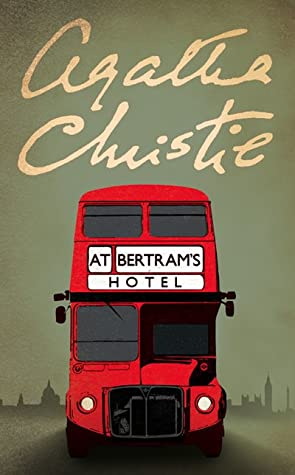
At Bertram’s Hotel by Agatha Christie

July’s theme for Read Christie 2022 is ‘a story which takes place on holiday’; I didn’t take part in last month’s read as I’d already read the suggested title (Murder in Mesopotamia), but decided to join in this month with At Bertram’s Hotel.

This late Christie novel, first published in 1965, begins with Miss Marple arriving for a two-week stay at Bertram’s Hotel in London courtesy of her nephew who thought she might like to get away from the village of St Mary Mead for a while. The hotel is one that Miss Marple remembers fondly from her youth and, having heard that it has changed very little over the years, she is looking forward to staying there again. However, it turns out not to be quite the relaxing break she expected; first an elderly hotel guest, Canon Pennyfather, goes missing, then Miss Marple’s attention is drawn to the unusual behaviour of two more guests – the notorious Lady Sedgwick and her estranged teenage daughter, Elvira. It seems that something is not quite right about Bertram’s Hotel, but can Miss Marple help the police to discover exactly what is going on?

I enjoyed this book, although I don’t think it’s one of Christie’s best. There’s no central mystery to be solved – there’s the murder of a minor character which takes place late in the novel, but otherwise we hear about crimes that have happened ‘off the page’ rather than witnessing them ourselves. The sequence of events surrounding the disappearance of the absentminded Canon Pennyfather was fascinating, but again more of a subplot than the main focus of the story. What we do get is a growing sense of unease and a feeling that something is wrong without knowing precisely what it is.

I loved the portrayal of Bertram’s Hotel, which at first appears to be a quaint, old-fashioned establishment that has deliberately tried to preserve its Edwardian charm with the sort of atmosphere, furnishings and food that will appeal to a certain age and class of guest. As the story progresses, Miss Marple’s pleasure at finding the hotel just as she remembered it turns gradually to disappointment as she discovers that you can never really go back and that things don’t stay the same forever, no matter how much you want them to.

Sadly, Miss Marple herself doesn’t have a very big role to play in this novel. Chief Inspector Davy – known as ‘Father’ because he’s close to retirement age – is the person responsible for carrying out the investigations and we see more of him than we do of Miss Marple. However, as usual, she is the one who provides the vital clues and observations that enable the crimes to be solved and the culprits to be caught.

August’s Read Christie theme is a book ‘set in a hot climate’, if anyone wants to join in!

This is book 8/20 from my 20 Books of Summer list.