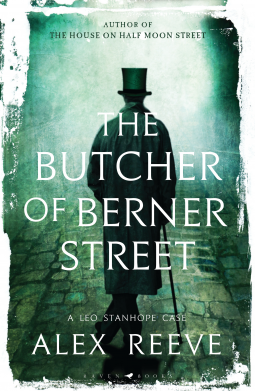
The Butcher of Berner Street by Alex Reeve

Along with Antonia Hodgson’s Thomas Hawkins books and Andrew Taylor’s Marwood and Lovett books, this is one of several new historical mystery series I have been enjoying over the last few years. It is set in Victorian London and follows the adventures of Leo Stanhope, an interesting, intelligent and likeable young man who has a secret he must keep hidden at all costs. This is the third book in the series and although you could certainly read it without having read the previous two (The House on Half Moon Street and The Anarchists’ Club), I do recommend getting to know Leo and his friends from the beginning if possible.

As The Butcher of Berner Street opens, we learn that Leo, formerly a coroner’s assistant, has a new job writing articles on science for the Daily Chronicle newspaper. He is enjoying the work and is grateful for the opportunity he has been given, but he longs for something more exciting to write about – something that will give him a front page headline. When he receives an anonymous note warning of a murder due to take place at a wrestling club in the East End of London that night, it seems Leo is about to get his wish. A murder does take place, although not quite in the way Leo had expected, and when suspicion falls on a Hungarian female wrestler, Irina Vostek, he must find a way to get the headlines he needs while making sure that Irina really is the killer.

I think The Butcher of Berner Street is my favourite of the three books in this series. The plot is well constructed and although I did guess who the murderer was, there were several possible suspects and enough twists and turns to give me a few doubts. More than the plot, though, I loved the setting, the atmosphere and the insights into various aspects of Victorian life: the class differences and the fate of those living in poverty, the early days of the women’s suffrage movement and attitudes towards the Catholic church.

Leo himself is a very compelling character; it’s no spoiler to tell you that although he has chosen to live as a man, he was born and raised as a girl before leaving home as a teenager and taking on a new identity, knowing that he could never be happy unless he had the freedom to be true to himself. Only one or two trusted friends know Leo’s secret and he lives in fear of anyone else finding out; life as a transgender man in the 19th century is not easy and he has heard stories of others who have been arrested and forced to undergo horrific ‘cures’. Although this book is first and foremost a mystery novel and not specifically a book about the experience of being trans, it does have an impact on the way Leo approaches solving the mystery, as he needs to avoid drawing too much attention to himself and risking being blackmailed or exposed. As well as Leo, there are lots of other recurring characters in the series and I enjoyed meeting them all again, particularly the pie maker Rosie Flowers and Alfie the pharmacist and his young daughter, Constance.

I don’t know whether there will be a fourth book in this series. This one has a proper ending, tying up some loose ends and not leaving too much unresolved, but I still hope to see Leo and his friends again soon!

Thanks to Raven Books for providing a copy of this book for review via NetGalley.

Dance of Death by Helen McCloy

This is the latest addition to Agora Books’ Uncrowned Queens of Crime series, making long-forgotten crime novels by female authors available again to modern readers. I think it’s probably my favourite so far. Originally published in 1938, it’s the first of several books written by American author Helen McCloy which feature the psychiatrist Dr Basil Willing.

The novel begins with the discovery of the body of a young woman, buried under a heap of snow in a New York street. Bizarrely, the cause of death appears to be heatstroke and the girl’s face is stained bright yellow. The police think they have identified her as Kitty Jocelyn, a beautiful debutante who has become famous as the face of an advertising campaign, but things take an even more confusing turn when they speak to her cousin, Ann Claude, who closely resembles the dead girl and who claims that she had been persuaded to impersonate Kitty at her recent coming out party.

Inspector Foyle begins to investigate this intriguing mystery, assisted by Basil Willing, an expert in Freudian psychoanalysis who provides a very different and, for the time, probably quite modern approach to crime-solving. While Foyle looks for tangible evidence and clues that will point to the culprit, Willing is more interested in the ‘blunders’ people make: a slip of the tongue, a lost item, a forgotten name. “Every criminal leaves psychic fingerprints,” he says, “And he can’t wear gloves to hide them.” I found Willing’s methods of solving the mystery fascinating, whether it was suggesting psychological reasons for the blunders, conducting word association tests or using his knowledge of the human mind to find out the motivation behind the crime.

Apart from Basil Willing, whom I liked and will look forward to meeting again, the other characters in the book are well drawn and believable too, which is important as the psychological angle of the story wouldn’t have worked if the characters had been nothing more than stereotypes. I didn’t manage to solve the mystery myself; although I suspected the right person, their motive came as a complete surprise to me, so I was content to let Willing do the investigating and explain the solution to me at the end. There are other aspects of the novel which I found nearly as interesting as the mystery, though, such as the ethics of advertising, attitudes towards money in 1930s society and the responsibilities of being a public figure. I thoroughly enjoyed Dance of Death and I’m sure I’ll be looking for more by Helen McCloy.

Thanks to Agora Books for providing a copy of this book for review via NetGalley.

Dead March for Penelope Blow by George Bellairs – #RIPXV

This is the third of George Bellairs’ Inspector Littlejohn mysteries I’ve read. I enjoyed the other two (A Knife for Harry Dodd and Death in Room Five), but I think this one is the best so far.

First published in 1951, Dead March for Penelope Blow is set in the small English town of Nesbury, home to the Blow family who live in the big house adjoining the bank which used to be the family business. The novel opens with Penelope Blow, one of the two surviving daughters of old William Blow, the banker, calling at Scotland Yard in the hope of seeing Inspector Littlejohn. Littlejohn, however, is away attending a murder trial and Penelope is forced to return to Nesbury, leaving a message for the Inspector to call her as soon as possible. Unfortunately, before Littlejohn has time to contact her and find out what she had been so desperate to tell him, Penelope falls to her death from a window while leaning out to water flowers in a window box.

As Littlejohn, with the help of his assistant Cromwell, begins to investigate the circumstances of Penelope Blow’s death, an intricate mystery unfolds involving family secrets, wills and inheritances, forgeries and thefts, and a suspected case of poisoning. The novel is carefully plotted, with some clever red herrings, and various revelations coming at just the right points in the story. It’s not really a very original mystery, but I still found it intriguing and although I correctly guessed who did it, I didn’t manage to work everything out before Littlejohn and Cromwell did.

What makes this a particularly enjoyable novel, though, is the strong, almost Dickensian, characterisation (in fact, when Cromwell is listening to the housekeeper, Mrs Buckley, talking about her ‘umble home, he thinks of Uriah Heep from David Copperfield). From Mr Jelley, the frail, elderly butler, and John Slype, the cheerful little window cleaner, to the fierce and beautiful Lenore Blow and her father Captain Broome, whom Littlejohn describes as ‘like a character out of Kipling’, they are all very strongly drawn and each of them, however minor, adds something special to the story. In contrast, Littlejohn and Cromwell are quite ordinary, but I do like them both!

Another interesting thing about this book is that, although it’s set in the post-war period and there are a few references to this (we are reminded that food rationing is still in place, for example), the story feels as though it could have been taking place in a much earlier period. The Blow family almost seem to be frozen in time, with relationships between the male and female members of the household and between servants and employers as rigidly structured as they would have been in Victorian times. The social history aspect of the novel is almost as fascinating as the mystery.

Having enjoyed this one so much, I’m looking forward to reading more from the Littlejohn series!

Thanks to Agora Books for providing a copy of this book for review via NetGalley.
This is my third and final book read for this year’s RIP Challenge.

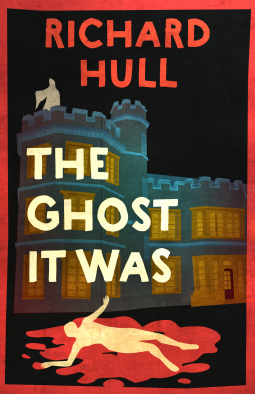
The Ghost It Was by Richard Hull – #RIPXV

I’ve enjoyed several of Richard Hull’s novels over the last few years – particularly The Murder of My Aunt and Left-Handed Death – and with Halloween quickly approaching, The Ghost It Was (first published in 1936) sounded like a good one to read next.

The novel begins with aspiring journalist Gregory Spring-Benson trying to get a job as a newspaper reporter. Having failed to impress the editor, Gregory is given new hope when he comes across a badly written article about James Warrenton’s purchase of the supposedly haunted Amberhurst Place. James Warrenton happens to be his uncle – his very rich uncle – and perhaps if Gregory goes to visit him in his new home he will be able to gather material for a much more interesting article that will help to launch his career in journalism. If he can also persuade Uncle James to leave him as much money as possible in his will, even better!

On his arrival, however, Gregory finds that he is not the only one hoping to secure his inheritance; three other nephews and a niece have also descended upon the house in an attempt to ingratiate themselves with their uncle. But while the cousins are busy plotting and scheming against each other, the ghost of Amberhurst Place makes an appearance at the top of a tower. Deaths soon follow, but is the ghost responsible or is there a human culprit?

Although all of the books I’ve read by Richard Hull so far have been very different, unlikeable characters seem to be the one thing they have in common! This worked very well in The Murder of My Aunt, where the characters were so horrible they were funny, but in this book they are just thoroughly unpleasant and not much fun to spend time with at all. I could easily have believed that almost any of them was the murderer and didn’t really care which of them was. It didn’t help that after a strong opening, introducing us to Gregory Spring-Benson and describing his ordeals at the newspaper office, the narrative then jumps around between the other cousins, the butler, a clergyman and some Scotland Yard investigators. We barely see Gregory after this and I felt that the novel lost focus through trying to involve too many different characters at once.

The ghost story aspect of the novel is well done – not at all scary, but it adds some atmosphere and makes it more difficult to work out exactly how the murders are being carried out. Despite the unpleasant characters and the lack of focus I’ve mentioned, it’s quite an enjoyable mystery to try to solve and the denouement, when it comes, is unusual and unexpected. Instead of tying everything up for the reader, Hull leaves us to make up our own minds and to decide whether we’ve correctly interpreted what we have been told. Not a favourite Hull novel, then, but still worth reading and I will continue to explore his other books.

Thanks to Agora Books for providing a copy of this book for review via NetGalley.
This is my second book read for this year’s R.I.P. Challenge.

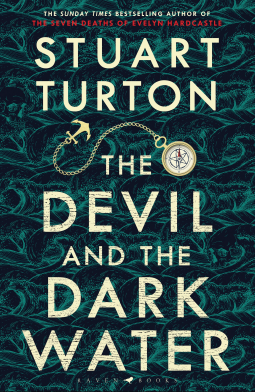
The Devil and the Dark Water by Stuart Turton – #RIPXV

I loved Stuart Turton’s first novel, The Seven Deaths of Evelyn Hardcastle, which I thought was one of the most original and unusual mystery novels I’ve ever read, so I had high hopes for his new book, The Devil and the Dark Water. However, although this is another complex and cleverly plotted novel, it has a very different structure, setting and feel, and didn’t impress me as much as the previous book did.

The Devil and the Dark Water opens in 1634 in Batavia (now Jakarta, Indonesia), an outpost of the United East India Company. The Dutch ship Saardam is about to set sail for Amsterdam, carrying a cargo of spices, a mysterious object known as The Folly – and a prisoner, Sammy Pipps, the world’s greatest detective. Nobody knows what crime Sammy is supposed to have committed, but his friend and bodyguard, Lieutenant Arent Hayes, has vowed to protect him during the journey and to prove him innocent if possible. As the passengers and crew prepare to embark, a leper wrapped in blood-stained rags appears on the dock and has time to place a curse on the ship before his body is consumed by flames.

The curse appears to set in motion a chain of eerie, unexplained events which begin to occur as soon as the ship sails out to sea. Is the Saardam really being haunted by the devil, Old Tom, or is a human being behind these sinister occurrences? With Sammy locked in a cell, it falls to Arent to investigate…but he is not the only person on the ship who is trying to solve the mystery. Sara Wessel, wife of the Governor General, is also determined to uncover the truth, with the help of her daughter, Lia, and her husband’s mistress, Creesjie.

This is a wonderfully atmospheric book, with a real sense of evil and foreboding, beginning in the first chapter with the leper’s curse – ‘Know that my master sails aboard the Saardam. He is the lord of hidden things; all desperate and dark things…’ – and continuing to build throughout the novel, with strange symbols appearing on the sails, a lantern that shines out at sea where no lantern should be, stories of witchfinders and burning villages, and a series of ‘unholy miracles’. I found it genuinely spooky and although the plot itself seemed to move along very slowly at times (I read it on my Kindle and hadn’t really appreciated what a long book it was), the atmosphere more than made up for it. The revelations at the end of the book also took me by surprise; I’d had my suspicions about one of the characters, but I certainly didn’t guess everything correctly!

There were things I liked, then, but the main problem I had with the book was that I never at any point felt fully immersed in the seventeenth century. There’s no real attempt to use language appropriate to the period, Sara and Lia are both modern women with modern attitudes, and the depiction of Sammy Pipps as a sort of Sherlock Holmes character whose cases had been written about (by Arent) for all the world to read seemed completely implausible. To be fair, Stuart Turton acknowledges in an author’s note at the end of the book that he ‘did his research, then threw away the bits that hindered the story’, but I personally prefer a story set in the past to actually feel historical – otherwise, why bother setting it in the past at all? If you’re not too bothered about historical accuracy and are just looking for a dark and atmospheric mystery novel, I’m sure you’ll find a lot to enjoy here, but I don’t think I was the right reader for this book.

Thanks to Raven Books for providing a copy of this book for review via NetGalley.
I am counting this book towards this year’s R.I.P. Challenge.

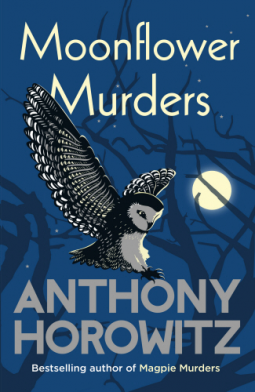
Moonflower Murders by Anthony Horowitz

A few years ago I read Anthony Horowitz’s Magpie Murders, a wonderful, imaginative novel containing a story-within-a-story – the outer one being a crime story set in the contemporary publishing world and the inner one being an entire Golden-Age-style murder mystery featuring a detective called Atticus Pünd. When I finished that book I remember feeling disappointed that there weren’t more Atticus Pünd novels to read, so I was delighted to find that Horowitz’s latest book, Moonflower Murders, is written in the same format.

Both books stand alone so it’s not essential to have read Magpie Murders before starting Moonflower Murders (although there are a few references in this one to the events of the previous book). At the beginning of the novel, we rejoin Susan Ryeland who is now running a small hotel in Crete with her boyfriend, Andreas. It’s not quite the idyllic life Susan had hoped for, though, and just as she is beginning to long for her old career in publishing, two guests approach her with an intriguing proposition.

Their names are Lawrence and Pauline Treherne and they run a hotel of their own in England, where a murder took place eight years ago. Stefan Codrescu, one of the hotel employees, was found guilty of the murder, but the Trehernes’ daughter, Cecily, has always believed him to be innocent. Now Cecily has disappeared, just after telling her parents that she had uncovered a clue in an Alan Conway novel called Atticus Pünd Takes the Case which proves that the wrong man had been charged with the crime. Knowing that Susan was the editor who worked on the Atticus Pünd novels in her publishing days, the Trehernes have come to ask for her help. What was the clue Alan Conway hid within the pages of his novel? Is Stefan innocent or guilty? And what has happened to Cecily?

After several chapters in which Susan begins to investigate the events of eight years earlier and how they could be connected with Cecily’s disappearance, we have the pleasure of reading the whole of Atticus Pünd Takes the Case, a detective novel dealing with the murder of a famous actress. Although this story-within-a-story is enjoyable in its own right, at first it’s not clear how it is linked to the murder at the Trehernes’ hotel, but Susan’s knowledge of how Alan Conway’s mind worked helps her to pick out possible hints and clues. I certainly didn’t manage to solve the mysteries – either the one in the Pünd story or the one in the framing story – myself, but I enjoyed watching everything unfold.

I didn’t love this book quite as much as Magpie Murders, probably because I already knew what to expect so it didn’t feel as original, but it was still hugely entertaining and, like the previous novel, packed with word games and other little puzzles cleverly woven into the text. And of course, as an Agatha Christie fan I adore the Atticus Pünd stories in both books, which are such perfect homages to Christie herself. As we have been told that the fictional author Alan Conway apparently wrote a whole series of Atticus Pünd novels, I hope Anthony Horowitz will give us the opportunity to read at least one more of them!

Thanks to Random House UK for providing a copy of this book for review via NetGalley.
This is book 12/20 from my 20 Books of Summer list.

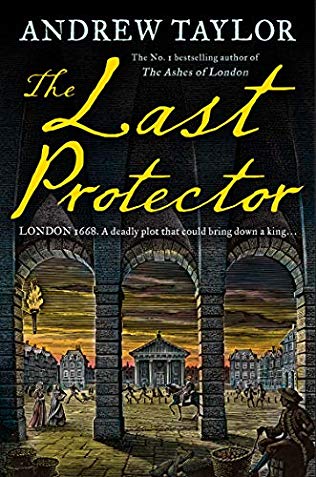
The Last Protector by Andrew Taylor

The Last Protector is the latest addition to Andrew Taylor’s wonderful Marwood and Lovett series set in England during the Restoration. It’s now 1668, and Charles II, restored to his throne eight years earlier, is beginning to lose the support of the people due to the extravagance of his lifestyle and the immoral behaviour of his courtiers. Many are starting to long for the days of the Lord Protector Oliver Cromwell and his son, Richard – and when Richard returns (in disguise) from exile, he becomes the centre of a conspiracy into which James Marwood and Cat Lovett are drawn.

At the beginning of the novel, government agent Marwood, still working for Joseph Williamson, Under-Secretary of State to Lord Arlington, is sent to spy on a duel between Lord Shrewsbury and the Duke of Buckingham, who is believed to be plotting against the king. Unfortunately, Marwood is seen by Buckingham’s men, making him a target of the Duke. Meanwhile, Cat, now married to the elderly architect Simon Hakesby (and not really enjoying the experience) has a chance encounter with a young woman she hasn’t seen for years. The woman’s name is Elizabeth Cromwell, the daughter of Richard, the last Protector. Richard has become caught up in Buckingham’s plans to gain power and he wants Cat and Simon to help him. In this way, Cat and Marwood are both pulled, via different routes, into the same circle of events and their two separate storylines become entwined.

This is the fourth book in the series and I would recommend reading them all in order if you can (the previous books are The Ashes of London, The Fire Court and The King’s Evil). It’s not really essential as the novels do all stand alone to a certain extent, but Marwood and Cat have a complex relationship and I think it’s best to follow their stories from the beginning. They don’t seem to have as many opportunities to interact in this book as they do in the earlier ones, but the occasions when their paths do cross are always worth looking forward to.

As usual, there’s also an interesting collection of secondary characters to get to know. One of the many things I enjoy about this series is the way the books incorporate both the lives of the nobility and the lower classes and there are two characters in particular who stand out this time: Ferrus, the ‘mazer-scourer’, a tall, skinny man whose job it is to squeeze himself down sewers to clear blockages underground, and Chloris, a kind-hearted prostitute who does her best to help Marwood despite her humble position in life.

Compared with the previous three novels, this book is more of a thriller than a mystery, still with plenty of twists and turns to the plot. And of course, the atmosphere and attention to detail are excellent, bringing to life the London of the period as the city continues to rebuild following the Great Fire of 1666. I hope there’s going to be a fifth book, especially as there’s a certain development towards the end of this one that has left me wondering what the future might hold for Cat and Marwood.

Thanks to HarperCollins for providing a copy of this book for review via NetGalley.