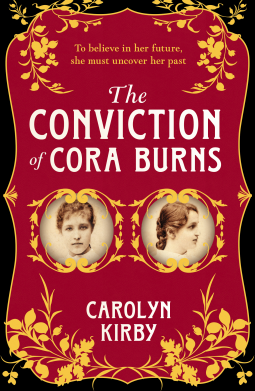
The Conviction of Cora Burns by Carolyn Kirby

The question of nature versus nurture lies at the heart of Carolyn Kirby’s dark and fascinating debut novel, The Conviction of Cora Burns. Are people born good or bad or is it their upbringing that determines their behaviour? Is it inevitable that some people will commit acts of evil or does this depend on their early influences and the way they have experienced the world? These ideas are explored through the fictional story of Cora Burns.

Born in a prison cell, Cora is raised in Birmingham’s Union Workhouse before going on to work as a laundry maid in the Borough Lunatic Asylum. It’s not the best of starts in life and by the time Cora is twenty she has served a prison sentence herself. At the beginning of the novel, in 1885, she has just been released and is about to take up a new position as ‘between maid’ in the household of the scientist Thomas Jerwood – not her ideal job, but she quickly finds that other opportunities for women in her circumstances are very limited.

A fragment of a bronze medal engraved with the words ‘Imaginem Salt’ – a reminder of her childhood friend, Alice Salt – and vague memories of a crime so terrible she has blotted out the details from her mind are all she has left of her earlier life and she is determined to make a fresh start. As she settles into her new home, Cora begins to befriend Violet, a young girl who appears to be the subject of Mr Jerwood’s experiments. But is Cora being experimented on herself – and if so, what will be discovered? Meanwhile, she decides to track down Alice Salt, the friend she hasn’t seen for years but who she believes holds the key to that terrible incident in her past.

As well as the nature or nuture debate that I’ve already mentioned, the novel incorporates many other interesting issues and themes, such as the effects of poverty, the treatment of prisoners and the mentally ill in Victorian Britain, and advances in science, psychology and technology (particularly photography). All of these things have an impact on Cora’s story, which is told in non-linear form, moving backwards and forwards between her present situation in Thomas Jerwood’s household and her childhood in the workhouse. Interspersed with these narratives are Jerwood’s reports to a scientific journal describing his latest research and theories and occasional updates from another doctor whose work may also shed some light on Cora’s past.

This is not an ‘easy’ read – you do need to concentrate to keep the various strands of the plot straight and you also need some patience as it takes a while for the different pieces of the story to fall into place, but it’s definitely worth it in the end. I should also warn you that the crime in which Cora was involved is a particularly chilling one and is described in detail, but I think this was necessary in order to illustrate the worst of Cora’s nature. Despite this, though, I could also see that Cora had plenty of good qualities and I hoped that she would eventually be able to move on from her past and find some happiness. Whether this does happen or not I will leave you to find out for yourself.

Finally, I loved the decision to set the story in Victorian Birmingham! It made a nice change from the many books set in Victorian London. This was an impressive first novel and I will be looking out for more from Carolyn Kirby.

Thanks to No Exit Press for providing a copy of this book for review via NetGalley.
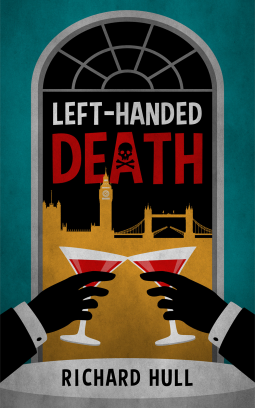
Left-Handed Death by Richard Hull

I loved Richard Hull’s The Murder of My Aunt – it was one of the best books I read last year – but when I tried another of his classic crime novels, And Death Came Too, I was disappointed to find that it was a much more conventional murder mystery without the humour and originality I had expected based on my first experience. Left-Handed Death is my third Hull novel and I’m pleased to report that it’s another good one – not in the same class as The Murder of My Aunt, but much better than And Death Came Too.

This book was published in 1946, but is set slightly earlier, just before the end of World War II. It begins with Guy Reeves, one of the two directors of the Shergold Engineering Company, returning to his office after lunch and making a shocking confession to his co-director, Arthur Shergold: he has just murdered Barry Foster, a civil servant who has been investigating the company’s finances. Foster may have been on the point of revealing corruption within the company, something which matters to the Ministry he works for because the Shergold Company have been supplying government contracts throughout the war.

Reeves describes his actions of the afternoon to his partner, finishing with a detailed account of how he carried out the murder, then he heads to Scotland Yard where he repeats his confession to the police. Inspector Hardwick doesn’t believe him – why would somebody voluntarily admit to murder? – but he sends his men to Foster’s home where they discover that Foster is indeed dead and that it’s entirely possible that the murder could have taken place exactly as Reeves has described it. There seems little reason to investigate further, but Hardwick still has his doubts and sets out to prove that Reeves is innocent.

All of this happens in the first chapter of the book and I was immediately intrigued. Why would Reeves confess to a murder that he hadn’t committed? On the other hand, why would he confess to a murder that he had committed? And if he didn’t kill Foster, then who did? As Inspector Hardwick himself points out:

“I like my murders to start at the beginning with the corpse and go on to the end with the conviction. But when you start in the middle with the confession – well, all I can say is that it’s all wrong!”

As I continued to read, I started to form my own theory about what was happening and I was able to predict the solution before it was revealed, but I still enjoyed watching Hardwick and his fellow detectives sorting through the clues, looking for alibis, speaking to witnesses and gathering medical evidence. I thought the ending did let the rest of the book down slightly, though – surely there was room for one or two more twists!

As well as being an entertaining murder mystery, I found this book interesting because of the time period in which it is set. The story takes place right at the end of the war and that has an impact on the lives of the characters and on just about everything that happens in the novel. Guy Reeves’ description of the lavish meal he and Foster ate on the day of the murder, for example, provokes disapproval at a time when rationing is in place; the war makes it difficult to get hold of a doctor to examine the murdered man; Cynthia Trent, who works as a secretary at the Shergold Company, takes a walk in the countryside past an Italian prisoner-of-war camp; and Reeves himself has suffered an injury while serving in the army which has implications for the way in which the murder is carried out.

I will continue to read Richard Hull’s books in the hope that the others will be at least as good as this one, if not as good as The Murder of My Aunt. I suspect I probably started with his best book, but that doesn’t mean the others aren’t worth reading!

Thanks to Agora Books for providing a copy of this book for review via NetGalley.
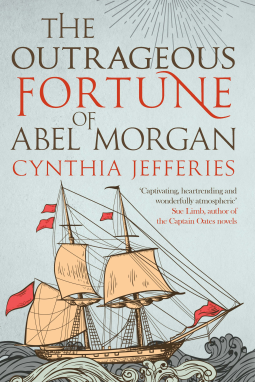
The Outrageous Fortune of Abel Morgan by Cynthia Jefferies

Cynthia Jefferies is probably better known as an established children’s author writing under the name of Cindy Jefferies, but she has recently turned her hand to writing novels for adults, of which The Outrageous Fortune of Abel Morgan was her first. It was the title and cover that caught my attention at first, then when I read what the book was about I thought it sounded like something I was almost certain to enjoy.

The story begins in 1660, with Christopher Morgan returning to England following the restoration of Charles II, having spent several years in exile with the others who fought on the side of the Royalists in England’s recent civil war. Christopher no longer has any interest in taking his place at court and intends to start a new life for himself and his family as owners of the wonderfully named Rumfustian Inn in the village of Dario, but his dreams are destroyed when his beloved wife dies in childbirth. Sinking into depression, he is sustained only by his relationship with his baby son, Abel, whom he raises alone with the help of the servants.

As the years go by, the two become closer than ever, but when Christopher makes an enemy of a local smuggler, he and Abel both pay a terrible price. Abel disappears while out riding his pony and Christopher’s only clue to his whereabouts is a mysterious map of Constantinople. Does this show where Abel has been taken? Christopher isn’t sure, but he’s determined to do whatever it takes to find his son. While he continues to search, however, Abel himself is having adventures of his own…

The Outrageous Fortune of Abel Morgan is best described as a good old-fashioned adventure story – a sort of cross between Robert Louis Stevenson’s Treasure Island and Daphne du Maurier’s Jamaica Inn. With smugglers, secret tunnels, sinister villains, pirate ships and action on the high seas, it’s a fun and entertaining read – yet I didn’t love it as much as I felt I should have done. While I had a lot of sympathy for Christopher, I never warmed to Abel at all; I found him quite selfish and some of his actions towards the end of the book made me actively dislike him. As half of the novel was narrated from his perspective, this was definitely a problem for me. I was also confused by the storyline which plays out in Constantinople as it seems to have very little bearing on the rest of the story and a villain introduced in this section didn’t have the impact I expected him to have.

Still, I was kept in suspense throughout the novel, wondering whether Christopher and Abel would ever meet again. The main theme of the love between father and son is handled with sensitivity and emotion and I had tears in my eyes several times towards the end of the book – which I always think is a sign that an author is doing something right! I would be happy to read more of Cynthia Jefferies’ adult novels; her new one, The Honourable Life of Thomas Chayne, is out now.

Thanks to Allison & Busby for providing a copy of this book for review via NetGalley.
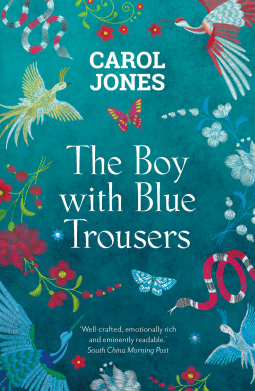
The Boy with Blue Trousers by Carol Jones

I love learning about the histories and cultures of different countries, so I was pleased to find that Australian author Carol Jones’ new novel, The Boy with Blue Trousers, is set in not one location but two – the mulberry groves of China and the goldfields of Australia – and introduces us to two women leading very different lives.

In 1850s China, seventeen-year-old Little Cat is growing up in a small village on the Pearl River Delta. Like the other girls in her community, she spends her days picking mulberry leaves and teasing out the threads from silkworm cocoons to produce reels of silk. It’s hard work, but it is the only life Little Cat has known and, now that she is approaching adulthood, she is growing nervous about what the future may hold. What sort of marriage will the matchmaker arrange for her? Will her husband and his family be kind? Will she have to go and live in another village far away from her own?

In the end, though, none of these things matter to Little Cat, because a disastrous encounter with the village headman, Big Wu, forces her to flee the country in fear of her life. Disguised as a boy, she embarks on a ship bound for Australia where she will join the hundreds of men heading there from China who are hoping to make their fortune in the goldfields.

Meanwhile, another young woman, Violet Hartley, has recently arrived in Australia. Violet, a governess, is trying to escape from her own past in England, and Australia seems like a place full of opportunities. When her first job, looking after two small children, proves to be not quite what she’d hoped for, she decides to accompany the Chinese immigrants on their journey – a decision that leads to her path crossing with Little Cat’s and tying the two separate threads of the story together.

The Boy with Blue Trousers is written in the form of two alternating narratives, so that we spend one or two chapters with Little Cat before switching to Violet for a while and then back again. This allows us to get to know both characters equally well and to see how, although they are living in very different environments, they face similar struggles as unconventional, independent women who don’t conform to the expectations of their respective societies. I have to admit, I didn’t like Violet at all; while I did have sympathy for her situation and the loss of her reputation following an affair with a married man in England – unfair when the man involved didn’t suffer in the same way – I just didn’t find her a very appealing character, especially in comparison to Little Cat, whom I loved.

I had a few problems with this book – apart from not liking Violet, I thought the way in which her story came together with Little Cat’s and the reaction they had to each other felt odd and unconvincing – but I was impressed by the sense of place Carol Jones creates. I particularly liked the descriptions of the mulberry trees, river banks, alleys and courtyards of Sandy Bottom Village, Little Cat’s home in the Pearl River Delta, but the coastal landscape of Robetown in South Australia is also beautifully portrayed.

Carol Jones is not an author I’ve come across until now, but I see she has written another novel, The Concubine’s Child, set in Malaysia, which also sounds interesting. If any of you have read that one, let me know what you thought.

Thanks to Head of Zeus for providing a copy of this book for review via NetGalley.
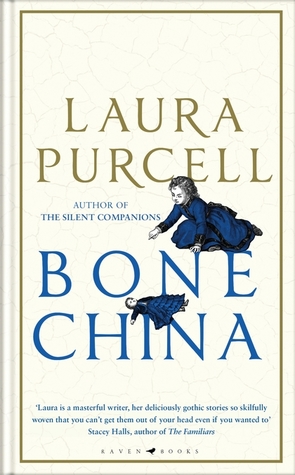
Bone China by Laura Purcell

Hester Why, the narrator of Laura Purcell’s latest gothic novel Bone China, is a woman with secrets. We know that Hester Why is not her real name, but what is the reason for her new identity? Why is she fleeing to Cornwall from London, who is she hiding from and how did she come to be addicted to gin and laudanum? These are questions we ask ourselves in the very first chapter and they are answered eventually, but first we must follow Hester to Morvoren House, perched high on the Cornish cliffs, where she is taking up a new position as nurse to Miss Louise Pinecroft.

Hester quickly discovers that her job is not going to be easy and soon she is asking questions of her own. What is wrong with Miss Pinecroft, who barely moves, never speaks and spends her days sitting in a cold room surrounded by china cups and plates? Who is Rosewyn, the strange, child-like young woman described as Miss Pinecroft’s ward? Is there any truth behind the claims of the superstitious servant Creeda that Rosewyn needs to be protected from fairies who are trying to steal her away and replace her with a changeling?

Bone China moves between three different timelines; as well as following Hester at Morvoren House, we also go back to an earlier time in her life, when she was known as Esther Stevens, and learn what went wrong in her previous employment, leading to her decision to run away and start again. Finally, in a third narrative we meet Louise Pinecroft as she was forty years earlier, when she and her father first arrived at Morvoren House after losing the rest of their family to consumption.

Laura Purcell has become known for writing dark, creepy Victorian novels and Bone China does have a lot of classic Gothic elements, including a gloomy, imposing clifftop house, family secrets and hints of madness. Despite this, I didn’t think this was a particularly scary or chilling story and although the exploration of Cornish folklore added atmosphere, I never doubted that the fairies and changelings existed only in legends and in Creeda’s stories. How much more spine-tingling it would have been if I had found myself feeling convinced that they could be real after all!

What I did find very disturbing and unsettling was the storyline set in Louise Pinecroft’s younger days, describing the work of her father, a doctor, who is looking for a cure for consumption (tuberculosis), the disease which took the lives of his wife and his other children. With Louise’s help, Dr Pinecroft carries out a revolutionary experiment, taking a group of prisoners who are suffering from the illness and lodging them in a cave beneath the cliffs where he claims the salty sea air will be good for their health. This part of the book was based on historical fact – cave air really was suggested as a possible cure for consumption at one time – and it was horrifying to read about the barbaric treatment of sick people due not to cruelty but to ignorance of modern medical procedures and a lack of understanding.

There are lots of interesting ideas incorporated into Bone China, then, but in the end I felt that the three threads of the story didn’t come together as neatly as they should have done. I also found the pacing uneven; in the second half of the book, the sense of mystery and carefully building tension of the earlier chapters was replaced by a sudden race to reach the conclusion. I didn’t enjoy this book as much as I’d hoped to, but I’m planning to read Laura Purcell’s first novel, The Silent Companions, soon and will see if I get on better with that one.

Big Sister, Little Sister, Red Sister by Jung Chang

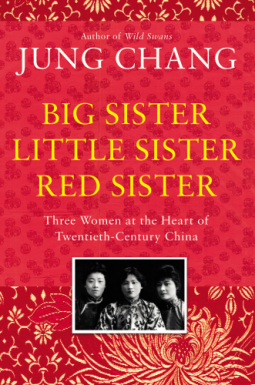
Jung Chang’s Wild Swans is one of the best non-fiction books I’ve ever read, so when I saw her new biography, Big Sister, Little Sister, Red Sister, available on NetGalley, I knew I wanted to read it. As the title suggests, this is the story of three sisters – the Soong Sisters – who were at the heart of twentieth century Chinese politics. Like Wild Swans, it gave me some fascinating insights into a country whose history I know very little about, but unlike Wild Swans, the author has no personal connection with the women she is writing about and I thought that made it a much less immersive and powerful read.

Despite their important roles in Chinese history, I’m ashamed to say that I had never heard of the three Soong Sisters before reading this book. In case anyone else hasn’t heard of them either, here’s a quick introduction:

‘Big Sister’ Ei-ling, born in Shanghai in 1888, was the eldest daughter of Charlie Soong and Ni Kwei-tseng. Through her marriage to the banker H.H. Kung – who later became Minister of Finance in the Nationalist government – Ei-ling was one of China’s richest women.

‘Little Sister’ May-ling was the youngest of the three. As the wife of Chiang Kai-shek, who was chairman of the Nationalist party (the Kuomintang) and later President of the Republic of China, May-ling was China’s First Lady. With her American education and excellent command of the English language, she provided a link between Chinese and Western cultures.

In the middle was Ching-ling, or ‘Red Sister’. In 1915, she married the much older Sun Yat-sen, the revolutionary leader who helped to overthrow the Qing Dynasty. After Sun’s death, Ching-ling’s continued involvement in left wing politics and her support for the Communist Party often put her in direct opposition to Big and Little Sister.

The book takes us through the lives of all three of these women from birth to death, comparing the different paths they choose to follow and describing their achievements and their influence on Chinese politics and society. Rather than devoting a separate section of the book to each sister, Chang jumps from one to the other and back again, moving forward chronologically over a period of more than a hundred years. As this is the first time I’ve read about the Soong sisters I’ve no idea how they are usually portrayed, but it seemed to me that Chang’s account was quite fair and balanced, showing sympathy for all three women but an awareness of their faults and weaknesses as well.

I found Ei-ling the least interesting to read about. With her wealth and position, there’s a sense that she is very detached from the realities of life, although she does come across as a generous and dutiful sister who tries to help her younger siblings in any way she can. May-ling is more appealing; although she is depicted as ambitious and sometimes extravagant, she also seems warm and compassionate, with a genuine interest in carrying out humanitarian work. But it was Ching-ling who intrigued me the most, with her unwavering dedication to the communist cause that sets her apart from her sisters and creates divisions in the family that never really heal. Was she, as one observer says, ‘most responsive and likeable, quiet and poised but misses nothing’ or was she, in the words of another, ‘basically a cold, hard, ruthless woman who knows what she wants and how to get it’?

Although the three Soong sisters all found themselves in positions of influence and power, these positions initially came about because of the men they chose to marry and that, for me, was one of the problems with this book. Almost as much time was spent describing the lives and careers of Sun Yat-sen, Chiang Kai-shek and H.H. Kung as was spent on May-ling, Ei-ling and Ching-ling, who were supposed to be the subjects of the book. Overall, it felt more like a general political history of twentieth century China than a biography of three specific people. I found it a much more challenging read than Wild Swans, which was as gripping as fiction, and it has taken me more than a month to finish it as there was just so much information to take in and digest. I can’t pretend that I am now an expert on Chinese politics, but I do feel that I learned a lot from this book and although it was a struggle at times, I’m glad I persevered and finished it!

Thanks to Jonathan Cape for providing a copy of this book for review via NetGalley.
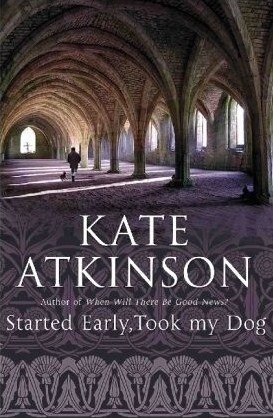
Started Early, Took My Dog by Kate Atkinson

This is the fourth book in Kate Atkinson’s Jackson Brodie series. For some reason, after reading the first three in quick succession in 2015, I never moved on to this one and it was only with the publication of the fifth book, Big Sky, earlier this year that I remembered I still needed to read it. Fortunately, the Jackson Brodie novels all stand alone very well so I found that it didn’t matter at all that I had left such a long gap between books three and four.

The plot of Started Early, Took My Dog is actually quite difficult to describe, but I’ll do my best. A good place to start is probably with Tracy Waterhouse, a retired police superintendent now working as head of security at the Merrion Shopping Centre in Leeds. Tracy is lonely and bored – she has no family, no friends and no social life; she gets up in the morning, goes to work, then comes home to spend every evening alone eating chocolate in front of the television. Then, one day, as she patrols the Merrion Centre, she sees a little girl being mistreated by Kelly Cross, a prostitute and drug addict whom Tracy recognises from her police days. She makes the decision to intervene and suddenly life becomes much more eventful!

While Tracy is trying to help an abused child, in a parallel storyline the novel’s other main protagonist, private investigator Jackson Brodie, is carrying out a good deed of his own. With a series of failed relationships behind him, Jackson is almost as lonely as Tracy, and when he witnesses a dog being kicked by its owner, he steps in and rescues it. The dog then becomes his inseparable companion as he embarks on his latest case – trying to trace the biological parents of Hope McMaster, a woman who was adopted as a child and grew up in New Zealand. This proves to be more difficult than he expected, because as soon as he starts asking questions it becomes obvious that those who do know the truth about Hope’s parentage will do anything to cover it up.

Jackson’s story quickly begins to intertwine with Tracy’s when he discovers that the murder of a woman in 1975 – a murder scene at which Tracy, then a young police officer, had been present – may have had something to do with the mystery of Hope’s origins. The novel moves backwards and forwards between the 1970s and 2010, showing how the events of the past have had an impact on the events of the present. Some of Tracy’s actions and choices following her encounter with the little girl in the Merrion Centre, for example, seem implausible at first but make more sense once you gain a deeper understanding of her background and her earlier experiences.

As with the other Jackson Brodie books, I found that the crime element of this one took second place to the characters. I thought Tracy was a great character and I loved her relationship with little Courtney, and, similarly, I enjoyed watching Jackson bonding with his new canine companion. The other character who stood out for me was Tilly, an elderly actress who is in the early stages of dementia; the way Kate Atkinson portrays Tilly’s fear and confusion over what is happening felt, to me, very convincing and very moving.

While the characters I’ve mentioned above were excellent, however, there were too many others whom I struggled to distinguish from each other; in particular, the other police officers involved in the 1975 storyline all seemed to blend into one which made that part of the book difficult to follow. There were also some subplots that didn’t seem to go anywhere and some important questions that remained unanswered at the end. Compared with the first three books in the series, I thought this one was disappointing. I’m sure I will still read Big Sky, but there are also a few other Kate Atkinson books I haven’t read yet: Transcription, Emotionally Weird and Not the End of the World. Have you read any of those and is there one you would particularly recommend?