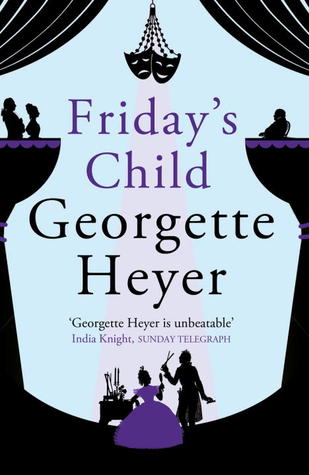
 This Heyer novel was published in 1944 and as it’s a particularly lively and humorous one, I expect it provided her wartime readers with some welcome escapism. It’s still an entertaining read in the twenty-first century too and although it hasn’t become a favourite, I did enjoy it.
“Friday’s child is loving and giving” says the famous rhyme and that is how the heroine of the novel, seventeen-year-old Hero Wantage, is described by her friends. As an orphan treated as a poor relation in her cousin’s household, Hero’s marriage prospects are not good and she is facing a future as a governess when she receives a surprise proposal from her childhood friend, Lord Sheringham. Hero is under no illusions that Sheringham – or Sherry, as he is known – is actually in love with her; she knows that he needs to marry in order to receive his inheritance and that he has already been rejected by the beautiful Isabella Milborne. It will be a marriage of convenience only, but even this is so much more than Hero could ever have hoped for that she has no hesitation in accepting.
Hero may be young and naïve, but Sherry is only a few years older and no more mature. He has no intention of changing his lifestyle just because he now has a wife, so he continues his reckless spending, gambling and womanising without considering the bad example he is setting for Hero. I don’t think it’s spoiling too much to say that Sherry does gradually come to love and appreciate his wife, but not without a lot of misunderstandings and ‘getting into scrapes’ along the way! And when he does eventually admit to himself how he really feels about Hero, will he have left it so late that he risks losing her to another man?
Although the relationship between Hero and Sherry is at the heart of the novel, with both characters slowly developing and maturing as time goes by, there is also a secondary romance which involves Isabella Milborne (known as the Incomparable) and George, Lord Wrotham, a passionate, hot-headed young man who is always ready to fight a duel. George, along with Gil Ringwood and Ferdy Fakenham, forms Sherry’s little circle of friends – and they become Hero’s friends too, providing most of the humour in the book as they give her some dubious guidance in the social etiquette of Regency London and try to help her out of the disastrous situations she finds herself in.
Friday’s Child has just about everything you would expect from a Heyer novel: duels, card games, gambling, balls and parties, elopements and attempted elopements. It reminded me of two of her other books, The Convenient Marriage and April Lady, which also have storylines revolving around a newly married couple learning to love each other. Although I enjoyed this book much more than April Lady, The Convenient Marriage is my favourite of the three, mainly because I preferred the hero in that one, the Earl of Rule. I do tend to prefer her older, wiser heroes rather than the young, irresponsible ones like Sherry. I also thought this book felt slightly longer than it really needed to be and the constant misunderstandings became a bit repetitive towards the end.
There are other Heyer novels that I’ve liked better than this one, then, but her books are always a lot of fun to read and this is no exception. There are plenty of funny moments, usually involving Sherry’s three friends (I particularly loved the hilarious Ferdy). I have The Corinthian, An Infamous Army and Faro’s Daughter to choose from for my next Heyer. If you have read them, which one would you recommend I read first?




 She Reads Novels