Verdict of Twelve by Raymond Postgate

A woman is on trial for murder and a jury is being sworn in to decide her fate. A jury of twelve men and women selected at random from all walks of life, each of whom has an interesting story of his or her own. Verdict of Twelve (1940), one of the British Library Crime Classics series, is as much about the jury as it is about the crime, which makes it an unusual and fascinating novel.

The book is divided into three main sections. In the first, we are introduced to each member of the jury as they step forward one by one to take their oaths. With an academic, a religious fanatic, a servant, a Greek restaurant owner and an encyclopedia salesman among them, many areas of society are represented and these twelve very different people must find a way to work together to reach what they believe to be the correct verdict.

The second part of the novel (which begins about a third of the way into the book) describes the crime itself. We are given some background information on the accused woman and then an account of the events which led up to the murder. I don’t think I can go into any detail without spoiling things, so I will just say that it is an intriguing mystery, very dark at times but with some humour at others. Although there are only a few suspects it is difficult to decide from the available evidence (which is largely circumstantial) exactly what happened and whether the jurors’ verdict should be guilty or not guilty.

Next, we watch the trial take place, listen to the witnesses and then join the jurors as they discuss the case and try to reach agreement. Finally a short epilogue lets us know whether we – and the jury – came to the right conclusion. It’s an interesting structure and one which I thought worked very well. Knowing the personal background of each juror before the trial begins helps us to see how their individual prejudices and experiences affects their reasoning when it comes to considering the evidence and making a decision. Some find that they have sympathy for the accused and some for the victim; as the reader, I felt that I was almost in the position of a thirteenth juror – and as I disliked one of the characters so much I found that I was also reacting emotionally rather than objectively.

My only slight criticism is that the first section of the book, in which the jury is introduced, is quite uneven. A few of the characters, particularly Victoria Atkins and Arthur Popesgrove, are fully fleshed out in what are almost self-contained short stories, while some of the others have only one or two pages devoted to them. As each juror has one twelfth of the input into the final decision, I’m not sure why we needed to know so much more about some of their backgrounds than others. Apart from this, I really enjoyed Verdict of Twelve – highly recommended for all lovers of classic crime!

Thanks to Poisoned Pen Press for providing a copy of this book for review via NetGalley.

This is book #6 for the R.I.P XII challenge.

Heartstone by CJ Sansom

As part of my Reading the Walter Scott Prize project, I knew that I would, at some point, need to read CJ Sansom’s Heartstone, which was shortlisted for the prize in 2011. Knowing that it was the fifth book in a series, though, and not having read any of the previous ones, I decided to start at the beginning with Dissolution and take my time working through them all. This was a good decision as I have thoroughly enjoyed the whole series – and now that I’ve finally read Heartstone, I won’t be stopping here but will be going on to read the sixth book, Lamentation, as well.

Like the earlier novels, this one is set in Tudor England and narrated by the hunchbacked lawyer Matthew Shardlake. It’s 1545 and with news of a huge French fleet about to cross the Channel, England is preparing for invasion. On Henry VIII’s orders, an army is being raised and warships including the Great Harry and the Mary Rose are getting ready for action in the harbour of Portsmouth. Meanwhile, Shardlake is also heading for the south coast on his latest mission for Catherine Parr, the Queen.

It has been claimed that “monstrous wrongs” have been committed against a young ward of court, Hugh Curteys, by his guardian Sir Nicholas Hobbey, and the Queen wants Shardlake to investigate. Accompanied, as always, by his assistant and clerk Jack Barak, Shardlake sets off on the journey from London to Hampshire, falling in with a company of soldiers on the way. On arriving at the Hobbey estate, it is obvious that there is something not quite right – but with Hugh insisting that he is not badly treated, how will Shardlake ever find out what is going on?

As if this wasn’t enough, Shardlake also has a second mystery to look into. In the previous novel, Revelation, he met Ellen Fettiplace, a woman who has been confined to the Bedlam for many years. With his work for the Queen taking him close to the village where Ellen grew up, he decides to do some investigating of his own in the hope of finding out what happened to her all those years ago and how she ended up in the asylum.

Poor Matthew; things just don’t run smoothly for him in this book and he is forced to acknowledge that he has been too “full of righteousness” – not a bad thing for a lawyer to be, you might think, but it does seem that he spends a lot of time trying to help people who really don’t want to be helped. Like Barak (who is desperate to get home in time to see the birth of his child), I found him quite frustrating with his refusal to leave things alone and take note of the warnings he is given, but of course that is what makes him feel so real and so human.

As I said, I’ve enjoyed all of the books in this series and this one is no exception. It isn’t my favourite, though, mainly because I felt that it was much longer than it really needed to be and that there was too much padding while Shardlake and Barak moved backwards and forwards between one location and another without anything happening to advance the plot. It didn’t help that I guessed the solution to one of the mysteries early in the book (probably because I have read a few other books recently with similar twists, and not because it was made particularly easy to guess) and had to wait a very long time for Shardlake to work it out for himself!

One thing I always love about the Shardlake novels is Sansom’s wonderful, vivid depiction of life in Tudor England. In this book, we are dropped right into a country making preparations for war (an unpopular and expensive war), and we learn a lot about the weapons and armour that are used, how men are recruited into the army and the training they undergo, as well as being treated to a long, dramatic description of the sinking of the Mary Rose at the Battle of the Solent. At the end of the novel, Sansom provides a detailed historical note in which he gives more information on the background to the story and separates fact from fiction.

Although I didn’t love Heartstone as much as some of the other books in the series, it was still a great read and I’m looking forward to joining Matthew Shardlake again soon in Lamentation.

This is book #5 for the R.I.P XII challenge.

Snowdrift and Other Stories by Georgette Heyer

I always love spending time in Georgette Heyer’s world; with duels, masked balls, elopements, high-stakes card games and lively period slang, her novels provide perfect escapism – and based on this collection, so do her short stories. Originally published as Pistols for Two in 1960, Snowdrift and Other Stories contains eleven of Heyer’s tales of Regency romance and adventure plus three additional stories not included in the earlier book.

I found these stories so enjoyable and so much fun, it was tempting to read them all at once, but instead I decided to just dip in and out, reading one or two at a time over the course of a few weeks. This was probably a good idea as many of the stories in the book are very similar, so better in smaller doses, I think! In particular, there are several that deal with young couples eloping with various family members in pursuit and a series of misunderstandings ensuing along the way – and also several involving duels, fought with either pistols or swords, and never quite going according to plan. Most of the stories have a twist or two, which are usually easy for the reader to predict, but come as a complete surprise to the characters!

I don’t want to discuss all fourteen stories here, but I can honestly say that I liked all of them – some more than others, of course. Some of my favourites included Bath Miss, in which a gentleman agrees to escort the daughter of a family friend home from school in Bath, but finds that the girl is not quite what he’d expected; The Duel, which follows a young lady who goes in search of the disreputable Lord Rotherfield to beg him not to shoot her brother; and Hazard, where a nobleman ‘wins’ a friend’s sister in a drunken game of dice and is horrified when he wakes up the next day and finds himself on the way to Gretna Green. Another which stood out, although it wasn’t one I particularly loved, was Night at the Inn. Unlike the others, which are all romances of various types, this one is more of a suspense story in which three guests arrive at a lonely inn one dark, foggy night.

As for the three extra stories – Pursuit, Runaway Match and Incident on the Bath Road (all from the 1930s, I think) – they are very entertaining too, although they suffered slightly from being placed at the end. Speaking as someone who is not usually a fan of short stories, I did really enjoy this book. I prefer her full length novels but, as I’ve said, if you just want a small dose of Heyer – or maybe if you’ve never read her before and don’t want to commit to anything longer – I would recommend giving Snowdrift a try.

Thanks to Sourcebooks for providing a copy of this book for review via NetGalley.

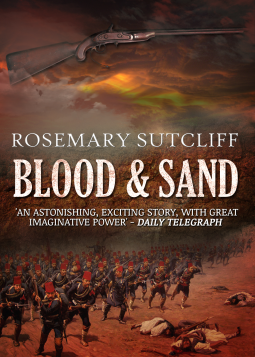
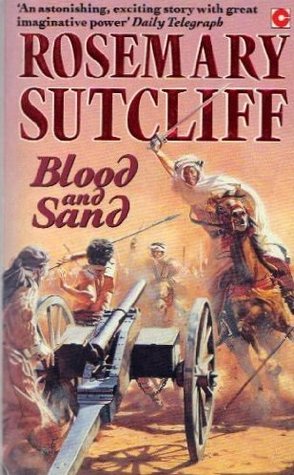
Blood and Sand by Rosemary Sutcliff

Rosemary Sutcliff is probably best known as a children’s author, but she also wrote several novels for adults and Blood and Sand, published in 1987, is one of them.

Blood and Sand is based on the true story of Thomas Keith, a Scottish soldier serving in the British Army during the Napoleonic Wars. Taking part in the Alexandria expedition of 1807 – an operation designed to capture the city of Alexandria in Egypt – Thomas is taken prisoner by Ottoman forces at El Hamed. Most of his fellow captives are sent back to Cairo as prisoners of war, but the Ottoman general in command of El Hamed has other plans for Thomas, who is ‘an extremely personable young soldier who speaks French, knows how to bear pain like a gentleman, and is the best swordsman and shot in his regiment’. Sent to train in the desert with the Bedouin cavalry, Thomas gradually rises through the ranks to enter the service of Tussun Bey, the Viceroy of Egypt’s youngest son, and to become Governor of Medina.

You may be wondering how it was possible for a Christian to reach such heights within the Ottoman Empire, so I should explain that Thomas makes the decision to convert to Islam. He does this partly because he is advised that it is the only way to progress in his military career but also because during his time as a prisoner he reads about and studies the Islamic religion and decides that conversion is something he feels comfortable with. However, it seemed to me that he made this choice a bit too easily and quickly; I would have found it more convincing if he had struggled with it more and if he had thought more often of the life he had left behind in Edinburgh and to which he would now never be able to return.

As far as I can tell – I had never heard of Thomas Keith until reading this book – most of the characters in the novel really did exist and most of the events described really did happen. This certainly seems to be true of the battles and military campaigns, but also two of the novel’s most exciting and memorable scenes: a dramatic duel and a desperate battle for survival on a dark turnpike stair. Of course, it’s Sutcliff’s skill as a writer which brings these scenes to life and fills them with suspense and tension, but it sounds as though the real Thomas Keith must have had a fascinating career and some hair-raising adventures. It’s surprising that he has not been a more popular subject for historical fiction.

In her author’s note Sutcliff says that the only area where she relies completely on her imagination is with the romance she creates for Thomas. This possibly explains why our hero’s love interest doesn’t appear until halfway through the book and only plays a relatively small role in the story. A much more interesting and moving relationship is the one between Thomas and Tussun, the Viceroy’s son – a relationship which develops over the years as Tussun grows from an impulsive, hot-headed teenager into a mature, well-respected leader and although it stops short of actual romantic love, is deeper than a normal friendship.

I enjoyed the first half of the novel very much, but later in the book Thomas and Tussun become embroiled in fighting against the Wahabis of Arabia and the heavy focus on military action was much less interesting to me than the more human story I had been finding so engrossing. That’s just my personal taste, though, and the battle scenes will probably appeal to other readers more than they did to me. I didn’t love this book quite as much as I’d thought I was going to at first, then, but I will certainly be reading more by Rosemary Sutcliff, having enjoyed both this one and The Rider of the White Horse.

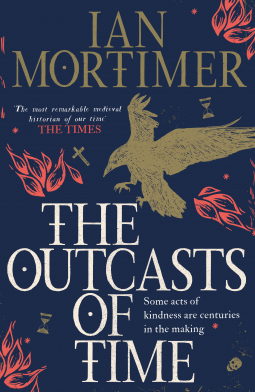
The Outcasts of Time by Ian Mortimer

Historian Ian Mortimer is probably best known for his non-fiction ‘handbooks’, The Time Traveller’s Guide to Medieval England and The Time Traveller’s Guide to Elizabethan England. His latest book, The Outcasts of Time, is a work of fiction but based around a similar concept. It’s a book packed with interesting ideas and intriguing themes, but although I found it an unusual and thought-provoking read, I don’t think it was entirely successful as a novel. I’ll try to explain.

The story begins in December 1348, with England ravaged by the Black Death. Two brothers, John and William, are walking home to their small village near Exeter when they too fall victim to the plague. Wandering into a stone circle in the dark, a mysterious, disembodied voice speaks to them, offering them a choice: they can return home and spend their last six days of life in familiar surroundings, but with the risk of spreading the sickness to the people they love – or they can live each of those six days in a different century, each one ninety-nine years after the one before. If they choose the second option, although they will still die at the end of the six days, all traces of plague will be removed during that period. I’m sure you can guess what they decide to do!

Waking up in the year 1447, the brothers find that the world is a strange and unfamiliar place – and each new dawn after that brings even greater challenges. As the novel’s narrator, John acts as our guide, describing the changes he sees in the English countryside and in the streets of the towns and villages he once knew so well. Some things, it seems never change – for example, in almost every year the brothers visit, a war is taking place – but it’s the great advances in technology and the small details of daily life which surprise John the most. When he reaches that distant age of 1942, he is equally amazed by the ‘flying crosses’ he sees in the sky and by the mysteries of an indoor bathroom!

With his background in history, Ian Mortimer has obviously taken great care to recreate each period his characters visit as accurately as possible, down to the tiniest details, showing the changes in architecture, fashions, food and drink, place names, and even the fact that people are growing taller over the centuries. However, although some characters do remark on the brothers’ unusual way of speaking, I’m not convinced that they would have been able to make themselves understood at all, bearing in mind how much the English language has changed since the 14th century (the time of Geoffrey Chaucer). Also, while I did like the different and unusual approach to time travel in the novel, it often felt more like the framework for a series of history lessons rather than the compelling story I would have preferred.

Religion played an important part in medieval life, and John and William, as they move forward through time, have the chance to see how Christianity, the church and the ways in which people worship have evolved over the years. The religious element of the book is very strong – too strong for me at times – but led to some interesting discussions between the brothers and the other characters they meet. Themes of faith, morality and redemption are always at the heart of the novel, and in each of the periods he visits, John attempts to carry out good deeds in the hope of earning his place in heaven. And as well as seeing some of the worst evils human beings are capable of, he also witnesses some acts of kindness and humanity.

The Outcasts of Time is a fascinating novel but I found it difficult to become fully engaged with it. With only one chapter devoted to each time period, there wasn’t really time to become attached to any of the characters apart from John and his brother. It wasn’t completely satisfying as a story, then, but I would still recommend it to anyone who loves the idea of time travel as much as I do!

Thanks to Simon and Schuster for providing a copy of this book for review via NetGalley.

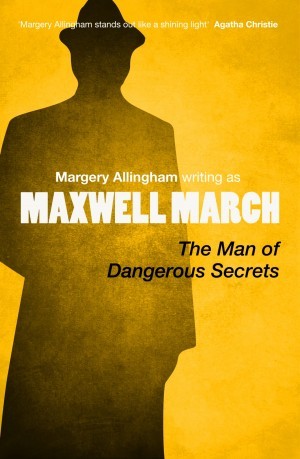
Margery Allingham writing as Maxwell March: The Man of Dangerous Secrets

Margery Allingham is probably one of the best known of the Golden Age crime authors but I’d had no idea that she had also written several thrillers under the name of Maxwell March until I came across this one, recently reissued along with two others by Ipso Books. I didn’t know what to expect from it, but I’m pleased to say that I thoroughly enjoyed it – and I’m sure Margery Allingham must have enjoyed writing it too!

Originally published in 1933 as Other Man’s Danger, the novel opens by introducing us to Robin Grey, the ‘man of dangerous secrets’, a detective who holds an unofficial position with the government. On a secret mission for the Foreign Office at Waterloo Station late one night, he witnesses a young man being pushed onto the tracks and manages to save him. The next day, he is visited by Jennifer Fern, the victim’s girlfriend, who begs him to look into the murder attempt as her previous two fiancés had died under suspicious circumstances and she’s sure it can’t possibly be a coincidence. Jennifer suggests that she and Robin pretend to be engaged and then wait for the unseen enemy to make the next move, but will Robin agree to this – and if so, what will happen?

The story then becomes more and more exciting and convoluted, so I’m not going to say anything else about the plot…except that it includes all of the following: murder, blackmail, kidnappings and car chases; hidden documents, clever disguises and secret conspiracies; a beautiful heiress, a sinister doctor and an escaped prisoner. I suppose you couldn’t describe it as great literature, but it’s certainly great fun to read, with a similar feel to Agatha Christie’s thriller They Came to Baghdad. It’s a real page-turner and I wished I hadn’t started reading it during a busy working week, as I think it would have been better read in one or two large chunks.

There’s not much in the way of character development, but I think that’s often the case with this sort of book. Robin is potentially an interesting character, but I couldn’t help thinking he was a bit careless for a man in a position of such responsibility. He’s too trusting, too quick to confide in people, gets himself into some dangerous situations which I felt could have been avoided and allows his judgement to be clouded by his feelings for a certain young woman…as his colleague Inspector Whybrow says, “I’ve never known a detective yet who could do his work when he was in love”.

As for the mystery itself, we are given enough hints to guess at least part of the solution, although the identity of the criminal mastermind is not as easy to work out. The final revelations are not very plausible and I couldn’t believe that the criminal could really have done what he/she is described as doing (sorry for being vague) but considering the tone of the rest of the novel I hadn’t really expected a realistic ending anyway!

This was a quick, entertaining and highly enjoyable read. The Albert Campion mysteries must have been the books Allingham really wanted to write, but I’m still sorry that she only wrote three as Maxwell March. I will definitely be reading the other two, Rogues’ Holiday and The Devil and Her Son.

Thanks to Ipso Books for providing a copy of this book for review via NetGalley.

This is book #4 for the R.I.P XII challenge.

Queens of the Conquest by Alison Weir

In Alison Weir’s new non-fiction book, Queens of the Conquest, she explores the lives of the five queens of England who followed the Norman Conquest of 1066. These five, in the order they appear in the book, are Matilda of Flanders (wife of William the Conqueror), Matilda of Scotland and Adeliza of Louvain (the two wives of Henry I), Matilda of Boulogne (wife of King Stephen), and the Empress Maud, Henry I’s daughter, who was never actually crowned but called herself Lady of the English. Lots of Matildas, then – Maud is also referred to in many sources as Matilda – but with each queen discussed chronologically (apart from where their stories overlap), things aren’t as confusing as you might imagine!

Apart from Maud, whom I have read about several times in fiction, I knew very little about the other queens whose stories are covered in this book. Considering the general lack of information available to us today – we don’t even have a clear idea of what these women looked like due to the absence of contemporary portraits – I think Weir still does a good job of providing as full and comprehensive an account of each queen’s life as she possibly could. There is inevitably a lot of padding – facts about medieval life, descriptions of castles and long passages quoted from letters – but if you don’t know a lot about the period, most of this should still be of interest.

I can’t really comment on the historical accuracy of this book as my own knowledge is very limited, but Weir does provide references to back up most of what she says. In fact, the additional material which includes the references, sources, maps etc takes up about a quarter of the book! There are still times, though, when she is forced to speculate and make assumptions about how one of the queens may have felt or behaved, and resorts to using words like ‘probably’ or ‘possibly’. Usually I prefer more certainty when I’m reading non-fiction, but in this case, I do understand that with the primary sources being so sparse, some guesswork was necessary to round out the characters of the queens and to make this into an entertaining read rather than a dry textbook.

15th century depiction of the Empress Matilda/Maud

The most enjoyable part of the book for me was the section describing the period of civil war known as the Anarchy during which Maud (who was named as her father Henry I’s heir) and Matilda of Boulogne (whose husband, Stephen, was Henry I’s nephew and another claimant to the throne) found themselves on opposite sides. As I’ve read several novels which have this period as a setting, it was good to read a factual account this time instead of a fictional one, while still recognising some of the most interesting episodes, such as Maud’s escape in the snow from the besieged Oxford Castle.

Maud certainly didn’t seem to have made herself very popular, having a reputation for being proud, haughty and arrogant, but I have always assumed that this was probably due to the prejudice of the male chroniclers of the time against a female ruler who didn’t behave the way they expected a woman to behave. Weir points out that Matilda of Boulogne often acted in a similar way but her actions were seen as acceptable because she was taking them on behalf of her husband, King Stephen, rather than for herself, but she also suggests that Maud’s overbearing attitude and poor decision-making may have been due to mood swings caused by early menopause or a long-term illness she suffered following childbirth. This was the one place where I thought there may have been some bias creeping in, as Weir clearly seems to like Matilda of Boulogne much more than the Empress – and I couldn’t help wondering what caused the aggression and lack of judgement of some of the kings mentioned in the book!

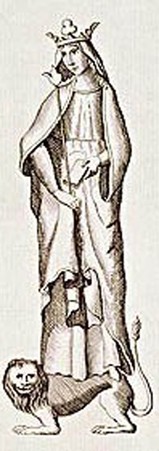
18th-century impression of Matilda of Flanders

I was also interested to read the various theories and legends behind Matilda of Flanders’ marriage to William the Conqueror and the controversies surrounding Matilda of Scotland’s marriage to Henry I (she had previously spent some time in a convent so it was debatable whether or not she was free to marry). I felt that I learned very little about Adeliza, though; while she is described as being particularly beautiful and helping to promote the arts, it seemed that she had less power and political significance than the other queens.

Although I sometimes felt that too much time was devoted to the general history of the period when I would have preferred more analysis of the specific lives and characters of the five queens, I did find Queens of the Conquest a fascinating read. Apparently this is just the first of four volumes which will take us through the rest of the medieval queens to the end of the Wars of the Roses. I will be looking out for the next one.

Thanks to the publisher for providing a copy of this book for review via NetGalley.