Death in Bordeaux by Allan Massie

As some of you may know, I am currently working my way through all of the titles shortlisted for the Walter Scott Prize for Historical Fiction since the prize began in 2010. Allan Massie’s End Games in Bordeaux appeared on the 2016 list, but on discovering that it was the final book in a series of four, I was faced with a dilemma: should I just read the book that I needed to read for the prize or should I do as I usually prefer to do and start from the beginning of the series? In the end I decided to at least try the first book, Death in Bordeaux, in the hope that I would enjoy it enough to want to read the other three anyway.

The novel opens in Bordeaux in March 1940, with Superintendent Jean Lannes investigating the death of an old friend, Gaston Chambolley, whose mutilated body has been found in a street near the railway station. Gaston was homosexual and Lannes’s superiors are happy to assume that this was some sort of sex crime, but Lannes himself is sure there must be another explanation. The dead man’s sister-in-law has gone missing after becoming caught up in the political intrigue surrounding the Spanish Civil War, but as soon as Lannes suggests that her disappearance could be linked in some way with Gaston’s murder, he is ordered to drop his investigations immediately. Lannes, however, knows that he won’t be able to rest until he finds out who killed his friend and why.

In a seemingly unrelated case, he is also called in to help the elderly Comte de Grimaud identify the sender of some threatening letters he has received. As he gets to know the various members of the Comte’s dysfunctional family, Lannes begins to uncover some links with the other case he is working on – and that is all I will say about the plot, as it quickly becomes quite complex and I couldn’t go any further without spoiling the story.

All of this unfolds during the early stages of World War II – a period in which, at first, very little seems to be happening despite France having declared war on Germany. Soon, though, France becomes occupied, refugees from Paris begin to arrive in Bordeaux, and Lannes and his wife become increasingly afraid for their eldest son, Dominique, who is at the Front. While the author does provide a lot of historical detail, describing the major events and political decisions, and setting the story in its context, the focus is always on how the war is affecting the lives of our main characters: Lannes’ wife, Marguerite, writes letters to Dominique which she knows she’ll never send; their younger children, Alain and Clothilde, try to decide how they feel about the occupation of their country; and Alain’s new Jewish friend, Léon, wonders for how much longer he will be safe in France.

By the end of the novel, the war is still in progress and the personal stories of the characters mentioned above (and many others) have not been resolved. I believe that in the next book in the series, Dark Summer in Bordeaux, we rejoin some of the characters introduced in this one, so for that reason I’m glad I decided to start at the beginning. I can’t say that I loved this book – I found it slow and a bit too drawn out in places and it didn’t really work for me as a murder mystery. As a portrayal of life in Occupied France, though, it is an interesting, quietly atmospheric read. I liked it enough to want to continue with the second novel – and hopefully then the third and the fourth.

This is Book #3 for the R.I.P. XII challenge.

Red Sky at Noon by Simon Sebag Montefiore

This is the third in Simon Sebag Montefiore’s Moscow trilogy. I have read the second one, One Night in Winter, but not the first, Sashenka; the books are only loosely connected and it’s not essential to read all three in order. Montefiore is better known as a historian and writer of non-fiction, but these three books are fictional – although based on real events from Russian history.

Red Sky at Noon tells the story of Benya Golden, a Jewish writer and former teacher who, in 1940, is given the death sentence for “terrorism, conspiracy to murder Comrades Stalin, Molotov, Kaganovich and Satinov, and membership of a counter-revolutionary Trotskyite group”. At the last minute Benya is given a reprieve and instead of being executed he is exiled to the Gulag of Kolyma and sentenced to ten years’ hard labour in the gold mines. Life in the camp is harsh and miserable, so when a chance comes two years later to join a penal battalion (a shtrafbat) formed to fight the Germans, Benya is quick to volunteer. The reward will be the opportunity to win redemption by the shedding of blood – either his own or the enemy’s.

The rest of the novel follows the adventures of Benya, his beloved horse Silver Socks and the assorted group of murderers, Cossack gangsters and fellow political prisoners who fight alongside him in the Soviet cavalry. Together they undertake dangerous missions behind enemy lines, facing death, capture or betrayal – or all three – and for Benya, there is also a romance when he meets a widowed Italian nurse, Fabiana. Of course, with Russia and Italy on opposite sides of the war, it’s clear from the beginning that their love affair is unlikely to run smoothly.

With so much happening and with such an action-packed plot and interesting historical setting, this could have been a wonderful novel, filled with drama, romance and excitement. However, I think Montefiore is probably a better historian than he is a novelist; although I have no doubts that he knows his Russian history, he never quite managed to bring the characters and events in this novel to life. The dialogue didn’t feel entirely convincing and there were only a few moments in the whole book when I felt any real emotional connection to Benya or the other characters, despite the horrors of war that were being described. I remember having similar thoughts about One Night in Winter, which was a more enjoyable novel in my opinion, but another one which made little emotional impact.

I haven’t mentioned yet that there is another thread to the novel, involving Svetlana Stalina. As Stalin’s daughter, sixteen-year-old Svetlana is a lonely and isolated figure, who has experienced little in the way of love and friendship as people are afraid to get too close because of who her father is. Svetlana’s story doesn’t really have anything to do with Benya’s, but it offers insights into life in the Stalin household and does add another layer to the novel.

I’m not sure if I would want to read more of Montefiore’s fiction – although Sashenka does still sound tempting – but I’m curious to know what his non-fiction is like. Has anyone read any of it?

As Chimney Sweepers Come to Dust by Alan Bradley

In this, the seventh book in Alan Bradley’s Flavia de Luce series, our twelve-year-old detective is sent away to boarding school in 1950s Canada, having been banished from her family home at the end of the previous novel. If you have never read a Flavia mystery before, this is probably not the best place to start; I would recommend reading at least a few of the earlier ones first, particularly the sixth, The Dead in Their Vaulted Arches, so that you will understand the reasons for her banishment and the choice of this particular Canadian school.

Anyway, back to As Chimney Sweepers Come to Dust. Almost as soon as Flavia arrives at Miss Bodycote’s Female Academy in Toronto, she stumbles upon yet another dead body – or rather, this one stumbles upon Flavia when it falls down the chimney in her room, having been dislodged by another girl who has climbed up to hide from a teacher. Why is there a dead body up the chimney? Who is it? Could it be one of the three missing girls who have all disappeared from the Academy over the last year or two? Flavia doesn’t know, but she’s determined to find out!

This is the first book in the series not to be set at Buckshaw, the de Luce ancestral home in the English village of Bishop’s Lacey. I have always found the setting to be part of the charm of these books, so although it was nice to have a change, I did find myself missing Father, Feely, Daffy, Dogger and everyone else from Buckshaw. There are plenty of new characters in this book to take their places – including an enigmatic and intimidating headmistress and a chemistry teacher who has been on trial for murder – but none of them felt as well drawn as the characters in the previous novels.

Still, I always enjoy a school setting because it brings back memories of the school stories I loved as a child, such as Enid Blyton’s Malory Towers and St Clare’s books. Maybe Alan Bradley liked that sort of story too and wanted an opportunity to write one of his own; otherwise I’m not sure I really see the point in moving Flavia out of her usual setting. I had expected the storyline involving the Nide, which was introduced in the last book, to be advanced in this one, but actually we learn very little more about it – and what we do learn just made me more confused!

I was pleased to find that this book had a much stronger mystery element than the previous one and although some parts of the mystery didn’t feel fully resolved at the end, it was nice to see Flavia back to making her lists of suspects and searching for clues. Finally, don’t Alan Bradley’s books have great titles? This one is taken from Shakespeare’s Cymbeline: “Golden lads and girls all must, As chimney-sweepers, come to dust”. The title of the next one, Thrice the Brinded Cat Hath Mew’d, is also Shakespeare-inspired. I’m looking forward to reading it – despite not liking the last two books as much as the earlier ones, I do still enjoy spending time with Flavia!

This is Book #2 for my R.I.P. XII challenge.

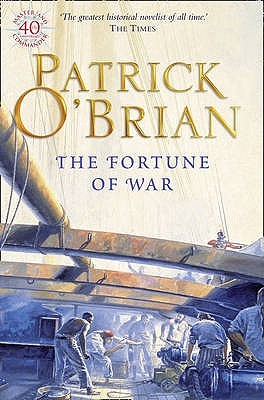
The Fortune of War by Patrick O’Brian

This is book number six in Patrick O’Brian’s Aubrey/Maturin series. I enjoyed the previous one so much I thought it would be a difficult act to follow, but I actually found this one just as good – and maybe even better. If you haven’t yet had the pleasure of meeting Captain Jack Aubrey and Dr Stephen Maturin, I would recommend beginning with the first of the series, Master and Commander, and saving this review until you’ve caught up; otherwise, although I have tried to avoid too many spoilers in this post, you may come across something you would prefer not to know just yet.

The Fortune of War picks up the story shortly after Desolation Island ended. With his ship HMS Leopard declared unfit, Jack receives orders to return to England to take command of a forty-gun frigate, the Acasta. He and Stephen Maturin, accompanied by several other members of the crew, begin the long journey home as passengers on the courier ship La Flèche. Early in the voyage, however, they learn that war has broken out between Britain and America – the War of 1812 – and following a series of disasters, they are taken prisoner and find themselves brought to Boston, which is now enemy territory. At first, despite being wounded in the arm, Jack is not too worried; he’s sure there will be an exchange of prisoners soon and then they can be on their way again. The Americans, though, are convinced that there had been a spy on board the Leopard and are not about to let their suspects escape so easily!

I really enjoyed this book, after an initial panic where I found I couldn’t remember what happened at the end of Desolation Island. I think I need to stop leaving such long gaps between books! Luckily, though, Jack gives a recap to the Admiral in the first chapter and this serves as a reminder for the reader too. Once I settled back into the flow of the story, I loved it, particularly the parts of the novel set in Boston where Stephen’s spying activities come to the forefront. This leads to exciting scenes which are different from anything we’ve read in the series so far.

Stephen also has his long-awaited reunion with Diana Villiers, the woman he loves and who broke his heart at the end of HMS Surprise – but Diana has changed and it seems that his own feelings for her have changed too. Despite his disillusionment I found Diana much easier to like in this book than I did in the earlier ones, although with so much still unresolved by the end, I was left wondering whether they will find any happiness in the next book or whether their relationship will continue down its tempestuous path.

I have stopped worrying about the nautical terminology in these novels. I appreciate the authenticity O’Brian brings to the naval scenes, the level of his research and of course, his writing ability, but I know I’m never going to be able to follow everything that is happening; as long as I can understand the outcome of each battle or manoeuvre I’m happy! I think this must be the first book in the series where Jack has not actually had a ship of his own to command, but he and Stephen still manage to get caught up in two naval actions, both of which are closely based on real events from the War of 1812.

The next book in the series is The Surgeon’s Mate and based on the quality of the last two books I’m really looking forward to it.

Hamlet, Revenge! by Michael Innes

My first experience of Michael Innes’ writing came earlier this year when I read one of his short stories in the British Library Crime Classics anthology, Miraculous Mysteries. I knew I wanted to read more of his work, so I was was delighted to have an opportunity to read Hamlet, Revenge! via NetGalley.

Published in 1937, this is the second in his series of detective novels featuring Inspector John Appleby. However, Appleby doesn’t appear until the second section of the novel – the first part is devoted to setting the scene and introducing the very large cast of characters. As with many Golden Age mysteries, the action takes place in an English country house – in this case, Scamnum Court, which has been home to the Dukes of Horton for centuries. The novel opens with friends and acquaintances of the family beginning to arrive at Scamnum to take part in an amateur production of Shakespeare’s Hamlet. When one of the guests is murdered during the performance, Appleby is called in to investigate.

This is a wonderfully complex mystery, even more so because Appleby doesn’t know exactly what type of crime has been committed. The murdered man was an important statesman whose death could have serious implications for the government, giving rise to fears that spies are operating at Scamnum Court. On the other hand, a series of revenge-themed messages received by the victim and several other guests indicate that this could be a crime of a more personal nature.

Mild curiosity ran round the table.

‘Yes. I had a telegram at the House just before coming down here. Just two words.’

This time Lord Auldearn spoke: ‘Two words?’

‘Hamlet, revenge!’

With a long list of potential suspects – we are told that there are more than thirty people involved in the play in some way – Appleby is kept busy trying to establish alibis and uncover motives, while avoiding the red herrings that are thrown in his way.

After a slightly overwhelming start (due to the number of characters and the detailed background information on Scamnum Court), once Appleby arrives on the scene and begins his inquiries the pace picks up and the story becomes quite gripping. It’s the sort of mystery I love: one with plenty of clues and several possible solutions – although of course only one is correct, and we have to wait until the end of the novel before everything is revealed. It’s also a very erudite and literary mystery; as well as lots of discussion and analysis of Hamlet, there are also a number of other literary allusions and references. If you know your Shakespeare you will probably get more out of the novel, but if not, don’t worry as it isn’t completely essential.

Although this is described as an Appleby novel, much of the story is actually written from the perspective of one of the other characters, Giles Gott, an academic who also writes crime novels under a pseudonym. As Michael Innes himself is a pseudonym (he also wrote using his real name of J.I.M. Stewart), I wondered whether Gott was a way for Innes to project some of his own personality into the story. There seems to be a previous friendship between the characters of Appleby and Gott, whom I have found out also appears in the first book in the series which I haven’t read yet; I don’t know whether he is in any of the others.

I really enjoyed Hamlet, Revenge! and am looking forward to reading more by Michael Innes.

This is book #1 for the R.I.P XII challenge.

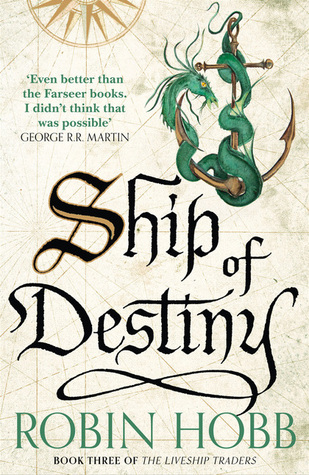
Ship of Destiny by Robin Hobb

This, the third of Robin Hobb’s Liveship Traders novels, brings the trilogy to an exciting and satisfying conclusion. Having become quite attached to the characters and swept away by the story over the course of the three novels, I’m sorry to have come to the end – but I have to admit, I’m also happy that I’ve finished and can now move on to the Tawny Man books and rejoin old friends from Hobb’s Farseer trilogy. First, though, I need to post my thoughts on Ship of Destiny – and as this is a trilogy which really needs to be read in order, I can’t avoid spoiling elements of the previous two books here; if you think you might want to read them I would recommend going no further with this review until you’ve read both Ship of Magic and The Mad Ship.

Ship of Destiny picks up each of the trilogy’s many storylines from where they left off at the end of The Mad Ship. For much of the novel, our main characters are divided into small groups, each having separate adventures of their own, until fate eventually brings them together in a dramatic sequence of events which brings The Liveship Traders to a close.

First of all, there’s Malta, who has escaped from the aftermath of the earthquake in Trehaug and has found herself sailing down the hazardous Rain Wild River in the company of the childish and petulant Satrap of Jamaillia. Malta’s betrothed, Reyn Khuprus, is desperately searching for her, with the reluctant help of Tintaglia the dragon. Newly released from her cocoon, Tintaglia would prefer to be getting down to more important business, such as saving her species from extinction.

On board the liveship Paragon, Althea Vestrit, Brashen Trell and Amber the wood-carver are getting closer and closer to the Vivacia, the Vestrit family liveship which Althea has her heart set on reclaiming. But Vivacia has already bonded with her new captain, the pirate Kennit, and with Althea’s nephew Wintrow; Althea could be facing disappointment when she finally catches up with her beloved ship. Meanwhile, Ronica and Keffria are trying to rebuild and reform Bingtown following the Chalcedean invasion – but for this they will need the cooperation of Serilla, the Satrap’s Companion, whose priority seems to be to obtain power for herself.

When I wrote about The Mad Ship a few weeks ago, I mentioned that I was particularly intrigued by Amber, as she made me think of another character from the Farseer trilogy. That character, of course, is the Fool, and I was pleased to find that my suspicions were confirmed in this book. Amber recarves Paragon’s figurehead to resemble Fitz, there are discussions of destiny, and there are exchanges like this:

“You’d have to be a fool to think you could change the course of the whole world.”

She was silent until she broke out in a shaky laugh. “Oh, Paragon, in that you are more right than you know, my friend.”

Other characters continued to interest me too, particularly Malta. Who would have thought the annoying, selfish girl we met in the first book would mature so quickly and turn out to be such a shrewd negotiator? Kennit, on the other hand, goes from being a complex and strangely sympathetic character to a villain whose treatment of Althea and Paragon made me lose all respect for him – although I did find his final scenes in the book quite moving.

On reaching the end of The Liveship Traders, I didn’t feel as bereft as at the end of The Farseer trilogy, which I think is partly because, while there were plenty of characters I liked and cared about, I never felt as close to any of them as I did to Fitz. I was less emotionally involved with this trilogy, but I did still thoroughly enjoy it; I loved the world Robin Hobb created here and I was impressed by her ability to handle multiple storylines and keep track of who knows what! Also, as someone who doesn’t read a lot of fantasy, I found the dragon element fascinating, which is probably fortunate as if I’m going to continue working through Hobb’s novels I will eventually need to read The Rain Wild Chronicles which, judging by the titles, sound very dragon-heavy! First, though, I’m looking forward to the Tawny Man trilogy – I have my copy of the first book, Fool’s Errand, ready and waiting…

Leopard at the Door by Jennifer McVeigh

This is the first book I’ve read by Jennifer McVeigh, although I do remember hearing good things about her first novel, The Fever Tree. This latest one, Leopard at the Door, sounded appealing too – and I did like it, although it was a much darker novel than I’d been expecting!

The novel opens in 1952 with our narrator, Rachel Fullsmith, arriving in Kenya after an absence of six years. Rachel was born to British parents but spent her childhood in Kenya until, after losing her mother at the age of twelve, she was sent to England to live with her grandparents. Now, as an eighteen-year-old, she is returning to the place she still considers to be home, only to find that everything has changed…and not in a good way.

Trouble is brewing in Kenya, with unrest threatening to spill over into violence as the group known as Mau Mau begin to rebel against British rule. Rachel has fond memories of her friendships with the Kikuyu people and at first she isn’t too worried, but with increasing reports of oaths being sworn to the Mau Mau and attacks on both Europeans and on Kikuyu who try to resist the movement, she realises how serious the situation is. The Fullsmith farmhouse is not a safe haven either, though; Rachel’s father has a new partner, Sara, who makes no secret of her contempt for the ‘natives’ and who can barely hide her hostility towards Rachel. Turning to her childhood tutor, Michael, for support, Rachel is glad that she still has one true friend left – but, as a Kenyan, Michael is torn between helping the cause of his own people and loyalty to the white people he has lived and worked with for so many years.

The Mau Mau Uprising of 1952 played a significant part in Kenya’s history, but although I had heard of it, I really knew nothing about it – the events leading up to it or what the rebellion itself involved – until reading this book. As you can probably imagine, it’s not pleasant to read about; although the cover may look light and romantic, the story is anything but. This was a harsh and violent time, with people killed for refusing to swear an oath and men, women and children murdered in their own homes or hacked to death with pangas (and I should warn you that there are also some graphic descriptions of the slaughter of animals). The characters in the novel provide us with a range of views and attitudes, from Sara’s racism and prejudice to Rachel’s horror at the brutality but desire to understand. As someone with no prior knowledge of the rebellion, I thought the author did an excellent job of explaining what happened and why, and of trying to show both sides of the story.

Rachel’s personal story is interesting too and again it’s quite dark. When she first returns to Kenya she is full of excitement and nostalgia, but she quickly has to reconcile her happy memories with the reality of the present day – with the violence surrounding her, the distance between herself and her father, and her struggle to find any common ground with Sara. Some horrible things happen to Rachel over the course of the novel, particularly near the end, but she does still have some moments of happiness; she also has a love interest, although I didn’t find their romance very convincing and I felt that this was the one element that let the book down.

Jennifer McVeigh writes beautifully about Kenya, bringing to life the vast landscape, the heat of the sun, the animals and birds. There is a lot to enjoy in this novel even if, due to the subject, it’s not always the easiest of reads. It reminded me at times of Dinah Jefferies’ The Separation, which is about a similar uprising in Malaya, so if you have read that novel I would recommend trying this one too.

Thanks to the publisher for providing a copy of this book for review via NetGalley.