Human Croquet by Kate Atkinson

Having read Kate Atkinson’s two most recent books, Life After Life and A God in Ruins, as well as some of her Jackson Brodie mysteries, I’ve been curious about her earlier novels and was pleased to see this one from 1997 on the library shelf. I knew nothing about this novel before I started to read it and I think that was a good thing because this is a story packed with surprises, plot twists and weird and wonderful occurrences. I have done my best here to give you an idea of what the book is about without giving too much away.
Human Croquet Human Croquet is narrated by sixteen-year-old Isobel Fairfax who lives with her family in a house called Arden in a small town somewhere in the north of England. Isobel’s family consists of her brother, Charles, their Aunt Vinny, and their father Gordon, who has recently returned after a long absence, bringing with him a new wife, Debbie. Gordon’s first wife, Eliza – mother of Isobel and Charles – disappeared years ago, although her presence at Arden can still be felt in small and unexpected ways. Throughout the novel we move between the Present (Isobel’s life in the 1960s) and the Past (in which we learn more about the early days of Gordon’s marriage to Eliza and the events leading up to her disappearance).

Now, this might all sound quite straightforward so far, but I’ve promised some surprises, plot twists and weird and wonderful occurrences – and yes, there are plenty of those! One of the first indications we get that something is not right in Isobel’s world comes when she finds herself suddenly slipping through time, briefly emerging in another period before just as suddenly returning to her own time. Charles, who is obsessed with the paranormal, is envious, telling her she must have experienced a time warp. But this is only the beginning of a series of increasingly bizarre things which happen to Isobel and her family. Things also become darker and darker as Isobel tries to make sense of what is going on and the truth about Eliza is slowly revealed.

Human Croquet is a wonderfully creative and imaginative story in which Atkinson plays with time and with our perceptions of what is real and what is unreal. The novel is rich in literary references and allusions; the name of Isobel’s home, Arden, brings to mind the Forest of Arden in Shakespeare’s As You Like It, and both the Shakespearean theme and the forest/tree symbolism continue throughout the book. Even the title, Human Croquet, has a meaning which only really becomes clear right at the end of the novel and which made me think again about Isobel’s role in the story.

My favourite thing, though, about this – and all of Atkinson’s books – is the characterisation. Isobel’s narrative voice is very strong and distinctive, sometimes funny, sometimes sad, and peppered with witty observations, self-deprecating humour and clever wordplay. Through Isobel’s eyes the rest of the Fairfax family, as well as their friends and neighbours, come to life in vivid detail. Among the most memorable are the people next door, timid Mrs Baxter and her daughter Audrey, both of whom live in fear of the sinister ‘Daddy’. The Fairfaxes are not the only troubled family in Human Croquet; this is definitely not a happy story, so I was pleased to find that there are some lighter moments to alleviate the darkness.

I haven’t read anything by Kate Atkinson yet that hasn’t impressed me; I’m looking forward to reading the rest of her earlier books, as well as Started Early, Took My Dog, the only Jackson Brodie novel I haven’t read yet. What is your favourite Kate Atkinson book?
Some Luck by Jane Smiley

Some Luck This is the first volume of a trilogy following the lives of the Langdon family across a period of a century. Beginning in 1920 and ending in 2020 (although Some Luck only takes us up to 1953), we will get to know several generations of the family over the course of the three novels, watching as the children grow up, get married and have children of their own, sharing their hopes and dreams, and accompanying them through some of the events which shaped the last one hundred years of American history.

At the heart of the story are Walter and Rosanna Langdon, a young married couple who, as the novel opens, are settling into life on the farm they have recently bought in Iowa. Rosanna has just given birth to their first child, Frank, and in the first few chapters, not only do we see things through the eyes of the two adults, but also through the baby’s, to whom everything in the world is new and strange. As the years go by, four more sons and daughters follow: quiet, gentle, animal-loving Joey; the sweet and angelic Lillian; Henry, who loves reading; and Claire, the youngest and her father’s favourite. Frank himself is handsome, clever and adventurous – and the contrast between his personality and Joey’s adds an interesting angle to the dynamics of the Langdon family.

The novel is carefully structured so that each chapter is devoted to one year and this keeps the story moving forward at a steady pace. However, it also gives the book an episodic feel; each time a new chapter begins and we find that we’ve jumped straight into the following year, there’s a sense that there are some gaps in the story and that things may have changed without our knowledge in a way that wouldn’t happen with a more fluent narrative. Also, as is true in all of our lives, some years are more eventful than others, which means that some chapters are more interesting than others.

Really, though, this is not a book you would choose to pick up if you were looking for a thrilling, action-packed read. Some Luck is a quiet, low-key story about ordinary people leading ordinary lives. Much of the novel is concerned with farming and all it involves: planting and harvesting crops, shearing sheep, trying to cope with summer droughts and winter snowdrifts. It reminded me in this respect of other farm-based novels I’ve read – Willa Cather’s My Antonia and, of course, Little House on the Prairie.

There are some dramas in the lives of the Langdons, but they are relatively small ones – the sort of things that could happen to any of us. Historical events are experienced mainly as the effects filter through to their remote Iowa farm – advances in farming methods, such as the replacement of horses with tractors, cause a lot of excitement and controversy – but occasionally a family member decides to leave the farm and see more of the world. Frank enlists in the army during the Second World War and is sent to North Africa, Rosanna’s sister Eloise moves to Chicago and marries a communist, and Lillian…well, I won’t say too much about what Lillian does except that it’s the one thing I found hard to believe.

Some Luck is the first book I have read by Jane Smiley. I’m aware that A Thousand Acres was her Pulitzer Prize-winning novel and might have been a better choice for me to start with, but I did still enjoy this one and am planning to continue with the trilogy soon. I have the next two books – Early Warning and Golden Age – ready to read.

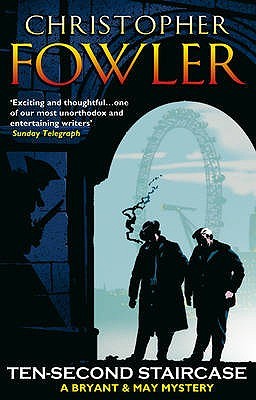
Ten-Second Staircase by Christopher Fowler

What a wonderful imagination Christopher Fowler has! This fourth novel in the Bryant and May mystery series involves the bizarre deaths of several minor celebrities, a mysterious highwayman complete with horse, cape and tricorn hat, gangs of feuding schoolchildren and a possible link to the Knights Templar. It’s just the sort of case the Peculiar Crimes Unit was created to deal with, and this is one of the most peculiar yet.

Ten Second Staircase As the novel opens, we learn that yet again the PCU is facing the threat of closure, with Bryant and May’s outdated methods of detection coming under attack. Bryant and May – Arthur and John – are the two elderly detectives around whom the rest of the unit revolves. John May is logical, methodical and more open to modern technology, but his partner prefers to rely on his tried-and-tested network of historians, clairvoyants, witches and psychics. Their different personalities and different approaches to crime-solving are the reasons why the two of them have had so much success over the years, right from the very first case they worked on together during the Second World War (described in Full Dark House). Among the successes, however, there has been one failure: the identity of the serial killer known as the Leicester Square Vampire, which has remained unknown since the 1970s.

Bryant and May’s latest mystery begins when a controversial modern artist is drowned in the display case of one of her own art installations. The only witness is Luke Tripp, a twelve-year-boy from nearby St Crispin’s Boys’ School, who claims to have seen a figure resembling Dick Turpin ride into the gallery on horseback and throw the artist into the tank. No sooner have the detectives begun to investigate than the Highwayman strikes again, his second murder as strange and inexplicable as the first. As Bryant and May dig deeper, they uncover some similarities between the Highwayman and the Vampire; if only they can find a way to solve both mysteries at once, the future of the PCU could be secured.

I enjoyed Ten-Second Staircase as I’ve enjoyed all of the previous books in this series, but this is probably my least favourite of the four. The Peculiar Crimes Unit seems to have been facing closure in every book so far and that aspect of the story is starting to feel repetitive, especially as with another nine (at least) books to follow, it was obvious that it would be allowed to stay open. I also couldn’t help feeling that the author was using Bryant and May in this book to voice his own views and opinions on society; this meant that the dialogue sometimes felt more like a lecture rather than a natural conversation between friends.

The things that I did love in this book were the same things I loved in the first three: the unusual and imaginative mystery (which, as usual, I failed to solve), Arthur’s unorthodox detection methods, and the fascinating historical facts and pieces of trivia which are incorporated into the plot. The real attraction of this series, of course, is the partnership of Bryant and May themselves, but we do get to know other members of the PCU as well and some of these characters are developed further in this novel, particularly May’s agoraphobic granddaughter, April, who I’m sure we’ll see more of in future books.

I’ll be continuing soon with book number five, White Corridor!

The Lion and the Cross by Joan Lesley Hamilton

The Lion and the Cross If you’re looking for the perfect book to read as St Patrick’s Day approaches, this could be it. Originally published in 1979, The Lion and the Cross: A Novel of Saint Patrick and Ancient Ireland has recently been made available as an ebook by Open Road Media. Narrated by Patrick himself, it is a fictional account of the life of the man who would become Ireland’s patron saint.

The story takes place in the 5th century, a time of unrest and uncertainty as the period of Roman rule in Britain has come to an end, leaving the country vulnerable to attacks from raiders. As the novel opens in the year 410, Magonus Sucatus Patricius, son of wealthy Romano-Britons, is sixteen years old. Despite being the grandson of Potitus the priest, Magonus himself has no intention of devoting his life to religion, but this is something which will slowly change. The first big turning point in Magonus’s life comes when he is captured by barbarian raiders who take him across the sea to Ireland where he is sold into slavery.

Now known as Padraic, or Patrick, he spends the next few years herding sheep in the Irish countryside and – after catching the attention of the Ri and Rigan (king and queen) – trying to survive the intrigues and machinations of the court. During this time his faith strengthens and when he eventually manages to escape from his captivity and from Ireland, Patrick must make the decision whether to one day return and convert the people to Christianity.

In The Lion and the Cross, Joan Lesley Hamilton has drawn on a variety of sources including The Confession of St Patrick, Irish mythology and historical fact to recreate the story of Patrick’s life. As she states in her author’s note, this period of history is ‘obscured by the roiling, silent fog of centuries’ and there are many things we don’t know about Patrick and his world; however, I think Hamilton does a good job of working with what little information is available and finding the right balance between fact and fiction.

The praise at the front of this book compares it to Mary Stewart’s Merlin trilogy, which I have read and loved. Although they are very different stories, I can understand the comparison; like Stewart’s The Crystal Cave, The Lion and the Cross is set shortly after the decline of the Roman Empire, it is narrated by a young male protagonist and it has a slightly magical feel (the first chapter deals with Patrick’s meeting with the Morrighan, a legendary Celtic goddess). The writing is quite beautiful and poetic at times, but let down by the dialogue – some of the characters speak with Irish accents which, to me, don’t sound at all right.

Patrick himself is not the easiest of characters to like. He is a stubborn, arrogant and defiant young man and because of this, despite the ordeals he goes through, I sometimes found him difficult to connect with. Patrick’s personality, though, is an important part of the story; it’s the reason he’s able to survive and to accomplish what he does, and it explains his internal struggles with God and the doubts he has to overcome. I did enjoy learning about Patrick and his life, but the religious element of the novel is very strong (as you would expect from a book about a saint) and I think the ideal reader for this book would be someone with a particular interest in religious history.

Thanks to the publisher for providing a copy of this book for review.

The Butcher’s Hook by Janet Ellis

The Butchers Hook Life is not easy for Anne Jaccob, the young protagonist (more anti-heroine than heroine) of The Butcher’s Hook. Her mother is an invalid, her father is cold and distant, and she is struggling to warm to her new baby sister, who will never, ever take the place of the beloved little brother who died. The one bright spot in Anne’s life is her secret romance with Fub, the butcher’s apprentice, but even this is threatened when her father announces that he is arranging a marriage for her with the vile Simeon Onions. It seems that Anne is going to have to take matters into her own hands…

The Butcher’s Hook is the debut novel of Janet Ellis, who is probably best known for presenting the BBC’s long-running children’s show Blue Peter in the 1980s. It’s an unusual and imaginative story set in a Georgian London populated with colourful, larger-than-life characters. Many of them feel as though they could have stepped out of the pages of a Charles Dickens novel. There’s Titus Levener, the grotesquely fat butcher, and Dr Edwards, the sinister tutor who gives the young Anne an education she’ll never forget. There’s Angus, the Scottish soldier defeated in the recent Jacobite rising, who wanders the streets of London hungry, ragged and cold. And then, of course, there’s Anne.

From the beginning I was drawn into Anne’s world – the world of a lonely, confused young woman who has difficulty fitting in with the people around her. As the story progresses, Anne decides to take control of her life and shape her own destiny despite the obstacles which have been placed in her way. From this point on, things become very dark and twisted! I don’t want to say too much, but you need to be aware that you’ll be spending a lot of time in the company of a character who is seriously flawed and capable of the most horrifying things.

The Butcher’s Hook is an unsettling and atmospheric novel, with a plot that took me by surprise several times with its unexpected changes of direction. Based on this first effort, I’m sure Janet Ellis can look forward to a successful new career as a writer. To think that I nearly didn’t read it because I’m a vegetarian and found the title off-putting! My only disappointment was that I thought the ending felt slightly unfinished, as if there was more of Anne’s story still to be told; I don’t know whether there will be a sequel, but if not I’ll be interested to see what Janet Ellis writes next.

I had the opportunity to read this book just before Christmas, but have been waiting to post my review here until after the UK release date – which was yesterday. Thanks to Lovereading for the review copy.

2016 Walter Scott Prize longlist announced

As some of you may know, I am in the process of slowly working my way through all the shortlisted titles for the Walter Scott Prize for Historical Fiction since it began in 2010. Historical fiction is my favourite genre and I have so far found the books nominated for this prize to be of a consistently high quality.

You can learn more about the prize on the Walter Scott Prize website and you can follow my progress through the shortlists on this page. Kay of What Me Read has already joined me in this project and if anyone else would like to do the same, you’re more than welcome.

Anyway, the reason I’m posting this today is that this year’s longlist has just been announced – with the shortlist to follow in March and the winner in June. I’m not currently planning to attempt to read the entire longlist, which includes thirteen books, but I would like to dip into the list from time to time and read at least some of them.

The thirteen books are as follows:

A God in Ruins A God in Ruins by Kate Atkinson
Sweet Caress by William Boyd
A Petrol Scented Spring by Ajay Close
A Place Called Winter by Patrick Gale
Dictator by Robert Harris
Devastation Road by Jason Hewitt
Death and Mr Pickwick by Stephen Jarvis
Mrs Engels by Gavin McCrea
End Games in Bordeaux by Allan Massie
Tightrope by Simon Mawer
Signs For Lost Children by Sarah Moss
Curtain Call by Anthony Quinn
Salt Creek by Lucy Treloar

The only one I have read so far is A God in Ruins, but I do have Dictator on hold at the library and can’t wait to read it. I have heard good things about Sweet Caress – and Death and Mr Pickwick sounds interesting, although I’m not sure if I should wait until I’ve read The Pickwick Papers first. Most of the others are new to me, so I have some investigating to do!

Have you read any of these books?

Renegade by Robyn Young

Renegade One of the reasons I love reading historical fiction is that it gives me an opportunity to learn about historical people and events that I might otherwise have gone through life knowing little or nothing about. I would probably never have thought of picking up a non-fiction book on Robert the Bruce, so I’m pleased to have been introduced to him in fictional form in this trilogy of novels by Robyn Young.

The first book, Insurrection, which I read in 2014 and loved, took us through Robert’s early years, explaining the origins of his claim to the Scottish throne, his family’s rivalries with the other contenders, the Balliols and the Comyns, and how he entered the service of Edward I of England after John Balliol was made King of Scotland. I immediately bought a copy of the second book, Renegade, so that I could find out how Robert’s story would continue, but I struggled to get into it and put the book aside until a few weeks ago, when I felt ready to have another attempt.

Renegade begins in the year 1300 with Robert Bruce in exile in Ireland, having betrayed the English and set his sights on taking the throne of Scotland. He intends to search for the Staff of St Malachy, one of four legendary relics, and use it to bargain with King Edward, but things don’t go according to plan and Robert is forced to take a different approach. Swearing loyalty to Edward again, Robert must convince the English that he has turned his back on Scotland once and for all…while secretly biding his time and waiting for a chance to launch his campaign for the Scottish crown.

I think my initial problem with this book was due to the fact that it opens with the search for the Staff of St Malachy and I tend to find ‘hunting for hidden relics’ stories quite tedious and over-used in historical fiction. However, once I got past the first few chapters this storyline was pushed into the background and I started to find the book much more enjoyable (although I still think Insurrection was the better of the two).

Robert himself is still not a character I particularly care for, which is maybe not surprising as his path to the throne is built around treachery and betrayal, but I did have sympathy for the position he found himself in and the difficult choices he had to make. I felt sorry for his friend, Humphrey de Bohun – one of the few characters in the trilogy that I do like – when it became obvious that he too was going to be deceived by Robert for a second time. As in the previous novel, the women in Robert’s life have only small roles to play, but I enjoyed the brief glimpses we are given of his wife, Elizabeth de Burgh, and daughter, Marjorie, and I was sorry that Robert seems to have so little time for them both. Isabel Comyn, Countess of Buchan, is another intriguing female character and I’m hoping we’ll find out what happens to her in the final novel – although I suspect it won’t be good.

Also in this book we learn the fate of William Wallace, who has been lying low since the Battle of Falkirk, trying to avoid being captured. Meanwhile, in England, the ageing King Edward is looking to his son – Edward, Prince of Wales – to carry on his work once he is gone, but the prince seems more interested in his friendship with Piers Gaveston and it is already obvious that he is not going to be the ruler or the military leader his father is. The period in which Renegade is set is a time of conflict and conquest, which means Robyn Young devotes a lot of pages to battles, sieges and ambushes. I’m not really a lover of battle scenes but these were easy enough to follow and understand, as well as being detailed and, as far as I could tell, quite accurate. I was interested to find that the trebuchet Warwolf which Edward is having built during the novel really existed and was used in the Siege of Stirling Castle just as Young describes in the book.

I’m now looking forward to reading the final part of the trilogy, Kingdom, and would like to do so as soon as possible, because Robyn Young has a new novel set in Renaissance Europe coming out later this year.