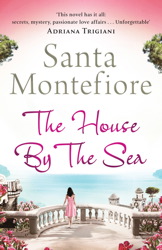
 The House by the Sea is the first book I’ve read by Santa Montefiore. The novel consists of two alternating stories, one set in present day England and the other in Italy several decades earlier. The Italian storyline begins in 1966 with Floriana, a ten-year-old girl who lives with her drunken father in a small village in Tuscany. Looking over the crumbling wall of a beautiful villa by the sea, Floriana comes face to face with seventeen-year-old Dante, whose parents own the house. Floriana dreams of one day marrying Dante and escaping from her lonely, miserable life but unfortunately things don’t go exactly as she planned.
In 2009 we meet Marina, a woman in her fifties who runs a hotel on the Devon coast. The hotel is in financial difficulties and in an attempt to save her struggling business, Marina advertises for an ‘artist-in-residence’ to spend the summer at the hotel teaching guests to paint. And so Rafa Santoro, an artist from Argentina, arrives in Devon and proves to be a big success – particularly with Marina’s stepdaughter, Clementine. But as Clementine begins to fall in love with Rafa, she starts to suspect that he may be hiding something.
What is Rafa’s secret? And what is the link between Floriana’s story and Marina’s? At first I had no idea; I couldn’t understand how the two could be connected. Eventually, though, the answers to these questions started to become clear – and there were a few other interesting sub-plots which also kept me guessing. I found myself completely engaged with both threads of the book. We spend quite a lot of time in each period before switching back to the other one, long enough to really get to know the characters and become absorbed in their lives. All of the characters were interesting to read about, even Clementine, who spent most of the book being completely annoying and irritating.
I thought Montefiore did a wonderful job of bringing two such different locations to life. The Devon chapters, with descriptions of cream teas, fishing trips and the office where Clementine works, have a very ‘English’ feel, while the Tuscan sections conjure up the sights and sounds of Italy. I loved both, though the Italian one felt particularly vivid and magical.
I really enjoyed this book and would be happy to read more books by Santa Montefiore, definitely. With mystery, romance, beautiful settings and well-developed characters, The House by the Sea proved to be a perfect summer read!
I received a copy of this book for review from Simon & Schuster