It’s the first Saturday of the month which means it’s time for another Six Degrees of Separation, hosted by Kate of Books are my Favourite and Best. The idea is that Kate chooses a book to use as a starting point and then we have to link it to six other books of our choice to form a chain. A book doesn’t have to be connected to all of the others on the list – only to the one next to it in the chain.
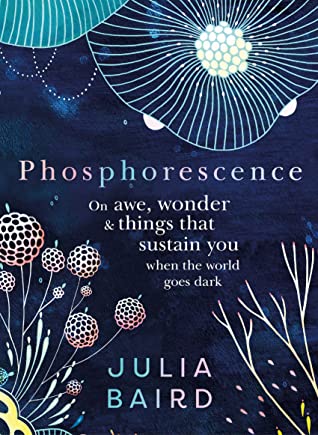
This month we are starting with Phosphorescence by Julia Baird. I haven’t read it, but it is described as:
A beautiful, intimate and inspiring investigation into how we can find and nurture within ourselves that essential quality of internal happiness – the ‘light within’ that Julia Baird calls ‘phosphorescence’ – which will sustain us even through the darkest times.
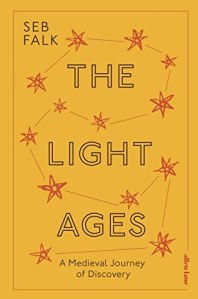
I’m going to take ‘light’ as my first link and feature a non-fiction book by Seb Falk that I read earlier this year: The Light Ages (1). In this book Falk looks at some of the advances in science, mathematics and astronomy during the medieval period and tries to dispel the idea that the Dark Ages were a time when progress stood still. A fascinating book, but I can’t claim to have understood everything in it!
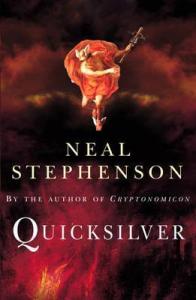
Another book – fiction this time – in which the history of science plays a part is Quicksilver by Neal Stephenson (2), the first volume in his Baroque Cycle. The protagonist Daniel Waterhouse is a 17th century natural philosopher who befriends Isaac Newton and becomes involved in the work of the Royal Society. I had been looking forward to reading this book, which sounded like the sort of thing I would usually love, but unfortunately I didn’t get on very well with it at all. I persevered through all 900 pages but was pleased to reach the end!
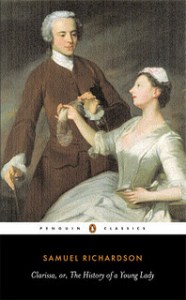
This leads me to another very long novel that I was glad to finish: Clarissa by Samuel Richardson (3). I read this 18th century classic as part of a year-long readalong with other bloggers and this definitely helped me get through what turned out to be a very repetitive and slow-paced novel. Still, I did appreciate the quality of the writing and found myself really enjoying parts of the book – and I felt a sense of accomplishment when I turned the final page.
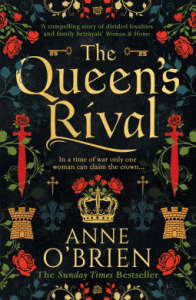
Clarissa is an epistolary novel consisting of letters – 537 of them – in which Clarissa Harlowe’s correspondence with her friend Anna Howe reveals the story of how she defies her parents’ plans for her marriage only to fall into the clutches of the notorious ‘libertine’ Robert Lovelace. A much more recent book I’ve read which is also written mainly in the form of letters is The Queen’s Rival by Anne O’Brien (4), which tells the story of Cecily Neville, mother of Edward IV and Richard III.
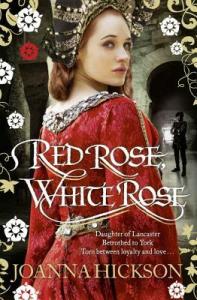
Joanna Hickson’s Red Rose, White Rose (5) is another novel about Cecily Neville and the part she plays in the Wars of the Roses. I preferred this one to the Anne O’Brien book as it is written as a straightforward narrative rather than in letter form and I think it’s always interesting to see how different authors choose to portray the same historical characters.
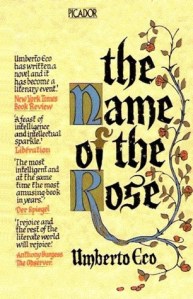
To finish my chain, I’m going to link to another book with the word ‘rose’ in the title. There are a few I could choose from, but I’ve decided on The Name of the Rose by Umberto Eco (6), a book I decided to re-read a few years ago as there was so much I missed the first time I read it. It can be described as a medieval murder mystery but is so much more than that with its themes of religious and political conflict and descriptions of monastic life.
And that’s my chain for March. My links have included: light, science, very long novels, epistolary novels, Cecily Neville and roses.
In April we will be starting with Shuggie Bain by Douglas Stuart



 She Reads Novels