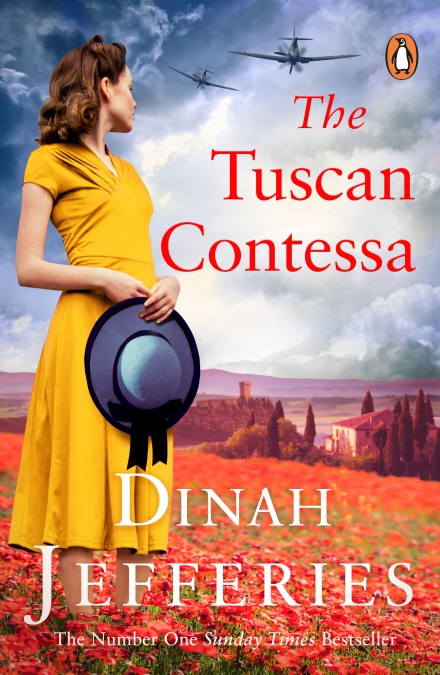
The Tuscan Contessa by Dinah Jefferies

This is the first of Dinah Jefferies’ novels not to be set in Asia. After being whisked off by her previous six books to Sri Lanka, Myanmar, French Indochina and other fascinating settings, it was a surprise to find that her latest one takes place in Italy. I do love reading about Italy, though, and this setting – Rome and Tuscany during World War II – was just as interesting as the others.

The Contessa of the title is Sofia de’ Corsi, who lives with her husband Lorenzo in their Tuscan villa in the Val d’Orcia. Lorenzo works for the Ministry of Agriculture but Sofia knows very little about what his work actually involves, other than that it takes him away from home for long periods of time. The war is in its final years – the story begins in November 1943 – yet life in Italy is becoming more dangerous and more complicated than ever. Much of the country is still under German martial law and although the Allies are advancing and driving the German army back, their progress is very slow. Not only do Italians have the Nazis to worry about, however, but they are also fighting each other, with anti-Fascist partisans locked in civil war with supporters of Mussolini and his Fascist forces.

When James, a British radio engineer, is found wounded near Sofia’s home she offers to give him shelter, but knowing that Lorenzo would be worried for her safety, she decides to keep his presence a secret from her husband. Meanwhile, Maxine, an Italian-American spy, has arrived from Rome to stay with Sofia, having been given the job of gathering information about the Germans to pass on to the resistance and the Allies. But with the Nazi officers stationed in the village beginning to grow suspicious about Sofia’s household, the two women and their loved ones could be in danger.

I have to confess that before I read The Tuscan Contessa I knew very little about Italy during the war, so I was pleased to find that a timeline is included at the front of the book, outlining the key events from the Italian perspective. This helped me to understand what had been happening in the months prior to the beginning of the novel and how there were so many different groups all working with or against each other: the German occupiers, Mussolini’s Blackshirts, the Partisans and communists, Allied soldiers and SOE spies. It’s not surprising that Sofia and her friends are never quite sure who can and cannot be trusted and who might be about to betray them. One thing I really liked about the novel is the way Jefferies shows that there are good and bad people on all sides of any conflict and that both friends and enemies can be found where they are least expected.

Although there are plenty of male characters, all with significant roles to play in the novel, the focus is mainly on the women and the decisions they have to make to keep themselves and their families safe. I liked Sofia but the other characters felt less well drawn and I even found myself confusing some of them with each other. I didn’t feel that I ever truly got to know and understand Maxine, which was a shame because her storyline should have been the most exciting and compelling, as her work took her into some very dangerous situations. It seemed that the characters sometimes took second place to the history unfolding around them, which made the story less emotionally gripping than it could have been.

This is not one of my favourite Dinah Jefferies novels, but I’m still glad I read it even if just for the knowledge I’ve gained of 1940s Italy!

Thanks to Penguin for providing a copy of this book for review via NetGalley.

The Two Hundred Ghost by Henrietta Hamilton

I read my first Henrietta Hamilton novel, Answer in the Negative, earlier this year and wasn’t particularly impressed by it; I wasn’t sure whether I wanted to read any more of her books, but I believe in giving an author a second chance and The Two Hundred Ghost sounded very tempting. I’m glad I gave it a try as I enjoyed it much more than Answer in the Negative.

The Two Hundred Ghost was first published in 1956 and is the first book in Hamilton’s Johnny and Sally Heldar mystery series. The unusual title refers to 200 Charing Cross Road, the address of the antiquarian bookshop in London which is owned by Johnny Heldar’s family and said to be haunted by a ghost. Sally Merton is one of the booksellers in the shop; she is not yet married to Johnny when we first meet her and has been attracting some unwelcome attention from one of the male employees, Victor Butcher. Mr Butcher is an unpleasant bully, disliked by everybody who knows him, so when he is found dead in his office with a knife in his back, there are plenty of suspects…including the ghost, which is sighted in the building shortly before the murder takes place!

This is a very short novel and the plot moves along at a steady pace, making it a quick and easy read; although, as with the other Hamilton novel I read, I felt that there was a bit of repetition surrounding discussions of alibis, timing of events and layouts of rooms, this one has a better balance between these technical aspects of mystery-solving and the more ‘human’ aspects, such as motives and personalities. I didn’t guess who the murderer was, but I don’t think the author was unfairly holding back information from the reader and it may have been possible to solve the mystery if you were paying more attention than I was and didn’t miss any clues!

Henrietta Hamilton (a pseudonym of Hester Denne Shepherd) worked in a London bookshop in the years following World War II and had personal experience of selling antiquarian books, which gives the novel a feeling of authenticity. Bookselling is not just a background to the novel, but an important part of the plot, and the author’s knowledge and interest in ‘incunabula’ (early printed books) comes through very strongly.

I was pleased to find that Sally plays a bigger part in the investigations in this book than she did in Answer in the Negative and makes some important discoveries which prove to be turning points in the mystery – although, remembering that it was written in the 1950s, there’s always a sense that Johnny feels the need to protect her because she’s a woman. Still, both Johnny and Sally are characters who are easy to like and to care about; it was nice to get to know them before they were married and to see their relationship develop (although it does so quite subtly and their romance is only one small part of the story). Having enjoyed this book, I would like to meet the Heldars again – luckily, there are another two books in the series and I’m hoping they will be reissued soon too!

Thanks to Agora Books for providing a copy of this book for review via NetGalley.
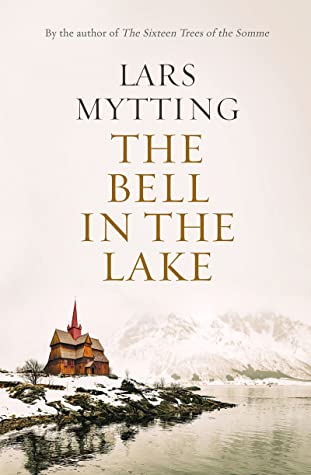
The Bell in the Lake by Lars Mytting

This beautifully written novel, translated from the original Norwegian by Deborah Dawkin, is the first in a planned trilogy based around the legend of the Sister Bells. The bells commemorate conjoined twin sisters Gunhild and Halfrid Hekne, who lived in the remote village of Butangen and died within hours of each other. Their family donated the bells to the local church in memory of the twins and they are still hanging there, in the bell tower, in 1880 when the novel begins…

As the rest of the world heads towards the twentieth century, Butangen appears to be frozen in time, a place where life is still ruled by superstition and folklore, where people still believe in evil spirits and ill omens. When Kai Schweigaard, an ambitious young pastor, arrives in the village he despairs of ever bringing change to a population so resistant to progress and modern ways of thinking.

If only people had light, he thought. If there was a strong lamp in every home, which could illuminate faces and edifying books, I could banish these mad notions in a few years. But at sunset the village grew dark, and with it folk’s minds, and these unknown powers ruled until sunrise.

One of the ways in which Kai hopes to improve life in the village is by replacing the ancient 12th century stave church where a parishioner actually froze to death during Mass with a larger, warmer, more comfortable building. The old church, complete with its pagan carvings and twin bells, is to be dismantled and reconstructed in Dresden, and a young German architect – Gerhard Schönauer – has arrived to make drawings of the church before it is taken down. However, Kai and Gerhard face opposition not only from the people of Butangen, who are suspicious and resentful of anything new, but also from the Sister Bells themselves. The bells are said to have supernatural powers and to ring on their own when danger is approaching – and it seems that the bells don’t want to be removed.

As well as the two men, a large part of the story is also written from the perspective of twenty-year-old Astrid Hekne, who works as a maid in Kai Schweigaard’s household at the parsonage. Despite the differences in their social standing, Kai is considering making Astrid his wife, but complications arise when Astrid finds herself drawn to Gerhard Schönauer. Meanwhile, as a descendant of the twins Halfrid and Gunhild, Astrid feels a responsibility for the bells and decides she must do whatever it takes to prevent Gerhard from transporting them to Dresden with the rest of the church.

The Bell in the Lake is a wonderfully atmospheric novel thanks to Lars Mytting’s beautiful descriptions of the landscape around Butangen, particularly in winter with its frozen lakes and snow-covered hills and valleys, while the supernatural elements and the role of the Sister Bells legend give the story an eerie and mysterious feel. The sense of time is as strong as the sense of place and the characters feel like real 19th century people, rather than modern day people dropped into a random historical setting. However, I think the decision to have Astrid and the other villagers speak in a dialect which seems to be mainly Scottish is a bit strange. I suppose the translator had to find a way to differentiate between the speech of the local people and the outsiders (who speak in standard English), and using Scottish words makes sense because of the close ties with Norway, but I found it slightly distracting and kept forgetting that Astrid was actually Norwegian!

One of my favourite themes in fiction is the conflict between old ways of life and new, and in this novel we see how the inhabitants of Butangen are reluctant to move away from the traditions they have always followed and try to resist any kind of social, scientific or religious progress. Although Astrid has been brought up with the same beliefs, she has a more adventurous spirit than most of her neighbours and longs to see more of the world, which is what draws her to Gerhard. The demolition of the old church, which Gerhard has come to oversee, and the building of the new one is symbolic of all of this. If you’ve never seen a Norwegian stave church, by the way, I recommend googling them – they look amazing and it’s sad to think that there are so few of them left.

Having enjoyed The Bell in the Lake so much, I am looking forward to the other two books in the trilogy and hope we won’t have to wait too long for the next one!

Thanks to Quercus Books for providing a copy of this book for review via NetGalley.

Top Ten Tuesday: Historical Winter Reads

This week’s Top Ten Tuesday (hosted by That Artsy Reader Girl) is a ‘seasonal freebie’. Here are ten historical fiction novels I have read and reviewed on my blog, all with the word Winter in the title. I hope my list gives you some ideas for your winter reading!

~

1. The Winter Isles by Antonia Senior – Set in 12th century Scotland, this is the story of Somerled and his rise to become Lord of the Western Isles.

2. Winter Siege by Ariana Franklin and Samantha Norman – In the winter of 1141, a little girl is rescued by a soldier and together they become caught up in the Anarchy, the conflict between King Stephen and the Empress Matilda.

3. The Winter Crown by Elizabeth Chadwick – This is the second book in Chadwick’s Eleanor of Aquitaine trilogy and follows the breakdown of Eleanor’s marriage to Henry II, the rebellion of their four sons, and the King’s feud with Thomas Becket.

4. Kingmaker: Winter Pilgrims by Toby Clements – A monk and a nun are forced to flee their priory, only to find themselves drawn into the Wars of the Roses. This is the first in a series, although I still haven’t read the others.

5. Wolves in Winter by Lisa Hilton – Set in Renaissance Italy, this novel takes us from the household of Piero de’ Medici in Florence to the home of Caterina Sforza, Countess of Forlì and Imola.

6. Wintercombe by Pamela Belle – First in a series set during the English Civil War and following the story of Silence St Barbe, left behind by her Parliamentarian husband to protect their beautiful home, Wintercombe.

7. The Winter Prince by Cheryl Sawyer – A novel about Prince Rupert of the Rhine, nephew of King Charles I and commander of the Royalist Cavalry during the Civil War.

8. The Winter Palace by Eva Stachniak – The early years of Catherine the Great, as seen through the eyes of Varvara, a fictional character who is brought to Russia’s Imperial Court as a spy for the Chancellor, Count Bestuzhev.

9. A Place Called Winter by Patrick Gale – A young man tries to build a new life for himself in a place called Winter in Saskatchewan, Canada at the turn of the 20th century.

10. One Night in Winter by Simon Sebag Montefiore – A thriller set in Stalin’s Moscow at the end of World War II and based on a true story.

~

Have you read any of these? If I had included other genres on my list, I could also have added The Winter of the Witch by Katherine Arden (historical fantasy) and Winter King by Thomas Penn (non-fiction). Are there any other books with ‘winter’ titles you can think of?

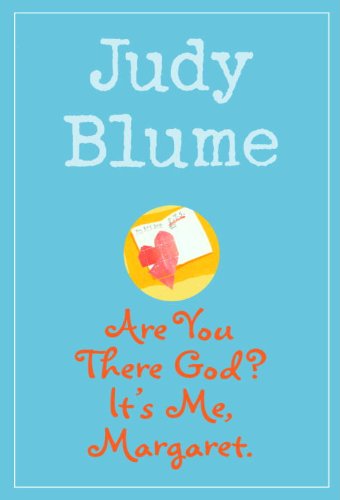
Six Degrees of Separation: From Are You There God? It’s Me, Margaret to A Long Petal of the Sea

It’s the first Saturday of the month which means it’s time for another Six Degrees of Separation, hosted by Kate of Books are my Favourite and Best. The idea is that Kate chooses a book to use as a starting point and then we have to link it to six other books of our choice to form a chain. A book doesn’t have to be connected to all of the others on the list – only to the one next to it in the chain.

This month we are starting with Are You There God? It’s Me, Margaret by Judy Blume. I read a lot of Judy Blume books in my childhood/early teens and this is one I particularly remember – not every detail of the plot, but certain scenes and lines. Here’s the blurb:

Life isn’t easy for Margaret. She’s moved away from her childhood home, she’s starting a new school, finding new friends – and she’s convinced she’s not normal. For a start she hasn’t got a clue whether she wants to be Jewish like her father or Christian like her mother. Everyone else seems really sure of who they are. And, worst of all, she’s a ‘late developer’. She just knows that all her friends are going to need a bra before she does. It’s too embarrassing to talk to her parents about these things. So she talks to God instead – and waits for an answer…

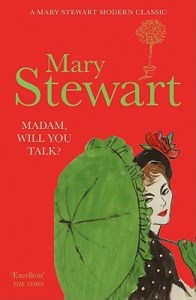
For my first link I have chosen another novel with a question as the title: Madam, Will You Talk? by Mary Stewart (1). Of all of the Stewart suspense novels I’ve read, I think this one and Nine Coaches Waiting are two of the best. Published in 1955, this was her first novel and features some beautiful descriptions of the French countryside where our heroine, Charity, is trying to protect a thirteen-year-old boy whose father has been acquitted of murder.

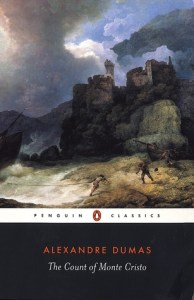
In Madam, Will You Talk? the characters visit the Château d’If, made famous as the fortress off the coast of Marseille where Edmond Dantes is unjustly imprisoned near the beginning of The Count of Monte Cristo by Alexandre Dumas (2). If I was forced to choose my absolute favourite classic novel, this would probably be it. At nearly 1,000 pages it has an incredibly complex plot, but it can be described quite simply as a tale of revenge. This leads me to..

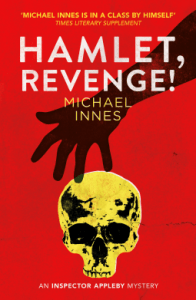
Hamlet, Revenge! by Michael Innes (3), the second in his series of novels featuring Inspector John Appleby. This Golden Age mystery from 1937 is set in an English country house where a guest is murdered during an amateur performance of Shakespeare’s Hamlet. It was the first of the Appleby novels I read and I enjoyed it so much I have since read another seven of them, although with more mixed results.

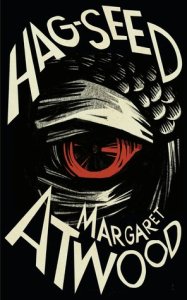
Another book in which the characters are staging a production of a Shakespeare play is Hag-Seed by Margaret Atwood (4). The play in this case is The Tempest and the novel follows Felix Phillips as he helps a group of prisoners to study the play and improve their literacy. I really enjoyed this book – it has so many different layers and even includes an element of revenge, so has a double link to book 3 in my chain!

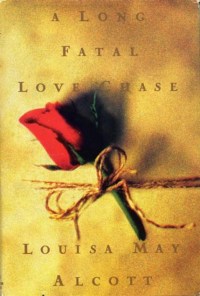
Phillip Tempest is the name of the villain in Louisa May Alcott’s A Long Fatal Love Chase (5). Having only been familiar with Alcott as the author of Little Women and its sequels, I remember being very surprised to discover that she had written a book like this which has much more in common with the Victorian sensation novels of authors like Wilkie Collins than it does with Little Women!

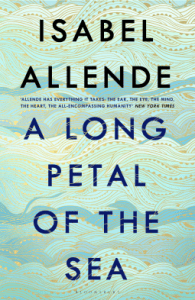
To finish my chain, I’m linking to another book with a title beginning ‘A Long’ – A Long Petal of the Sea by Isabel Allende (6). I don’t think I’m ever going to be a fan of Allende’s writing; I have tried two of her books and didn’t love either of them, but they always sound interesting and I might be tempted to give her one more chance. A Long Petal of the Sea is set in Spain during the Civil War and then in Chile in the decades that follow.

~

And that’s my chain for this month! My links have included titles that are questions, the Château d’If, tales of revenge, Shakespeare’s plays, tempests and titles beginning with ‘A Long’.

In January we are starting with Hamnet by Maggie O’Farrell.

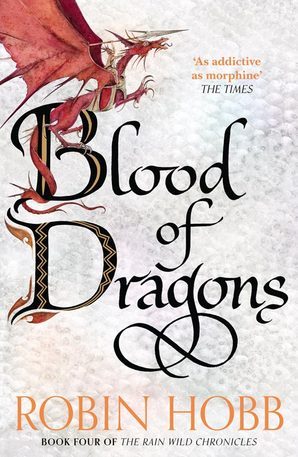
Blood of Dragons by Robin Hobb

This is the fourth and final book in Robin Hobb’s Rain Wild Chronicles quartet and I can honestly say I don’t think I’ve ever been so pleased to come to the end of a series! Why have I persevered with it through four long books that I wasn’t particularly enjoying? Well, the series is part of the sixteen-volume Realm of the Elderlings sequence. I loved the first nine books (The Farseer, Liveship Traders and Tawny Man trilogies) and intend to read the last three, so didn’t feel that I could leave out these four in case I missed out on any details or plot points that turned out to be important later. Anyway, they’re not that bad – they’re just not as good as the earlier books I read by Hobb.

Blood of Dragons continues the story from the previous book, City of Dragons, with our band of young keepers and their dragons beginning to make their way into the deserted Elderling city of Kelsingra. Abandoned by the Elderlings in the aftermath of an earthquake many generations earlier, Kelsingra has been left in ruins but still holds magic within its stones. As the dragons replenish their strength and energy in the enormous hot baths, the keepers search for the source of the legendary Silver, the mysterious substance the dragons desperately need if they are ever to regain their full powers. Meanwhile, Tintaglia, the magnificent blue queen dragon, is trying to return home after being wounded in an attack by Chalcedean dragon-hunters – while in faraway Chalced itself, Selden Vestrit has found himself imprisoned by the Duke, who believes that Elderling blood is the next best thing to the dragon blood he needs to prolong his life.

As the last of the Rain Wild Chronicles, I thought this book brought the series to a satisfactory conclusion and I didn’t feel that anything significant had been left unresolved. Although these four novels seem very separate from the rest of the sequence (only a few shared characters with The Liveship Traders and hardly any overlap at all with the Farseer and Tawny Man books), I’m still pleased that I read them as they have added to the overall world-building and helped me to understand more about the relationship between dragons and Elderlings. I was particularly intrigued by the role of the Silver as a sort of life-force with magical properties; I’ve been remembering other references to silver in the earlier Hobb trilogies and trying to work out how all of this relates to the Skill. It was also interesting to see Rapskal taking on more and more of the characteristics of his long-ago counterpart Tellator as he spends more time immersing himself in Kelsingra’s memory stones.

Despite enjoying the magical elements of the story, however, I again struggled to really engage with any of the characters, something which has been a problem for me in all four novels. I became quite fond of a few of them (such as Alise, Sedric and Leftrin), but I felt that too much time was spent on the love triangle between Thymara, Rapskal and Tats, and on trying to sort all of the characters into romantic pairings, even the dragons. I did love the way Hest’s story ended, though! After a short break while I read other books, I will be ready to embark on the final trilogy, which begins with Fool’s Assassin, and am very much looking forward to rejoining Fitz and the Fool at last.

My Commonplace Book: November 2020

A selection of words and pictures to represent November’s reading:

commonplace book
noun
a book into which notable extracts from other works are copied for personal use.

~

It wasn’t until several days late that Maloin wondered why he hadn’t called for help. The fact was, he just hadn’t thought of it. When you imagine something dramatic, you think you’ll do this or that. But when you’re there, it’s different.

The Man from London by Georges Simenon (1934)

~

“If you’d only begin at the beginning!” pleaded Sobel.

“But that’s so hard, isn’t it? Because nothing ever really has a beginning. There’s always something before that and something before that and so on. That’s why modern authors always begin in the middle, though I do think it’s awfully confusing, and I never get the characters straightened out afterward.”

Dance of Death by Helen McCloy (1938)

~

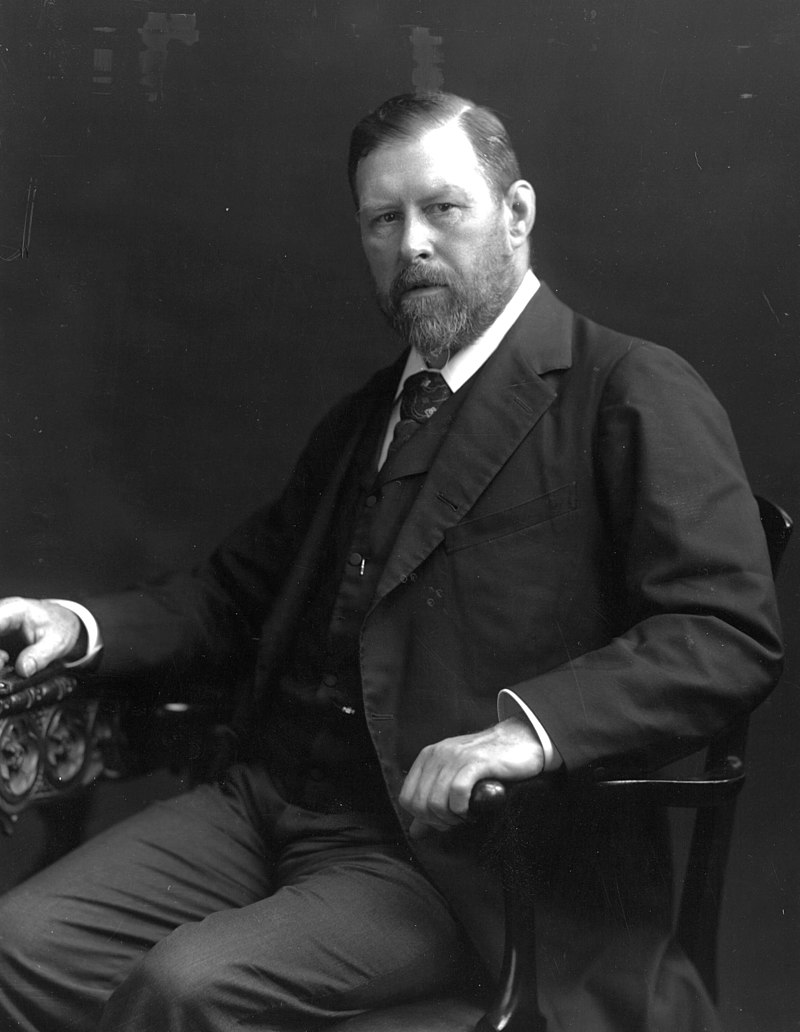
Bram Stoker, c. 1906

Flo: These abstractions of the artist hold little interest for me, I’m afraid. I choose to live in the real world.

He: Ah, the real world, that vile dungeon of cruelty and hunger. You are welcome to it.

Flo: It must be a very heavy burden to think that of the world.

He: I never trust a thinker – to feel is the only calling. But without what we do as artists your real world would be less bearable, no?

Shadowplay by Joseph O’Connor (2019)

~

‘Yes, of course. One always regrets everything one hasn’t done. But it’s not that. I can’t bear totting up what one gets or doesn’t get out of life as though it were a commercial proposition.’

‘Surely one must try and get the most out of life and not miss any chances,’ Barney replied, in the voice of one who states the first article of a religion.

Still She Wished for Company by Margaret Irwin (1924)

~

The others were heading back to the mob, which now seemed to me like a swarm of flies on rotten fruit. Was this what men do when they go into battle, I wondered? Must they become insects in order to survive? I felt no comradeship with them, no common cause. I was a different kind of man entirely.

The Butcher of Berner Street by Alex Reeve (2020)

~

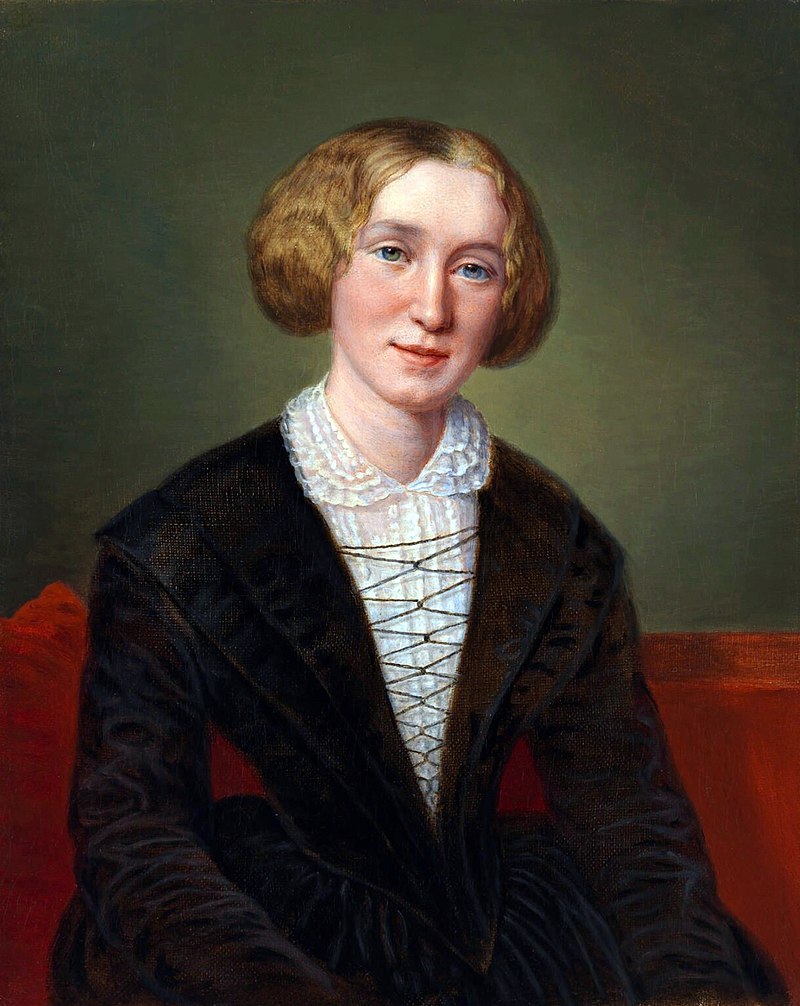
Portrait of George Eliot c. 1849

It is an old story, that men sell themselves to the tempter, and sign a bond with their blood, because it is only to take effect at a distant day; then rush on to snatch the cup their souls thirst after with an impulse not the less savage because there is a dark shadow beside them for evermore. There is no short cut, no patent tram-road, to wisdom: after all the centuries of invention, the soul’s path lies through the thorny wilderness which must be still trodden in solitude, with bleeding feet, with sobs for help, as it was trodden by them of old time.

The Lifted Veil by George Eliot (1859)

~

Happily, we are not dependent on argument to prove that Fiction is a department of literature in which women can, after their kind, fully equal men. A cluster of great names, both living and dead, rush to our memories in evidence that women can produce novels not only fine, but among the very finest — novels, too, that have a precious speciality, lying quite apart from masculine aptitudes and experience. No educational restrictions can shut women out from the materials of fiction, and there is no species of art which is so free from rigid requirements. Like crystalline masses, it may take any form, and yet be beautiful; we have only to pour in the right elements — genuine observation, humour, and passion.

Silly Novels by Lady Novelists by George Eliot (1856)

~

Favourite books read in November:

Still She Wished for Company, The Butcher of Berner Street and Dance of Death

Countries visited in my November reading:

France, USA, England, Ireland

Authors read for the first time in November:

Georges Simenon, Helen McCloy

~

Have you read any of these? What did you read in November?