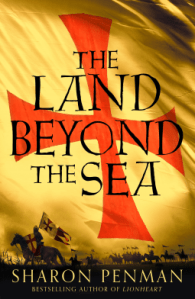
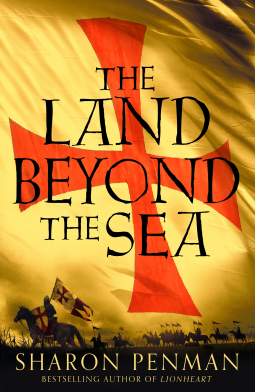
 The first book I have finished in 2021 is actually one that I started last summer, but as with many of the books I tried to read last year I found that I wasn’t in the right frame of mind for anything long and complex. And at almost 700 pages, this novel is certainly long – and with a plot dealing with the history and politics of Outremer, or the Kingdom of Jerusalem, it is certainly complex! As I’m finding it a lot easier to concentrate on reading now, I picked the book up again and have enjoyed immersing myself in it over the last week or two.
Jerusalem was captured by the Crusaders in 1099, at the end of the First Crusade, and the kingdom they established there became known as Outremer or ‘the land beyond the sea’. The Crusaders who stayed in Outremer and made it their home were mainly of French origin and Penman refers to them (and their descendants) as Franks or Poulains. The novel covers the period from 1172 to 1187, a period when the kingdom is becoming divided by disputes over the succession to the throne and when the Muslim Arabs (referred to as Saracens in the book), led by their sultan Saladin, are taking advantage of this to try to reclaim their lands.
With Outremer under threat from Saladin’s armies, strong leadership is more important than ever, but the young king of Jerusalem, Baldwin IV, has been forced to confront an unwelcome truth: he is suffering from leprosy and can expect an early and unpleasant end to his life. As rival Poulain lords begin plotting and scheming to become the influence behind the next king or queen, the Saracens advance further into Outremer, with their eye on Jerusalem itself…
The Land Beyond the Sea is a fascinating novel. I have read a lot about Europe in the medieval period, but not so much about other parts of the world. Apart from Elizabeth Chadwick’s Templar Silks, I can’t really think of anything else I’ve read that focuses entirely on the Holy Land and its people. As my knowledge of the subject was so limited, I didn’t always know how or when a character would die, or who they would marry, or what the outcome of a battle would be, which made a nice change from reading about the Tudors or the Wars of the Roses, where I usually have a good idea of what is going to happen next! It also meant that it wasn’t a particularly easy read; the number of characters introduced in the first half of the book was overwhelming, especially as so many of them were used as viewpoint characters, which made it difficult to really settle into the story. By the middle of the novel, though, I felt that I was getting to know some of them much better and they were starting to feel like real people rather than just names on the page and from this point on I really enjoyed the rest of the book.
Most of the novel is written from the perspective of the Franks, with a focus on three of them in particular: Baldwin, the ‘Leper King’, who is depicted as a courageous and intelligent young man determined to take care of his kingdom until his illness makes it impossible; William, Archbishop of Tyre, tutor to Baldwin, whose chronicle History of Deeds Done Beyond the Sea is one of our most important sources of information on the Kingdom of Jerusalem; and Balian d’Ibelin, one of the leading Poulain noblemen who, due to the respect he commands amongst the other lords and his marriage to the king’s stepmother Maria Comnena, often finds himself drawn into the kingdom’s military and political affairs. I’ve noticed that a few other readers have said they found Balian too good to be true, or even anachronistic, but I disagree – there are plenty of other characters in the book who are selfish, weak or untrustworthy, so why shouldn’t there also be one who is decent and honourable? Balian was the only character I fully connected with emotionally; I sympathised with him as he struggled with some very difficult decisions and shared his frustration at the behaviour of some of the other Franks whose inability to put the welfare of the kingdom before their own interests led Jerusalem towards disaster.
We do occasionally see things from the Saracen point of view, particularly when Balian crosses paths with Saladin and his brother al-Adil, and I think Penman does give a balanced portrayal of both sides in the conflict. Although for most of the book the Saracens are the ‘enemy’, whenever the perspective switches to their side we see that Saladin and al-Adil are more admirable than many of the Franks, are prepared to be reasonable in negotiations and to show compassion where necessary. My only complaint is that I would have liked to have spent more time with them instead of just a few pages here and there.
As with Sharon Penman’s other books, this one has clearly been very well researched and her afterword and author’s note are almost as interesting as the story itself. Apart from maybe two or three words and phrases out of a 700 page book, I didn’t have any problems with inappropriately modern language (and I’m usually the first to complain about that sort of thing). However, I didn’t love this one as much as some of her others such as The Sunne in Splendour or Falls the Shadow, which I think is down to finding the writing slightly dry in places and the lack of emotional impact until nearer the end. Still, I really enjoyed The Land Beyond the Sea and am determined to find time soon to read the final book in Penman’s Welsh Princes trilogy, The Reckoning, which has been waiting on my shelf for years!
 Book 1/50 read for the Historical Fiction Reading Challenge.
Thanks to Pan Macmillan for providing a copy of this book for review via NetGalley.






 She Reads Novels