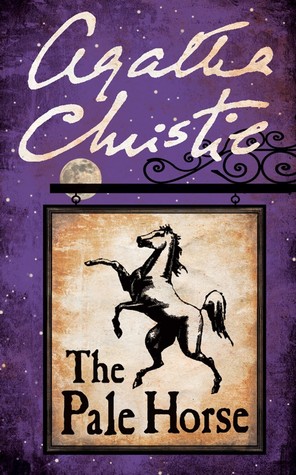
 Last year I took part in the Read Christie 2019 challenge hosted by the Agatha Christie website. The idea was to read twelve Christie books – one per month – corresponding to twelve different categories. I didn’t manage to join in with all twelve, but I read eight of them and enjoyed them all, particularly The ABC Murders, Dumb Witness, and the book for December, The Pale Horse. There’s a new BBC adaptation of The Pale Horse coming soon (not sure of the exact dates, but sometime in 2020) so I’m pleased to have had a chance to read it first.
The Pale Horse is one of Christie’s standalones and doesn’t feature either of her famous detectives, Miss Marple or Hercule Poirot, although there are a few appearances from another recurring character, Ariadne Oliver. The story is narrated by Mark Easterbrook, not a detective but a writer and historian who is researching a book on Mughal architecture. At the beginning of the novel, Mark witnesses two young women fighting in a London coffee shop. A few days later, he is surprised to hear that one of the girls, Tommy Tuckerton, has died of what appear to be natural causes, unconnected with the fight. Presumably this is just a coincidence, but soon afterwards Mark learns of a list of names found in the shoe of a murdered priest – and one of those names is Tuckerton. When Mark recognises another of the names, that of his godmother Lady Hesketh-Dubois, who has also recently died, he becomes convinced that something sinister is happening.
With the help of his crime writer friend Ariadne Oliver and a young woman called Ginger Corrigan, Mark begins to investigate and finds a series of clues leading him to a former inn, The Pale Horse, which is now home to three witches. Not real witches, of course…or are they? Mark isn’t sure what to think, but it certainly seems that The Pale Horse is well known within the community as the place to go if you want to put a curse on somebody.
Christie’s novels are always entertaining, but this is one I particularly enjoyed. The plot intrigued me from the beginning; it seemed such an unusual set of circumstances and while I didn’t really believe that the three women of The Pale Horse were able to kill people through supernatural means, I couldn’t work out how else the murders were being committed. It was all quite unsettling, with a real sense that something evil was taking place. I had to avoid reading this book late at night!
It was good to see Ariadne Oliver again, who plays a small but important part in the solution of the mystery and in her role of crime novelist gives Christie an opportunity to put a little bit of herself into the story. There are plenty of other memorable characters too, though, from the three witches to Ginger Corrigan to Mr Osborne, a pharmacist who witnesses one of the murders and insists that he knows who the culprit is, despite all evidence to the contrary!
The Read Christie Challenge is happening again in 2020, with a new set of monthly categories. January’s theme is ‘a book that changed Christie’s life’ and we have been given a few suggestions to choose from. I have opted for Murder on the Orient Express!








 She Reads Novels