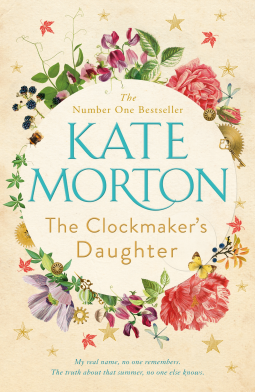
 A 19th century artist and his beautiful model; a young girl raised in India and sent to an English boarding school; a writer who takes her children to the countryside during World War II; and a 1920s biographer researching his latest work. These are just some of the characters whose stories are told in The Clockmaker’s Daughter and tied together by a present day archivist, Elodie Winslow, who is trying to make sense of it all.
At the beginning of the novel, in 2017, Elodie comes across two intriguing items in the archives of a man called James Stratton. One is an old photograph showing a woman dressed in Victorian clothing; the other is a sketchbook with a drawing of a house near the bend of a river. Elodie feels that the house looks familiar somehow…but where could she have seen it before? And who is the woman in the photograph?
To find the answers to these questions, we have to go back to the summer of 1862 when a group of young artists known as ‘the Magenta Brotherhood’ are gathering at Birchwood Manor, the home of the talented painter Edward Radcliffe. By the end of their stay, a woman has been killed, another has vanished without trace and a valuable jewel has disappeared. We know that these incidents must be linked in some way to the photograph and sketch that Elodie has found, but before we can fully understand their significance we must follow the stories of all the characters I mentioned above – and several more.
The Clockmaker’s Daughter is a complex novel and, I have to admit, I would have preferred it to have been a bit less complex! There were far too many different strands to the story and I struggled to keep track of what was happening and how the various characters were related to each other. New characters, often seemingly unconnected to any of the others, were still being introduced well into the second half of the book and it wasn’t always very clear how they were going to fit into the sequence of events. It all makes sense in the end, but I’m not sure it was really necessary for things to be so confusing.
Although I would have preferred a more straightforward, linear structure, I still found a lot to like about this book: there’s a supernatural element which I thought was used very effectively; I loved Birdie Bell, the eponymous clockmaker’s daughter; and I really enjoyed the last few chapters, in which we finally discover what really happened that summer in 1862. To compare it with the other two Kate Morton novels I’ve read, I thought this one was better than The Distant Hours but not as good as The Forgotten Garden. I’m not sure whether I will be reading any more of her books, although I could probably be tempted.
Thanks to Pan Macmillan for providing a copy of this book for review via NetGalley.



 She Reads Novels