A Triple Knot by Emma Campion

A Triple Knot There are some historical women whose lives have been covered many times in fiction – Elizabeth I is one example and Anne Boleyn is another. The heroine of Emma Campion’s latest novel, A Triple Knot, is a less popular choice: she is Joan of Kent, cousin of King Edward III and once described as “the most beautiful woman in all the realm of England”.

Joan is the daughter of Edmund, Earl of Kent, and his wife, the Countess Margaret. Edmund, the younger half-brother of the deposed Edward II, is executed for treason several years before our story begins, leaving Joan and her brother to grow up in the household of their cousin, Edward III, and his wife, Philippa of Hainault. Joan’s Plantagenet blood and her great beauty give the King reason to hope that he can negotiate a marriage for her that will be useful to him from a political perspective. When he and Philippa notice that their own son, Ned (who will become known as the Black Prince), seems to be showing too much interest in Joan, they decide that she needs to be married off sooner rather than later. However, Joan has other ideas.

On a journey to the Low Countries to see the father of a potential husband picked out for her by Edward and Philippa, Joan meets and falls in love with Sir Thomas Holland. Thomas is twenty-six and Joan is only twelve, but while their relationship would be shocking by modern standards, this is the fourteenth century and an age difference like this is not too uncommon. They marry in secret, knowing that the King would not approve, but are soon parted when Thomas has to return to the army. Back at home with her family, Joan is forced into a second marriage with William Montague, the Earl of Salisbury’s son, and faces a long, difficult battle to prove that her marriage to Thomas was legal. But as she and Thomas struggle to have their marriage recognised, the Black Prince waits for his chance to win back the woman he has always wanted more than any other.

A Triple Knot is the first book I’ve read by Emma Campion, but I’m aware that she has also written a novel about Alice Perrers, mistress of Edward III, as well as a series of historical mysteries published under the name Candace Robb. Having read this one, I’m not sure I would want to try any of her others, as I didn’t really enjoy it very much. While it was good to learn more about a woman I previously knew very little about, I was left thinking that maybe there’s a good reason why not many novels have been written about Joan of Kent – her story just wasn’t interesting enough to sustain a novel of this length. Apart from her relationships with Thomas, William and Ned (I’m assuming this is what the ‘triple knot’ of the title refers to) other aspects of Joan’s life aren’t given much attention. As for Joan herself, I was surprised every time her age was mentioned as she didn’t feel like a child to me – in fact, she didn’t seem any older at the end of the book than she did at the beginning, even though many years had gone by!

There were some things that I did like, of course, otherwise I wouldn’t have been able to continue reading. The novel felt very well-researched and there were lots of details of fourteenth century life, both at court and away from it. The historical background is quite complex and it was sometimes difficult to untangle the relationships between various members of the royal family, especially in the first few chapters of the book, but I love reading about medieval history so I didn’t mind this. Overall, though, I was quite disappointed with this book – and as a side note, I really dislike the cover. It’s definitely not an image I would have chosen to represent the story and the time period!

I received a copy of this book via NetGalley for review.

The Streets by Anthony Quinn

The Streets In 1882, twenty-one-year-old David Wildeblood comes to London to begin his new job working as a reporter for Henry Marchmont’s weekly newspaper, The Labouring Classes of London. The idea of the paper is to highlight the suffering of some of the city’s poorest people and David’s task is to visit some of London’s worst slum areas, such as the notorious Somers Town, to speak to the inhabitants and report on their living conditions.

Having grown up in rural Norfolk, David is instantly an ‘outsider’, inexperienced in London ways and unfamiliar with the slang. This makes his job very difficult, but things improve when he is befriended by Jo, a young costermonger who can introduce him to people and places he would never have been able to access on his own.

As David continues his investigations into living standards at Somers Town, he is shocked by the state of the housing and the poverty of the people who live and work there. Soon he uncovers something even worse – a network of corruption and exploitation by unscrupulous landlords – and finds that he has gained some very powerful enemies.

The story also has a romantic element and there are two main female characters whom David gets to know throughout the novel. One is Kitty, the daughter of David’s godfather, and the other is Roma, the sister of his new friend, Jo: two very different women. Kitty, with her valuable jewels and pet monkey, comes from a rich, privileged background and while she does take an interest in the welfare of those who are less fortunate than herself, she seems to view them as a project or a problem to be solved. Roma, on the other hand, has endured hardships and made sacrifices from an early age to support herself and her brother: she and Jo are the type of people Kitty considers to be in need of help. David himself doesn’t quite fit in with either of these social groups and it was interesting to see his relationships with both Kitty and Roma develop.

Looking at other reviews of this book I see the word ‘Dickensian’ being used a lot, and while there’s nothing in the writing style or atmosphere that reminds me of Dickens, it is certainly a novel that draws attention to some of the same issues that were obviously very important to Dickens. I could appreciate the huge amount of research Anthony Quinn must have carried out while writing this novel (in the acknowledgments he mentions two 19th century sources: London Labour and the London Poor by Henry Mayhew and Life and Labour of the People in London by Charles Booth) and I found it fascinating from a social history perspective. Fascinating, but disturbing too; the plans of the wealthy for social engineering, segregation of the lower classes and the creation of rural labour camps were uncomfortable to read about.

As a work of fiction, though, I didn’t enjoy The Streets very much at all; the pace was slow and the plot, despite sounding so promising, was not very entertaining. I didn’t feel I was fully engaging with David or any of the other characters (apart from Roma on occasions) and the ‘back slang’ used throughout the book, which I know must have been intended to add some authenticity to the story, really irritated me. What made it even more disappointing is that this book really did sound like something I should have loved: a Victorian setting, a mystery to be solved, and references to Dickens and Eliot on the cover. I didn’t regret persevering to the end, but I was still quite pleased when I reached the final page and could move on to something else.

Assassin’s Apprentice by Robin Hobb

Assassin's Apprentice Yet again I have book blogging to thank for helping me to discover an author who I think is going to become a favourite. Not being a big reader of fantasy, I would probably never have thought of reading Robin Hobb until I noticed how enthusiastic bloggers such as Leander and Alex were about her work. Assassin’s Apprentice, the first book of The Farseer Trilogy seemed the logical place to start, and what a great book it turned out to be!

Assassin’s Apprentice is set in the Kingdom of the Six Duchies, a fictional world that in some ways resembles Europe during the medieval period. Our narrator is Fitz, the illegitimate son of Prince Chivalry, the heir to the throne. Fitz is only six years old when he comes to court for the first time, having been handed over by his maternal grandfather. Chivalry himself considers the arrival of his bastard son such a disgrace that he retires from court and removes himself from the line of succession before he and Fitz even have a chance to meet. As the years go by, Fitz tries to settle into his new life at Buckkeep, the home of the royal family (the Farseers), but he finds that while there are some people who show concern for his welfare – his uncle, Prince Verity, for example, and Chivalry’s loyal stableman, Burrich, who cares for him during his early years – there are others who have no intention of making him feel welcome, such as Prince Regal, the younger half-brother of Chivalry and Verity (in Fitz’s world, the nobility have names that reflect their personal qualities).

While Fitz struggles to find a place for himself at Buckkeep, his grandfather, King Shrewd, decides to gain the boy’s loyalty and assure himself that Fitz will be working for the royal house rather than against it. And so Fitz begins to receive private lessons from the mysterious assassin, Chade, who will train him in the art of killing for the king. The adventures Fitz has over the years that follow are best left for readers to discover for themselves, so I won’t say any more about the plot here, except to say that I thought it was wonderful!

The world Robin Hobb describes in Assassin’s Apprentice is not greatly different from our own – or as our own world used to be a few hundred years ago. That is, there are no elves, wizards, goblins or other magical beings of the sort you find in other fantasy novels. However, there are a small number of magical abilities which some of our characters possess: the Wit – a special affinity between humans and animals; the Skill – the power to communicate telepathically with other people; and Forging – the act of removing a person’s emotions and humanity, named for the village of Forge where this first occurred. The first two are abilities which Fitz himself uses or attempts to use, without fully understanding either of them; the third is a method employed by the Red Ship Raiders who spend most of the novel attacking the coasts of the Six Duchies. All the other things we need to know about this world – history, geography, traditions – are described in brief passages at the beginning of each chapter so that we can learn gradually without having too much information thrown at us all at once.

I’ve discussed the plot and the setting, so what about the characters? Well, they are excellent as well. Fitz is one of the most endearing and engaging narrators I’ve come across for a long time. It would be difficult not to have sympathy for the lonely little boy he is at the beginning of the book, but I continued to love him as he grew into an awkward, insecure teenager. The other characters range from the ‘good’ (Burrich and Verity) to the ‘bad’ (Galen the Skillmaster and Prince Regal) to those, like King Shrewd, whose motives are more difficult to interpret. I was also intrigued by the Fool, who appears from time to time and gives Fitz advice in the form of cryptic riddles. I can see from the titles of some of Robin Hobb’s other books that the Fool must have a bigger part to play than was obvious from this first novel, so I’ll look forward to meeting him again.

Knowing that there are another two books in The Farseer Trilogy and having enjoyed this one so much, I will naturally be starting the second one as soon as possible!

The Miniaturist by Jessie Burton

The Miniaturist In October 1686, eighteen-year-old Petronella (Nella) Oortman travels from Assendelft to Amsterdam to join the household of her new husband, Johannes Brandt. Johannes is a merchant with the VOC – the Dutch East India Company – and spends a lot of time away from home, leaving his young wife in the company of his sister, Marin, and their two servants, Cornelia and Otto. Disappointed with the lack of affection from her husband and confused by Marin’s cold, unwelcoming reception, Nella quickly finds that married life is certainly not what she had hoped and expected it would be.

Unable, for various reasons, to give Nella the attention she deserves, Johannes presents her with a special wedding gift to help her pass the time: a cabinet containing a dolls’ house that resembles the Brandts’ own home. The little rooms are empty and it is up to Nella to decide how to furnish them. Responding to an advertisement by a ‘miniaturist’, she sends a letter with her requests, but when the tiny items and figures begin to arrive, Nella is amazed by how accurately they reflect life within the real Brandt household. How can the miniaturist possibly know so much about Nella and her family?

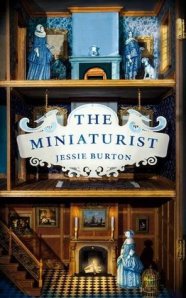
I was drawn to The Miniaturist by its striking cover and although the book itself didn’t quite live up to my expectations, it was certainly an unusual and intriguing story. I have seen comparisons with Tracy Chevalier’s Girl with a Pearl Earring and it’s easy to see why, as both books tell the story of a young woman living in 17th century Holland, but apart from this I don’t think the two novels really have a lot in common. While I found that Girl with a Pearl Earring felt realistic and true to life, The Miniaturist has an element of magical realism that makes it very different – and this supernatural aspect was possibly the reason why I didn’t love the book as much as I wanted to. I thought the mystery of the miniaturist’s creations was a great idea, but I felt that it was never sufficiently explained or resolved, which left me wondering if I’d missed the point.

I found a lot to like about The Miniaturist, though, particularly the setting – not a common one in historical fiction, but very interesting to read about. I learned a lot about Amsterdam in the 1600s and the world of trade and commerce in which Johannes Brandt and his fellow merchants operate. It’s quite an atmospheric novel too, and a bit darker than I’d expected; bad things happen to some of the characters in the story and not everyone gets a happy ending. Nella herself is a character who grows and changes, from an innocent, nervous young girl at the beginning of the book to a strong, mature woman at the end. And I must mention Marin, secretive and hostile, but with much more depth than is obvious at first.

I had assumed this was a purely fictional story, so I was surprised to find that Petronella Oortman was a real person and her miniature house can be seen in the Rijksmuseum in Amsterdam. As for the true story behind the house and its contents, who knows?

I received a copy of this book for review via NetGalley

R.I.P. IX is here!

lavinia-portraitRIP92751

It’s the first day of September on Monday and that can only mean one thing…the start of R.I.P. (R.eaders I.mbibing P.eril), my favourite reading challenge! R.I.P. is now in its ninth year and is again hosted by Carl of Stainless Steel Droppings.

If you need a reminder, the idea of R.I.P. is to read books that fit one or more of the following categories during the months of September and October:

Mystery
Suspense
Thriller
Dark Fantasy
Gothic
Horror
Supernatural

As usual, there are different levels of participation to choose from – and I have chosen this one:

ripnineperilfirst

“Peril the First:

Read four books, any length, that you feel fit (the very broad definitions) of R.I.P. literature. It could be King or Conan Doyle, Penny or Poe, Chandler or Collins, Lovecraft or Leroux…or anyone in between.”

I’m hoping to read some of the books below. I know I won’t have time to read all of these, but part of the fun of R.I.P. is compiling a list of possibilities! I find it difficult to stick to lists, though, so I might change my mind and decide to read something entirely different.

The Haunting of Hill House by Shirley Jackson (The Estella Society are hosting a R.I.P. readalong)
The Mummy Case by Elizabeth Peters
The Romance of the Forest by Ann Radcliffe
Savage Magic by Lloyd Shepherd
The Hunchback of Notre Dame by Victor Hugo
Dark Fire by C.J. Sansom
The House by the Churchyard by Sheridan Le Fanu
Vlad: The Last Confession by C.C. Humphreys
What Angels Fear by C.S. Harris
Blood Harvest by Sharon Bolton
Bleeding Heart Square by Andrew Taylor
The Dead in their Vaulted Arches by Alan Bradley

Will you be taking part in R.I.P. this year?

Mr Harrison’s Confessions by Elizabeth Gaskell

Mr Harrison's Confessions Mr Harrison’s Confessions is a novella often described as a prequel to Gaskell’s longer novel, Cranford. Published in 1851, it’s the story of a young doctor and his adventures in the provincial town of Duncombe – and at just over 100 pages it can easily be read in an afternoon.

In the first chapter, Mr Harrison agrees to entertain his friend, Charles, with the story of how he and his wife met. While his wife goes upstairs to put the baby to bed, Mr Harrison begins his tale, starting with his arrival in Duncombe as a newly qualified surgeon. After becoming a partner in Mr Morgan’s medical practice, Mr Harrison gets to know his patients, many of whom are unmarried women. Needless to say, the appearance of a handsome young man in a small, rural community causes a lot of excitement and it’s not long before Mr Harrison has attracted the attentions of several of Duncombe’s female residents. Unfortunately, though, none of them is Sophy, the vicar’s pretty daughter and the only girl Mr Harrison himself is interested in…

Mr Harrison’s Confessions is a lovely, witty story and although it is not actually set in Cranford, but in a similar small town, it has all the humour and charm I remember enjoying when I read Cranford. There’s not a lot of plot, but what you’ll find instead is a mixture of domestic scenes, funny anecdotes and moments of poignancy and sadness: the same combination that makes Cranford such a success.

For such a short book, Gaskell also manages to incorporate a good variety of interesting characters into the story, from Mr Morgan, the traditional country doctor with a suspicion of modern medicine, to Mr Harrison’s friend, Jack, who is fond of practical jokes, and the widowed housekeeper, Mrs Rose, obsessed by the memory of her late husband. The only disappointment is that Sophy, the woman Mr Harrison loves, is kept in the shadows and we don’t have an opportunity to really see romance blossoming between them.

While this is the same type of book as Cranford, the characters are different and it’s certainly not necessary to read one before the other. For those readers who enjoyed Cranford and want to return to that world, Mr Harrison’s Confessions should satisfy your craving, but I also think it might be a good introduction to Gaskell’s work for newcomers who don’t want to commit to a longer novel.

Thanks to Hesperus Press for my copy of Mr Harrison’s Confessions.

The Idiot by Fyodor Dostoevsky

The Idiot The Idiot was the book chosen for me by the Classics Club Spin earlier this month. I have to confess I wasn’t thrilled when I saw that this was the book I’d have to read but, as so often seems to happen with my spin books, I ended up enjoying it much more than I’d expected to. This wasn’t my first experience of Dostoevsky’s work; I’ve tried twice to read Crime and Punishment and both times gave up after a few chapters. Luckily, I’ve had more success with The Idiot!

The ‘idiot’ of the title is Prince Lev Nikolaevich Myshkin, a young man who, as the novel opens, is returning home to Russia after spending several years at a Swiss clinic receiving treatment for his epilepsy. On the train to St Petersburg he meets for the first time the man whose fate will become entwined with his own: Parfyon Semyonovich Rogozhin. Rogozhin is passionately in love with the beautiful but self-destructive Nastasya Filipovna, who has suffered a series of misfortunes that have led to her being labelled a ‘fallen woman’.

With no family of his own in the city, the prince introduces himself to the Epanchins, to whom he is distantly related. This family consists of General Epanchin, his wife Elizaveta, and their three daughters, Alexandra, Adelaida and Aglaya. As the story progresses, Myshkin becomes romantically involved with both Nastasya Filipovna and Aglaya Epanchin, but his inability to read between the lines and understand that people don’t always say what they really mean leads to trouble in his relationships with both women. His path will also cross again and again with Rogozhin’s, but while the prince pities Nastasya and hopes to save her from herself, Rogozhin’s love is of the violent and obsessive kind.

The intensity of Rogozhin’s personality is very different from the prince’s own gentle, peaceful nature. In fact, Myshkin seems to possess such simplicity of character, to be so trusting and gullible, so incapable of dealing with the subtleties of St Petersburg society that people think he must be an idiot. Of course, Myshkin is not really an idiot – that is, he doesn’t lack intelligence – but he is what Dostoevsky himself described as a portrayal of a ‘completely beautiful human being’. He is a genuinely good, kind-hearted person, but ironically it’s his goodness and his willingness to always see the best in people that are his weaknesses when it comes to negotiating complex social situations and dealing with people who are less honest than himself.

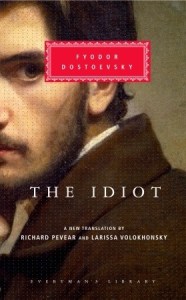
The edition of The Idiot that I read was the one pictured above, published by Everyman’s Library and translated by Pevear and Volokhonsky. This would maybe not have been my first choice of translation (this is the third of P&V’s Russian translations I’ve read and I’ve decided I’m not really a fan) but this is the book I already had on my shelf so it made sense to at least try it. Having said that, I found their translation of this particular book perfectly readable – though with a few strange word choices – and I’m sure I would still have found The Idiot a challenging read regardless of who it was translated by!

To clarify what I mean by ‘challenging’, I didn’t have any problem actually following the plot and understanding what was going on. This is really more of a character-driven novel than a plot-driven one anyway. Although I found it quite absorbing and was never bored, the pace is uneven and there are some long diversions in which various characters discuss religion or politics or philosophical ideas. Three chapters, for example, are devoted to a long confessional letter written by Ippolit, a young man who is dying from consumption – however, I thought this was one of the most powerful and moving sections of the book.

What I did struggle with at times was trying to interpret the actions and motivations of the characters, particularly the two main female characters, Nastasya and Aglaya. I won’t attempt an analysis of those two characters here, except to say that they are both so complex I’m not surprised the unsophisticated, unworldly Myshkin found it difficult to understand what they were really saying to him!

I enjoyed The Idiot a lot more than I thought I would, but I know I would have to read it again to be able to fully appreciate it. I don’t think I would want to do that in the near future but I will certainly try Crime and Punishment again and maybe The Brothers Karamazov as well.