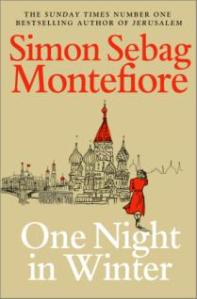
One Night in Winter by Simon Sebag Montefiore

One Night in Winter It’s Moscow, June 1945 and a Victory Parade is taking place to celebrate the defeat of Nazi Germany. A group of teenagers, all members of a secret literary society called the Fatal Romantics’ Club, meet on a bridge during the parade to re-enact a duel scene from the poet Pushkin’s Eugene Onegin. It’s supposed to be a game, but something goes tragically wrong and two of them are shot dead.

The secret police begin to investigate at the orders of Stalin himself, but it’s not clear whether the deaths were the result of an accident, a suicide pact or a murder. Because the teenagers involved in the incident are the children of some of the Soviet Union’s highest-ranking officials, they find themselves suspected of conspiring to overthrow the government. When the children are arrested and questioned they discover that the answers they give could incriminate their families and that innocent people could suffer.

More and more people are gradually drawn into the investigation and taken to Moscow’s Lubianka Prison where they are interrogated. As well as the members of the Fatal Romantics’ Club themselves (including eighteen-year-olds Serafima Romashkina, the daughter of a famous actress, and Andrei Kurbsky, son of an ‘Enemy of the People’), questions are also asked of their school teachers, parents and even two younger children aged just ten and six.

One Night in Winter is based on a real incident that occurred in 1943 and as you would expect, some parts of the book are quite harrowing, especially the descriptions of frightened children being made to testify against their own families, knowing that if they say the wrong thing they could be condemning a parent to death. Some of the parents, such as Hercules Satinov, have to continue working with and obeying Stalin even while knowing that he is responsible for the imprisonment of their children.

But this is also a book about love – in many different forms, whether it’s the romantic love between a man and a woman or the special bond between a parent and a child. Almost everyone in the novel seems to be in love with someone else and some of them are involved in secret romances. Over the course of the novel we see how far our characters are prepared to go to protect the ones they love. The secret police believe that a mysterious lover of Serafima’s could hold the key to the whole mystery. And the idea behind the Fatal Romantics’ Club is that “if we cannot live with love, we choose death”.

Simon Sebag Montefiore is a historian and the author of several historical non-fiction books which include a biography of Stalin. It’s obvious that he has an excellent knowledge of the period and its historical figures (Stalin himself has an important role to play in the novel) and his portrayal of life in Stalinist Moscow feels thoroughly researched and authentic. The settings include School 801, the exclusive school attended by all of the children in the story, the interior of Lubianka Prison, the dirty communal apartment where Andrei and his mother live and the luxurious homes of the Bolshevik leaders.

The only thing that was lacking in this novel was emotional impact and I do think this could have been improved if the author had chosen to focus on the viewpoint of just one or two characters, rather than switching between so many different characters. There are such a lot of people to keep track of that I found the character list at the front of the book absolutely essential and while I can understand the reasons for telling the story from different perspectives, it meant I struggled to form any strong emotional connections.

Simon Sebag Montefiore is a new author for me, but I am now interested in reading his other Russian novel, Sashenka.

I received a copy of this book from the publisher for review

The Midnight Rose by Lucinda Riley

The Midnight Rose Anahita (Anni) Chavan’s whole family are gathering at her hill-top bungalow in Darjeeling to celebrate her one-hundredth birthday, but even surrounded by her children, grandchildren and great-grandchildren, there is still one person missing. This is Moh, her beloved son, whom she has not seen since he was a small child. Everyone believes him to be dead…everyone except Anni who is sure that he is still alive somewhere in the world. A year later Anni herself has died, but before her death she had written down her story and entrusted it to her favourite great-grandson, Ari Malik, in the hope that he would try to find out what happened to her missing son.

Anni’s story leads Ari to Astbury Hall in England, where filming is currently taking place for a new period drama set in the 1920s starring the beautiful young American actress, Rebecca Bradley. When Lord Astbury invites her to stay at the Hall for the duration of the filming as a safe haven away from the world’s press, Rebecca gratefully accepts, hoping that the peace and quiet will give her a chance to decide what to do about her equally famous actor boyfriend, Jack, who has just proposed to her.

Soon Rebecca is drawn into Ari’s search for the truth about Anahita’s past and as her tragic story unfolds, we are taken back to India in 1911, where as a young girl Anni becomes friendly with Princess Indira, the daughter of the Maharaja and Maharani of Cooch Behar. She and Indira are sent to school in England just before the beginning of the Great War, and while staying with family friends at Astbury Hall in Devon the relationship Anni forms with Donald Astbury changes her life forever.

This is the third Lucinda Riley novel I’ve read (the other two were The Girl on the Cliff and The Light Behind the Window – I still need to read Hothouse Flower) and it’s my favourite of the three. Although there were times when I found the plot easy to predict and a few coincidences that felt too implausible, there were enough unexpected twists to keep me in suspense wondering what was going to happen next. I particularly loved the parts of the book set in India during the British Raj and also the insights into what life was like for a young woman trying to find a place for herself in a new and unfamiliar country.

Sometimes when a book is set in multiple time periods, the different threads of the story can feel disjointed and unconnected, but that was not the case here. They came together perfectly, with the secrets of Astbury Hall being slowly revealed as Ari and Rebecca discover them. As usual, though, I found myself enjoying the historical sections of the book more than the contemporary ones. The modern day characters do have storylines of their own – Rebecca’s troubled relationship with her boyfriend and Ari’s struggle to find the right balance between his work and his personal life – but they didn’t interest me as much as Anni’s. I thought Lucinda Riley’s writing really came alive in the sections about Anni – the dialogue felt vibrant and the characters were strong and memorable, especially Anni herself, her best friend Indira, and Donald’s cruel and manipulative mother, Maud Astbury, the villain of the book.

The Midnight Rose is a long novel (650 pages – and it’s one of those books that is physically big and heavy too) but once I became swept up into the story I stopped thinking about the number of pages and concentrated on enjoying Anahita Chavan’s fascinating tale.

I received a copy of this book from Pan Macmillan for review

Little Man, What Now? by Hans Fallada

Little Man What Now I know it’s only the middle of January and it’s ridiculously early to start talking about books of the year but I’ll be very surprised if this one is not on my list in December! I loved every minute of this funny and charming yet dark and poignant German novel from 1932.

Johannes Pinneberg (Sonny) and Emma Morschel (Lammchen) are a young German couple in their early twenties. After discovering that Lammchen is pregnant they get married and move into their first rented home together in the town of Ducherow. As they await the birth of their child (who they think of as The Shrimp), Sonny and Lammchen struggle to get by in the harsh economic conditions of 1930s Germany.

When Sonny loses his job (because his employer has discovered that he is married and no longer free to marry his daughter), he and Lammchen are forced to move to Berlin in search of work and cheaper accommodation. The trouble is, in times of high unemployment and widespread poverty, jobs are not easy to find and rents are high (and the situation isn’t helped by Sonny’s impulsive decision to surprise Lammchen with the expensive dressing-table she’d set her heart on, or Lammchen, suffering from cravings, eating all the salmon on her way home with the shopping). But while others around them lie, cheat and think only of themselves, the honest, hard-working Pinnebergs are determined to survive and to create a happy, safe environment for their new baby.

It was such a relief to find that I loved this book, as I’ve had mixed experiences with Hans Fallada’s novels in the past. Alone in Berlin, which I read in 2011, remains one of my favourite books that I’ve read since I started blogging, but the next one I picked up, A Small Circus, was a huge disappointment and put me off wanting to try any more of his books. I was hesitant to start reading Little Man, What Now? but I’m so glad I did because the problems I had with A Small Circus – the translation, the unlikeable characters, the unfamiliar politics and the fact that most of the novel was written in the form of dialogue – were not problems at all with this book. I was happy with the translation (though I wish I was able to read it in its original German), the Pinnebergs were both lovely, the politics stayed in the background and there was a good mixture of dialogue, action and description.

The book was originally published in 1932 in German as Kleiner Mann, was nun? and a successful film version followed. It’s easy to see why it was so popular, as according to the Afterword, 42% of German workers were unemployed in 1932 (compared with 22% in Britain) and many people would have been able to identify with Lammchen and Sonny. The book still feels relevant today, with many countries around the world suffering high unemployment in recent years. In 1930s Germany, the resulting poverty opened the way for the National Socialist and Communist parties. Yet the novel is far less political and far more domestic than I thought it would be at first.

As Sonny moves from job to job he meets people from a range of different backgrounds and religious or political beliefs, but he doesn’t side with or against any of them; his biggest concerns are for his wife and unborn child. This is not a story that deals with the bigger issues of the time, but about the immediate day to day struggles that ordinary people faced. Sonny is the ‘little man’ of the title, aware that he is only one of millions in the same position, but what sustains him throughout his ordeals is his love for Lammchen and his knowledge that however hard things may be he is still lucky in so many ways.

I liked both of the Pinnebergs from the beginning. I couldn’t help thinking how rare it is that we actually get to read a book about the daily lives of a couple who are happily married, rather than a book that deals with the breakdown of a marriage or one that ends with the wedding rather than beginning with it, as this one does. Sonny and Lammchen are a husband and wife who really love each other, who discuss things together and make decisions as equals. Their story feels completely realistic and the problems they face are the same problems that many young married couples will face: managing their money, finding somewhere to live, worrying about their jobs and preparing for the arrival of their first child. There’s an innocence about Lammchen and Sonny that makes them completely endearing and I think it would be almost impossible to read this book and not fall in love with them both!

While this book is available for Kindle, it seems that paperback and hardback copies of this particular Fallada title are harder to find. If you do have the opportunity to read it I hope you’ll enjoy this glimpse of 1930s German life as much as I did.

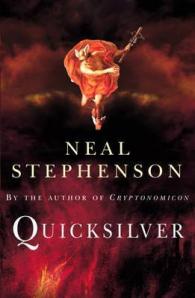
Quicksilver by Neal Stephenson

Quicksilver Quicksilver is the first of Neal Stephenson’s Baroque Cycle, a series of novels set during the 17th century. I had been interested in reading this book for a long time but was putting off reading it because of its length (over 900 pages) and its reputation for being a very difficult, challenging read. I don’t have a problem with long, difficult books but need to be in the right frame of mind to begin reading them.

At the beginning of the novel, the mysterious Enoch Root arrives in Boston, Massachusetts, to deliver a letter to Daniel Waterhouse, an English Puritan and natural philosopher, asking him to return to England to solve a dispute between the mathematicians Isaac Newton and Gottfried Wilhelm Leibniz over who was first to invent calculus. As Daniel voyages home across the Atlantic, pursued by the pirate Edward Teach, we are given a series of flashbacks to the 1660s and his time at Trinity College, Cambridge where he first met Isaac Newton and the other famous scientists of the period.

At the end of the first part, we leave Daniel Waterhouse’s story behind for a while, to be picked up again later. The middle section of the book follows the adventures of Jack Shaftoe, a ‘vagabond’, who rescues a beautiful slave, Eliza, from a Turkish harem during the 1683 Siege of Vienna. Together they travel across half of Europe, ending in Amsterdam, where Eliza becomes involved in the world of trade and banking. We then rejoin Daniel Waterhouse again just before the death of King Charles II and the Glorious Revolution.

In the two paragraphs above I have only given a very basic outline of what Quicksilver is about. It would be impossible for me to mention everything! The book covers almost every important historical event of the period including the plague, the Great Fire of London and the Restoration – and there are appearances from everyone you can think of, from Newton and Leibniz to Samuel Pepys, William of Orange and Benjamin Franklin. Stephenson also mixes some different forms of writing into the novel, so that although most of the book is written in normal prose there are also some sections presented as a play or as minutes from a meeting or letters written in code.

As I said, I had been curious about this book for a while but now that my curiosity has been satisfied I can safely say that I won’t be continuing with the other two books in the trilogy! There were parts of the book that I enjoyed but overall I thought it was too much effort for too little reward – and I say that as someone who is usually happy to read big, complex books that require effort from the reader. Part of my problem could have been that I probably tried to rush through the book too quickly (if you can call spending two months on a book ‘rushing’; I started reading one day in November and finished just before the New Year). Maybe I should have tried reading it over six months or even a year, putting it aside for a while when I got bored with it – looking at other reviews, this seems to be what a lot of people recommend. But really, once I got halfway through I just wanted to be finished with it.

I should point out that I didn’t actually hate Quicksilver and there were times when I became completely immersed in its world. I enjoyed reading about the early days of the Royal Society and the work of its members and here I was reminded of An Instance of the Fingerpost by Iain Pears. There were detailed descriptions of their experiments and discoveries and we learn about a wide range of scientific topics including sundials, clocks and telling the time, the development of language and vocabulary, the formulation of the laws of gravity and the development of calculus. Most of this was fascinating (though be warned that there are some gruesome experiments on animals described in graphic detail) and I particularly loved the characterisation of Isaac Newton as an eccentric genius, forgetting to eat and sleep, and sacrificing his health in the name of science. Often, though, the story seemed to disappear under pages and pages of exposition (sometimes complete with diagrams and notes) and I felt I was reading a science textbook rather than a work of fiction.

There were also a few other things that I found very irritating, such as the spelling of the word fancy as phant’sy and the fact that, in the middle section of the book in particular, there is absolutely no attempt to use dialogue suitable to the time period. I understand that this is not your average ‘historical fiction’ novel and Stephenson probably had a good reason for his choice of language, but modern slang spoken by historical characters is something that nearly always annoys me, whatever the reason.

But the biggest problem, for me, was that the novel has no real plot – or at least, there’s no single plot that runs through the book from beginning to end. Instead there are lots of disjointed subplots, lots of ideas and concepts, but they never come together at any point to form an engaging story. When I came to the end of the book I didn’t feel the sense of accomplishment and satisfaction that I felt on finishing other long books like War and Peace, for example, or Clarissa or Les Miserables; all I felt when I finished Quicksilver was relief – and that was disappointing after the time I’d invested in it and the high expectations I’d had. On a more positive note, I do feel that I’ve learned a lot about 17th century science, religion and politics – though whether I understood it all is a different matter!

I think I’ll end this post here before it becomes as long as Quicksilver itself. Clearly there are a lot of people who have loved this book and the other two in the Baroque Cycle, so if this sounds like something you would enjoy please don’t let me put you off it!

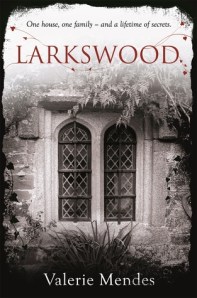
Larkswood by Valerie Mendes

Larkswood - Valerie Mendes “One house, one family and a lifetime of secrets” it says on the front cover of Larkswood, a new novel from Valerie Mendes set in England in 1896 and 1939. The house is Larkswood House, a mansion in the Hampshire countryside, the family are the Hamiltons (three generations) and the secrets…well, obviously I’m not going to tell you those, but will leave you to discover them for yourself if you choose to read this book.

In 1939, Louisa Hamilton is in London for the Season with her parents and sister, Milly. Louisa has just turned seventeen and is preparing for her ‘coming out’, but she can’t help thinking that it’s all very silly and boring; she would much rather be at home reading Jane Austen. The day after she attends her first ball, she becomes ill with glandular fever and is sent to Larkswood, her grandfather’s house, to recuperate.

Edward Hamilton, Louisa’s grandfather, has just returned home from India where he has lived for the last forty-two years, haunted by the memory of the tragic events of the summer of 1896. As Louisa regains her strength at Larkswood and starts to form a bond with Edward, she begins to uncover the truth about what happened all those years earlier. Louisa’s story, unfolding in the months leading up to the beginning of the Second World War, alternates with the story of Edward and his two sisters, Cynthia and Harriet.

It was the striking front cover that first drew me to this book, so I was pleased to find that the story inside was enjoyable too. I guessed most of the novel’s big secrets before the truth was revealed, but that wasn’t really a problem and the fun was in wondering when Louisa would find out and what she would do with the knowledge. I did find some of the language used in the dialogue quite irritating – the working class characters seemed to finish almost every sentence with “that’s for certain sure” and generally sounded a bit stupid, I thought – but not so irritating that it spoiled the rest of the novel for me. The plot was entertaining enough that I could enjoy the book while still being aware of its flaws.

Away from the novel’s central storyline, I also enjoyed reading the letters sent to Louisa by her sister Millicent (or Silly Milly, as Louisa calls her) who is still in London spending her days in a whirlwind of parties and dances. Milly’s letters are fun to read but also give some insights into the war preparations in London as they appear to a shallow, self-absorbed young woman who doesn’t want the good times to end. I was reminded here of The Last Summer by Judith Kinghorn – a different war and a very different plot, but a similar setting and atmosphere.

I understand that Valerie Mendes has written several books for young adults, but this is her first historical novel for adults. I’ll be hoping for more!

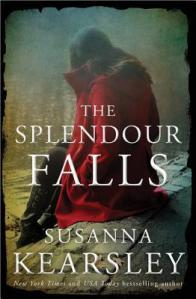
The Splendour Falls by Susanna Kearsley

The Splendour Falls This is the fifth Susanna Kearsley book I’ve read and while I’ve enjoyed them all (I think The Firebird is my favourite) I found this one a bit different from most of the others. Usually Kearsley’s novels include a supernatural element and some form of time-travel, whether it’s via telepathy, reincarnation or being physically transported through time, but this book doesn’t have anything like that, being set almost entirely in the present.

The Splendour Falls is narrated by Emily Braden, who has agreed to join her historian cousin, Harry, on a trip to Chinon in France where he is planning to do some research on the Plantagenets. Knowing Harry’s absent-mindedness and lack of consideration for other people, she is not surprised when she reaches Chinon and discovers that her cousin is nowhere to be seen. As she waits for him to arrive, Emily forms some new friendships among the other guests staying in her hotel and also becomes intrigued by the stories of two Isabelles who lived in Chinon several centuries apart.

The first is the 13th century queen, Isabelle of Angouleme, wife of King John of England, who may have hidden some treasure in the tunnels beneath Chinon while the castle was under siege from John’s enemies. The second Isabelle lived during World War II and is also believed to have hidden a treasure of her own to keep it safe from the Nazis. As Emily begins to grow concerned for her missing cousin she learns more about both Isabelles and their lost treasures. Could they be linked to Harry’s disappearance?

I enjoyed The Splendour Falls but it’s not one of my favourite Kearsley novels as I do prefer the ones with stronger historical elements (I really wanted more information on the two historical Isabelles). This is more of a mystery novel than a historical novel and in this respect it reminds me of Every Secret Thing more than any of her other books. I think one of the things I liked best about this book was the setting. Kearsley’s descriptions of Chinon – the narrow streets and steps, the vineyards, the medieval castle (the Château de Chinon) and the Chapelle Sainte-Radegonde – are all so beautiful. I’ve never been to that part of France but this book had me instantly searching Google for pictures and it does look as lovely as it sounds.

My only problem with The Splendour Falls was trying to keep track of all the characters. A huge number of them were introduced in the first few chapters, including two Canadian brothers, a French vineyard owner, a British musician, a German artist, an American couple and a gypsy. It was completely overwhelming and I felt I didn’t have time to get to know one character before another one appeared! I also found it hard to believe that Emily would instantly become such good friends with a group of random strangers staying in the same hotel.

This book has been reissued by Sourcebooks for the first time this week, but it’s not a new Susanna Kearsley novel. While I was reading I kept thinking that the ‘present day’ setting felt slightly dated – there was a noticeable lack of modern technology which would surely have made Emily’s attempts to contact Harry a lot easier – and the explanation for this is that the book was originally published in 1995. I wouldn’t recommend this as a first introduction to Kearsley’s work, but I think existing fans will probably find a lot to enjoy in The Splendour Falls, as I did.

I received a copy of this book from NetGalley for review

Reading Don Quixote in 2014

Nearly two weeks into 2014 and so far I’m still happy with my strategy of reading what I want to read when I want to read it. One thing I’m missing, though, after taking part in year-long readalongs of Clarissa in 2012 and War and Peace in 2013, is having a long classic on my reading pile which I can divide into manageable monthly instalments. I looked at my Classics Club list and chose the longest unread book on the list, which is…

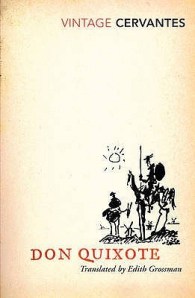
Don Quixote - Edith Grossman

Don Quixote by Miguel de Cervantes.

Synopsis from Goodreads: Don Quixote has become so entranced by reading chivalric romances, that he determines to become a knight-errant himself. In the company of his faithful squire, Sancho Panza, his exploits blossom in all sorts of wonderful ways. While Quixote’s fancy often leads him astray-he tilts at windmills, imagining them to be giants-Sancho acquires cunning and a certain sagacity. Sane madman and wise fool, they roam the world together, and together they have haunted readers’ imaginations for nearly four hundred years.

So, I’m going to be reading Don Quixote in 2014! Any advice on which translation to read would be welcome. I know Edith Grossman’s translation (pictured) was very well received a few years ago but I’ve also heard that John Ormsby’s older translation is more faithful to the original (it’s also available as a free ebook which is an advantage, but I don’t mind paying for a better version).

I don’t want to set a fixed number of pages that I have to read every month as I don’t want to feel under any pressure, but I will probably aim for somewhere between 100-200 pages a month. I decided not to make this an official readalong as I wasn’t sure anyone else would want to participate and I’m not very good at sticking to schedules anyway, but if anyone else is reading it or planning to read it soon, please let me know – it would be interesting to compare our thoughts at the end!