Best Books of 2012

It’s that time of year again when I look back at the best books I’ve read over the last twelve months. And unlike last year, when I had so much difficulty narrowing down my choices, this year I found it very easy…

My favourite books of the year

The Game of Kings - Lymond Chronicles

The Lymond Chronicles by Dorothy Dunnett

Not one book but six: The Game of Kings, Queens’ Play, The Disorderly Knights, Pawn in Frankincense, The Ringed Castle and Checkmate. I don’t think anyone who has been following my blog all year will be surprised to see this series at the top of my list!

From my review of the final book, Checkmate: For anyone who has yet to read these books, I can promise you that although they’re not the easiest of reads, it’s definitely worth making the effort and getting to know Francis Crawford of Lymond, one of the most complex, charismatic, fascinating characters you’re ever likely to meet in literature. Working through the six books of the Lymond Chronicles has been one of the greatest experiences in my lifetime of reading.

Niccolo Rising

The House of Niccolò by Dorothy Dunnett

Again I’m including six books here: Niccolò Rising, The Spring of the Ram, Race of Scorpions, Scales of Gold, The Unicorn Hunt and To Lie with Lions. There are actually eight in the series, but I haven’t finished Caprice and Rondo yet and still need to read Gemini.

From my review of The Spring of the Ram: One of the things I love about Dorothy Dunnett’s books is that they give me an opportunity to learn about people and places I might never have known anything about otherwise. Dunnett’s novels open up whole new worlds, focusing on periods of history and geographical locations that are usually ignored in historical fiction.

Other books I enjoyed this year

Here Be Dragons

Here Be Dragons by Sharon Penman

From my review: Here Be Dragons is the first in Penman’s Welsh Princes trilogy and follows the lives of King John’s daughter, Joanna, and her Welsh husband, Llewelyn ab Iorweth (known as Llewelyn the Great)…The relationship between Joanna and Llewellyn forms a big part of the plot, but that’s not all this book is about. As well as romance, the story also includes political intrigue, battles, feuds, rivalry between brothers, betrayal and forgiveness.

Scaramouche

Scaramouche by Rafael Sabatini

From my review: From the wonderful opening line of this 1921 novel by Rafael Sabatini (“He was born with a gift of laughter and a sense that the world was mad”) I could tell I was going to love Scaramouche! And I did – it’s one of the best books I’ve read so far this year.

Wolf Hall

Wolf Hall by Hilary Mantel

From my review: It was good to read a novel that showed Cromwell not as a villain, but as an intelligent, charismatic, complex human being with both positive and negative qualities…Every little piece of information Mantel gives us, however trivial it may seem, helps to slowly build a full and vivid picture of daily 16th century life.

The Scarlet Pimpernel

The Scarlet Pimpernel by Baroness Orczy

From my review: A quick read and lots of fun too: a combination of swashbuckling adventure story, historical fiction and romance. It’s one of those novels where you sit down planning to just read one or two chapters and before you know it you’re halfway through the book!

The Handmaid's Tale

The Handmaid’s Tale by Margaret Atwood

From my review: What makes this book so disturbing is that the type of community Atwood is writing about is not completely far-fetched or implausible. Many of the things she describes are things that have actually happened in some part of the world at some time in the past, or that might even still be happening at this moment, and so the depiction of Gilead is terrifyingly believable.

The Master of Verona

The Master of Verona by David Blixt

I finished reading this book on Christmas Eve, just in time for it to make an appearance on this list. I haven’t had a chance to post my thoughts on it yet, but I loved it and am looking forward to reading the sequel.

And these deserve a special mention too:

The Beekeeper’s Apprentice by Laurie R. King
I Capture the Castle by Dodie Smith
The Gods of Gotham by Lyndsay Faye
The Sultan’s Wife by Jane Johnson
The Conductor by Sarah Quigley
Madensky Square by Eva Ibbotson

Have you read any of these? What are your favourite books of the year?

To Lie with Lions by Dorothy Dunnett

To Lie with Lions To Lie with Lions is the sixth volume in the House of Niccolò series and although I loved it, this is not the place to start if you’re new to Niccolò. To be able to fully appreciate this book, you really need to have read the series from the beginning and, in particular, you need to read the fifth book, The Unicorn Hunt, before this one. To Lie with Lions picks up a lot of the threads from The Unicorn Hunt and in some ways I thought they almost felt like two halves of the same novel, so please be aware that if you haven’t read all of the previous five books yet you will encounter spoilers in the rest of this post.

***

In To Lie with Lions, Nicholas de Fleury returns to Scotland with his wife, Gelis, and son, Jodi. On the surface it may appear that he and Gelis have been reconciled; in reality, the mysterious ‘game’ they are playing is about to enter its final stages. Meanwhile, as Nicholas continues to make himself indispensable to the young King James III of Scotland and his court, he also becomes embroiled in the conflict in Europe between the King of France and the Duke of Burgundy – but which, if either, is he really working for?

Previous books have dealt with the trade of alum, silks, sugar, gold and slaves; this book looks at the trade of another commodity: stockfish (dried, unsalted fish). To find these supplies of fish, Nicholas must embark on a sea voyage to Ultima Thule – Iceland and the Westmann Islands. As usual, he has more than one reason for this trip, and to make things even more interesting, the Bank of Niccolò’s rivals, the Vatachino and Anselm Adorne, as well as Paúel Benecke of the Hanseatic League, are also on their way to Iceland. There were a lot of dramatic scenes and set pieces in this book – a walk through the ducal château of Hesdin where traps and practical jokes lie around every corner; a game of Florentine football on the castle walls in Edinburgh; skating on the frozen Nor’ Loch – but it was this excursion to Iceland in the middle of the novel that I found the most memorable. There’s some beautiful descriptive writing in this section of the book, bringing to life all of Iceland’s distinctive natural features – the glaciers, geysers, hot springs and volcanoes – and the wildlife – the eagles, ‘white bears’ and ptarmigans. The descriptions of the volcanic eruptions are stunning and made me think how much more frightening and awe-inspiring such phenomena must have been in Nicholas’s time.

“The Mouth of Hell opened when they were a long way out to sea, and the glacier over Katla lifted its city of ice into the sky…Now, you could no longer diminish what was happening by translating it into human dimensions. This was not a play. This was the hurling into the sky of thousand-ton blocks of ice, glinting and roseate in the thundering night. This was the discharge of millions of gallons of boiling water, plunging down from the mountain in a wild dashing glitter, outrunning the billows of its own pink-flushed steam.”

As with all of Dunnett’s novels, there are things that seem confusing at the beginning but have taken on new meaning by the end of the book. Among other things, we finally discover, after endless hints about ‘the game’ Nicholas and Gelis were playing, what it was all about and what each of them was hoping to achieve; we learn why Godscalc had been so determined to keep Nicholas from returning to Scotland; and the reason for Nicholas’s reaction to the Nativity Play he had worked so hard on and received so much praise for. After disliking Nicholas throughout most of The Unicorn Hunt, I found him more likeable again in this book, rather like Tobie, who returns to Nicholas’s side filled with hope that perhaps he is not beyond redemption after all. Tobie, with his ever-changing opinion of Nicholas, is someone I can definitely identify with! We do see some evidence of Nicholas’s warmer, more human side again in the relationships he forms with Kathi Sersanders and Robin of Berecrofts (two of my favourite characters) in Iceland and in the effort he makes to bond with Jodi.

It seems, though, that Nicholas often gets so carried away with the intricacies of his elaborate machinations that he forgets, or ignores, the fact that his schemes are affecting real people’s lives. And after feeling so much more sympathetic towards him during this book than I did during the last one, the revelations in the final chapters caused me, like many of his friends and colleagues, to become disillusioned with him again. Still, I was pleased that the contest between Nicholas and Gelis had finally come to an end and I was left with the feeling that one episode is over and a new one is about to begin.

Memories of A Christmas Carol: a Classics Club meme

The Classics Club monthly meme question for December asks us for our thoughts and memories of A Christmas Carol by Charles Dickens:

What is your favorite memory of Dickens’ A Christmas Carol? Have you ever read it? If not, will you? Why should others read it rather than relying on the film adaptations?

A Christmas Carol I was given a copy of A Christmas Carol as a Christmas present when I was a child, though I don’t know exactly how old I was. I can’t remember who gave it to me either, but I suspect it was probably an aunt or uncle. I remember taking the book with me to my grandmother’s a few days after Christmas and reading those famous opening lines for the first time:

Marley was dead, to begin with. There is no doubt whatever about that.

The last time I re-read the book was in 2009, shortly after I started blogging, and it was still a pleasure to read – both the story itself and this particular edition. It’s a beautiful hardback book with colour illustrations and black and white line drawings by Arthur Rackham. Reading a book that looks and feels beautiful can really enhance the experience! Rackham’s twelve colour plates, originally published in 1915, can be seen here. I’ve always liked the one of Bob Cratchit sliding down the icy street.

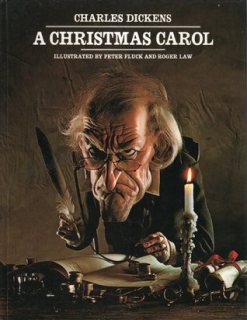
I received a different edition of the book a few years later from another family member (again I’ve forgotten who it was). I’m not sure where I’ve put this one, though I know I must still have it somewhere. After a lot of searching online – which wasn’t easy, as there are literally hundreds of different versions of A Christmas Carol and I couldn’t recall the names of either the illustrators or the publisher – I managed to find a picture of the front cover for you:

A Christmas Carol - Peter Fluck and Roger Law This edition, which I’ve discovered was published by Viking, was illustrated by Peter Fluck and Roger Law (who were also the creators of Spitting Image) with pictures of grotesque puppet-like caricatures, like the one of Scrooge pictured on the cover.

There have been so many adaptations of A Christmas Carol, but although the story and the sentiment might be the same, if you only watch them instead of reading the novel you will be missing out on so much. As I said in my 2009 post on the book, even if you already know the story it’s still worth reading it for the richness and humour of Dickens’ writing and for his wonderful descriptions and imagery.

You can see how other Classics Club members responded to this month’s meme here.

Have a great Christmas and I’ll be back later in the week with my Best Books of 2012!

The Queen’s Promise by Lyn Andrews

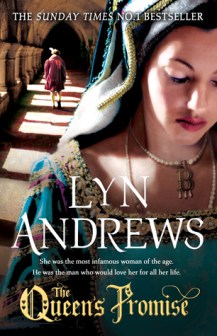
The Queens Promise Everyone knows that Anne Boleyn was one of the six wives of Henry VIII, but did you know that before her marriage to the King, Anne was secretly betrothed to another Henry – Henry Percy, son and heir of the 5th Earl of Northumberland? The Queen’s Promise is the story of Anne and Henry’s relationship.

When you try a new author for the first time you can never be quite sure what to expect. Until I read The Queen’s Promise I was unfamiliar with Lyn Andrews’ work, but after doing some research I discovered that she has written many bestselling family sagas which, although they have obviously been very successful, don’t look like books that would appeal to me. The Queen’s Promise seems to be a new genre for Andrews; I think this is her first historical fiction novel and based on this one, I hope she writes more. I’ll admit that when I first started to read it I thought it would be just another Tudor court romance – an impression not helped by the title and cover of the novel which do absolutely nothing to set the book apart from others of this type – but I was pleased to find that although there was certainly a romantic aspect to the story, it also had a detailed and well-researched historical background with almost as much attention given to the history and politics of the period as to the romance between Anne and Henry Percy.

Anne’s marriage to Henry VIII and the events leading to her death have been well documented in both fiction and non-fiction. However, in this novel there is actually more focus on Henry Percy than there is on Anne, which was the right choice in my opinion. Anne is such a popular subject for historical fiction and there’s not much that can be said about her that hasn’t been said before, but Henry Percy, on the other hand, is a historical figure who is less well known and Andrews does go into quite a lot of depth on not just his relationship with Anne, but also his life before and after Anne.

As so much of Henry’s life was spent in Northumberland, we are given a lot of information about the Border Reivers, who raided both sides of the English/Scottish border, and Henry’s role as Lord Warden of the Marches. Life in the borders was wild and dangerous in those days and it was not easy to maintain law and order there. We see how difficult it was to keep the peace between Northumberland’s feuding families and protect the people from outlaws while always being aware that there could be an attack from the Scottish side of the border at any time. I’m always looking out for books set in Northumberland as I’m from the North East myself and it was interesting to read about so many places I know – Alnwick, Hexham, Prudhoe, Warkworth – and to have the chance to add to my knowledge of the region’s history.

I really liked the way Henry Percy is portrayed as being refreshingly different to most of the other young men at the Tudor court – loyal, sincere and honest, but also quiet, cultured and sensitive, qualities which sadly make him a disappointment to his father, the Earl. It’s not a happy story for Henry – he also has to fight a recurring illness and to come to terms with being forced into a loveless marriage to Mary Talbot, the Earl of Shrewsbury’s daughter – and of course it isn’t a happy story for Anne either. I did like the young Anne we meet in the earlier chapters of the book, though after she begins her rise to becoming Queen she becomes much harder and a less sympathetic character.

Much of Henry’s and Anne’s story is seen through the eyes of Henry’s friend and squire, Will Chatton, who joins Henry’s household as a boy of eleven and later becomes a successful merchant. Will and his family are purely fictitious characters but they add another interesting angle to the story. As well as allowing us to observe Henry and Anne from a third perspective, the inclusion of the Chatton family gives us the chance to explore another side of Tudor society, away from life at court.

I enjoyed this book, after my initial concerns had proved to be unfounded. It was interesting, very readable and the focus on Henry Percy makes it slightly different from other Anne Boleyn-based historical fiction. It also raises the intriguing question of whether, if Anne and Henry had been allowed to be together as they wished, what impact would this have had on the future of the royal family and the whole course of history?

Clarissa by Samuel Richardson (final thoughts)

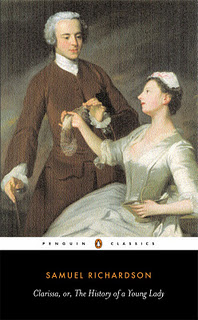
Clarissa I have never been so relieved to reach the end of a book! It’s not that I didn’t enjoy Clarissa, but when I embarked on JoAnn and Terri’s year-long group read back in January, I don’t think I fully understood what a huge commitment it was going to be. But even though reading Clarissa did sometimes feel like a chore, there was still something very compelling about it and I knew I would keep reading until I had finished, however long it took.

Clarissa, or The History of a Young Lady, published in 1748, is the story of Clarissa Harlowe, a beautiful and virtuous young woman who suffers at the hands of the unscrupulous ‘libertine’ Robert Lovelace. Clarissa has long been loved and admired by her friends and family, but this changes when she refuses to marry Mr Solmes, the man her parents have picked out for her. Forbidden to communicate with Lovelace and under increasing pressure to accept Solmes, Clarissa becomes virtually a prisoner in her family’s home. Isolated and desperate, she agrees to escape with Lovelace but soon finds herself at the mercy of cruel schemes designed to break down her virtue and attack her moral integrity.

Clarissa is completely epistolary – that is, the whole story is told in the form of 537 letters dated between 10th January and 18th December of the same year. The original aim of our group read was to read each letter on or around the dates given in the book, although that quickly became impossible because some letters were undated, multiple letters were sent by different people on the same day, and other letters were received in the wrong order or withheld until weeks later. Samuel Richardson must have been amazingly well organised, as there are also lots of cross references, with letters referring to something that had been mentioned in a previous letter, sometimes one that had been written many months earlier. This is where reading the Kindle version of the book was a disadvantage, as I would have found it so much easier to flick backwards and forwards in the paperback version!

There are four main correspondents in the book: Clarissa herself, her best friend Anna Howe, Lovelace and his friend Mr Belford, and I appreciated the way Richardson attempted to give each of them a different, distinctive voice of his or her own – something so important in an epistolary novel. There are letters sent to and from other characters too, but these are the four we spend most time with and get to know over the course of the novel.

I didn’t dislike Clarissa because, really, there was nothing to dislike but I do find perfect characters boring to read about and I couldn’t help wishing she’d had a few flaws. Still, if Clarissa had been flawed then Lovelace would probably not have been so attracted to her, his plots would have lost their effect and there would have been no story for us to read! I did admire the way she stayed true to herself and never tried to take the easy way out and I could certainly sympathise with her as the full extent of Lovelace’s wicked schemes became apparent and we could see how she had been manipulated and tricked by him. As for the Harlowes, they were completely vile, particularly her father, brother James and sister Arabella, who gave no thought to what Clarissa might want and were prepared to force her into marriage with a man she didn’t love because of the advantages it would bring to the family. The one bright spot in Clarissa’s life and the thing that sustains her through all her troubles is her friendship with Anna Howe. Anna’s personality is very different to Clarissa’s – she’s a more forceful, outspoken person than Clarissa – so she sometimes gives her the wrong advice but there’s obviously a lot of love and warmth between the two of them.

Apparently Samuel Richardson was disappointed to discover that so many of his readers actually liked Lovelace! That was not what he intended at all and he even adds a footnote to this effect at the end of one of the letters. Lovelace is a despicable person and really is the villain Clarissa’s family make him out to be, but he is also a great character and whenever he makes an appearance the story becomes imbued with a new energy and sense of excitement. In comparison to the letters written by Clarissa, Anna or Belford, his letters are more fun to read: flamboyant and entertaining – filled with poetry, quotations, classical references and lots of self-congratulations and flourishes. He revels in his badness and brags about it in his letters to Belford:

“Here have I been at work, dig, dig, dig, like a cunning miner, at one time, and spreading my snares, like an artful fowler, at another, and exulting in my contrivances to get this inimitable creature, absolutely into my power.”

Our fourth letter writer, Belford, is probably the character who changes and develops the most over the course of the novel. At first I found him quite bland and it seemed his only real purpose in the story was as an outlet for Lovelace’s letters, although there are hints from early on that Belford, despite also being described as a libertine, disapproves of his friend’s behaviour:

“‘Tis a seriously sad thing, after all, that so fine a creature should have fallen into such vile and remorseless hands: for, from thy cradle, as I have heard thee own, thou ever delightedst to sport with and torment the animal, whether bird or beast, that thou lovedst, and hadst a power over.”

Belford eventually begins to emerge as a decent person with a sense of honour and responsibility, although he does still retain some affection for Lovelace – even when Lovelace sends him letters like this:

“Confound thee for a malicious devil! I wish thou wert a post-horse, and I upon the back of thee! how would I whip and spur, and harrow up thy clumsy sides, till I make thee a ready-roasted, ready-flayed, mess of dog’s meat; all the hounds in the country howling after thee, as I drove thee, to wait my dismounting, in order to devour thee piece-meal; life still throbbing in each churned mouthful!”

Richardson’s prose really is wonderful – it can be alternately dramatic and moving, flippant and funny, or beautiful and thought-provoking. I’ve included a sample of quotes in this post already, but here are a few others I particularly liked:

“We must not, in short, expect that our roses will grow without thorns: but then they are useful and instructive thorns: which, by pricking the fingers of the too-hasty plucker, teach future caution. And who knows not that difficulty gives poignancy to our enjoyments; which are apt to lose their relish with us when they are over easily obtained?” – Clarissa to Anna Howe

*

“You must not wonder at my inquiries, Mr. Belford, said she; For who is it, that is to undertake a journey into a country they never travelled to before, that inquires not into the difficulties of the road, and what accommodations are to be expected in the way? I gave her a brief account of the poor man’s terrors, and unwillingness to die: and, when I had done, Thus, Mr. Belford, said she, must it always be with poor souls who have never thought of their long voyage till the moment they are to embark for it.” – Belford to Lovelace

*

“What briars and thorns does the wretch rush into (a scratched face and tattered garments the unavoidable consequence) who will needs be for striking out a new path through overgrown underwood; quitting that beaten out for him by those who have travelled the same road before him!” – Lovelace to Belford

*

“And yet great engines are often moved by small springs. A little spark falling by accident into a powder-magazine, hath done more execution in a siege, than an hundred cannon.” – Lovelace to Belford

*

“And I think, that smooth love; that is to say, a passion without rubs; in other words, a passion without passion; is like a sleepy stream that is hardly seen to give motion to a straw. So that, sometimes to make us fear, and even, for a short space, to hate the wretch, is productive of the contrary extreme.” Anna Howe to Clarissa.

*

There were times when I just couldn’t believe how slowly I was progressing through this book. I don’t think it was actually the length that was the problem – it was the repetitiveness. Richardson could literally spend hundreds of pages describing the events of one or two weeks in Clarissa’s life. The Harlowe family’s endless attempts to get Clarissa to give in and marry Mr Solmes went on and on and on…going round in circles, doing nothing to move the plot forward other than to reinforce how helpless and trapped Clarissa was. After Clarissa leaves her parents’ house and falls into Lovelace’s clutches, things do get more exciting – although this book was written in the 18th century, not the 19th, the plot has a lot of the elements we find in the Victorian sensation novels written more than a hundred years later: escapes and abductions, disguises, duels, wills and inheritances – but the pace is still painfully slow.

When I finally reached the end of volume 9 of 9 it was with mixed feelings: relief, a sense of accomplishment and also sadness – after spending a whole year with Clarissa, Lovelace, Anna and Belford, I now feel that something is missing from my life. If you’ve read Clarissa, either as part of this group read or in the past, I’d love to know what you thought of it!

Jasmine Nights by Julia Gregson

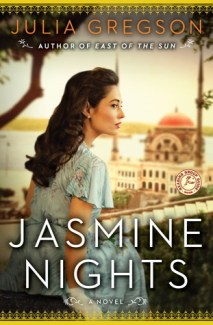
Jasmine Nights It’s 1942 and World War II fighter pilot Dom Benson is recovering in hospital after being injured in a plane crash. It is here that he meets Saba Tarcan, a talented young singer who has come to entertain the wounded soldiers in Dom’s hospital ward. Saba and Dom are instantly attracted to each other but before their relationship has a chance to develop, Saba passes an audition to join ENSA (Entertainments National Service Association) and is sent to North Africa to perform for the troops.

Soon after her arrival in Cairo, Saba is approached by the Secret Service and finds herself agreeing to spy for them. She is under strict orders not to tell anyone about her mission, but when Dom returns to action with the Air Force and is also sent to Egypt will their relationship be able to withstand Saba’s secrets?

I love reading novels set during World War II and I particularly enjoy those that approach the subject from an unusual perspective or cover aspects of the war that we don’t often hear about. Jasmine Nights does both, so it really should have been a book that I loved. Unfortunately it wasn’t. I had no problems with the style of Julia Gregson’s writing, I thought the settings – wartime Cairo, Alexandria and Istanbul – were fascinating to read about and there was certainly enough material here to form a compelling story. It just lacked that special spark that would have transformed it into a book that I could wholeheartedly recommend.

Individually, both Saba and Dom are interesting, complex characters. Despite her strict Turkish father disapproving of her choice of career, Saba is ambitious and determined to fulfil her dreams of becoming a successful singer and escaping the monotony of her life in Wales, even if it means losing contact with her family. After joining ENSA, Saba is forced to juggle her relationship with Dom, her singing career and her desire to serve her country and help the war effort. Over the course of the novel, she has to make some difficult decisions and try to decide which of these things is most important to her. Dom also has an interesting story of his own and we see him struggling to come to terms with the idea of flying again after his crash and his guilt about escaping death when some of his close friends were not so lucky.

I liked both main characters but their romance never felt very natural or believable to me. A wartime love story should be very emotional but this one left me unmoved and I would have preferred more focus on the spying storyline instead. I knew female entertainers sometimes acted as spies during the war, but I’ve never read about the subject in a novel before and this was what had initially attracted me to this book. Sadly, I found this aspect of the story disappointing too. There was a lot of build up but it seemed to take such a long time before Saba found herself in any real danger and for a book about war and espionage it was strangely unexciting, without any of the suspense and tension I would have expected.

I did enjoy the descriptions of life as part of ENSA and the variety of colourful characters Saba meets in the troupe, including Janine the dancer, Willie the comedian and one of the other singers, Arleta, who becomes a good friend of Saba’s and was probably my favourite character. But this was not enough to rescue the book for me and I just felt that there was not enough depth, not enough emotion and none of the magic I was hoping for in a book that had sounded so promising.

The Light Behind the Window by Lucinda Riley

The Light Behind the Window With 2012 coming rapidly to a close I’ve now had to accept that I’m not going to have time before the end of December to write about all of the books I’ve read this year. I still have three outstanding reviews to post from October, five from November, plus any more books that I finish in the final two weeks of this month. The good news is that I do have drafts nearly complete for most of those books, so it’s just a case of finding time to finish them. I’m going to try to post as many as possible this week and next, beginning with this one, The Light Behind the Window.

This is the third novel by Lucinda Riley. I haven’t read her first, Hothouse Flower (published as The Orchid House in America), but I enjoyed her second, The Girl on the Cliff and was looking forward to reading this one. I would describe Lucinda Riley’s books as similar to Kate Morton’s: a mixture of history, romance and suspense within a dual time-frame structure. The action in The Light Behind the Window is divided between England in the 1990s and France in the 1940s.

We begin in 1998, when we meet Emilie de la Martinieres whose mother has just died, leaving Emilie to inherit the family estate which includes a beautiful château and vineyard in the south of France. Alone in the world and not sure what to do with her inheritance, Emilie is grateful for the help of her new friend, Sebastian Carruthers, who she meets at a restaurant in the village. Sebastian is an Englishman with connections to the de la Martinieres’ château – he tells Emilie that his grandmother, Constance, had stayed there during the Second World War. After a very short time, Sebastian and Emilie marry and return to England where the Carruthers have a home in Yorkshire. Here at Blackmoor Hall, Emilie meets her new brother-in-law, Alex, who is not on good terms with Sebastian and lives in a separate wing of the house. Sebastian has nothing good to say about Alex, but as Emilie gets to know them both better she begins to wonder whether there’s more to the feud between the brothers than meets the eye.

The link between the two families – the Carruthers and the de la Martinieres – is explored further in the novel’s other storyline, which takes place in the 1940s and follows the adventures of Constance Carruthers who has been recruited by the SOE (the British Special Operations Executive) to carry out espionage in occupied France and assist the French Resistance. After she finishes her training, Constance travels to Paris on her first secret mission but things don’t go according to plan and instead of being met by her contact she ends up in the home of Edouard de la Martinieres – Emilie’s father. The past and present stories – Constance’s in the 1940s and Emilie’s in the 1990s are connected in many ways and during the course of the novel the two threads meet and become woven together. As it says on the front cover of the book, “Unlocking the past is the key to the future…”

I didn’t enjoy this one as much as The Girl on the Cliff, though it was still an entertaining read. I do like Lucinda Riley’s writing overall, but I couldn’t help thinking that the dialogue in this book felt very stilted and unnatural. I have to mention it because it was something that really grated on me, especially in the first half of the book, though by the time I was halfway through I had been swept away by the story and after that any problems with the writing were less noticeable.

Whenever I read a novel set in more than one time period I usually (though not always) find that I become more involved in one than the other. Being the lover of historical fiction that I am, it’s not surprising that it tends to be the historical storyline that I prefer and that was the case again with this book. The contemporary story felt too predictable at times and there were too many plot developments that I found hard to believe, but the wartime story was fascinating and exciting. I’ve never read anything about the SOE before and it was so interesting to learn about their work in France and what it involved.

Another aspect of the book I want to mention is that two of the main characters are Nazi officers; one of them is not much more than a stereotype and is one of the novel’s villains, but the other is portrayed more sympathetically, as someone who is not completely committed and having doubts about the Nazi regime. I thought this was an interesting perspective, but it would have been nice to have seen him actually do more to act on his concerns and I’m not sure I was really very comfortable with the way his story ended.

Despite having a few problems with The Light Behind the Window I’m looking forward to Lucinda Riley’s next book and will hopefully get around to reading Hothouse Flower at some point too!