Innocent Traitor by Alison Weir

Alison Weir is best known for her non-fiction books but Innocent Traitor is her debut historical fiction novel from 2007 in which she tells the tragic story of Lady Jane Grey, the ‘Nine Day Queen’.

Jane was a great-niece of King Henry VIII. Her ambitious parents never bothered to hide their disappointment that she wasn’t the son they had hoped for – however, they immediately began plotting and scheming, first to marry Jane to Henry’s son, the young King Edward VI, and when this plan failed, to have the order of succession changed so that Jane would become heir to the throne in her own right. As Jane’s story unfolds, we are shown how terrible it must have been to be a girl born into the royal family in the 16th century and used as an innocent pawn in her parents’ selfish plans.

Much of the story is told from Jane’s point of view, but there are also sections narrated by her mother, Lady Frances Brandon, her nurse, Mrs Ellen, and several others, including Mary I, who is shown to have more compassion and humanity than she is usually given credit for – until, of course, she makes the final decision that will seal Jane’s fate. The use of multiple narrators to tell the various parts of the story worked very well. One minor criticism is that the early sections which are supposed to be narrated by a four-year-old Jane are not convincing at all, but I was able to overlook this. The book does focus more on the female perspective, but there are also one or two male narrators, the Duke of Northumberland (Jane’s father-in-law, John Dudley) being one of them.

I have no idea what Jane was supposed to be like in reality but Alison Weir has created a very engaging and sympathetic character. The sad thing is that under different circumstances Jane might actually have made a very good queen. She was intelligent and well-educated, courageous and dignified. Unfortunately when she came to the throne she was only fifteen, not old enough or strong enough to be able to deal with the unscrupulous, manipulative people around her. I found the portrayal of Jane’s husband, Guilford Dudley, interesting too. He’s shown as a cruel, unpleasant person who treats his wife badly, but like Jane he was also a pawn in his father’s ruthless plans and had no more control over his own destiny than Jane had over hers.

“If you don’t cry at the end you have a heart of stone” it says on the front cover of the book. Well, I’m pleased to report that I don’t have a heart of stone – the final pages of this novel are unbearably sad and yes, I did cry. I knew from the beginning how her story would end, but that didn’t make it any easier to read when it came. Despite already knowing what the outcome of the story would be, I couldn’t help wishing things would turn out differently for poor Jane. I’m not a big fan of the Tudor period as a subject for historical fiction, but I had never read a book about Lady Jane Grey before and am glad that I’ve now had the opportunity to learn more about this important but too often forgotten historical figure.
The Memory of Love by Aminatta Forna

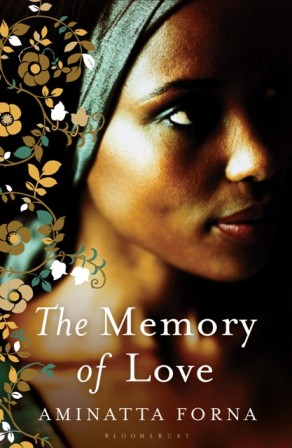
Adrian Lockheart is a British psychologist working in Freetown, the capital city of Sierra Leone. For ten years the country has been torn apart by civil war and a large percentage of the population have been left suffering from post-traumatic stress disorder. Adrian’s job is to help people cope in the aftermath of the war. One man, who set fire to people’s houses during the war is now haunted by the smell of burning meat. Another woman is showing symptoms of fugue – a rare condition which occasionally causes her to disappear from her everyday life and turn up in another place miles away from her home. But Elias Cole is the patient Adrian spends the longest with and who intrigues him more than any of the others.

Elias Cole is an elderly retired professor who is dying of lung disease and he relates to Adrian his memories of the woman he once loved: her name was Saffia and she was married to a fellow academic, Julius Kamara. As Adrian learns more about Elias and his relationships with both Saffia and Julius during the period of political unrest in the late 1960s, it becomes clear that Elias’s story may have an effect on Adrian’s own life. We also meet Kai Mansaray, a young surgeon at the hospital where Adrian works, who has been left traumatised by the war and is suffering from insomnia and recurrent nightmares. He and Adrian become friends but their friendship comes with its own set of obstacles that need to be overcome.

The Memory of Love is the first book I’ve read set in Sierra Leone. One of the great things about fiction is that it gives us the opportunity to learn about countries that we may otherwise have gone through our whole lives knowing very little about. The descriptions of life in Sierra Leone are beautifully written: the sights and sounds, the trees and flowers, the colours of the sky. I didn’t know anything about the history and politics behind the civil war but it wasn’t really necessary to have any prior knowledge – and even after finishing the book I didn’t feel I’d really learned much about the war itself. But what the book does do, and does very well, is show the effects the war had on the personal lives of the population, particularly the fear and uncertainty people felt, not knowing who they could and couldn’t trust.

I wish I could say I had loved this book, but I didn’t. It was extremely well written but after about 100 pages I was bored. I put the book aside for a few days and then picked it up again. This time I managed to finish it, but it still seemed to take forever to read. And towards the end, when the various threads of the story began to come together it all seemed a bit too convenient – too predictable, too many coincidences. But the fact that I didn’t enjoy this book probably says more about me as a reader than it does about The Memory of Love as a novel. It was too detailed and descriptive for me and I found it very, very slow. I do seem to be in the minority though, so maybe you’ll have better luck with it than I did!

Childhood Memories: An evening with Enid

When I sat down to write this, my third Childhood Memories post, I was shocked when I discovered it’s been more than a year since the last one! I had been hoping to make Childhood Memories a regular series, so I do apologise for the long delay between posts. If you missed the previous ones, I wrote about Ursula Moray Williams last April and children’s ballet books last May.

Like many children I grew up reading Enid Blyton books. For those of you who aren’t familiar with her books, Enid Blyton was one of the most successful British children’s writers of the twentieth century. She wrote over six hundred books and I’m sure I must have read most of them! For a while now I’ve been desperately wanting to revisit some of my old Enid Blyton books and I recently found time to do so.

Of all Blyton’s books, The Valley of Adventure was one of my absolute favourites. The Adventure series (published between 1944 and 1955) featured four children – brother and sister Philip and Dinah Mannering, and two orphans, Jack and Lucy Ann Trent, who are later adopted by Mrs Mannering. Philip is an animal lover and always seems to have a mouse, toad or other small wild animal hidden in his pockets, much to the disgust of his sister Dinah, while Jack is passionate about birds. Another character who appears throughout the series is Bill Cunningham, a member of the secret service who becomes a good friend of the Mannering family. In The Valley of Adventure, Bill offers to take the children for a flight in his new plane. However, they somehow get on the wrong plane and end up stranded in a lonely Austrian valley surrounded by mountains and waterfalls, trying to hide from a gang of criminals who are searching for hidden treasure.

I think one of the reasons I loved the Adventure series so much was that whilst most other Blyton books were set in small English villages or in boarding schools, the Adventure books had more exotic settings: a cruise ship in the Greek islands, a circus in the fictional country of Tauri-Hessia, or a river in a mysterious distant land, for example. Oh, and I also used to love Kiki, Jack’s talking parrot!

Blyton’s books were never politically correct (one of the reasons why they’ve suffered a decline in popularity) and this one was no exception. Dinah and Lucy Ann automatically take on the jobs of making beds and preparing food and the boys refuse to let them take part in anything that might be dangerous. And of course, the villains are usually either foreign, ugly, working-class or all three. I can understand why newer editions of the books have tried to change some of these things, though having looked at a few of these updated versions it seems that a lot of words and phrases have also been altered that didn’t really need to be. The old-fashioned vocabulary was part of the charm and never caused any confusion for me.

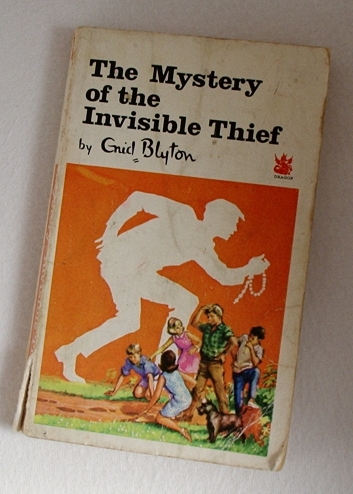
The second book I decided to read during my recent ‘evening with Enid’ was The Mystery of the Invisible Thief, one of the Five Find Outers series. This was another of my favourite series, which I always preferred to the more popular Famous Five series. The Five Find Outers – Fatty, Larry, Daisy, Pip and Bets (and Buster the dog) – were a group of children who lived in the village of Peterswood and solved mysteries during the school holidays.

In The Mystery of the Invisible Thief, the Find Outers investigate a number of burglaries that have taken place in Peterswood. The mystery is quite a clever one, with lots of clues, disguise-wearing and interference from the village policeman, Mr Goon. I really enjoyed my re-read of this book and could remember exactly why I used to love this series! As you can probably tell from the picture, my copy has been read many, many times.

Were you an Enid Blyton fan too? Which were your favourite books?

Life of Pi by Yann Martel

I always feel a bit apprehensive when reading a book like Yann Martel’s Booker Prize-winning Life of Pi which has been read by so many people and seems to divide opinion so much. Would I love it or would I hate it? I was actually expecting to hate it, since I did try to read it a few years ago and gave up after a couple of chapters. After deciding to give the book a second chance and making it to the end this time, I was surprised to find that I had the exact opposite reaction – I loved it and was completely captivated by it from start to finish. Now I’m annoyed with myself for waiting so long before giving it another try!

Pi Patel’s father runs the Pondicherry Zoo, so Pi has grown up surrounded by animals. However, this still doesn’t prepare him for what happens when he and his family decide to emigrate to Canada, taking several of their animals with them to be traded to other zoos. When they are shipwrecked in the middle of the Pacific Ocean, Pi finds himself trapped in a lifeboat with a hyena, a zebra, an orangutan – and a Bengal tiger called Richard Parker.

I remember that when I first tried to read Life of Pi I struggled to get through the opening chapters, but this time I found them much more interesting. Not much actually happens in this early section of the book, but the scene is set for the rest of the story. We learn a lot about animals and how they are treated in zoos. We also see how Pi explores various religions and the benefits of each, before deciding to be a Christian, Muslim and Hindu all at the same time. But it wasn’t until the shipwreck scene and Pi’s subsequent discovery of the tiger sharing his lifeboat that I really became absorbed in the story. The account of Pi’s battle for survival and his relationship with Richard Parker makes for fascinating and compelling reading. It’s hard to believe that a story which takes place mainly within the confined space of a small lifeboat can be so enthralling!

Which brings me to the final section of the book. At first I hated the way the book ended and I did feel cheated – I expect a lot of readers have felt the same way, which will be one reason for the love/hate divide – but then I found that I couldn’t stop thinking about it and how clever it was. I have rarely come across a book with such a thought-provoking and ambiguous ending. I’m so glad I decided to give Life of Pi a second chance, as after my first attempt at reading it I had thought it just wasn’t for me.

Have you ever been surprised by a book after giving it another chance?

Darkside by Belinda Bauer

When an elderly woman is found murdered in her own home in the sleepy village of Shipcott, local policeman Jonas Holly begins to investigate. A team of detectives soon arrive to take over the case, however, and Jonas finds himself pushed into the background. As the snow falls in Shipcott and tension builds in the village, the killer strikes again and again. Then Jonas himself starts to receive anonymous notes taunting him for his incompetence and he begins to grow concerned that his wife, Lucy, could be in danger…

Darkside is the second novel by crime writer Belinda Bauer. After finding her first book, Blacklands, so impressive when I read it last year I was looking forward to reading this one – and I wasn’t disappointed. But this is a different type of crime novel – while Blacklands featured a highly original plot involving a child killer communicating with a young boy from his prison cell, Darkside is more of a traditional murder mystery.

I hadn’t realised that this book was going to be set in the same village as the previous novel so it was a nice surprise to see one or two old friends making a brief reappearance. However, both books do stand alone and Darkside is not really a sequel. It’s set four years later, the plot is entirely different and the focus is on a new group of characters. The only thing the two novels really have in common is the setting. And the setting, by the way, is one of the strong points of both books. Shipcott feels like a real English village and its inhabitants are so realistic they feel like they really could be the people you live or work with. I love the world Belinda Bauer has created and I’m glad she decided to revisit it.

Jonas Holly was an interesting character. We are told that as a young police officer he had once been very ambitious, but had given up his hopes of career advancement to care for his beloved wife, Lucy, who was diagnosed with multiple sclerosis. I thought Bauer’s portrayal of their relationship, with both husband and wife trying to come to terms with Lucy’s diagnosis, was very moving and believable. The other person with whom we spend a lot of time is the head of the murder investigation, DCI Marvel, one of those obnoxious characters who, despite being completely unlikeable, is great to read about.

The only slight problem I had with this book was that the ending felt very dramatic and didn’t really match the tone of the rest of the story. But I didn’t guess who the murderer was until near the end, so it worked in that respect. Looking back the clues were there, but I didn’t pick up on them straight away as I had expected the killer to be someone entirely different to who it actually turned out to be! I loved this gripping novel and can’t wait to see what Belinda Bauer’s next book is like.

Rule Britannia by Daphne du Maurier

I love Daphne du Maurier; whenever I pick up one of her books I know I’m guaranteed a good read. Although this one was not as good as some and I can certainly understand why it’s one of her less popular books, it still kept me gripped for all 300+ pages. I’m pleased I can say that because, having read other opinions on this book, I was concerned that it might be the first du Maurier novel that I wouldn’t like.

Published in 1972 her final novel, Rule Britannia, imagines that the UK has broken away from Europe to form an alliance with the US. This new nation will be known as USUK. The first twenty-year-old Emma knows about this is when she wakes up one morning to find that the tranquil corner of Cornwall where she lives is now under American occupation – there’s an American warship in the harbour, American marines stationed in the area and roadblocks on the routes leading in and out of the town. Already the Queen is visiting the White House and the President is preparing to come to Buckingham Palace. Despite reassurances from the government that the formation of USUK is essential for Britain’s economic and military stability, Emma’s family, friends and neighbours begin to grow increasingly concerned about the exact nature of the alliance and the effect it will have on their previously peaceful lives.

It can’t happen here, thought Emma, it can’t happen here, that’s what people in England have always said, even in wartime when they were bombed, because they were all together on their own ground. Not any more.

Although the story unfolds from Emma’s perspective, the real heroine of the story is her seventy-nine-year-old grandmother, Mad (short for Madam – unless I missed it, we aren’t told her real name), who is a retired actress. Mad and Emma live together with Mad’s six adopted boys whose ages range from three to nineteen, all of whom have suffered some form of tragedy in their early lives. Mad, even in her old age, is a strong-minded, independent woman who is determined to defend her home and family no matter what, and she plays an important part in Cornwall’s resistance to the occupying forces. But although Mad and her family believe they have been invaded, I should point out that we’re told the majority of British people are very happy with the alliance and that it’s only a small percentage of the population who are rebelling against it.

As with most Daphne du Maurier novels, this one does have some suspenseful and unsettling moments. I know from my past experience of her work that nothing is ever quite as it seems and I was wondering what surprises and twists she might have in store for the reader – but unfortunately I found the way the book ended slightly disappointing because I felt there was a lot more she could have done with the story. Another thing I didn’t like was the fact that one of Mad’s adopted sons, three-year-old Ben who happens to be black, appeared to have been included simply as an excuse to make racist jokes. The book was a product of the 1970s I suppose, but these comments are offensive rather than funny. These negative points, along with the overall strangeness of the book, stopped me from enjoying it as much as I’ve enjoyed her other books. It doesn’t compare to her best work and if you’re new to Daphne du Maurier I would suggest starting somewhere else.

The Master and Margarita by Mikhail Bulgakov

I’d been wanting to read The Master and Margarita for a long time but had always felt too intimidated to pick it up. I expect there are probably other people who feel the same, so I want to reassure you that there’s really no need to be scared! Yes, it’s Russian literature, but it’s a lot easier to read and understand than I thought it would be. After just a couple of pages I could tell I was going to love it – isn’t it great when that happens?

It’s best if you know as little as possible before you begin, so to put it as simply as I can, The Master and Margarita imagines that the devil, in the guise of Professor Woland, arrives in Soviet Moscow and proceeds to wreak havoc on the city’s literary world. Woland is accompanied by a retinue of memorable characters including his assistant, Koroviev – a tall, skinny man in a jockey’s cap and broken pince-nez glasses – and a giant, talking black cat known as Behemoth. This storyline is interwoven with the story of Pontius Pilate, giving us an insight into Pilate’s thoughts and feelings in the period leading up to the crucifixion of Jesus Christ. A third thread of the novel, closely connected to the other two, features a romance between the writer of the Pontius Pilate story, a mysterious man who is referred to only as ‘The Master’, and his lover, Margarita.

This was a fantastic book – it was breathtakingly different and original, with so many different layers to it. There were some scenes that were so surreal and bizarre I had to read them twice to make sure I hadn’t misunderstood. I’m sorry I can’t give any examples of what I mean, but I don’t want to spoil any of the fun for you! Admittedly there were a few parts of the book where the story seemed to lose its way for a while, but the engaging writing, weird and wonderful characters and the dark humour all helped to keep me interested. There were some excellent set pieces too: the séance in the theatre, Margarita’s moonlight flight, the Great Ball at Satan’s, to name just a few that have stuck in my mind.

A quick note on the translation: the version I read was the Pevear and Volokhonsky translation which, as far as I can tell from reading other reviews, may not be the best one. Personally I didn’t have any complaints about this translation, though obviously I can’t compare it with the others because I haven’t read them.

This is a book that I would definitely like to read again in the future; I might not find it as stunning the second time round but I’m sure I’ll be able to pick up on lots of little details that I missed the first time. I hope I’ve convinced you to give it a try too!