New book arrivals

As a change from all the book reviews I’ve been posting recently I thought I’d share with you some of the new books I’ve acquired in the last couple of weeks.

Touch by Alexi Zentner – I’ve already finished reading this novel about a Canadian gold mining town and I would highly recommend it – it’s beautifully written with some haunting imagery and elements of magical realism.

Here Be Dragons by Sharon Penman – I bought this secondhand copy for myself because I loved The Sunne in Splendour and want to try another of Penman’s books. This one is set in 13th century Wales.

The Report by Jessica Francis Kane – I’ve seen so many positive reviews of this book recently and am interested in learning more about the Bethnal Green tube disaster.

The Map of Time by Felix Palma – This book is set in Victorian London and features characters such as H.G. Wells, Jack the Ripper and Bram Stoker. This really sounds like something I should love, so I hope it lives up to my expectations.

Gillespie and I by Jane Harris – I was delighted to win a copy of this book from LibraryThing Early Reviewers. I haven’t heard much about it but it looks and sounds wonderful.

Have you read any of these?

The Creation of Eve by Lynn Cullen

I think most people have probably heard of famous Renaissance artists such as Michelangelo and Leonardo da Vinci. But what about Sofonisba Anguissola? In The Creation of Eve, Lynn Cullen introduces us to this talented female artist who was prevented from reaching her full potential simply because she was a woman. Sofonisba, who spent many years in the Spanish court, was not allowed to sign her paintings with her own initials and some of her works were even credited to other people.

At the beginning of the book, Sofonisba is studying in Rome with Michelangelo. She leaves Rome following an affair with another student and travels to Spain where she joins the royal court as lady-in-waiting and art instructor to the fourteen-year-old Queen, Elizabeth of Valois. Here she becomes caught up in a scandal involving the Queen and the King’s half brother, Don Juan.

This book was not quite what I had thought it would be. I was expecting it to focus on the story of Sofonisba Anguissola and was looking forward to learning about her training as an artist and the challenges she faced as a woman working in a male-dominated field. As it turned out though, the book was as much about the relationship between King Felipe II and his young French wife, Elizabeth, as it was about Sofonisba. For much of the book Sofonisba is little more than a passive observer, a witness to the events that are unfolding in the Spanish court.

I thought The Creation of Eve was an interesting and entertaining read but it lacked any real emotional impact for me. Looking at other reviews of this book (as I usually do after writing my own) opinion seems to be overwhelmingly positive, so if you like reading historical fiction revolving around intrigue in royal courts there’s a good chance that you’ll love this book. The novel does appear to be very well-researched. Cullen manages to incorporate a large amount of historical detail, but this never gets in the way of the plot. I appreciated the author’s note at the end of the book which tells us which parts of the book are historical fact and which are fiction.

I actually won this book in last year’s Readathon (April 2010) and am glad I’ve finally read and enjoyed it, as I was starting to feel very guilty about not reading it sooner!

Some examples of Sofonisba Anguissola’s paintings can be seen on her Wikipedia page.

Swamplandia! by Karen Russell

Swamplandia! is an alligator-themed amusement park in the Everglades run by Chief Bigtree, his wife, Hilola, and their three children. For years tourists have been flocking to the park to see the star attraction: Hilola Bigtree and her alligator-wrestling act. The fortunes of the Bigtree family start to change, however, when Hilola dies of cancer – and then a rival theme park called World of Darkness opens on the mainland nearby and the downfall of Swamplandia! is complete.

Swamplandia! first came to my attention when it appeared on the Orange Prize longlist. Not having read anything by Karen Russell before I didn’t know what to expect from this book but was intrigued by the unusual setting and subject. And at first I loved the originality and quirkiness of the story. I loved reading about the Swamplandia! theme park (complete with Swamp Café and Bigtree Family Museum), the alligator-wrestling and the other details of the Bigtree family’s life on the island. After a while the novelty started to wear off, but luckily the characters were strong enough to keep me interested.

The three Bigtree children all have an innocence that makes them likeable and endearing characters. It’s understandable in a way, as they haven’t had the most conventional of childhoods. They’ve been homeschooled on the island and the only other children they’ve really come into contact with have been tourists visiting the park. After their mother’s death, each of the three tries in their own way to cope with what has happened, unable to rely on their father who is reluctant to accept that his beloved park is in trouble and who fails to be there for his family when they need his support.

Osceola, the elder sister, announces that she’s in love with a dead man – and begins ‘dating’ him via séances and possessions. Ossie’s ghostly romance seemed ridiculous at first, but was actually quite a poignant and moving story. Her brother, seventeen-year-old Kiwi, runs away from Swamplandia! quite early in the story and goes to work on the mainland in an attempt to earn money to solve his family’s financial problems. But it’s Ava, as the youngest girl, who is particularly vulnerable. It’s Ava’s narration (including some disturbing scenes involving a ‘journey to the underworld’ with a stranger who calls himself the Bird Man) that gives the book an underlying darkness, with some moments of real sadness and heartbreak.

I loved the chapters narrated by Ava and I was also interested in Ossie’s storyline, but whenever the action switched to Kiwi’s adventures on the mainland, I quickly got bored. I can see why the Kiwi sections were included, as a way of lightening the mood of the book and to show how his childhood growing up in the swamps left him completely unequipped for life on the mainland, but to me they just didn’t fit with the rest of the book and I would rather have stayed with Ava’s narration. This was potentially a great book but the uneven plot let it down.

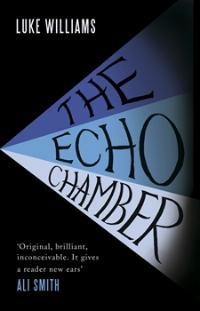
The Echo Chamber by Luke Williams

The Echo Chamber is narrated by Evie Steppman who was born in Lagos in 1946. Evie has always considered herself to have a remarkable sense of hearing – she even remembers listening to her father telling her stories while she was still in the womb – but now that she’s getting older she can’t hear as well as she used to. Sitting in her attic in Scotland surrounded by diaries, maps, postcards and other items from her past, Evie decides that it’s time to write the story of her life.

This is an interesting and unusual book which encourages the reader to think about sound in a new way. It made me really appreciate the everyday sounds that we take for granted.

At first I found it difficult to form an emotional connection with Evie as a person. There were other characters that I found more interesting – I was particularly fascinated by the character of Evie’s grandfather, Mr Rafferty, a watchmaker who tried to create a clockwork replica of his late wife. And so I appreciated the inclusion of two chapters in which we get the chance to read Evie’s lover’s diary; seeing her through someone else’s eyes gave an extra dimension to her character. I also enjoyed the chapters which dealt with Evie’s childhood in Nigeria during the final years of British rule.

The Echo Chamber is written in a number of different formats – diary entries, question and answer sessions, stories-within-stories – and although I’m not sure this really worked for me it did add to the originality of the book. I didn’t find it an easy read, but as a debut novel I think Luke Williams can be proud to have come up with something so different and imaginative.

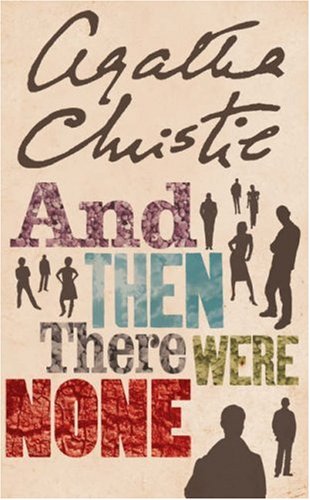
And Then There Were None by Agatha Christie

Although I usually enjoy mysteries, I’ve never considered myself to be a big fan of Agatha Christie. I didn’t really like the Poirot books I’ve read (though admittedly I’ve only tried a few of them) and Miss Marple didn’t appeal to me either. If only I had started with this one instead!

At the beginning of the book we are introduced in quick succession to ten people who have all been invited to a house on Soldier Island, off the coast of Devon. Each person has been given a different reason as to why their presence on the island is required, but on arriving at the house the group discover that their hosts are mysteriously absent. When, one by one, they begin to suffer gruesome deaths in accordance with the children’s rhyme “Ten Little Soldiers” it becomes obvious that one of the ten is a murderer.

The thing that makes this book such an exciting and suspenseful read is that all ten characters seem suspicious and the more you learn about them the more it appears that any one of them could be the killer. Halfway through the book I thought I had worked it out as there was one character in particular that I had suspected from the start (although it was more just an instinct rather than anything specific that he or she had done). As the story moved towards the conclusion it looked as if I was going to be right…

Do I need to tell you that I got it entirely wrong? I admit that solving whodunits is not one of my strong points, but I think most people would be baffled by this one! Christie expertly leads you to believe one thing, then a few pages later proves you wrong. I was sure that as more and more of the ten were eliminated one of them would emerge as the most obvious suspect, but that didn’t happen.

Have you read this book? Did you guess the solution to the mystery?

April Reading Summary

I can’t believe it’s May already! Looking back at the books I read in April, it was probably my best month so far this year. I read fifteen books (plus a few children’s books – more on that later this week) including six from the Orange Prize longlist, two classics and my Persephone Secret Santa present.

Favourite books read in April

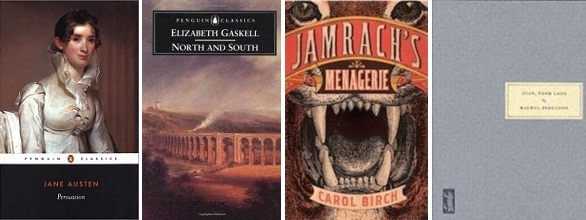
I loved Persuasion and now Sense and Sensibility is the only Austen novel I still haven’t read. I also enjoyed North and South – and as I’ve now read two works by Elizabeth Gaskell this year it means I’ve completed the Gaskell Reading Challenge. I thought Jamrach’s Menagerie was a very entertaining read. And Alas, Poor Lady has become one of my favourite Persephones so far!

Other books read in April

The Seas by Samantha Hunt
Naming the Bones by Louise Welsh
Room by Emma Donoghue
The Song Before it is Sung by Justin Cartwright
The Tiger’s Wife by Tea Obreht
The Daughter of Time by Josephine Tey
Swamplandia! by Karen Russell
Great House by Nicole Krauss
Darkside by Belinda Bauer
Brooklyn by Colm Toibin
The Echo Chamber by Luke Williams

I enjoyed all of these apart from the Justin Cartwright book. Reviews will be coming soon, I promise! They’ve all been written and it’s just a case of scheduling the posts. I don’t really like posting more than three or four times a week but it might be necessary for a while until I catch up.

I hope you all had a good April. Enjoy your reading in May!

Naming the Bones by Louise Welsh

In Naming the Bones, the first book I’ve read by Louise Welsh, university lecturer Dr Murray Watson takes a sabbatical from work in order to research a new book on the life of Archie Lunan, a little-known Scottish poet. Lunan drowned in a sailing accident decades earlier and his death is still surrounded by mystery. Murray’s investigations take him from his home in Glasgow to the Isle of Lismore – where he learns more about Lunan’s life and death than he could ever have imagined and begins to ask himself the question: does knowing what an artist is like as a person really add to our appreciation and understanding of their work – or is the work best left to stand on its own?

Although I did end up enjoying this book, it wasn’t really what I was expecting at all – from the blurb and the quotes on the back of the book it sounded like it would be a fast-paced thriller. Unfortunately I really struggled to get through the first half of the book – it was very slow and there were too many sub-plots that didn’t seem to add much to the story – Murray’s affair with his head of department’s wife, for example, and his estrangement from his brother. But I did like Murray as a character – I found him a likeable and wryly funny narrator who seemed to stumble from one disaster to another – and I wanted to find out what had happened to Archie Lunan, so I was happy to keep reading.

In the second half of the book, when Murray arrived on the island of Lismore, the pace started to pick up and the story became very compelling. The island with its ruined castle, abandoned cottages and ancient broch provided an atmospheric setting for this part of the novel. Welsh increased the tension with every chapter, threw in some twists and surprises (though nothing too unbelievable) and left me feeling satisfied with the way the book had ended.