Cleopatra’s Daughter by Michelle Moran

I was lucky enough to win a signed copy of this book in a giveaway last year. I feel bad about taking so long to read it, but it just never felt like the right time. When I eventually read it I was pleased to find that although I did have one or two problems with it, overall it was very enjoyable.

Kleopatra Selene is the daughter of the famous Queen of Egypt, Cleopatra, and her husband Marc Antony. When Antony’s army is defeated by Octavian at the Battle of Actium and Cleopatra commits suicide, ten year-old Selene and her brothers are left orphaned. Octavian takes them back to Rome with him where they join the household of his sister Octavia. On her arrival in Rome, Selene soon discovers that the city is in a state of unrest, with an unknown rebel known as the Red Eagle urging Rome’s huge slave population to rise against their masters. But Selene also has more personal things to worry about, such as going to school, falling in love and forming friendships – and through it all she hangs on to her dream that one day she will be able to return to Egypt.

I confess that I don’t know very much at all about Ancient Rome. It’s not one of my favourite periods of history to read about and although I know there are lots of historical fiction novels out there about the Romans, I’ve read very few of them. However, this was a good thing because it meant that a lot of the information in Cleopatra’s Daughter was new to me and I learned a lot of interesting facts. For example, I had never heard about the Columna Lactaria (Milk Column), a monument in Rome where mothers left their unwanted babies in the hope that someone would come and feed them.

One thing that strikes me about the Romans is the huge difference between the sophistication and advancement of their culture and the cruelty and barbarity of many of their customs. Michelle Moran does an excellent job of showing both the good side of Rome (the advanced technology, the architecture and the infrastructure of the city) and the bad side (there’s a scene where two hundred innocent slaves face being crucified because one of them has committed a crime, for example).

I did find it difficult to keep the relationships straight between the large cast of characters. This was partly because so many of them had similar names and also because most of the adults had been married at least two or three times each with several children from each marriage. Obviously this wasn’t the author’s fault though, and I did find the character list at the front of the book very useful! There are also some maps, a timeline, a glossary and an afterword explaining the eventual fate of each of the characters. All of these things were extremely helpful to someone like myself, with very little knowledge of Ancient Rome!

Although I did enjoy Cleopatra’s Daughter, it felt a bit too light for me. The characters didn’t have a lot of depth and the story didn’t affect me emotionally the way it was probably intended to. With the teenage narrator and lively writing style, I think this book would appeal to younger readers as well as adults.

Can you recommend any books about Ancient Rome that I might like better than this one?
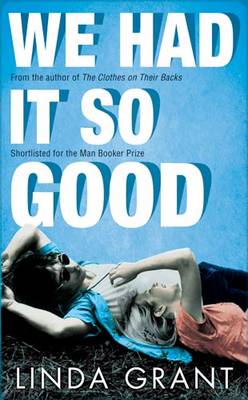
We Had It So Good by Linda Grant

Stephen Newman is getting older and is finding it difficult to come to terms with the way his life has turned out. What happened to his hopes and ambitions, to the generation that was going to change the world?

We Had It So Good follows the story of Stephen and his family over several decades during the second half of the twentieth century and the beginning of the twenty-first. At times reading this book was almost like watching one of those nostalgic television documentaries that show us snapshots of life in the 1960s and 70s. We learn about Stephen’s time at Oxford University where he met his future wife Andrea, how he made LSD in the chemistry lab, lived in a commune, went to the Isle of Wight festival and ate macrobiotic food. As we move forward through the 1980s and 1990s we see the early days of computers and the internet, and learn what it was like to be a photo-journalist reporting on the Bosnian War. And finally, we are brought right up to date with the tragedies of 9/11 and the 2005 London bombings.

As the years go by we see how Stephen and Andrea have changed over time, have had to abandon some of their dreams, and are leading more conventional lives – but with Stephen in particular there’s always that feeling of regret, that he’s settled for second-best, and he does at one point decide that “that was what life was, perennially settling for less”.

The book doesn’t have much of a plot, concentrating instead on painting a detailed and realistic portrait of the Newman family. Despite the lack of action though, there are still some moments of drama – mainly the types of small dramas that most people will experience in their lifetime – and there were even a few surprises and revelations that I didn’t see coming. The viewpoint switches from chapter to chapter allowing us to see things through the eyes of Stephen, Andrea, and several of the other characters. Sometimes I couldn’t immediately tell who was narrating, but this seemed to be intentional. The story also moves around in time, showing us the significant moments that have shaped the lives of each of the characters.

Linda Grant’s writing is of a high quality and she develops her characters in great detail from their appearance and the clothes they wear, to their likes and dislikes, hopes and fears. And yet throughout the first half of the book I didn’t feel any personal involvement in their story and always felt slightly detached from what was going on. Although the Newmans and their friends felt believable and real to me, I didn’t think I liked them enough to want to spend 340 pages reading about their everyday lives. But halfway through the book I started to warm to some of the characters and as a result, the story became more compelling. And once I had settled into the pace of the writing, I started to enjoy it.

It was interesting to see how Stephen as an American (with a Polish immigrant father and a Cuban mother) adapted to life in England, first at Oxford and then in London. And equally interesting when the family went to America and this time it was Andrea who had to readjust. I also liked reading about the relationship between Stephen and his father, Si. Stephen and Andrea’s daughter, Marianne, is another intriguing character. And this post wouldn’t be complete without mentioning Andrea’s best friend, Grace, who is quite a sad and solitary figure, still clinging to her ideals and travelling aimlessly round the world on her own, running away from her past and searching for something unobtainable. Although she’s not the most pleasant of people, with a hard, prickly personality, I was far more interested in Grace than in the Newmans.

I should point out that I’m probably not really the target audience for this book and although I did end up enjoying it, I can see that it would probably be appreciated more by readers of Stephen and Andrea’s generation. However, the book still left me with a lot of things to think about, from bigger issues such as immigration, family relationships and generational differences to the smaller ones, such as the principles behind the advertising of washing powder!

We Had It So Good was the January selection for the Virago Book Club. I received a copy from Virago for review.

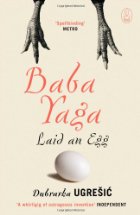
Baba Yaga Laid an Egg by Dubravka Ugresic

Baba Yaga Laid an Egg is part of the Myths series by Canongate Books, in which authors retell traditional myths from around the world in a new and original way. This book by Croatian author Dubravka Ugresic takes a fresh and unusual approach to the Slavic myth of Baba Yaga.

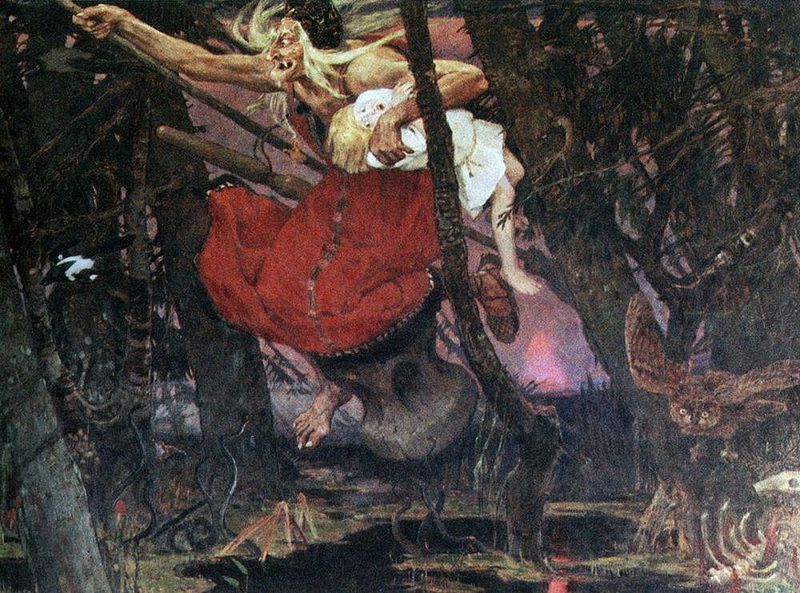
Baba Yaga (shown here in a painting by Viktor Vasnetsov – picture from Wikipedia in public domain) is usually portrayed as a hag or witch who lives in a log cabin mounted on a pair of chicken legs. She uses a giant mortar and pestle to fly through the air, kidnapping and threatening to eat small children. Although she has a terrifying appearance, Baba Yaga is also said to possess great wisdom and will sometimes give help and advice to anyone brave enough to ask.

Rather than simply reiterating this myth, Ugresic relates the myth to the lives of modern women and explores a large number of topics including ageing, feminism, love and loneliness. The book does not follow the format of a conventional novel and is divided into three separate and seemingly unconnected stories.

In the first story, the narrator travels to Varna in Bulgaria, the childhood home of her mother who is now old and ill. In the second story, we meet Beba, Pupa and Kukla, three old women who are staying together at a spa in the Czech Republic. But what is the connection between these two stories and what do they have to do with Baba Yaga? I have to admit, by this point I was starting to feel slightly confused. Yes, I had learned a lot about growing old, but how did all of these things relate to the myth of Baba Yaga? Luckily, I found the answers to my questions in the third and final section of the book.

Part 3 is presented as if a folklore expert was responding to a request for information about Baba Yaga and had been asked to explain the meaning of the first two sections. This part of the book was fascinating but began to feel like a very, very long encyclopedia entry. I previously knew almost nothing about Baba Yaga though, so it was good to learn something about the myth. I was also pleased at how well this final section pulled all the threads of the book together and helped me understand the significance of everything I had just been reading.

This book should appeal to anyone who has ever worried about growing old or anyone with an interest in mythology as it relates to feminism. I can’t honestly say that I loved this book or even that I particularly enjoyed it, but it was a very interesting concept and I’m glad I decided to give it a try.

Has anyone read any of the other Canongate Myths books. Are they similar to this one?

I’m an accessory in The Great Transworld Crime Caper!

After the success of last year’s Summer Reading Challenge, Transworld Publishers are hosting another great reading challenge for EU readers. This time there’s a crime theme, with a list of twelve crime novels to choose from.

If you’re an EU resident you can sign up for the The Great Transworld Crime Caper too! All you need to do is leave a comment on Transworld’s Between the Lines blog and start choosing your books. Transworld will then contact you for your address, they’ll send out your first book, and after you’ve read and reviewed it, you’ll receive the next one.

My three choices are:

1. Sacrifice by S. J. Bolton
2. Mistress of the Art of Death by Ariana Franklin
3. Echoes from the Dead by Johan Theorin

Who else is participating in this? Have you read any of the books I’ve chosen?

January Reading Summary

January has been a great reading month for me – much better than last January. I read twelve books and although I had mixed feelings about one or two, most of them were wonderful!

January Stats:

Books read: 12
New-to-me authors: 8
Male to female author ratio: 3:9
Publication dates: 19th century – 2; 20th century – 5; 21st century – 5
Countries visited in my reading: England, Ethiopia, USA, Italy/Ancient Rome, Croatia, Bulgaria, Czech Republic, France, Germany

~

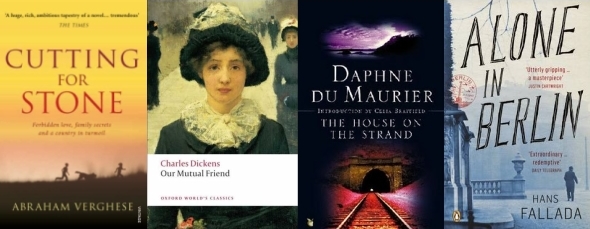
Favourite books read in January:

Cutting for Stone by Abraham Verghese
From my review: …even though it’s still only January, I can’t imagine I’ll be reading a lot of books this year that are better than this one.

Our Mutual Friend by Charles Dickens
From my review: Our Mutual Friend is such a big, complex novel it does require the reader to invest a lot of time and effort in it, but it was definitely worth it for me!

The House on the Strand by Daphne du Maurier
From my review: …a strange and unusual book which blends historical fiction, science fiction, time travel and psychology. I loved it!

Alone in Berlin by Hans Fallada
I haven’t reviewed this yet, but I can tell you that it was an excellent book and one that I would highly recommend!

~

Other books read in January:

Spilling the Beans on the Cat’s Pyjamas by Judy Parkinson
Major Pettigrew’s Last Stand by Helen Simonson
The Return of the Soldier by Rebecca West
The Enchanted April by Elizabeth von Arnim
Cleopatra’s Daughter by Michelle Moran – Review to follow
Baba Yaga Laid an Egg by Dubravka Ugresic – Review to follow
The Virgin Blue by Tracy Chevalier – Review to follow
Villette by Charlotte Bronte – Review to follow

~

Challenge progress:

I haven’t made a lot of progress in any of my challenges this month, but I’m not too worried about that as I have plenty of books for all three challenges on my tbr pile and am planning to read some of them in February.

Victorian Literature Challenge: 2/15
Gaskell Reading Challenge: 0/2
Historical Fiction Challenge: 1/20

This month I’m participating in a group read of Elizabeth Gaskell’s novella The Moorland Cottage hosted by Gaskell Blog, which will count towards the Gaskell Reading Challenge.

~

Other reading/blogging activities in January:

I took part in Bloggiesta the weekend of 21-23 January and although I wasn’t able to spend as much time on it as I would have liked, I still managed to accomplish a few things.
24-30 January was Virago Reading Week. I read The Enchanted April by Elizabeth von Arnim and The Return of the Soldier by Rebecca West and enjoyed them both. I had fun reading everyone else’s posts and adding lots of Viragos to my wish list!

Was January a good month for you?

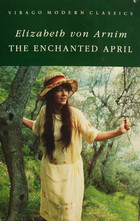
Virago Reading Week: The Enchanted April by Elizabeth von Arnim

This is my second post for Virago Reading Week, hosted by Rachel of Book Snob and Carolyn of A Few of My Favourite Books. When I was choosing my books for this week, I knew it was time to try something by Elizabeth von Arnim, a writer whose work I had never read but who seems to be one of the most popular and most loved Virago authors.

The Enchanted April, first published in 1922, is the story of four women who rent a castle in Italy together one April. The women are strangers to each other at the beginning of the novel, but each of them has her own reasons for wanting a holiday. Spending a month at San Salvatore surrounded by sunshine and flowers gives each woman a chance to resolve her problems and try to find happiness.

Our four main characters have very different personalities and very different circumstances. First, there’s Lotty Wilkins who has grown tired of having her life controlled by her husband and is desperate to escape from him for a while. Calm, grave Rose Arbuthnot has the opposite problem: her husband is so wrapped up in his career that he barely remembers she exists:

To be missed, to be needed, from whatever motive, was, she thought, better than the complete loneliness of not being missed or needed at all.

Then there’s Lady Caroline Dester, also known as ‘Scrap’, who is bored with her life and just wants to be left alone. And finally there’s Mrs Fisher who, at sixty-five, is older than the others, and spends most of her time reminiscing about the past.

The story begins when Lotty and Rose meet for the first time in a Women’s Club in London one rainy afternoon and decide to respond to an advertisement in The Times:

To Those Who Appreciate Wistaria and Sunshine: Small mediaeval Italian Castle on the shores of the Mediterranean to be Let furnished for the month of April. Necessary servants remain. Z. Box 1000, The Times.

How could anyone resist answering an ad like that? However, they need to find another two ladies to help share the cost and this is where Lady Caroline and Mrs Fisher come into the story. All four of the female protagonists are interesting, complex people and I enjoyed seeing how they were transformed by their time in Italy. I think my favourite was probably Lady Caroline. She’s tired of being surrounded by people who only care about her looks and money and throughout the novel she attempts to keep her companions at a distance – but as the reader, we are given an insight into her mind and can understand her unhappiness.

People were exactly like flies. She wished there were nets for keeping them off too. She hit at them with words and frowns, and like the fly they slipped between her blows and were untouched. Worse than the fly, they seemed unaware that she had even tried to hit them. The fly at least did for a moment go away. With human beings the only way to get rid of them was to go away herself.

I’m so glad my first experience with von Arnim was a good one. I hadn’t expected something so readable and full of gentle humour and wit and yet with so much depth and such a lot of character development. I also loved the setting and the atmosphere. The images of Italy in the spring were beautifully described, with the sun shining and the flowers bursting into bloom. I defy anybody to read this story and not want to immediately book a trip to Italy this April!

As the title suggests, The Enchanted April is a lovely, enchanting story! After enjoying this one so much, I’ll definitely be reading more of Elizabeth von Arnim’s books – any suggestions as to which one I should read next?

Cutting for Stone by Abraham Verghese

“I will not cut for stone, even for patients in whom the disease is manifest; I will leave this operation to be performed by practitioners, specialists in this art.” ~ the Hippocratic Oath

We’re in the middle of Virago Reading Week at the moment (I posted my thoughts on Rebecca West’s The Return of the Soldier on Tuesday and will be posting on The Enchanted April by Elizabeth von Arnim at the weekend) but today I want to talk about a non-Virago book I read earlier this month. It’s taken me a while to put this post together as I’ve had trouble finding the words to convey how wonderful the book was.

Cutting for Stone is the story of Marion and Shiva, the identical twin sons of Sister Mary Joseph Praise, an Indian nun, and Thomas Stone, a British surgeon, who are both working at Missing Hospital in Addis Ababa, Ethiopia. When Mary Joseph Praise dies in childbirth, Thomas Stone is unable to cope and, refusing to take responsibility for his children, disappears from the hospital. It falls to two of Missing’s other doctors, Hema and Ghosh, to give the twins a loving home and ensure their safety amid the political instability and military coups that affected life in Ethiopia in the second half of the twentieth century.

Cutting for Stone has an epic feel, spanning several continents and several decades. Through the eyes of our narrator, Marion Stone, we meet the people who live in and around Missing Hospital from the Matron and the Staff Probationer to Thomas Stone’s former maid, Rosina, and her daughter, Genet, the girl Marion loves. All of the characters, even the less likeable ones, have a lot of depth and as we learn more about them, we are able to understand what makes them behave the way they do. But at the heart of the story is the relationship between Marion and Shiva. Conjoined twins, born attached at the head, they have a very special bond which is put to the test several times throughout the novel.

There are some very detailed and graphic descriptions of surgical procedures throughout the whole book. This didn’t really bother me, and a lot of it was very interesting, but I feel I should warn you so that those of you who are squeamish can be prepared! Without even reading the author bio, it was obvious that Abraham Verghese must be a doctor himself because the language he uses is very technical. The fact that the book was written by a physician gives it a real authenticity and the author’s own passion for medicine and healing shines through. Medical care in 1950s Ethiopia was very basic and I had a lot of sympathy for the Matron of Missing Hospital, who did her best for the patients under her care despite the limited resources available to her. I could really feel her frustration as the hospital patrons gave her Bibles in place of the medicine and food she so desperately needed.

I think this is the first book I’ve read that is set in Ethiopia. Before I started reading I knew almost nothing about the country and its political history, but this didn’t matter at all as everything was explained in a way that was both informative and easy to understand. Little facts and details were dropped into the story, building up a clear picture of Marion’s life in Ethiopia. I love books like this one that leave me feeling that I’ve really learned something new while being entertained by a great story at the same time!

Although I’ve had a copy of Cutting for Stone since last summer I wasn’t sure I would enjoy it and hadn’t felt like reading it until I saw how many people had named it as one of their top books of 2010 and I finally decided I’d better read it as soon as possible, in the hope that it might become one of my own top books of 2011. Well, even though it’s still only January, I can’t imagine I’ll be reading a lot of books this year that are better than this one.

Highly recommended.