Devil Water by Anya Seton

Several years ago I had the pleasure of discovering Anya Seton’s historical fiction novels. The first one I read was Katherine, the story of Katherine Swynford and John of Gaunt, quickly followed by Green Darkness, Avalon and The Winthrop Woman. After that I moved on to other authors and never got round to reading Seton’s other novels. And so I was pleased to come across one I hadn’t read, Devil Water, in the library. This book was originally published in 1962 and the story takes place during the Jacobite Rebellions of 1715 and 1745.

Devil’s Water is the name of the river that flows past Dilston, a village in Northumberland in the north east of England. In the early 18th century, when Anya Seton’s novel begins, Dilston is home to the Radcliffe family. James Radcliffe, the 3rd Earl of Derwentwater, and his younger brother, Charles, are descendants of King Charles II and were both real historical figures.

The first half of the book concentrates on the life of Charles Radcliffe and his secret marriage to a working-class Northumberland girl, Meg Snowdon, with whom he has a daughter, Jenny. Both Charles and his brother, the Earl, are Catholics and Jacobites (supporters of the Catholic James Stuart who is living in exile in France while his half-sister, the Protestant Queen Anne, reigns in his place). In 1715 the Radcliffes join the Jacobite Rising in an attempt to put James, who they consider their rightful king, on the throne. When the rebellion ends in defeat, Charles escapes to France and leaves Jenny to be raised in London by his friend, Lady Betty Lee. Throughout the second half of the book the focus is on Jenny’s adventures which take her across the Atlantic to the plantations of colonial Virginia in search of Rob Wilson, the man she loves.

This book was particularly interesting to me as I’m from the north east of England myself. There are very few novels set in this part of the country so it was nice to read about places that I’m familiar with. I appreciated the effort Seton made to reproduce various local dialects, depending on whether a character comes from Northumberland, London, Scotland, Ireland, Virginia or elsewhere. Although the northern dialects didn’t always seem quite right to me, it wasn’t a bad attempt and it gave the book a more authentic feel. And the characters never sounded too modern or used language that felt out of place either.

Although I knew absolutely nothing about the Radcliffes before reading Devil Water, you can always trust that an Anya Seton novel would have been well researched and as historically accurate as she could make it, while bearing in mind that it’s still fiction and not everything that happens in the book will be completely factual. This book includes two author’s notes at the beginning and end in which she details the research she carried out and explains which parts of the story are likely to be true. There are also some useful maps and family trees which I found myself referring to occasionally. Don’t worry though, because the book is easy enough to read and doesn’t feel like a history lesson at all.

So, I loved the settings and the time period (I’ve read historical fiction about the Jacobites before and it always makes me feel sad, knowing what the outcome will be) but I did have one or two problems with the book. I thought it was much longer than it needed to be and seemed to take forever to read; the pacing didn’t feel right either – some parts of the book dragged and there were some big jumps forward in time, often leaving gaps of ten years. But the main thing that prevented me from really loving this book was that some of the characters were very difficult to like. I never managed to feel any connection to Charles and was more interested in his brother, the Earl of Derwentwater. And another character, who I had just started to warm to, does something really unforgivable that completely changed my impression of them. I did like Jenny (and a few of the minor characters, such as Betty Lee) but because the people around her were so unlikeable, the story didn’t have the emotional impact on me that it might otherwise have done.

Have you read any other Anya Seton books that I haven’t read yet? Which ones would you recommend?
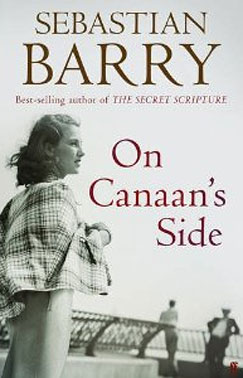
On Canaan’s Side by Sebastian Barry

“Bill is gone. What is the sound of an eighty-nine-year-old heart breaking? It might not be much more than silence, and certainly a small slight sound.”

When this year’s Man Booker Prize longlist was announced at the end of July, one of the titles that I was most looking forward to reading was this one, On Canaan’s Side. I read The Secret Scripture last year and fell in love with Sebastian Barry’s beautiful, poetic writing style. There are some similarities between The Secret Scripture and On Canaan’s Side, the most obvious one being the idea of an old woman looking back on her life, but the stories are different enough to make this book a good read too.

On Canaan’s Side is narrated by Lilly, a retired cook. At the beginning of the book she is eighty-nine years old and has just lost her beloved grandson, Bill, who has committed suicide after returning from fighting in the Gulf War. As Lilly mourns for her grandson, she begins to remember all the things that have happened in her life and over the next seventeen days she shares her memories with us.

Canaan, in the Bible, is the ‘promised land’ and the title On Canaan’s Side represents the idea that many Irish people had that America was a place where they would be safe and happy. Lilly’s story begins during her childhood in Ireland as the daughter of the superintendent of the Dublin police. She is forced to run away to America when both she and her boyfriend, Tadg Bere, find themselves the target of an IRA death sentence. However, Lilly soon discovers that even there, on ‘Canaan’s Side’, she and Tadg are still in danger. The following decades are filled with tragedy and sorrow. Lilly’s story is unbearably sad and yet her voice never becomes self-pitying; she stays a strong and resilient character until the day when her ‘eighty-nine year-old heart’ finally breaks.

At first I thought I wasn’t going to enjoy this book because the first chapter was very ‘stream-of-consciousness’ and it seemed as if it was going to be one of those novels where nothing really happens. But when I got further into the book and the story began to take shape I didn’t want to stop reading. I mentioned at the start of this post how beautifully written The Secret Scripture was and I thought Sebastian Barry’s writing was possibly even more beautiful in this book. I usually prefer books with more plot but the way Barry uses language and imagery is so stunning and mesmerising, the slow pace of the story didn’t bother me.

And it’s really not true that nothing happens: there’s murder, rape and suicide, for a start. Other themes include war (both World Wars, Vietnam and the Gulf War) and how it’s possible to survive a war physically but not mentally; identity and how sometimes we can live with people for years without really knowing who they are; important events in Irish and American history; racial tensions; love and loss.

I loved this book and although it was slow to begin with, I was soon swept away by the quality of Barry’s writing and the atmosphere his words convey. I haven’t read his previous books Annie Dunne and A Long, Long Way but as they are about Lilly’s sister and brother I really should read them soon.

The Blank Wall by Elisabeth Sanxay Holding

Every time I pick up a Persephone book I’m amazed by the diversity of the books they publish. The Blank Wall, written by the American author Elisabeth Sanxay Holding and originally published in 1947, is completely different to the others I’ve read, in terms of both plot and overall feel.

The Blank Wall is a suspense novel set during World War II. Lucia Holley is living with her two teenage children and her father in their lakeside home, while her husband, Tom, is serving in the navy somewhere in the Pacific. Her daughter, Bee, has been having an affair with an older man who Lucia considers to be entirely unsuitable. Things quickly start to spiral out of control and Lucia finds herself involved in murder, blackmail and a series of other crimes, all of which she attempts to conceal from her family. But as she desperately tries to protect her loved ones and avoid a scandal, could Lucia actually be putting herself and others in danger?

With the story being told from Lucia’s perspective, we are given lots of insights into her thought processes as she tries to cope with the disruption to her previously peaceful life. I could really feel Lucia’s fear and panic as everything seemed to be closing in around her. I didn’t always understand her actions and there were times when I felt frustrated with her because some of her decisions were clearly silly and irrational, but it was an interesting study into the way a 1940s woman of Lucia’s class and background might have reacted. It was easy to see why Lucia felt under so much pressure. She was doing her best to take care of her family during wartime and provide meals for them despite rationing and shortages, as well as trying to solve their personal problems and keep them safe – while continuing to send letters to her husband assuring him that everything at home was fine.

The pages of The Blank Wall are filled with tension and suspense. The plot is exciting and fast-paced and I could never guess what might happen next. But apart from the thrilling plot, the other strength of this book is the skilful way Holding portrays the relationships between Lucia and the other characters, particularly with her daughter Bee, the housekeeper Sybil and one of the blackmailers, Martin Donnelly, with whom she starts to form a surprising friendship. And I haven’t read many stories of the American Home Front during the war, so this was another interesting aspect of the book for me. A great story and one of my favourite Persephones so far.

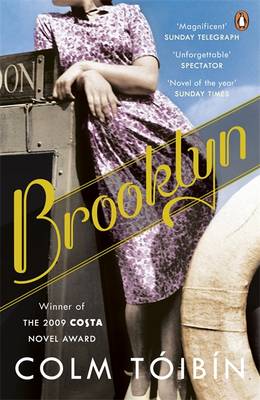
Brooklyn by Colm Tóibín

Brooklyn tells the story of Eilis Lacey, a young woman who lives in a small town in Ireland with her mother and sister. It’s the 1950s, only a few years after the end of World War II and it’s not easy to find a good job in a town like Enniscorthy. When Eilis is offered the chance to work and study in New York she leaves her family behind and prepares to start a new life in Brooklyn. After a traumatic journey across the Atlantic, we see how she settles into her new home and job, struggles with homesickness and makes new friends. But it’s during a trip home to Ireland that Eilis is faced with making the biggest decision of her life…

Brooklyn is a warm, gentle story with an old-fashioned charm. It’s not the most original book I’ve ever read and it’s not the most exciting or dramatic, but when I picked it up and started reading, I found it was just what I was in the mood for. Tóibín tells his story using simple language and a controlled, understated writing style and it was actually quite refreshing to read a book with such clear, direct prose and such a straightforward plot. The book was published in 2009 (and made the Booker Prize long list that year) but if I hadn’t been aware of that I could almost have believed it was written in Eilis’s own era because it does somehow have a very 1950s feel.

Eilis herself is a pleasant, likeable person. Looking at other reviews, many people have complained that she is too passive, allowing other people to run her life for her. I could accept her passivity as part of her quiet, innocent personality, though I agree that it didn’t make her a particularly strong or memorable character. I thought some of the minor characters were more interesting to read about – such as Georgina, the woman who befriends Eilis on her nightmare ocean crossing, or Miss Kelly, who runs the local shop in Enniscorthy where Eilis used to work. We stay with Eilis’s perspective throughout the whole book which means we only get to see the other characters when they are interacting with her directly, but something Tóibín does very successfully is to explore the relationships between Eilis and the important people in her life.

The book does touch on some of the social issues of the time – we learn a little bit about Ireland’s economy, the Holocaust is briefly mentioned, and we get a glimpse of racism in 1950s New York when Eilis starts serving black customers at Bartocci’s department store. But although those issues and others are there in the background they don’t form a major part of the plot. Instead, the focus of Brooklyn is very much on Eilis and the things that affect her personally: her new job at Bartocci’s, studying bookkeeping at evening classes, making new friends and visiting her boyfriend. The reader is immersed completely in the small details of Eilis’s daily life, something which could easily have become very boring, but in Tóibín’s hands is fascinating and compelling.

I haven’t personally had the experience of living in another country and I’m not sure how I would feel about it, but there were still parts of Eilis’ story that resonated with me and that I could identify with. I loved Brooklyn – and I was happy with the way the book ended too!

The Lost Book of Salem by Katherine Howe

Note: This book was also published under the title The Physick Book of Deliverance Dane.

This book got a lot of attention when it was first published a couple of years ago and I couldn’t wait to read it as I thought it sounded like something I would really enjoy. But after seeing quite a few negative reviews I wasn’t so sure and decided that maybe I wasn’t in such a hurry to read it after all. I finally picked it up in the library last month and thought I’d give it a try.

The Lost Book of Salem (I’m not sure why it was necessary to change the title) is a dual time-frame novel, with part of the story set during the Salem witch trials in the 17th century and the rest of the story taking place in 1991. The modern day storyline follows Connie Goodwin, a history graduate who is attempting to track down a spell book belonging to Deliverance Dane, one of the Salem women accused of witchcraft in 1692. Connie believes the book has been passed down through the generations and could still be in existence. Through a number of flashbacks we meet Deliverance Dane herself and some interesting questions begin to arise: could she really be a witch – and does magic really exist?

I wish I could say I had enjoyed this book, but I didn’t. I had trouble with Katherine Howe’s writing style, which was overly descriptive and made the story drag in places. I also found the plot too predictable – it was interesting enough to keep me turning the pages, but there were no real surprises.

As the main character, I found Connie very irritating. Considering she was a PhD student and supposedly an expert in colonial American history she was very slow to pick up on clues that were obvious even to me. She didn’t appear to have much knowledge of the period she was studying either – I’d have thought she would have known that ‘receipt’ used to mean ‘recipe’, for example, and she seemed to be mystified by the word ‘bottel’ before it finally dawned on her that it was just the phonetic spelling for ‘bottle’. Deliverance Dane was a more interesting character and I would have preferred to have spent longer in the 17th century, rather than just the brief interludes that we were given.

There were still a lot of things to like about this book, though. The historical sections were atmospheric and appeared to have been well-researched. And for anyone with an interest in the Salem witches, the book goes into a lot of detail about the trials and the events that lead up to them. So, although I was disappointed by it, I’m sure other people would enjoy it more than I did.

Ethan Frome by Edith Wharton

Ethan Frome is married to Zeena, a woman he doesn’t love. Trapped in his unhappy marriage, Ethan has no joy in his life and no hope for the future. One day Zeena’s cousin, Mattie Silver, comes to stay with the Fromes. Mattie is everything Zeena isn’t – warm and loving and pretty – and soon she and Ethan begin to fall in love.

Ethan Frome is a short book with a simple but very effective plot, so for those of you who haven’t read it yet, I don’t want to go into any more detail about it and risk spoiling the story for you. But although this is not a particularly complex story, it is a powerful and memorable one.

The tone of the book is very bleak, filled with foreboding and a hint of tragedy to come. The only characters explored in any depth are the three main ones (Ethan, Zeena and Mattie) but all three are realistic, believable people. Ethan and Mattie’s relationship felt real and natural, and I wanted them to find happiness together. Zeena, as seen through Ethan’s eyes, was portrayed as such an unpleasant person I found it difficult to have much sympathy for her, but it was clear that she was also stuck in a desperately sad situation.

The most striking thing about this book, for me, was the tense, claustrophobic atmosphere Wharton created, making the reader feel locked within Ethan’s miserable world. The town of Starkfield, Massachusetts is as stark as its name suggests; the descriptions of the snow, the ice and the cold all contribute to the heavy feeling of oppression which hangs over the entire book. The wintry landscapes are so vivid I wished I’d saved this book to read on a snowy day, as I think it would have made a perfect seasonal read! As well as the winter imagery, I also loved the way the book ended. I thought it was obvious what was going to happen but I was wrong; there was a twist at the end that gave the story an unexpected conclusion.

This is the first book I’ve read by Edith Wharton and although I did like it, it hasn’t become an instant favourite. I can definitely understand why people love it, but it didn’t affect me emotionally as much as I had expected it to. I don’t know why not because it was certainly a tragic story, so maybe I just wasn’t in the right mood for it. Overall, my first experience of Wharton’s work was a good one, but I think I’ll have to try another of her books before I can decide if she’s my type of author or not – any suggestions as to which one I should read next?

The Help by Kathryn Stockett

As I’ve mentioned before, I always find it difficult to write about a book that so many people have already read. I feel as if there’s nothing new I could possibly say and that nobody will want to hear about it yet again anyway (which I know is not true – there is no book that absolutely everybody in the world has read, however much it sometimes seems that way). But at least I’ve read The Help now and can see why it’s been getting so much attention. And I have to agree with all the bloggers who’ve been giving this book such glowing reviews because it really does deserve it.

The Help is told in the form of alternating narratives by three women living in Jackson, Mississippi during the early 1960s. Two of them, Aibileen and Minny, are black women working as maids, or ‘helps’, for white families. The third is Eugenia Phelan, nicknamed Skeeter because she’s ‘long and leggy and mosquito-thin’. In contrast to the first two narrators, Skeeter is a white woman from a rich family. Skeeter dreams of becoming a writer and convinces Aibileen and Minny to help her write a book throwing new light on the life of a black maid in Jackson.

I loved all three of the narrators, who were each given very different and distinctive voices of their own. I thought it was impressive that Stockett could write so convincingly from the perspectives of three such different people. The intelligent, dignified Aibileen was a lovely, engaging narrator and probably my favourite. But Minny was an equally captivating character – she was outspoken and funny and in some ways felt the most real. I liked Skeeter too but found that she didn’t come to life for me as vividly as the other two. I found it hard to believe that she hadn’t noticed how cruel and prejudiced her best friends were until she reached the age of twenty two (and also hard to believe that she would have been friends with people like them in the first place).

The Help is a powerful and thought-provoking read which raises a number of issues relating to various aspects of racial discrimination, segregation and the Civil Rights Movement, though I’m happy to leave it to people with more knowledge of these subjects to discuss them in the depth they deserve. Judging it purely on its merits as a novel, this was one of the most enjoyable books I’ve read this year. I was alternately enraged by the prejudice and injustice the black maids were forced to endure, amused by the antics of Minny and the other characters, intrigued by the well-meaning but very eccentric Celia Foote, and filled with loathing for Hilly Holbrook, one of the vilest characters ever!