The Vicomte de Bragelonne by Alexandre Dumas

The Vicomte de Bragelonne This is the third Dumas novel to feature d’Artagnan and his three friends, Athos, Porthos and Aramis. Originally published in serial form as part of a much longer book, it is now usually split into three volumes of which The Vicomte de Bragelonne is the first and Louise de la Vallière and The Man in the Iron Mask are the others. As Dumas is one of my favourite authors I was fully expecting to love this book – and I did, although it was not quite as satisfying as the first two d’Artagnan novels – The Three Musketeers and Twenty Years After.

The first thing to say about The Vicomte de Bragelonne is that it is not really about the Vicomte de Bragelonne! He does appear near the beginning and again near the end, but his role in the story is not really any more significant than any number of other characters. The next thing I should say is that any reader hoping to find the four friends working together again in the spirit of “all for one and one for all” will be disappointed; we do see quite a lot of Athos, but Porthos and Aramis only come into the story very briefly towards the end.

So, what is this book about, then? Well, possibly because this is only one section of a longer work, it’s difficult to give a summary of the plot. The first half of the novel concentrates mainly on d’Artagnan and Athos who are working on two separate schemes both designed to restore Charles II to the throne of England. History tells us that the restoration would be accomplished – though not quite in the way described in this book, which is much more fun than what actually happened!

Later in the book we learn that Aramis and Porthos seem to be helping the Superintendent of Finances, Monsieur Fouquet, to build fortifications on the island of Belle-Île. We don’t find out exactly what they are up to, however, and this part of the story is left shrouded in mystery, presumably to be developed in the next two novels. Finally, there’s the storyline involving the title character, Raoul (the Vicomte), and his love for Louise de la Vallière.

The gaps between these three subplots are filled with lots of chapters detailing the political situation in France in the 1660s (particularly the death of Cardinal Mazarin and the rivalry between Fouquet and Louis XIV’s new Minister of Finance, Colbert) and the romantic intrigues of the French court (revolving around the King’s marriage and also his brother’s marriage to Charles II’s sister, Henrietta). All of this makes The Vicomte de Bragelonne a heavier, slower read than the previous two novels, but I didn’t find it boring at all – I love the way Dumas writes and I love French history, so I didn’t really mind the fact that there was less swashbuckling action and that we don’t see as much of d’Artagnan’s friends.

Of course, where history (or even geography) is concerned it can’t always be assumed that everything in a Dumas novel is completely accurate. I was amazed to find that in Dumas’ world the city of Newcastle had suddenly been transported from the River Tyne to the banks of the River Tweed sixty miles to the north! Dumas also tends to change dates or rearrange the sequence of events whenever the story calls for it as well, though I’m sure I wouldn’t have even noticed most of these alterations if I hadn’t been referring to the notes at the back of the book. I’m pleased to say, by the way, that the notes in the Oxford World’s Classics edition didn’t spoil any of the story – although I avoided the introduction just in case.

As The Vicomte de Bragelonne doesn’t stand alone as a complete novel and wasn’t originally intended to, there are a lot of things left unresolved at the end of the book, as you would expect. I’m looking forward to continuing the story soon with Louise de la Vallière!
Cousin Bette by Honoré de Balzac

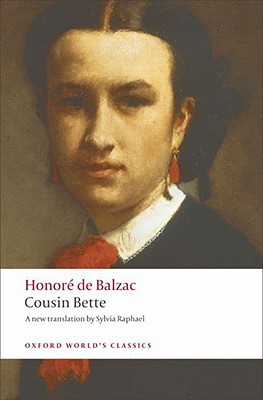
Cousin Bette Balzac is an author I have wanted to try for years but have kept putting off, partly because I thought he sounded intimidating and difficult to read and partly because he wrote so many books it was hard to know where to start! Then, last month I chose ten books at random from my Goodreads “to-read” shelf – and one of them was Cousin Bette, a novel I couldn’t even remember adding to my shelf in the first place, but which sounded very appealing. I obviously couldn’t put off reading Balzac any longer!

Cousin Bette (originally La Cousine Bette and sometimes translated as Cousin Betty) was published in 1846 and is set in 19th century Paris. The title character is Lisbeth – Bette – Fischer, a relation of the Hulot family who has always been jealous of her beautiful cousin Adeline. Plain, poor, and having turned down several marriage proposals, Bette is still unmarried at the age of forty-two. When she rescues a young Polish sculptor, Wenceslas Steinbock, from a suicide attempt and takes him under her wing, she is pleased to be able to tell everyone that she has a lover at last. Her happiness is shattered, however, when Adeline’s daughter, Hortense, falls in love with Wenceslas and marries him herself.

Bette vows to take revenge on the Hulot family and joins forces with Valerie Marneffe, her pretty young neighbour. Knowing that Adeline’s husband, the Baron Hulot, is a notorious womaniser and that Valerie is looking for a rich lover, Bette sees a way to ruin the Baron and destroy the rest of the family in the process.

I enjoyed Cousin Bette and I think it was a good choice for my first Balzac novel. I found it surprisingly easy to read and very entertaining, although I did need to concentrate to follow all the intricacies of the plot. The summary I have given above is only the beginning of the story; Bette is by no means the only character who plots and schemes and tries to cause trouble – and in fact, many of the misfortunes that befall members of the Hulot family are caused by their own personal weaknesses and flaws rather than the influence of others. Baron Hulot, for example, despite being one of the targets of Bette and Valerie’s cruelty, really only has himself to blame as he is unable to resist the temptation placed in his way.

I saw the three main female characters – Cousin Bette, Valerie Marneffe and Adeline Hulot – as representing three stereotypical views of 19th century women of different classes and social groups. Bette is the bitter, jealous middle-aged spinster, Valerie the selfish, manipulative beauty, and Adeline the faithful, loving wife who turns a blind eye to her husband’s many affairs. Any reader who is interested in gender roles and the portrayal of women in literature will find a lot to think about in Cousin Bette.

Before reading this novel I had no idea what the outcome of the story would be and I was kept in suspense until the end. Of course, I’m not going to tell you how it ends, but it’s not quite as simple as the ‘good’ characters being rewarded and the ‘bad’ ones being punished. It’s all very melodramatic – and all very bleak as well – but I enjoyed it and am looking forward to reading more Balzac. As he wrote more than one hundred books, I would love to know if you’ve read any of them and which ones you would recommend.

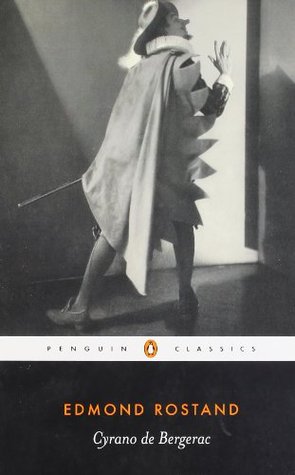
Cyrano de Bergerac by Edmond Rostand

Cyrano de Bergerac How many ways are there to insult a man with a big nose?

“Solicitous: ‘But sir, how do you drink? Doesn’t it trail in your glass?’
Or else descriptive: ‘It’s a rock, it’s a peak, it’s a cape…No, not a cape, it’s a peninsula!’
Inquisitive: ‘Do tell me, what is that long container? Do you keep pens in it, or scissors?’
Twee: ‘How darling of you to have built a perch for little birds to rest their tiny claws’.”

These are Cyrano de Bergerac’s own words about his own nose and although it might seem from this that he can see the funny side, he is actually very sensitive about it. Because of his appearance he believes no woman could ever find him attractive – especially not his beautiful cousin, Roxane, the woman he loves.

The handsome Christian is also in love with Roxane but is afraid that he doesn’t have the ability with words to impress her. Cyrano, who is a talented poet as well as a great swordsman and soldier, comes up with the perfect solution: he will write love letters to Roxane and send them in Christian’s name. Not only will this help to further Christian’s romance with Roxane, it will also give Cyrano a chance to express his own feelings. The plan is a success, but who is Roxane really falling in love with – the man who is writing the letters or the man she thinks is writing them?

Edmond Rostand’s French play Cyrano de Bergerac (subtitled An Heroic Comedy in Five Acts) was hugely successful when it was first performed in 1897. The audiences must have loved the same things that I did: the action, the romance, the combination of comedy and tragedy, and the swashbuckling hero. I’m not fortunate enough to have seen a stage version of this play (or any of the film versions either) but I’m sure it must be great fun to watch, with its swordfights, battle scenes and witty dialogue. I enjoyed reading it on the page, but it’s not quite the same as being able to see it performed!

Rostand’s inspiration for the play was a real person, the novelist, playwright and soldier Savinien de Cyrano de Bergerac, but only a few elements of his life are included in the play; the rest is imaginary. And what a great imagination Rostand had! There are so many memorable scenes, ranging from Cyrano fighting a duel while simultaneously composing a ballad, to Roxane standing on a balcony listening to Christian declare his love for her while Cyrano hides in the shadows telling him what to say, to the play’s tragic and emotional ending.

Rostand is credited with bringing the French word ‘panache’ into popular use (at least with the meaning we know today i.e. style and flamboyance). There are many examples of Cyrano’s panache throughout the play – and it is even his final word (although some translators give it the literal translation ‘white plume’). The edition I read was the Penguin Classics one with a recent translation by Carol Clark. I know this is not considered one of the better ones, so I do plan to read a different version of the play at some point. Any recommendations are welcome!

A Country Doctor’s Notebook by Mikhail Bulgakov

A Country Doctors Notebook A Country Doctor’s Notebook is the book that was selected for me in the last Classics Club Spin. I was happy when I discovered that I would be reading this one, not only because it’s much shorter than most of the others on my Classics Club list, but also because I loved Bulgakov’s The Master and Margarita which I read four years ago in 2011. I knew this book was going to be very different from The Master and Margarita, but I hoped I would still enjoy it…and I did.

A Country Doctor’s Notebook is a collection of semi-autobiographical short stories originally written in Russian in the 1920s (the edition I read uses Michael Glenny’s English translation from 1975). Like the protagonist of this book, Mikhail Bulgakov was a ‘country doctor’. After graduating from Kiev University he became a physician and from 1916-1918 he worked at a small hospital near a remote village in the province of Smolensk.

The fictional doctor in the book, Vladimir Bomgard, is clearly based on Bulgakov himself and in the first story we see him as a young, newly-qualified doctor of twenty-four arriving at Muryovo Hospital, a full day’s drive from the nearest town. He is pleased to find that the hospital is clean and well equipped, but with no practical experience and nobody to turn to for advice (apart from a feldsher, or partly-qualified assistant, and two midwives) the thought of bearing sole responsibility for the lives of his patients terrifies him.

During his first weeks and months at Muryovo, the country doctor faces all sorts of problems for which his university education had completely failed to prepare him. With no electricity, no telephones, poor roads, the risk of being cut off from the world during snowstorms, and the ignorance of peasants regarding simple medical matters, life at Muryovo is primitive and isolated. Most of all, the young doctor lives in fear of encountering a strangulated hernia, a case of peritonitis or a difficult birth and he comes to dread hearing a knock on the door in the middle of the night.

“It’s not my fault,” I repeated to myself stubbornly and unhappily. “I’ve got my degree and a first class one at that. Didn’t I warn them back in town that I wanted to start off as a junior partner in a practice? But no, they just smiled and said, ‘You’ll get your bearings.’ So now I’ve got to find my bearings. Suppose they bring me a hernia? Just tell me how I’ll find my bearings with that?”

As the book progresses the doctor slowly begins to gain confidence and discovers that true knowledge comes with experience.

It was fascinating to read about conditions in a remote Russian hospital at the start of the twentieth century and the medical procedures and treatments that were used. I had a lot of sympathy for the doctor, being thrown in at the deep end with so little experience and being expected to operate on patients with no supervision and no advice other than illustrations in his textbooks. If you’re squeamish I should probably warn you that some of the operations he performs are described in full, gory detail (the tracheotomy particularly sticks in my mind). But this is also a book with a lot of humour and there are some very funny moments as the doctor panics, guesses and muddles his way through each crisis.

As I mentioned above, I read the Michael Glenny translation which I was quite happy with and found perfectly readable. I enjoyed all of the stories in A Country Doctor’s Notebook and I’m so pleased the Classics Spin motivated me to pick up this book at last.

Don Quixote by Miguel de Cervantes

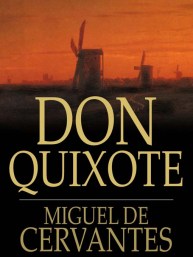
Don Quixote Reading Don Quixote has been a year-long project for me in 2014. After reading Clarissa over a twelve month period as part of a readalong in 2012 and then War and Peace in 2013 I decided to tackle another of the very long, intimidating classics on my Classics Club list, this time on my own. Now that I’ve finished I don’t know why I had ever been intimidated by it. Yes, it’s long (over 1,000 pages in most editions) and old (originally published in two parts in 1605 and 1615) and a translation, but I didn’t find it difficult to read at all. It’s fun and imaginative and entertaining – and I loved it.

Don Quixote is the story of a gentleman of La Mancha who has spent so many years reading books of chivalry and romance that he has come to believe the tales they tell are true. Inspired by the heroes of his favourite books, he decides to become a knight errant and go out into the world in search of adventures. Renaming himself Don Quixote and his horse Rocinante, he convinces a neighbouring peasant, Sancho Panza, to join him as his squire. With Sancho at his side, Don Quixote sets out to right wrongs, fight duels and rescue damsels in distress, in the hope that his valiant deeds will win him the love of the beautiful (and largely imaginary) Dulcinea del Toboso.

As Don Quixote and Sancho travel across Spain they have one adventure after another, each one headed with a long and intriguing chapter title such as “Of the strange adventure which befell the valiant Don Quixote with the bold Knight of the Mirrors” or “Which deals with the adventure of the enchanted head, together with other trivial matters which cannot be left untold”. As you read on, however, it soon becomes obvious that these ‘adventures’ are not quite as amazing as they sound and usually have a logical explanation.

Many people, even without reading the book, will have heard of the famous ‘tilting at windmills’ episode. There are many, many other similar episodes in the novel but this one appears near the beginning which is probably why it’s the best known. If you’re not familiar with it, on approaching some windmills in a field Don Quixote becomes convinced they are giants and attacks them with his sword:

“What giants?” said Sancho Panza.

“Those thou seest there,” answered his master, “with the long arms, and some have them nearly two leagues long.”

“Look, your worship,” said Sancho; “what we see there are not giants but windmills, and what seem to be their arms are the sails that, turned by the wind, make the millstone go.”

“It is easy to see,” replied Don Quixote, “that thou art not used to this business of adventures; those are giants; and if thou art afraid, away with thee out of this and betake thyself to prayer while I engage them in fierce and unequal combat.”

This is a pattern that is repeated over and over again throughout the novel: Don Quixote mistakes inns for castles and flocks of sheep for armies – and even when Sancho points out the truth he still insists that he is right. The castles and the armies must have been enchanted by great wizards, he says, so that they appear to be inns and sheep. As the story progresses, Don Quixote’s fame spreads and he is thought of as insane and Sancho as an idiot. The response of some of the people they meet can be very cruel and it’s quite sad to see how Don Quixote and Sancho are ridiculed, scorned and made the target of elaborate practical jokes. I wouldn’t describe this as a sad book, though; in fact, it’s a very funny one. The humour doesn’t always work (being four hundred years old and in translation, maybe that’s not surprising) but at times it’s hilarious!

As well as the adventures and the humour, there are lots of songs, poems and ballads interspersed with the prose. There are also lots of stories-within-stories – almost everyone they meet on their journey has a long and tragic story of their own to tell – and many of these have no relevance to the rest of the novel. For example, a lot of time is devoted to the tale of a Christian who was held captive by Moors in Algiers and has escaped back to Spain – nothing to do with Don Quixote, but apparently based on Cervantes’ own experiences. This is why the novel is so long and why you need to have some patience with it! Reading this book over a period of several months was the perfect strategy for me as the episodic nature of the story meant that I could leave it for a few weeks and still get straight back into it when I picked it up again. Breaking it up into small sections kept it feeling fresh and interesting so that I never felt bored or overwhelmed.

A quick note on the translation now. There have been many English translations of Don Quixote over the years but not really having any idea which to choose, I started reading the 1885 John Ormsby translation (in the public domain so free to download from Project Gutenberg and other websites) and I found it perfectly readable so decided just to stick with it. I wouldn’t necessarily recommend that translation to everyone as it does use some archaic terms and feels ‘old’ but that’s what I prefer when I’m reading an old book so it wasn’t a problem for me. Whichever may be closest to the literal translation, Ormsby’s description of Don Quixote as “Knight of the Rueful Countenance” just sounds better to me than, for example, Edith Grossman’s “Knight of the Sorrowful Face”. It’s a matter of personal taste, though, so it’s probably a good idea to look at a few different translations and find one that suits you before you embark on such a long novel!

Much as I enjoyed this book it did sometimes feel as if I was never going to finish it, so I was pleased to reach the end. I’m going to miss Don Quixote and Sancho, though, after spending so much time with them this year!

The Hunchback of Notre-Dame by Victor Hugo

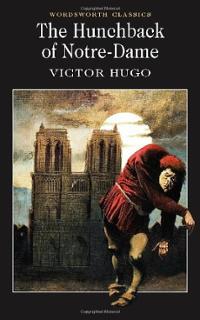
The Hunchback of Notre-Dame Or Notre-Dame de Paris, to give it its original French title and one which is much more appropriate. Quasimodo, the hunchback, has a surprisingly small role in the book while the cathedral of Notre-Dame itself is at the heart of the story, with most of the action taking place within its walls, on top of its towers or in the streets and squares below.

Set in 15th century Paris, the novel follows the stories of three tragic and lonely people. First there’s the beautiful gypsy dancer, La Esmeralda, who captivates everyone she meets with her looks, her dancing and her magic tricks. Alone in the world with only her goat, Djali, for company, she dreams of one day being reunited with her parents. Then there’s Claude Frollo, the Archdeacon, once a good and compassionate man who rescued Quasimodo as a child and raised him as his son. He becomes obsessed with Esmeralda after seeing her dancing in the Place de Grève and descends into a life dominated by lust and envy, turning away from the church and towards black magic. Finally, of course, there’s Quasimodo himself, the bell-ringer of Notre-Dame. Outwardly deformed and ugly, his kind heart and his love for Esmeralda lead him into conflict with his adoptive father, Frollo.

I read Hugo’s Les Miserables almost exactly five years ago and I really don’t know why it has taken me so long to read another of his books. I loved Les Miserables and I loved this one too, though not quite as much; this is a shorter and slightly easier read, but I didn’t find the story as powerful or emotional. It was a good choice for the R.I.P. challenge, though – the atmosphere is very dark and there are plenty of Gothic elements.

At least having had some previous experience of Hugo meant that I knew what to expect from his writing! You need to be prepared for some long diversions and chapter after chapter that has almost nothing to do with the plot or the main characters. Hugo devotes a lot of this novel to discussing Gothic architecture, the structure of the cathedral, the geographical layout of Paris and other topics which may or may not be of interest to the reader. I’m happy to admit that I didn’t read every single word of these sections (in fact, I skipped most of the chapter entitled A Bird’s-Eye View of Paris) and I don’t feel that I missed anything as a result.

The version of the book that I read is not actually the one pictured above (I just wanted a book cover to illustrate my post). I downloaded the free version from Project Gutenberg for my Kindle, which is Isabel F. Hapgood’s 1888 translation. I was very happy with it, but I’m used to reading older books and older translations; depending on your taste you might prefer a more modern translation. And just as a side note, does anyone else love books with imaginative chapter titles? There are some great ones here, including The Inconveniences of Following a Pretty Woman through the Streets in an Evening, The Effect which Seven Oaths in the Open Air Can Produce and The Danger of Confiding One’s Secret to a Goat. Much more intriguing than just numbering them 1, 2, 3!

As I’ve now read Hugo’s two most popular books, can anyone tell me if there are any others that I should read? I like the sound of Ninety-Three and The Man Who Laughs, but are they worth reading?

The Idiot by Fyodor Dostoevsky

The Idiot The Idiot was the book chosen for me by the Classics Club Spin earlier this month. I have to confess I wasn’t thrilled when I saw that this was the book I’d have to read but, as so often seems to happen with my spin books, I ended up enjoying it much more than I’d expected to. This wasn’t my first experience of Dostoevsky’s work; I’ve tried twice to read Crime and Punishment and both times gave up after a few chapters. Luckily, I’ve had more success with The Idiot!

The ‘idiot’ of the title is Prince Lev Nikolaevich Myshkin, a young man who, as the novel opens, is returning home to Russia after spending several years at a Swiss clinic receiving treatment for his epilepsy. On the train to St Petersburg he meets for the first time the man whose fate will become entwined with his own: Parfyon Semyonovich Rogozhin. Rogozhin is passionately in love with the beautiful but self-destructive Nastasya Filipovna, who has suffered a series of misfortunes that have led to her being labelled a ‘fallen woman’.

With no family of his own in the city, the prince introduces himself to the Epanchins, to whom he is distantly related. This family consists of General Epanchin, his wife Elizaveta, and their three daughters, Alexandra, Adelaida and Aglaya. As the story progresses, Myshkin becomes romantically involved with both Nastasya Filipovna and Aglaya Epanchin, but his inability to read between the lines and understand that people don’t always say what they really mean leads to trouble in his relationships with both women. His path will also cross again and again with Rogozhin’s, but while the prince pities Nastasya and hopes to save her from herself, Rogozhin’s love is of the violent and obsessive kind.

The intensity of Rogozhin’s personality is very different from the prince’s own gentle, peaceful nature. In fact, Myshkin seems to possess such simplicity of character, to be so trusting and gullible, so incapable of dealing with the subtleties of St Petersburg society that people think he must be an idiot. Of course, Myshkin is not really an idiot – that is, he doesn’t lack intelligence – but he is what Dostoevsky himself described as a portrayal of a ‘completely beautiful human being’. He is a genuinely good, kind-hearted person, but ironically it’s his goodness and his willingness to always see the best in people that are his weaknesses when it comes to negotiating complex social situations and dealing with people who are less honest than himself.

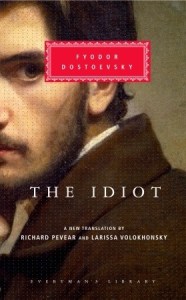
The edition of The Idiot that I read was the one pictured above, published by Everyman’s Library and translated by Pevear and Volokhonsky. This would maybe not have been my first choice of translation (this is the third of P&V’s Russian translations I’ve read and I’ve decided I’m not really a fan) but this is the book I already had on my shelf so it made sense to at least try it. Having said that, I found their translation of this particular book perfectly readable – though with a few strange word choices – and I’m sure I would still have found The Idiot a challenging read regardless of who it was translated by!

To clarify what I mean by ‘challenging’, I didn’t have any problem actually following the plot and understanding what was going on. This is really more of a character-driven novel than a plot-driven one anyway. Although I found it quite absorbing and was never bored, the pace is uneven and there are some long diversions in which various characters discuss religion or politics or philosophical ideas. Three chapters, for example, are devoted to a long confessional letter written by Ippolit, a young man who is dying from consumption – however, I thought this was one of the most powerful and moving sections of the book.

What I did struggle with at times was trying to interpret the actions and motivations of the characters, particularly the two main female characters, Nastasya and Aglaya. I won’t attempt an analysis of those two characters here, except to say that they are both so complex I’m not surprised the unsophisticated, unworldly Myshkin found it difficult to understand what they were really saying to him!

I enjoyed The Idiot a lot more than I thought I would, but I know I would have to read it again to be able to fully appreciate it. I don’t think I would want to do that in the near future but I will certainly try Crime and Punishment again and maybe The Brothers Karamazov as well.