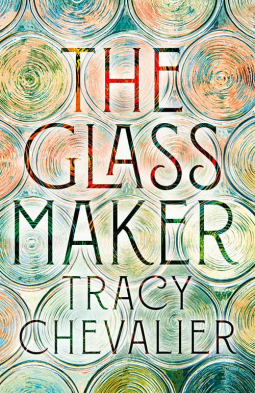
 Having enjoyed some of Tracy Chevalier’s previous books I was particularly looking forward to this one because of the setting. It takes place on Murano, an island in the Venetian Lagoon which for centuries has been associated with glass making. It begins in the 15th century but doesn’t remain in that time period because, Chevalier tells us, time works differently there – more on that later!
1486 is when we first meet Orsola Rosso, the eldest daughter of a Murano glassmaking family. Working with glass is considered a man’s job, but Orsola feels that glassmaking is in her blood and longs to have the same opportunities as her brothers. When her father is killed in an accident in the workshop and the family begin to struggle both financially and creatively, Orsola comes up with a plan to earn some extra money by making glass beads. Despite bead making being looked down on by men as not ‘real’ glassmaking, it’s difficult, intricate work and takes Orsola a lot of time and effort to master, but eventually she learns the necessary skills and is helping to keep the family business afloat.
In 1574, the Rosso family experience more hardships when plague makes its way across the water from Venice to Murano – but this is where time begins to move strangely. Although many decades have gone by, the characters have barely aged at all and the story just continues within this new setting as if nothing unusual has happened. We jump forward in time several more times throughout the book until we are brought right up to date with the Covid pandemic – and still Orsola and the other central characters remain unaware that they should have been dead for hundreds of years! I don’t think I’ve read another novel that handles time in this exact way; Virginia Woolf’s Orlando has a similar concept, but it only involves one or two characters rather than the entire cast, and she plays with gender as well as age. John Boyne’s The Thief of Time also has a protagonist who doesn’t age, but he is at least aware that something odd is going on. What Chevalier does here is different and I think readers will either dislike it or just accept and enjoy it.
The device Chevalier uses to tell the story has two advantages. The first is that it allows her to give an overview of the history of Venice and Murano from the 1400s to the modern day and explore the ways in which things have changed over the centuries (plagues, two world wars, increasing tourism, competition affecting Venice’s position as a centre of trade). The second is that she can focus on developing one set of characters – including Orsola and her brothers and sisters, her lover Antonio, the German merchant Klingenberg and the African gondolier Domenego – instead of introducing new generations. Still, I think I would have been just as happy if the book had been set entirely in one of the earlier time periods, as they were the ones that interested me most.
A lot of Chevalier’s novels tend to deal with specific crafts or vocations: embroidery and bell ringing in A Single Thread; fossil collecting in Remarkable Creatures; or growing apple trees in At the Edge of the Orchard. Obviously in this book it’s the making of glass and beads and we learn a lot about the skills required, the methods used and the personal touches each individual glassmaker brings to their work. I’m fortunate enough to have visited both Venice and Murano and seen a glass blowing demonstration so I could easily picture some of the things and places Chevalier describes, but even if you haven’t she does an excellent job of bringing them to life. This is a fascinating book and I did enjoy it, even if I wasn’t completely convinced by the time travel element!
Thanks to The Borough Press for providing a copy of this book for review via NetGalley.

Book 46/50 for the Historical Fiction Reading Challenge 2024
 She Reads Novels
I began this a few weeks ago with great anticipation, because I do enjoy Chevalier’s books, but like you, I had major problems with the time issue. Call me pedantic, but when I read a historical novel I want to be totally immersed in it and believe in the world it’s depicting (which is one reason why I’m so hot on accuracy). And you can’t do that with The Glassmaker. I liked the first part, in the 15th century, but once I’d realised about the time issue, she’d lost my interest and I skim-read the rest. I agree, concentrating on the earlier sections would have been better, because they’re more interesting. I do recognise she wanted to do something different, but I don’t think this experiment succeeded. Though of course that’s just my opinion, and others may differ!
I enjoyed the overall story and Venice/Murano is always a setting I love, but I agree that the time element was definitely a problem – particularly when we reached the more modern sections, I thought. I don’t mind authors trying something different, but I hope she goes back to more conventional historical fiction for her next book.
I do think she should have jumped one way or another with the time issue. I’d have liked to see her go more fully speculative and had the family accept that they don’t age in the same way as the mainland, and all the issues that would bring up. But I think this would also have worked as a straight histfic set at the time of the plague.
The plague was the most interesting section anyway, so she could easily have chosen just to focus on that period. Otherwise I agree that she could have done more with the speculative element and explored all kinds of fascinating issues. I did enjoy the book overall but there were some missed opportunities there, I think.
I had this one on my radar, but I don’t think that time jump thing is right for me.
It wasn’t really what I had expected.
Oh. This one’s on my Amazon wishlist, but I hadn’t realised that it involved time travel. Maybe not!
I’m not sure if time travel is the right term for it (it’s weirder than that) but I didn’t know what else to call it!
I’m reading this at the moment, Helen. As you say, the time jumping device is certainly different and quite hard to adjust to. I decided to just suspend disbelief and go with it and find that I really like it. I’m about halfway through and in the third time period I think so I’ll reserve judgement until the end of the book. I can’t imagine Orsola in 2020! But so far I think it’s wonderful for its descriptions of glass-making and life in Venice and Murano. She has been very brave and ambitious in using this device.
Yes, I love all the descriptions of Venice and Murano, which are always beautiful, atmospheric settings. I think just accepting the time jumping is the best thing to do. I’m glad you’re enjoying it!
That’s so cool that you’ve been to both Venice and Murano! I’d love to go to Venice someday. Until then, I can at least enjoy reading about it. This book does sound interesting, even with the time traveling twist.
Venice is beautiful. I hope you get the opportunity to go one day!
This is a book that I’d like to read, because the Murano setting attracts me and maybe the time travel thing sounds a bit strange, I’ll give it a try. I’m so behind in reading Chevalier’s books, but I always like them.
There are a lot of her earlier books I still haven’t read yet. This is a good one, even though the time travel is strange.
I am interested in this one due to the glass making aspects, and because I have visited Venice and Murano, but the time jumping thing does make me hesitate to pick it up.
Thanks for sharing your review with the Historical Fiction Reading Challenge
If you’ve been to Venice and Murano, I think you would find this book interesting – the setting is beautifully described and atmospheric. The time jumping is a weird concept, though!
I enjoyed the book, and think Chevalier’s storytelling skill makes it a worthwhile read. Like Helen, I think the plague era would have been the best setting for the entire book, and I enjoyed the earlier time periods more than the more recent ones. I am one of those readers who overlooked the time shifts, not being one who loves speculative elements. I enjoyed The Time Traveler’s Wife and Outlander despite the time travel, not because of it. One thing I would have liked to see omitted from this book were the passages in the narrator’s voice that begin each era. It took me out of the close point of view Chevalier excels at, and I just didn’t need them to understand what was going on, certainly after the first time slip. I think I would read this again, and I will certainly read Chevalier’s future work.
Thanks for commenting, Kelly. I’m glad you liked this book despite the time shifts. The plague era would definitely have been a strong enough setting for the whole story, in my opinion, but I did enjoy the book overall anyway. The narrator’s passages didn’t really bother me, but I agree that they weren’t necessary.
I loved this book and I felt that the story brought more to know the characters because we saw them deal with difficulties across time periods. I liked that we met her as a late teen and left her around 60 years old. Venice was also an important character and the various time periods also made me think of my own pace of life throughout the years.