My Commonplace Book: December 2017

A selection of words and pictures to represent December’s reading

My Commonplace Book

commonplace book
Definition:
noun
a notebook in which quotations, poems, remarks, etc, that catch the owner’s attention are entered

Collins English Dictionary

~

“Just so. A great warrior may be a poor father or a worse husband. A respectable cleric might hide a youthful crime in a lifetime of good deeds. Most often a man is remembered for the evils he commits. But there is no man who ever lived that did nothing worthwhile through the course of his life.”

Voice of the Falconer by David Blixt (2010)

~

New Mexico

The nun took Father Latour to a window that jutted out and looked up the narrow street to where the wall turned at an angle, cutting off further view. “Look,” she said, “after the Mother has read us one of those letters from her brother, I come and stand in this alcove and look up our little street with its one lamp, and just beyond the turn there, is New Mexico; all that he has written us of those red deserts and blue mountains, the great plains and the herds of bison, and the canyons more profound than our deepest mountain gorges. I can feel that I am there, my heart beats faster, and it seems but a moment until the retiring-bell cuts short my dreams.”

Death Comes for the Archbishop by Willa Cather (1927)

~

“But your husband-” He closed his eyes for a moment and said, “The bravest are surely those who have the clearest vision of what is before them, glory and danger alike, and yet notwithstanding, go out to meet it. He did that, every day, for a long time.”

“You sent him, though,” she said, her voice as low as his. “You did.”

His smile was bleak.

“I’ve done such things every day…for a long time.”

Seven Stones to Stand or Fall by Diana Gabaldon (2017)

~

Medieval Wales

Sybil’s Breton maid, Amelina, who is of a poetical turn of mind it seems, on seeing the princess, said, “She is very beautiful. She looks like Wales – her eyes like the brilliant blue wind-driven skies and the colour of her hair reminding me of the black rugged mountains.” But Lady Sybil clicked her tongue and told her this was nonsense. “She looks like a poor orphaned child to me,” she said.

Conquest: Daughter of the Last King by Tracey Warr (2016)

~

“A mean between two extremes is apt to be satisfactory in results. If we don’t produce a Marcus Aurelius or a Seneca, neither do we produce a Nero or a Phocas. We may have lost patriotism, but we have gained cosmopolitanism, which is better. If we have lost chivalry, we have acquired decency; and if we have ceased to be picturesque, we have become cleanly, which is considerably more to be desired.”

A Point in Morals by Ellen Glasgow (1899) – taken from In the Shadow of Agatha Christie edited by Leslie S Klinger (2018)

~
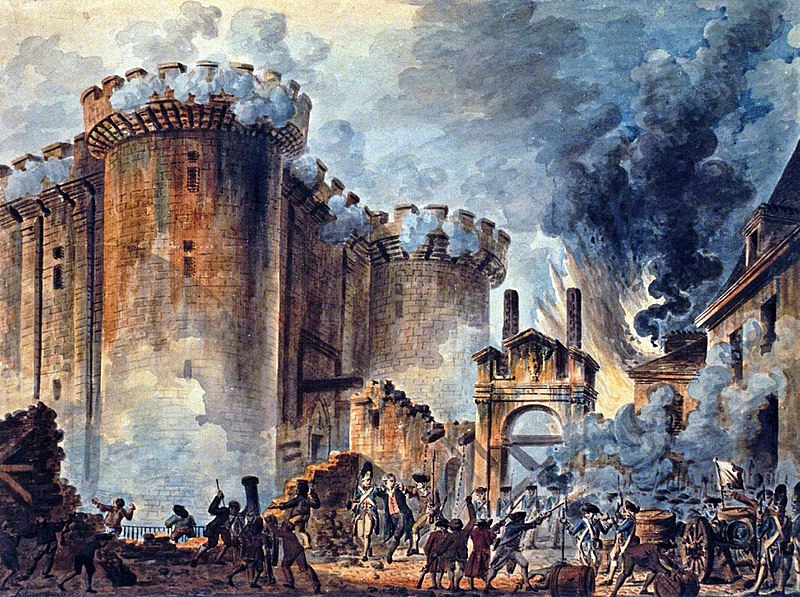
The French Revolution

Now it seemed that in France, everything my mother and her friends had long talked about was coming true. Human beings really were capable of uniting to defeat tyranny and injustice. A new order could be created, based on the rights of man. And woman too. I was the one who had been mistaken. Everything they had dreamed of and written about was coming to pass, not two hundred miles from London.

Birdcage Walk by Helen Dunmore (2017)

~

Favourite books read in December: Voice of the Falconer and Death Comes for the Archbishop

~

Happy New Year – and happy reading in 2018!

My Commonplace Book: November 2017

A selection of words and pictures to represent November’s reading

My Commonplace Book

commonplace book
Definition:
noun
a notebook in which quotations, poems, remarks, etc, that catch the owner’s attention are entered

Collins English Dictionary

~

“Why do you keep all those rooms empty, Cousin Clarissa?” she asked.

“Because I cannot afford to furnish them in the style they demand, my dear,” was the reasonable reply. “I had rather live in the part of a beautiful house than in the whole of an ugly one. You will allow that an old woman has a right to her fancies.”

“I call it very sensible,” said Nigel. “You have an elastic house. You can expand or contract within it according to the fluctuations of your income.”

“Mr Strangeways,” announced Clarissa Cavendish, “I perceive we are going to understand each other.”

The Corpse in the Snowman by Nicholas Blake (1941)

~

Did he think to win them over like this? She remembered the boyish charm he had once possessed and wondered where it had gone. Perhaps like a bag of gold dust with an open top, the winds of time had swirled it away in a glittering spiral until there was nothing left but an empty pouch.

The Autumn Throne by Elizabeth Chadwick (2016)

~

A Midsummer Night’s Dream – title page from the first quarto, printed in 1600

It was nonsense, of course! It was, as Hippolyta says of Pyramus and Thisbe, ‘the silliest stuff that ever I heard.’ But somehow the nonsense worked. It is one of the marvels of the playhouse that whatever you lay in front of the groundlings, they believe. “They want to believe,” my brother once explained. “They do half our work for us. They come wanting to be amused, to be impressed, to be awed, to be frightened. And they have imaginations too, and their imaginations amend our work.”

Fools and Mortals by Bernard Cornwell (2017)

~

I knew what it was to lose someone to the clutches of despair; I knew what it was to be robbed of a voice. And the mad had all too often been abandoned to such – to empty rooms furnished only with straw, chained to the walls, their every utterance made the subject of mockery and laughter. I must never allow myself to judge; not before I had listened, touched – treated the person before me rather than any preconceptions formed against them.

The Crow Garden by Alison Littlewood (2017)

~

The pearls must be somewhere. They must search the rooms again. Could not Lord Peter Wimsey, with his experience of – er – mysterious happenings, do something to assist them?

“Eh?” said his lordship. “Oh, by Jove, yes – by all means, certainly. That is to say, provided nobody supposes – eh, what? I mean to say, you don’t know that I’m not a suspicious character, do you, what?”

Murder Under the Christmas Tree edited by Cecily Gayford (2016)
(Taken from Dorothy L. Sayers – The Necklace of Pearls)

~

Plaque in Weymouth, England, noting the entrance of plague into the country.

“I doubt that it’s his advice, milady.” He turned with a cynical smile. “Where’s the sense in shutting our gates against a mild affliction that kills no one? For myself, I would rather have news of how the pestilence is affecting our neighbours than refuse them entry for fear of catching a headache.”

“You may change your mind when your head begins to ache in earnest. From my experience, the best cure for a disease is never to catch it.”

The Last Hours by Minette Walters (2017)

~

It is a big grandfather clock, nearly old enough to be in keeping with the hall, and with a loud and – as you would think – peculiarly slow tick. You know how competent actors can build up an illusion of overwhelming suspense, of mere, sheer waiting? I suddenly found the clock doing all that for me. In other words I found myself projecting upon an elderly and impersonal scientific instrument a mounting and urgent sense of impending catastrophe.

Lament for a Maker by Michael Innes (1938)

~

How many young women could dream of freedom, after all? Others were tied to a husband just as these girls were tied to this Queen Mary.

Blinded to much of life, like the hooded hawks in the palace mews, they had no real understanding of the stakes of this game. But unless they were greater fools than they looked, they might still be given a few cards to play.

The Queen’s Mary by Sarah Gristwood (2017)

~

Abraham Lincoln in November 1863

Strange, isn’t it? To have dedicated one’s life to a certain venture, neglecting other aspects of one’s life, only to have that venture, in the end, amount to nothing at all, the products of one’s labors ultimately forgotten?

Lincoln in the Bardo by George Saunders (2017)

~

So long as one is young one regards Youth as a misfortune. Only later does one discover that Youth is happiness.

Wolf Among Wolves by Hans Fallada (1937)

~

“You don’t really know him, that’s all.” Her voice had a tight, sinister edge to it. “He’s not who you think he is.”

I laughed uncomfortably. “So mysterious!” I said. We’d reached 321 and I turned onto the wider road in the direction of the Catawba River. “I’ll have to ask him to tell me all his deep, dark secrets.”

The Stolen Marriage by Diane Chamberlain (2017)

~

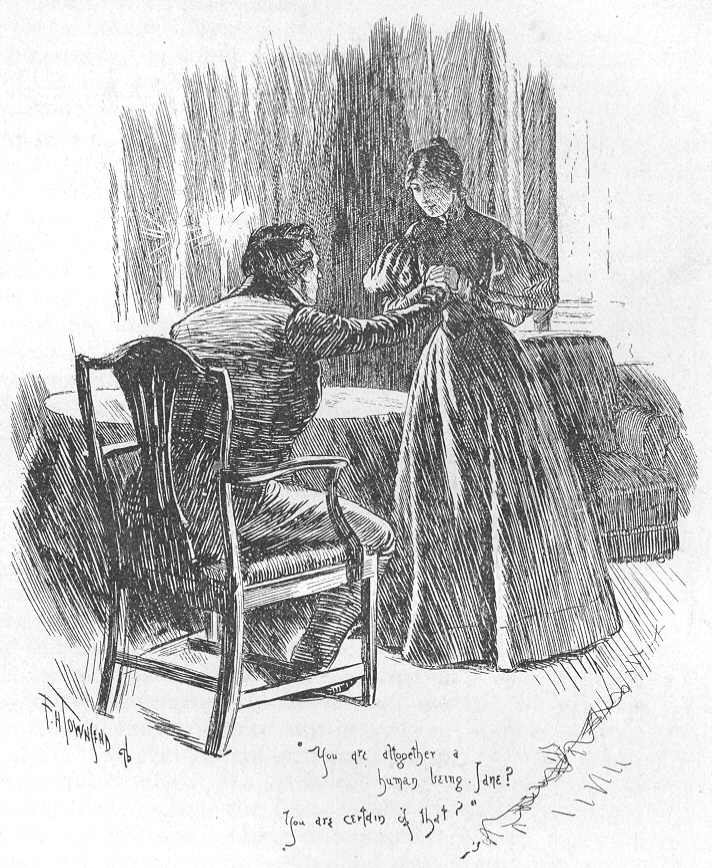
Jane Eyre, illustrated by F. H. Townsend

Riding across the countryside, I purposely turned my mind to Miss Ingram and reminded myself that this was where my affections should lie. She was beautiful, charming, accomplished in every way, an established and admired member of the neighbourhood society. Yet, I did not feel a sympathy with her in the way that I had come to feel with Jane. She did not have the power to intrigue me, as this young girl had, did not bring me the same pleasure – or pain. Still, is it ever wise to let one’s emotions rule one’s life?

Mr Rochester by Sarah Shoemaker (2017)

~

There are years that pass in which nothing at all seems to happen but the change in seasons, and even those can’t be called events considering the way in which they dissolve into each other. And there are days in which entire lives turn on their axes, grinding against each other like mechanisms, crushing the things that fall between. Afterwards there are only pieces remaining and people must make of them what they will and what they can.

Salt Creek by Lucy Treloar (2015)

~

Favourite books read in November: The Autumn Throne and Lament for a Maker

My Commonplace Book: October 2017 – and R.I.P. XII summary

A selection of words and pictures to represent October’s reading

My Commonplace Book

commonplace book
Definition:
noun
a notebook in which quotations, poems, remarks, etc, that catch the owner’s attention are entered

Collins English Dictionary

~

You know, the Church has a doctrine called just war. St Thomas Aquinas wrote on it, though the doctrine is much older than that. A State going to war must have tried all other options, must have justice on its side and have an honourable purpose in mind. None of Henry’s wars has been like that. Though he claims to be God’s representative on earth.”

Heartstone by CJ Sansom (2010)

~

She censured his conduct in having given the man money instead of knocking him down. “Which I am persuaded you might have done, because Priscilla’s brother told us that you are a Pink of the Fancy,” she said severely.

“I shall be obliged to you,” said Sir Charles, with asperity, “if you will refrain from repeating the extremely improper remarks made to you by Priscilla’s cub of a brother!”

Snowdrift and Other Stories by Georgette Heyer (2016)

~

Fingal’s Cave, Island of Staffa, Scotland

If anyone cares, Fingal, I am told, is a mythical Celtic giant. His cave is nearly seventy feet high and forty feet wide at the entrance, with the sea running inland to its full length of over two hundred feet. If anyone cares.

To me, it was a black booming vault lined with columns, grey, rose, lilac and charcoal, of natural basalt. Uneven, crowded columns hung from the roof and stuck up through the opaque peacock water, thinning here to bright green, which lay surging and lapping below us, darkening as it moved away from the sunlight and into the depths of the cave.

Rum Affair by Dorothy Dunnett (1968)

~

He never ate the lower leaves: the top appeared more succulent. Whether he knew or not that this destroyed any possibility of flowering is a question that it is no good asking a rabbit. He seemed indifferent, in any case; there are few things more equable than the expression of a rabbit nibbling the head off a prize bloom.

Verdict of Twelve by Raymond Postgate (1940)

~

“Why, what ails you?” asked he of Edmond. “Do you fear any approaching evil? I should say that you were the happiest man alive at this instant.”

“And that is the very thing that alarms me,” returned Dantès. “Man does not appear to me to be intended to enjoy felicity so unmixed; happiness is like the enchanted palaces we read of in our childhood, where fierce, fiery dragons defend the entrance and approach; and monsters of all shapes and kinds, requiring to be overcome ere victory is ours. I own that I am lost in wonder to find myself promoted to an honor of which I feel myself unworthy – that of being the husband of Mercedes.”

The Count of Monte Cristo by Alexandre Dumas (1844)

~

19th-century illustration of Cinchona calisaya

He nearly laughed. “Of course you’ll go. You must. People are like bees. They’re all workers who could be queens, with the right stuff, but once a queen-making has begun, it can’t be reversed. A bee that’s halfway a queen can’t turn back into a worker. She’d starve. She must keep growing and then she must leave.”

The Bedlam Stacks by Natasha Pulley (2017)

~

He went on looking at the medal, head down. I felt a poignant memory of those desolate patches of disillusion which are the shocks of growing up. The discovery that one lived in a world which could pay honour where honour was not due, was just such a one. The values were rocked, the dependable was suddenly flimsy, the solid became hollow, gold turned to brass, there was no integrity anywhere…

Chocky by John Wyndham (1968)

~

Sir Mordred by H. J. Ford, from King Arthur- The Tales of the Round Table by Andrew Lang, 1902

Mordred did not reply. He had a habit of quenching silences. He had discovered that if you failed to answer an awkward question, people rarely asked it twice. He did not know that this was a discovery normally only made in later life, and by some weaker natures not at all.

The Wicked Day by Mary Stewart (1983)

~

Favourite books read in October: The Count of Monte Cristo, Snowdrift and Other Stories and Chocky

~

The end of October also meant the end of this year’s R.I.P Challenge.

I was aiming to read four books for R.I.P. and managed six, so I’m pleased with that! Here are the books I read:

1. Hamlet, Revenge! by Michael Innes
2. As Chimney Sweepers Come to Dust by Alan Bradley
3. Death in Bordeaux by Allan Massie
4. The Man of Dangerous Secrets by Maxwell March
5. Heartstone by CJ Sansom
6. Verdict of Twelve by Raymond Postgate

Have you read any of these? How was your October?

My Commonplace Book: September 2017

A selection of words and pictures to represent September’s reading

My Commonplace Book

commonplace book
Definition:
noun
a notebook in which quotations, poems, remarks, etc, that catch the owner’s attention are entered

Collins English Dictionary

~

Now, her existence seemed always to be intruding upon any activity; she seemed to herself a larger, more disparate person, who was never wholeheartedly engaged – whatever she did, some bit of her sat on the sideline, jeering, making insiduous alternative suggestions: “You’re far too old for that book – anyway, you’ve read it before.” Age came into it a great deal; she seemed to be too young or too old for most things.

The Light Years by Elizabeth Jane Howard (1990)

~

Between the trees I see the flickering white bob of a tail – a gazelle – and I breathe more easily: there are no lion lying here panting in the shade. Stillness settles over everything; the fears which have haunted me since leaving England – that my father might not want to see me, that home will be altered – slip away. I belong here; and this place is too wild, too remote for change.

Leopard at the Door by Jennifer McVeigh (2017)

~

“What stuff, Jack. In its very nature an invitation implies an option, the possibility of refusal. You can no more compel a man to be your guest in the sense, the only valid sense, of a willing commensal, a glad partaker of your fare, than you can oblige a woman to love you.”

The Fortune of War by Patrick O’Brian (1979)

~

All over the world today are we not facing a rising tide of ideological intolerance, and are not violence and terrorism more and more in men’s thoughts? And this dressing-up of the lawless and primitive as a ruthless-because-right philosophy or world-picture or ideology that must and will prevail – is this not something to haunt and hold naturally unstable men, whatever their particular belief may be?

Hamlet, Revenge! by Michael Innes (1937)

~

“What I adore is the sunflowers,” he’d replied. “We rode through them, frosted by dust. The sun beat down, and their faces seemed to smile at me, the only smiling faces in a land devoted to gunpowder and murder.”

Red Sky at Noon by Simon Sebag Montefiore (2017)

~

There are choices in life which you are aware, even as you make them, cannot be undone; choices after which, once made, things will never be the same.

There is that moment when you can still walk away, but if you do, you will never know what might have been.

As Chimney Sweepers Come to Dust by Alan Bradley (2015)

~

Who was responsible? The question brought him up, hard, against his policeman’s creed. There was always someone responsible for a crime, whatever mitigating circumstances might be found; there was always one finger on the trigger, even though the gun might have been supplied, and the gunman primed, by another. If you dug long enough, you came up with an answer, what they liked to call a solution. You could then tie a red ribbon round the dossier and hand it over to the examining magistrate. Your job was done, case solved, what happened next no concern of yours. But responsibility for a national disaster? Could that ever be determined?

Death in Bordeaux by Allan Massie (2010)

~

“No, brother. We’d be nothing if we did not carry the past with us. We’d be ignorant of good and evil, of changing circumstances and unchanging virtues.”

The Outcasts of Time by Ian Mortimer (2017)

~

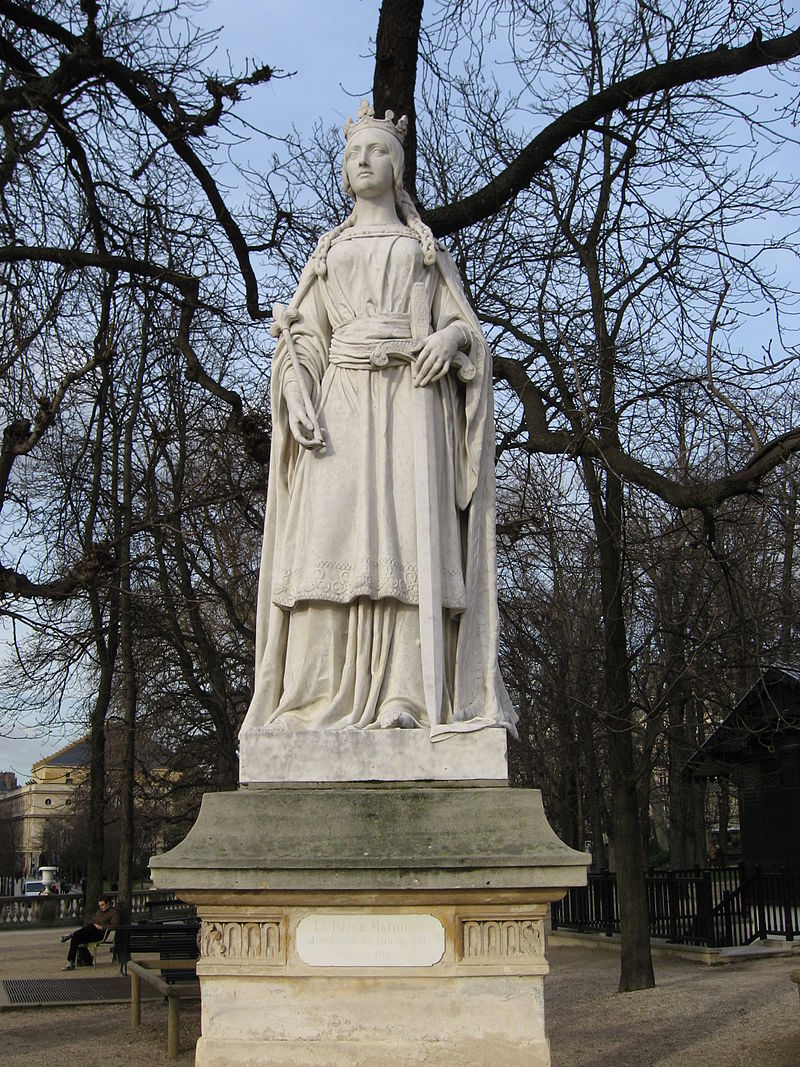
This is perhaps borne out by a posthumous tribute paid to Matilda [of Flanders] in a eulogy by the poet Godfrey of Cambrai, Prior of Winchester: “The King dominated his enemies with arms, and you, Matilda, you dominated them with peace. And your peace turned out to be far more efficient than war.”

Queens of the Conquest by Alison Weir (2017)

~

And as the weeks went by and the heat mounted, he was becoming more and more familiar with Cairo itself, the city whose life formed a shifting and glinting, shadowed and furtive tapestry into which his days were woven; coming to know it from the citadel to the narrow twisting alleyways of the old city further west, where it was not wise to go alone; through the crooked canyons of the bazaars, smelling of amber and incense, spices and camel dung and things nameless and infinitely worse, and the throat-catching metallic smitch of the coppersmiths; where awnings rigged between rooftops four and five storeys overhead kept out the sun and air.

Blood and Sand by Rosemary Sutcliff (1987)

~

The great door under the ornate porch opened to his touch, and he stepped into a darkened hall, from which a flight of steps rose into the gloom above.

As soon as he entered he was aware of an atmosphere of horror. It descended upon him unexpectedly, and he reproached himself for what he felt was an unnecessary alarm.

Nevertheless he pulled out his torch and hurried up the staircase, the feeling of apprehension growing upon him at every step.

The Man of Dangerous Secrets by Maxwell March (1933)

~

Favourite books read in September: The Fortune of War, Blood and Sand and The Man of Dangerous Secrets

My Commonplace Book: August 2017

A selection of words and pictures to represent August’s reading

My Commonplace Book

commonplace book
Definition:
noun
a notebook in which quotations, poems, remarks, etc, that catch the owner’s attention are entered

Collins English Dictionary

~

“You see?” Luc’s voice was close, and quiet. “Beautiful. I’m sure it was a good house in its time as well, but sometimes what is left behind when something is lost is even better than the thing that came before, you know?”

A Desperate Fortune by Susanna Kearsley (2015)

~

Why does the menagerie at the Tower of London not include a King and Queen – in a cage like the lions and bears? “Here, ladies and gentlemen, we have a genuine King and Queen, to amaze you with their antics. The wonder of the world is, they’re very like you ordinary folk!” We’d get as big an audience as a two-headed calf.

Some Touch of Pity by Rhoda Edwards (1976)

~

Each time I turn these brittle pages, and imagine the Colonel camped right outside my window, writing by campfire, meeting the first people of this land, it feels like time has collapsed and the past is happening now. This is what made me fall in love with history.

To the Bright Edge of the World by Eowyn Ivey (2016)

~

“Yes, sir. Going away, sir?”

“I’m going to the devil,” said Tommy, regardless of the menial’s feelings.

That functionary, however, merely replied respectfully:

“Yes, sir. Shall I call a taxi?”

Tommy nodded.

The Secret Adversary by Agatha Christie (1922)

~

“We cherish a theory that to listen to warnings, or act upon them, is a sign of panic and shows loss of confidence, and we would rather lose our lives any day then be accused of either. It is an exasperating trait. The kind that curls in on itself and ends by eating its own tail, because precautions that are not taken in time of peace cannot be taken when a crisis is imminent,for the simple reason that to take them then creates panic and loss of confidence at a time when one can afford to do neither.”

Shadow of the Moon by M.M. Kaye (1957)

~

Mary laid aside the letter she had received from her cousin Charles.

“Tolerance,” she muttered to herself as she sat in the gathering dusk. It was still very warm and the windows of her chamber were open but the air was oppressive and sultry and her head ached. She repeated the word. How could she be tolerant when she had been persecuted for her beliefs, had been on the point of desperate flight? It was all very well for Charles to talk blithely of being tolerant, she thought; he had not suffered.

Elizabeth, the Witch’s Daughter by Lynda M Andrews (1977)

~

Francis had saved her from that world, the world where indigo and violet meant bruises, and brought her to a place where they meant summer storm clouds over Florence.

Crimson and Bone by Marina Fiorato (2017)

~

“Innocent?” He was incensed at her suggestion he was somehow responsible for this mess. “I’ve done nothing wrong, I intend nothing wrong. I am innocent!”

“Half the evil in this world occurs while decent people stand by and do nothing wrong. It’s not enough to refrain from evil, Trell. People have to attempt to do right, even if they believe they cannot succeed.”

The Mad Ship by Robin Hobb (1999)

~

She gave him a long appraising look. It don’t do to dwell too much on what’s gone, Mr. Foole, she sighed. It ain’t easy, I know it. I tell Hettie the past is writ. But tomorrow ain’t never existed before. Not in the whole history of the world.

By Gaslight by Steven Price (2016)

~

Some of the children were getting restless. It was time to move on. “I like writing fiction,” I said. “That’s what I do.”

“Aren’t you worried that your books might be considered irrelevant?”

“I don’t think they have to be real to be relevant.”

The Word is Murder by Anthony Horowitz (2017)

~

Margaret became a little calmer. “Your Majesty has been most kind. I am sorry to have burdened you with my problems.”

“Because I am a Queen ’tis often forgotten that I am also a woman,” Elizabeth answered sadly.

The Tudor Heritage by Lynda M Andrews (1977)

~

“Don’t think of the obstacles that lie between now and the moment when we confront him.” The ship spoke in a low, soft voice. “Long or short, if you worry about every step of a journey, you will divide it endlessly to pieces, any one of which may defeat you. Look only to the end.”

Ship of Destiny by Robin Hobb (2000)

~

Favourite books read in August: Shadow of the Moon, The Mad Ship and Ship of Destiny

My Commonplace Book: July 2017

A selection of words and pictures to represent July’s reading

My Commonplace Book

commonplace book
Definition:
noun
a notebook in which quotations, poems, remarks, etc, that catch the owner’s attention are entered

Collins English Dictionary

~

“That’s the only way we ever will go. You can’t sit on the bank and think about it. You have to plunge. That’s the way I’ve always done, and it’s the right way for people like you and me. There’s nothing so dangerous as sitting still. You’ve only got one life, one youth, and you can let it slip through your fingers if you want to; nothing easier. Most people do that.”

Hemmed In edited by MR Nelson (2017) (Quotation from The Bohemian Girl by Willa Cather, 1912)

~

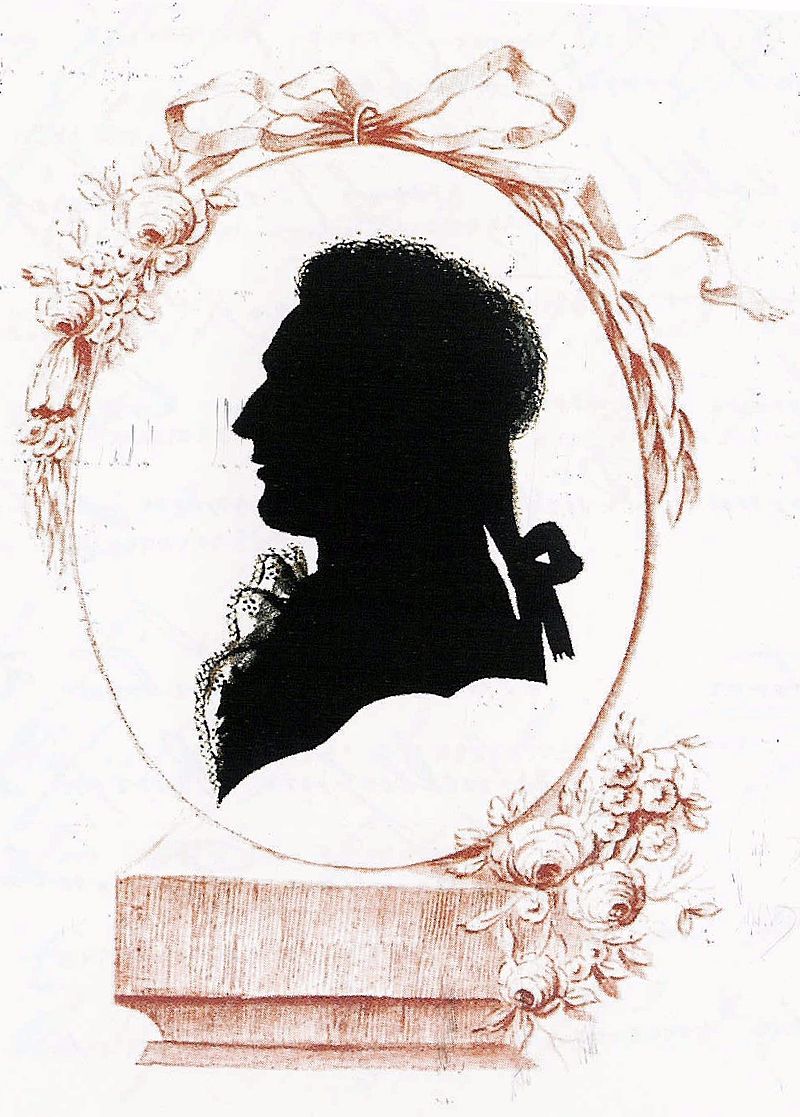
A traditional silhouette portrait of the late 18th century

The walls were hung with shades, exemplars of the dead man’s trade. These were mostly plain black on a white background, but some had embellishments of gold or silver around the edge of the figure, creating a kind of halo. The subjects were usually single individuals, but there was one family group, sitting on delicately made iron chairs – the very same chairs, I now saw, as those partly covered in sacking by the window. There was something salutary about this society of shadows. The meaning appeared to be that everyone’s life was occluded – a notion I could very easily credit.

Soot by Andrew Martin (2017)

~

“This violence of landscape, this cruelty of climate, this continual tension in everything, and even these monuments of the past, magnificent yet incomprehensible because not built by us and yet standing round us like lovely mute ghosts; all those rulers who landed by main force from every direction who were at once obeyed, soon detested, and always misunderstood, their only expressions works of art we couldn’t understand and taxes which we understood only too well and which they spent elsewhere: all these things have formed our character, which is thus conditioned by events outside our control as well as by a terrifying insularity of mind.”

The Leopard by Giuseppe Tomasi de Lampedusa (1958)

~

“Well, lad, the Bible teaches us that if Satan can disguise himself as an angel of light, then his servants will almost certainly follow suit. People and things are not always what they seem. You must treat everyone and everything with suspicion. It is the only way to root out evil.”

Widdershins by Helen Steadman (2017)

~

Atalanta and Hippomenes by Willem van Herp (circa 1650)

“Don’t you see?” Iris asks, and in spite of herself, she leans forward a little on her seat, her breath coming rather fast. “It means that it’s not about Fate, or forcing the mortals to do our will, as we thought. It is about the choices mortals make – a world of freedom, where our destiny is our own, and not determined for us.”

For the Winner by Emily Hauser (2017)

~

That’s me, thought Laure, a mad intellectual! They had all been mad for a few weeks in Paris. Never again would she feel that intense sense of freedom, empowerment and fellowship. What were they fighting for? Sometimes they had all wondered themselves, but they knew they were fighting against something – against the suffocating old University and its lack of freedoms, against the brutality of the police and the authorities, against the old regime that was leaving France a century behind the world.

Mediterranean Summer by Jane MacKenzie (2017)

~

M. de Sarcey was fascinated by this spirit so akin to his own. For the first time in his life he felt a pang of wonder as to whether he had not missed something by the assured magnificence of his position, a sudden glimpse of how splendid it might have been to have been free even from the chains of luxury and custom.

Eugenie by Marjorie Bowen (1917)

~

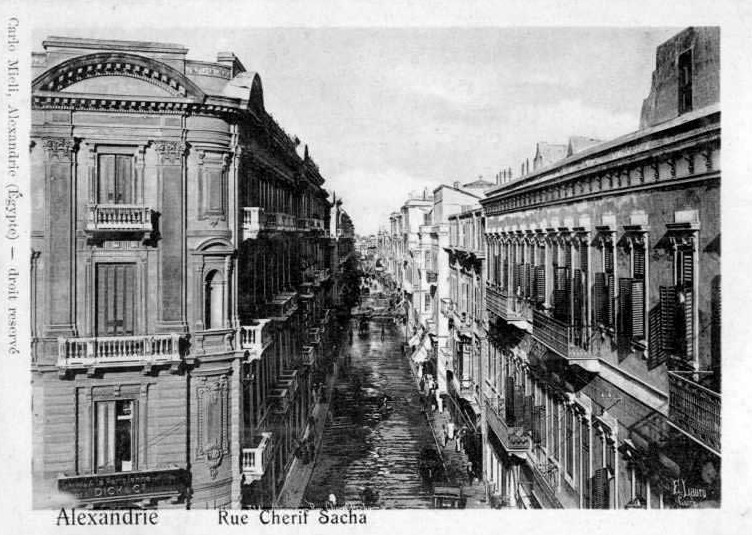
Rue Cherif Pacha, Alexandria, Egypt in early twentieth century

They left the carriage in Alex’s centre square, the palm-fringed Place Mohammed Ali, and set off to Draycott’s on foot. It was as they joined the crowds coursing down the main shopping thoroughfare, the elegant Rue Cherif Pasha, that Olivia felt the straining atmosphere of the day dip and darken. She looked to the heavens to see if a storm was coming, but the sky was pure blue.

Beneath a Burning Sky by Jenny Ashcroft (2017)

~

I believe there is a theory that men and women emerge finer and stronger after suffering, and that to advance in this or any world we must endure ordeal by fire. This we have done in full measure, ironic though it seems. We have both known fear, and loneliness, and very great distress. I suppose sooner or later in the life of everyone comes a moment of trial. We all of us have our particular devil who rides us and torments us, and we must give battle in the end. We have conquered ours, or so we believe.

Rebecca by Daphne du Maurier (1938)

~

Craddock stood looking up at it for several minutes, watching the west windows turn ruby in the sun and as he stared, eyes half closed against the sun, the silent building began to stir with life, so that he saw it as an ageing and once beautiful woman, awaiting the return of sons who had marched away centuries since and been swallowed up in a forgotten war. There was patience here, patience and a kind of desperate dignity, as though all hope of their return had never been abandoned, and that one day all the windows would glow with candles.

Long Summer Day by RF Delderfield (1966)

~

Hot air balloon in flight

The balloon hung in the air like an inverted Christmas bauble, its voluptuous, candy-striped sphere reflected perfectly in the lake. In the early light, the water glowed with the colours of a ripe peach, pale gold towards its edges, a deeper, richer pink at its heart. There was no wind. No sound. The trees along the shoreline had ceased their pre-dawn rustling and none of the balloon’s thirteen passengers was either moving or speaking. The world seemed to be holding its breath.

Dead Woman Walking by Sharon Bolton (2017)

~

“How will you know what is true,” Adam asked, “if they are conflicting accounts? Who is telling the truth? You see, it’s not just you. We all have to face this. People have different versions of what happens. Everyone is sure that theirs is the right one.”

A Week in Paris by Rachel Hore (2014)

~

Favourite books read in July: Soot, Long Summer Day, Dead Woman Walking – and my re-read of Rebecca.

My Commonplace Book: June 2017

A selection of words and pictures to represent June’s reading

My Commonplace Book

commonplace book
Definition:
noun
a notebook in which quotations, poems, remarks, etc, that catch the owner’s attention are entered

Collins English Dictionary

~

“Wintrow,” he chided softly. “Refuse the anxiety. When you borrow trouble against what might be, you neglect the moment you have now to enjoy. The man who worries about what will next be happening to him loses this moment in dread of the next, and poisons the next with pre-judgement.”

Ship of Magic by Robin Hobb (1998)

~

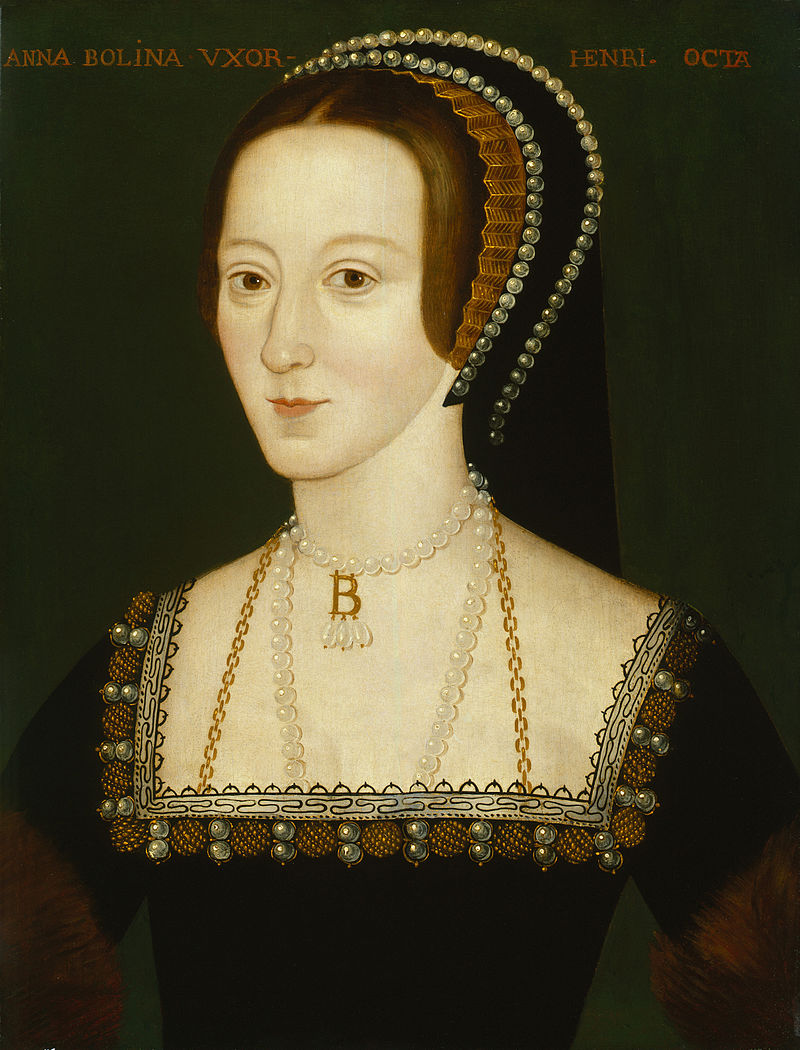
Anne Boleyn

“But that’s dreadful!” Anne cried. “If she is not mad, then she should be restored to her throne. Surely her own father would not treat her so terribly.”

“When kingdoms are at stake, Mistress Anne, human feelings count for nothing,” Sir John observed.

Anne Boleyn: A King’s Obsession by Alison Weir (2017)

~

How could the child bear not just the hunger, but the boredom? The rest of humankind used meals to divide the day, Lib realised – as reward, as entertainment, the chiming of an inner clock. For Anna, during this watch, each day had to pass like one endless moment.

The Wonder by Emma Donoghue (2016)

~

Unconsciously, she had always clung to dignity as her sole possession. She had asked for no pity, made no lamentation, and had endured each moment as it came, waiting patiently for release, because she believed that in all circumstances there must be some right way in which to think and act, which can lift them into a kind of beauty.

Lucy Carmichael by Margaret Kennedy (1951)

~

Prague Castle

It was the heart of winter, and a crescent moon hung crookedly over the bulk of Hradčany Castle, looming above the narrow laneway where the body lay. Such stars there were! – like a hoard of jewels strewn across a dome of taut black silk. Since a boy I had been fascinated by the mystery of the heavens and sought to know their secret harmonies.

Prague Nights by Benjamin Black (2017)

~

“Modern society is the greatest criminal of all. Distribution of wealth notoriously unjust. So-called “justice” a mockery. Organised society makes criminals by the hundred, and then revenges itself upon them – if they’re poor. Big thieves get off and get honours. All wrong. Prevention of crime is the great thing – not punishment.”

Miraculous Mysteries edited by Martin Edwards (2017)

~

History wasn’t made without taking risks, that much he knew. So maybe sometimes you had to take risks to write it, too.

Archangel by Robert Harris (1998)

~

It was easy to wander into the heart of the ancient streets, laced together by alleys aromatic with the smell of ginger and charcoal. She watched women traders shouting out their wares in shrill voices, their socks, shawls and cotton reels displayed on trolleys covered with straw and tarpaulin, while the men sat crosslegged on low stools, rolling dice on the pavement. Canaries sang in bamboo cages hanging from canopies outside narrow shops and the sun lit up particles of dust, making the air shimmer.

The Silk Merchant’s Daughter by Dinah Jefferies (2016)

~

Elizabeth Stuart, Queen of Bohemia

Elizabeth could not imagine being dismissed with a shrug and a careless sentence. That was not the lot of princesses. If they were not beautiful men pretended that they were. If they were fortunate enough to possess beauty, charm and wit then poets wrote sonnets to them and artists had no need to flatter them in portraits.

House of Shadows by Nicola Cornick (2015)

~

“You are right, Mother: long before I was born, you tied my fate to the Palmisanos. I can’t break away from that. Even if I hated them with all my might I couldn’t get away. If I chose not to take sides, I would still be shackled to them. But am I condemned to death by this curse? Aren’t I a free man? Don’t I control my actions? Can’t I rebel and fight against destiny?”

The Last Son’s Secret by Rafel Nadal Farreras (2017)

~

But tomorrow there will be another theory, and another; one will be discredited and the other praised; they’ll fall from fashion and be resurrected a decade later with added footnotes and a new edition. Everything is changing, Mrs. Seaborne, and much of it for the better: but what use is it to try and stand on quicksand? We will stumble and fall, and in falling become prey to folly and darkness – these rumours of monsters are nothing more than evidence that we have let go of the rope that tethers us to everything that’s good and certain.

The Essex Serpent by Sarah Perry (2016)

~

Favourite books read in June: The Wonder, Ship of Magic and The Essex Serpent